
Object Detection Annotation Services for Accurate and Reliable AI Models
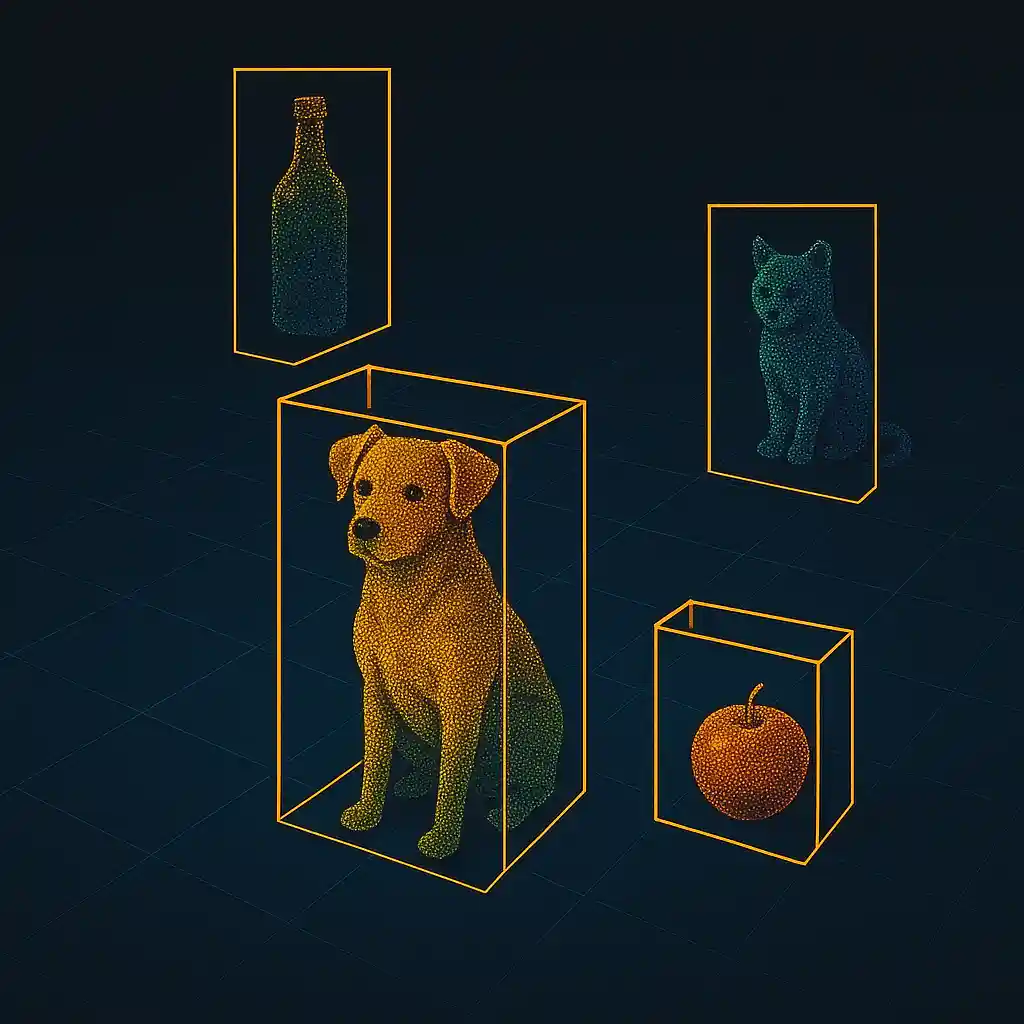

Object Detection Annotation Services
Built for teams shipping computer vision AI who need reliable labeled video. You get bounding boxes, stable label guidelines, and QA you can audit, without slowing your roadmap. Object Detection Annotation Services is delivered with secure workflows and consistent reporting from pilot to production.
Accurate bounding boxes and class labels for single and multi class detection models.
Quality control focused on box tightness, class consistency, and repeat accuracy.
Support for object detection in images and video sequences.
Object detection is one of the core tasks in computer vision, and high quality annotation is essential for training reliable detection models.
Annotating objects consistently requires precise rules for box placement, class selection, occlusions, scale variation, and edge cases.
DataVLab provides object detection annotation services designed for engineering teams that need accuracy and scalability. Our annotators specialize in detecting objects across robotics, autonomous mobility, smart cities, industrial inspection, healthcare imaging, agriculture, and retail.
They follow detailed class instructions that specify how to handle partially visible objects, crowded scenes, reflective surfaces, motion blur, and small objects. We support single class and multi class detection models. Tasks include bounding boxes, detection attributes, hierarchical classes, and object states. For video datasets, we annotate frame to frame detection with stable object identities and smooth temporal transitions. Quality control includes multi step review with checks for box tightness, class drift, and consistency across similar frames.
Sensitive datasets can be processed under GDPR aligned workflows with optional EU only annotation.
How DataVLab Provides High Quality Object Detection Annotation
Our workflows are designed to improve detection model performance by producing clean, precise, and consistent annotation.

Bounding Boxes for Object Detection

Accurate placement for diverse object types
We annotate vehicles, pedestrians, animals, tools, products, medical structures, industrial parts, and environmental elements with clean boundaries and correct labels.
Small Object and Dense Scene Annotation
High precision labeling in crowded or complex frames
We label shelves, crowds, microscopic structures, agricultural fields, and industrial environments where small or overlapping objects require careful attention.
Video Object Detection and Tracking
Frame to frame consistency for temporal datasets
Annotators maintain object identity across frames, ensuring smooth transitions, stable IDs, and accurate tracking even with motion blur or occlusions.
Attribute and State Annotation
Additional cues for detection based AI systems
We label attributes such as orientation, color, part status, visual condition, or tool state to support advanced detection models.
Industrial and Manufacturing Detection
Annotation for inspection, safety, and automation
We annotate equipment, components, defects, safety hazards, and operational zones to support industrial inspection and automation workflows.
Quality Control for Object Detection Annotation
Human in the loop review for clean datasets
Quality checks include boundary accuracy, class audits, drift analysis, and correction cycles with instructions evolving based on model feedback.
Discover How Our Process Works

Defining Project
Sampling & Calibration
Annotation
Review & Assurance
Delivery
Explore Industry Applications



We provide solutions to different industries, ensuring high-quality annotations tailored to your specific needs.
We provide high-quality annotation services to improve your AI's performances

Annotation & Labeling for AI
Unlock the full potential of your AI application with our expert data labeling tech. We ensure high-quality annotations that accelerate your project timelines.
Image Annotation Services
Image annotation services for AI teams building computer vision models. DataVLab supports bounding boxes, polygons, segmentation, keypoints, OCR labeling, and quality-controlled image labeling workflows at scale.
Computer Vision Annotation Services
High quality computer vision annotation services for image, video, and multimodal datasets used in robotics, healthcare, autonomous systems, retail, agriculture, and industrial AI.
Bounding Box Annotation Services
High quality bounding box annotation for computer vision models that need precise object detection across images and videos in robotics, retail, mobility, medical imaging, and industrial AI.
Polygon Annotation Services
High accuracy polygon annotation for computer vision teams that require precise object contours across robotics, medical imaging, agriculture, retail, and industrial AI.
Semantic Segmentation Services
High quality semantic segmentation services that provide pixel level masks for medical imaging, robotics, smart cities, agriculture, geospatial AI, and industrial inspection.
FAQs
Here are some common questions we receive from our clients to assist you.
What is object detection annotation and why is it needed?
Object detection annotation is the process of labeling images or video frames so that a machine learning model can learn to locate and classify objects within them. Annotators draw bounding boxes, polygons, or other geometric shapes around each instance of each object class, and assign the correct class label to each shape. The resulting dataset teaches detection models the relationship between visual patterns and object identity and location. Object detection is foundational for autonomous driving, surveillance, retail analytics, medical imaging, and industrial inspection.
What is the difference between object detection and image classification annotation?
Object detection locates and classifies objects within an image, producing one or more labeled regions per image. Image classification assigns a single label to the entire image without locating specific objects. Object detection annotation is more complex because each object instance must be individually located and labeled, and images typically contain multiple objects of multiple classes. Classification annotation is appropriate when only the image-level category matters. Detection annotation is required when location and per-instance identity matter.
How do you handle truncated, occluded, or small objects in annotation?
Handling difficult cases consistently is what separates high-quality object detection datasets from noisy ones. For truncated objects (partially cut off by the image edge), annotation guidelines must specify whether to label them and at what minimum visibility threshold. For occluded objects (partially hidden by another object), the annotation typically covers the visible portion of the actual object boundary, not the occluded boundary. For small objects (below a pixel threshold), guidelines must specify whether to annotate them, since very small objects often add noise rather than useful signal. These decisions must be made explicitly before annotation begins and applied consistently throughout the campaign.
How is inter-annotator agreement measured for object detection?
Inter-annotator agreement for object detection is typically measured by comparing box coordinates and class assignments across multiple annotators on the same images. Agreement on class assignment is straightforward to measure. Agreement on box placement is measured using Intersection over Union (IoU), where an IoU above 0.7 between two annotators' boxes on the same object is typically considered agreement. For quality control in production campaigns, a sample of images is double-annotated and IoU distribution across the sample is tracked over time to catch annotator drift.
What industries use object detection annotation?
Object detection annotation use cases span industries. Autonomous driving requires detecting vehicles, pedestrians, cyclists, road signs, and obstacles across hundreds of object classes. Retail analytics requires detecting products, SKUs, and shelf placement. Security and surveillance requires detecting people, vehicles, and specific behaviors. Medical imaging requires detecting abnormalities, lesions, instruments, and anatomical structures. Industrial inspection requires detecting defects, foreign objects, and assembly errors. Agriculture requires detecting plants, pests, and crop conditions from aerial or ground-level imagery.
How much annotation data is needed to train an object detection model?
Annotation volume requirements depend on object diversity, class count, and desired model performance. A simple two-class detector (for example, car vs. not-car in controlled conditions) can achieve acceptable performance with 2,000 to 5,000 annotated images. A complex multi-class detector for autonomous driving or retail typically requires 50,000 to 500,000+ annotated images to achieve production-grade performance across the full class distribution and environmental variation. Data augmentation, transfer learning from pretrained models, and active learning (prioritizing the most informative images for annotation) can reduce the required annotation volume substantially.


Custom service offering

Up to 10x Faster
Accelerate your AI training with high-speed annotation workflows that outperform traditional processes.

AI-Assisted
Seamless integration of manual expertise and automated precision for superior annotation quality.

Advanced QA
Tailor-made quality control protocols to ensure error-free annotations on a per-project basis.

Highly-specialized
Work with industry-trained annotators who bring domain-specific knowledge to every dataset.

Ethical Outsourcing
Fair working conditions and transparent processes to ensure responsible and high-quality data labeling.

Proven Expertise
A track record of success across multiple industries, delivering reliable and effective AI training data.

Scalable Solutions
Tailored workflows designed to scale with your project’s needs, from small datasets to enterprise-level AI models.

Global Team
A worldwide network of skilled annotators and AI specialists dedicated to precision and excellence.
Potential Today
Blog & Resources
Explore our latest articles and insights on Data Annotation



We are here to assist in providing high-quality data annotation services and improve your AI's performances