
Computer Vision Annotation Services for Training Advanced AI Models


Computer Vision Annotation Services
Built for teams shipping computer vision AI who need reliable labeled video. You get segmentation masks, polygons, and tracking, stable label guidelines, and QA you can audit, without slowing your roadmap. Computer Vision Annotation Services is delivered with secure workflows and consistent reporting from pilot to production.
Support for a complete range of computer vision annotation tasks.
Multi step quality review for accurate and consistent datasets.
Trained annotators experienced with complex industry specific imagery.
Computer vision models require accurate and consistent annotation to learn how to interpret complex scenes. From object detection to segmentation and tracking, every component of the dataset influences model performance.
DataVLab provides computer vision annotation services designed for engineering teams that need reliable labeling at small or large scale. Our annotators are trained on tasks such as detection, segmentation, polygon annotation, tracking, pose estimation, classification, and event labeling.
They follow structured guidelines for class rules, edge cases, occlusions, lighting variations, object size differences, and temporal consistency in video. We support robotics, autonomous mobility, healthcare imaging, smart city systems, retail and e commerce, industrial automation, and scientific research. Workflows include multi step quality review, instruction refinement, and collaboration with your technical team. For sensitive projects, we offer GDPR aligned workflows and optional EU only annotation.
Whether you are training a new model or improving an existing one, our annotation services provide stable, production ready datasets.
How DataVLab Supports Computer Vision Annotation Workflows
We provide high quality annotation for diverse vision tasks, complex environments, and detailed class structures.

Object Detection and Multi Class Labeling

Consistent classification for diverse object types
We annotate bounding boxes and class tags for objects in robotics, mobility, healthcare, retail, and industry with careful class selection.
Semantic and Instance Segmentation
Precise pixel level masks for detailed model training
Our teams create segmentation masks that capture fine boundaries and subtle structures in medical imaging, robotics, environmental analysis, and safety systems.
Video Annotation and Tracking
Frame to frame consistency for moving objects
We annotate object tracks, ID transitions, movement paths, and temporal events for behavior analysis, autonomy, sports analytics, and monitoring.
Keypoints and Pose Annotation
Landmark and skeleton labeling for motion analysis
We annotate human pose, facial landmarks, hand joints, animal pose, and articulated tools to support robotics, sports, safety monitoring, and healthcare.
Scene and Environment Annotation
Contextual labeling for complex environments
We label roads, walkways, shelves, vegetation, machines, tools, and background classes to support scene understanding for robots and vehicles.
Dataset Review and Quality Control
Human in the loop verification and correction
Our QA system includes audits, sample based review, error mapping, and instruction refinement for a clean and consistent dataset.
Discover How Our Process Works

Defining Project
Sampling & Calibration
Annotation
Review & Assurance
Delivery
Explore Industry Applications


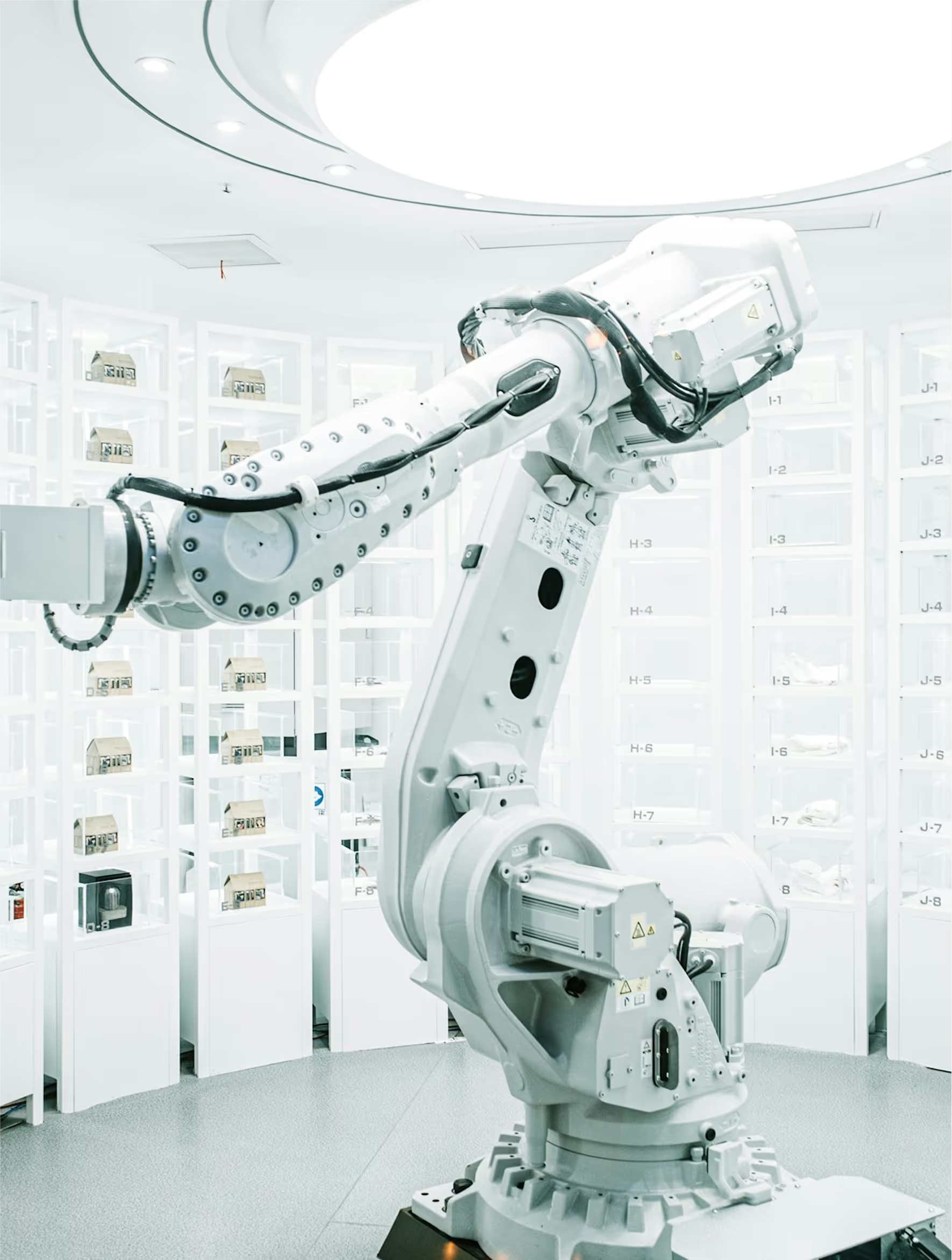

We provide solutions to different industries, ensuring high-quality annotations tailored to your specific needs.
We provide high-quality annotation services to improve your AI's performances

Annotation & Labeling for AI
Unlock the full potential of your AI application with our expert data labeling tech. We ensure high-quality annotations that accelerate your project timelines.
Image Annotation Services
Image annotation services for AI teams building computer vision models. DataVLab supports bounding boxes, polygons, segmentation, keypoints, OCR labeling, and quality-controlled image labeling workflows at scale.
Object Detection Annotation Services
High quality annotation for object detection models including bounding boxes, labels, attributes, and temporal tracking for images and videos.
Bounding Box Annotation Services
High quality bounding box annotation for computer vision models that need precise object detection across images and videos in robotics, retail, mobility, medical imaging, and industrial AI.
Polygon Annotation Services
High accuracy polygon annotation for computer vision teams that require precise object contours across robotics, medical imaging, agriculture, retail, and industrial AI.
Semantic Segmentation Services
High quality semantic segmentation services that provide pixel level masks for medical imaging, robotics, smart cities, agriculture, geospatial AI, and industrial inspection.
FAQs
Here are some common questions we receive from our clients to assist you.
What is computer vision annotation and what does it include?
Computer vision annotation is the process of labeling visual data (images, video, 3D point clouds, or multimodal inputs) so that computer vision models can learn to interpret them. It encompasses all annotation types used to train vision systems: bounding boxes, polygons, semantic and instance segmentation, keypoints, depth estimation labels, optical flow, video tracking, and natural language captions. Computer vision annotation is the foundational data work that makes autonomous driving, medical imaging, industrial inspection, robotics, and visual AI applications possible.
What is the difference between semantic segmentation and instance segmentation?
Semantic segmentation labels every pixel in an image with a class label, treating all pixels belonging to the same class as identical. Instance segmentation labels every pixel and additionally separates individual instances of the same class, so two adjacent cars are labeled as separate objects rather than merged into a single region. Semantic segmentation is used when class-level understanding is sufficient. Instance segmentation is used when individual object identity matters, for example in autonomous driving, robotics pick-and-place, or medical imaging where counting individual structures is required.
Why do computer vision annotation projects fail and how do you prevent it?
Computer vision projects fail at the data stage for several predictable reasons. Annotation guidelines that are ambiguous about edge cases produce inconsistent datasets that introduce noise into model training. Annotators without domain expertise produce incorrect labels in specialized domains like medical imaging or satellite analysis. Insufficient quality control allows errors to accumulate without detection until model performance reveals them. Misaligned annotation format means delivered data requires expensive preprocessing before training can begin. DataVLab addresses each of these through explicit guideline development, domain-matched annotator selection, multi-stage quality control, and format-validated delivery.
How does video annotation differ from image annotation?
Video annotation typically extends image annotation with temporal tracking: the same object instance must be consistently identified and labeled across frames. This involves assigning a persistent track ID to each object, maintaining that ID across occlusions and re-appearances, and propagating annotations between keyframes. For dense video annotation, annotators label every frame. For sparse annotation, annotators label keyframes and interpolation handles intermediate frames. Video annotation is significantly more complex and expensive than image annotation for the same number of frames.
How do you minimize the amount of annotated data needed to train a computer vision model?
The most data-efficient approach combines transfer learning, active learning, and model-assisted annotation. Transfer learning starts from a pretrained model so that the fine-tuning dataset needs to cover your specific distribution rather than general visual knowledge. Active learning selects the images where the model is most uncertain for annotation first, concentrating annotation budget on the data that will improve the model most. Model-assisted annotation uses a baseline model to pre-annotate images and has annotators review and correct, which is typically 2 to 4 times faster than annotating from scratch.
What computer vision annotation use cases does DataVLab support?
DataVLab provides computer vision annotation for autonomous driving, medical imaging, retail analytics, industrial inspection, agricultural monitoring, satellite and aerial imagery analysis, security and surveillance, robotics, and consumer AI applications. We support all annotation types including bounding boxes, polygons, semantic and instance segmentation, keypoints, video tracking, 3D point cloud annotation, and multimodal annotation combining images with text or sensor data. EU-based annotator teams are available for projects with sovereignty or compliance requirements.


Custom service offering

Up to 10x Faster
Accelerate your AI training with high-speed annotation workflows that outperform traditional processes.

AI-Assisted
Seamless integration of manual expertise and automated precision for superior annotation quality.

Advanced QA
Tailor-made quality control protocols to ensure error-free annotations on a per-project basis.

Highly-specialized
Work with industry-trained annotators who bring domain-specific knowledge to every dataset.

Ethical Outsourcing
Fair working conditions and transparent processes to ensure responsible and high-quality data labeling.

Proven Expertise
A track record of success across multiple industries, delivering reliable and effective AI training data.

Scalable Solutions
Tailored workflows designed to scale with your project’s needs, from small datasets to enterprise-level AI models.

Global Team
A worldwide network of skilled annotators and AI specialists dedicated to precision and excellence.
Potential Today
Blog & Resources
Explore our latest articles and insights on Data Annotation



We are here to assist in providing high-quality data annotation services and improve your AI's performances