Object Detection for Cars : How Automotive AI Understands Roads, Traffic, and Safety Events
.jpeg)
Object detection for cars is one of the pillars of modern automotive AI, enabling vehicles and infrastructure systems to analyze traffic, understand road scenes, and detect relevant actors in real time. As cameras, sensors, and embedded compute become more powerful, object detection has evolved into a sophisticated ecosystem that includes semantic segmentation, multi object tracking, and behavior prediction. This article explores how object detection works, why annotated datasets are essential, and how automotive AI teams build robust perception systems for complex road environments. It also explains the challenges of real world deployment and highlights how multi sensor integration enhances reliability. The goal is to give automotive, mobility, and AI teams a comprehensive understanding of how object detection supports next generation transport systems.
- Object detection for cars is one of the pillars of modern automotive AI, enabling vehicles and infrastructure systems to analyze traffic, understand road scenes, and detect relevant actors in real time.
- As cameras, sensors, and embedded compute become more powerful, object detection has evolved into a sophisticated ecosystem that includes semantic segmentation, multi object tracking, and behavior prediction.
- This article explores how object detection works, why annotated datasets are essential, and how automotive AI teams build robust perception systems for complex road environments.
- The goal is to give automotive, mobility, and AI teams a comprehensive understanding of how object detection supports next generation transport systems.
Object detection for cars refers to the automated identification of vehicles, pedestrians, cyclists, road signs, and infrastructure elements in images or video streams. It is a cornerstone of automotive AI because perception modules rely on object detection to understand the scene, anticipate hazards, and support advanced driver assistance functions. The model typically takes inputs from front view, rear view, or surround cameras and identifies all relevant road actors by drawing bounding boxes and assigning class labels. This process enables higher level decisions such as braking, lane changes, or collision avoidance.
The significance of object detection extends beyond autonomous vehicles. Smart infrastructure systems, traffic monitoring units, and city planning departments use detection models to analyze traffic density, estimate congestion, and detect unusual road events. Studies from the World Economic Forum highlight how object detection contributes to safer and more efficient mobility systems when combined with digital infrastructure investment. As cities become more connected, automotive object detection plays an increasingly central role in shaping transport ecosystems.
Object detection models are trained using large annotated datasets and optimized for real world conditions that include variation in lighting, weather, camera placement, and vehicle motion. Because road environments are unpredictable, the design of the dataset and annotation strategy significantly influences model performance. The next sections explore how these components work together to create reliable perception systems.
Why Object Detection Matters in Automotive AI
Real time scene understanding
Object detection serves as the first layer of perception. Without reliable detection of cars, pedestrians, or obstacles, higher level planning systems cannot make informed decisions. This capability lays the foundation for safe automation.
Collision avoidance and risk prediction
Detection models identify potential hazards and track them across frames. By combining detection with motion prediction, systems can anticipate collisions and support emergency braking or evasive maneuvers.
Traffic analytics and smart city planning
Cities use object detection to measure traffic flow, categorize road users, and study congestion patterns. Public mobility insights from the International Transport Forum emphasize how detection driven analytics help optimise road networks globally.
Driver assistance systems
ADAS functions such as lane keeping, blind spot detection, pedestrian detection, and adaptive cruise control all depend on object detection. Without precise detection, these systems risk false alarms or missed hazards.
Fleet operations and safety monitoring
Fleet operators use detection models to monitor driver behavior, identify unsafe events, and analyze incident videos. The same technologies applied to autonomous driving can enhance fleet safety even in conventional vehicles.
Object detection is therefore indispensable for both embedded vehicle intelligence and large scale infrastructure intelligence. In every case, accuracy is heavily influenced by data quality.
How Object Detection Works
Image capture and sensor pipeline
Road object detection begins with image capture. Cameras mounted on vehicles or infrastructure record scenes from multiple angles. The sensor pipeline may include exposure correction, motion compensation, and filtering to ensure high quality input for the perception module.
Neural network based feature extraction
Models use convolutional filters or transformer layers to extract spatial and contextual features. These features describe object shapes, textures, edges, and motion cues. The model learns to recognise consistent visual patterns across many examples.
Prediction of bounding boxes and classes
Object detection models output predicted bounding boxes that enclose objects in the scene. Each box is assigned a class label such as car, truck, pedestrian, cyclist, or traffic sign. Confidence scores quantify how certain the model is about the prediction.
Non maximum suppression and refinement
Because models often produce overlapping predictions, post processing steps filter out duplicates. The result is a final set of clean detections. Systems may also refine box coordinates using additional neural layers or tracking feedback.
Integration with tracking and planning
Detected objects are passed to a tracking module that assigns consistent IDs over time. This enables the system to follow each actor and anticipate future positions. In autonomous vehicles, detection directly influences planning decisions such as stopping or steering.
Object detection is therefore not a standalone technology but part of a complex perception and decision pipeline.
Road Object Detection and Its Importance
Road object detection expands the detection task to include infrastructure and environmental elements. This includes road signs, lane markings, potholes, barriers, and debris. Although these items may seem static, they are critical for safe driving and vehicle compliance.
Understanding environmental context
Road object detection helps vehicles interpret the road scene as a whole. By identifying lane markers, speed limits, traffic lights, and signs, the system gains essential context for navigation.
Supporting autonomous and semi autonomous systems
Without precise detection of road signs or lane boundaries, autonomous systems cannot follow rules. Road object detection ensures that perception aligns with real world constraints.
Enhancing roadside infrastructure
Traffic monitoring systems use detection analytics to track road wear, identify hazardous debris, and monitor signage visibility. Research from the UK Transport Research Laboratory describes how AI powered detection improves infrastructure maintenance planning.
Road object detection therefore supports both in vehicle perception and large scale road governance systems.
Semantic Segmentation for Road Scenes
Semantic segmentation road systems assign a pixel level class to every point in the image. While object detection draws boxes around objects, segmentation provides a detailed map of what the road scene contains. This includes lanes, sidewalks, vegetation, medians, drivable areas, and vehicles.
Pixel level scene understanding
Semantic segmentation allows the model to differentiate drivable space from restricted zones. This is essential for autonomous navigation, especially in complex environments.
Enhanced understanding of road boundaries
Segmentation helps models identify where the road ends and where obstacles begin. Unlike bounding boxes, segmentation captures subtle structural details.
Integration with lane detection
Segmentation can extract lane boundaries even when markings are worn or partially occluded. This improves lane keeping functions and reduces drift.
Improving object detection accuracy
Segmentation contextualizes detection results. A detected object that appears outside a drivable region may be filtered or handled differently. Segmentation therefore complements detection by providing global structure.
Semantic segmentation is one of the most powerful tools for understanding road geometry and environmental context, enabling deeper and more accurate automotive perception.
Multi Object Tracking and Temporal Analysis
Object detection operates frame by frame, but vehicles operate in dynamic environments. Multi object tracking connects detections over time, providing a coherent view of the scene.
Tracking identity consistency
Tracking assigns persistent IDs to objects, allowing the system to understand motion patterns. This is critical for predicting trajectories.
Temporal smoothing for noisy detections
Detections may fluctuate due to lighting or occlusion. Tracking stabilises these outputs by combining evidence over time.
Trajectory prediction
Tracking enables the system to anticipate how vehicles and pedestrians will move. This supports decision modules responsible for planning safe maneuvers.
Dataset considerations for tracking
A multi object tracking dataset differs from standard detection datasets by including time series data and consistent frame level labeling. These datasets require significantly more annotation effort and strict QA consistency.
Research published by the Carnegie Mellon Robotics Institute highlights how multi object tracking improves perception reliability under challenging conditions such as urban traffic and heavy occlusions.
Tracking therefore transforms isolated detections into meaningful temporal information that drives vehicle decision making.
Datasets for Object Detection and Road Segmentation
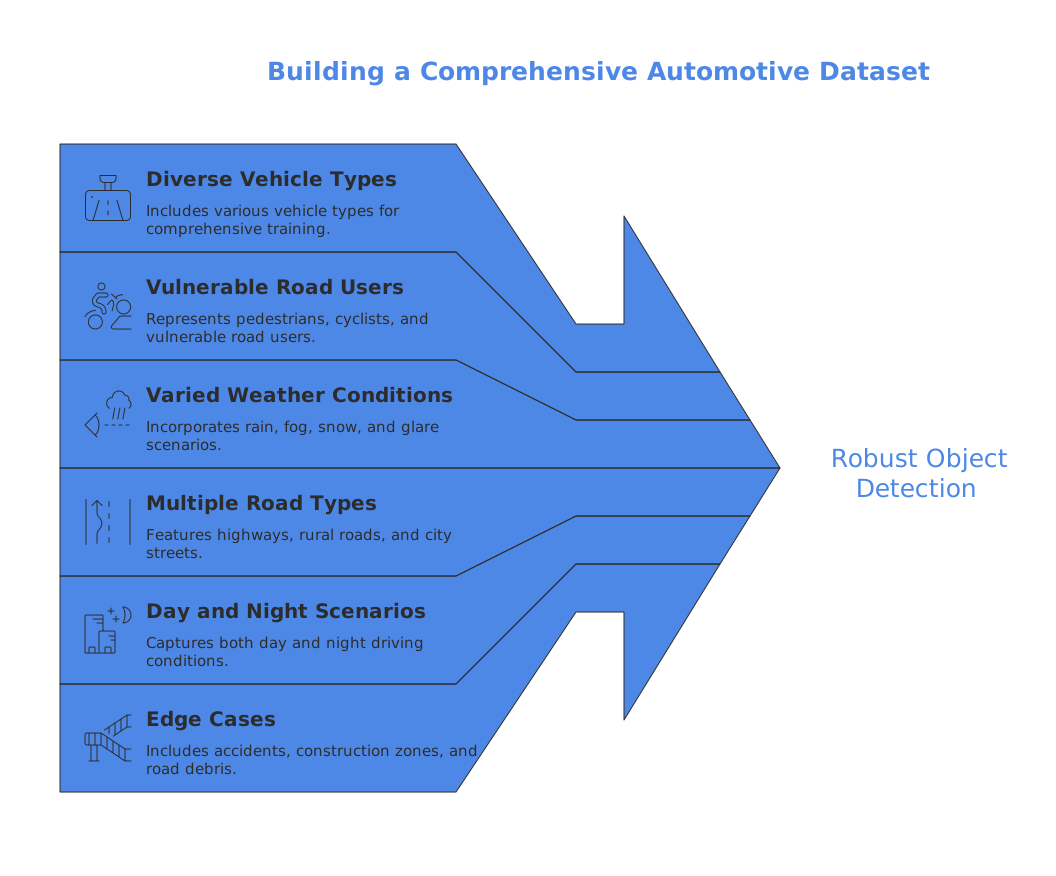
Datasets are a crucial component of automotive perception systems. High quality datasets must represent diverse driving conditions and a wide range of scenery types.
Key dataset components
A strong dataset typically includes:
- Diverse vehicle types
- Pedestrians, cyclists, and vulnerable road users
- Varied weather including rain, fog, snow, and glare
- Multiple road types including highways, rural roads, and city streets
- Day and night scenarios
- Edge cases such as accidents, construction zones, and road debris
Importance of dataset realism
Models trained on synthetic or idealised data often fail in field deployment. Real world datasets capture noise, unpredictability, and natural variation. Automotive AI research from the University of Toronto Robotics Institute emphasises how real world driving datasets enable robust model generalisation.
Handling class imbalance
Some objects, such as pedestrians or emergency vehicles, appear far less frequently than cars. Balancing strategies and targeted data collection improve robustness.
Temporal sequence labeling
For tracking tasks, annotators must label consecutive frames consistently. This requires specialised tools and highly trained annotators.
Creating and maintaining a strong automotive dataset is an ongoing investment. Without this foundation, object detection systems cannot perform reliably in unpredictable road environments.
Annotation Strategies for Object Detection and Segmentation
Bounding boxes for object localisation
Bounding boxes are the cornerstone of object detection annotation. They provide a coarse object location and serve as the input representation for many model architectures.
Polygon and instance segmentation
Polygon segmentation outlines object boundaries precisely. Instance segmentation distinguishes between individual objects of the same class, such as multiple cars in a single frame.
Semantic segmentation for pixel level labeling
Semantic segmentation labels each pixel with its corresponding class. This provides a rich understanding of road geometry and structure.
Keypoints for specialised tasks
Keypoints help models identify specific features such as lane marker intersections or signpost corners. These points support fine grained interpretation.
Tracking ID labeling
Tracking annotation assigns a unique ID to each object across frames. This ID must remain consistent even when objects leave and re enter the scene.
QA and annotation consistency
Quality control processes must include reviewer checks, consensus validation, and automated anomaly detection. Small errors in labeling can lead to major performance degradation.
Annotation is therefore both a technical and operational challenge that requires a skilled workforce and strong guidelines.
Model Architectures for Road Object Detection
Convolutional neural networks
CNN based architectures such as YOLO, RetinaNet, and Faster R CNN remain widely used for detection due to their speed and efficiency.
Vision Transformers
Transformers capture long range dependencies and contextual information. This helps in scenes with many overlapping objects or complex background structures.
Hybrid detection segmentation networks
Models such as Mask R CNN or DETR based segmentation variants combine detection and segmentation into a single architecture. They are powerful for detailed road scene analysis.
Multi task learning approaches
Some architectures jointly learn detection, segmentation, and tracking. This reduces redundancy and improves performance through shared representations.
Lightweight models for edge deployment
Automotive systems often run models on embedded hardware. Lightweight versions of detection networks are designed to meet real time constraints.
External research from the University of California Berkeley AI Research Lab explores these architectural improvements and their impact on road scene understanding.
Challenges in Real World Detection and Segmentation
Weather conditions
Rain, snow, and fog significantly degrade image quality. Models must be trained on weather diverse datasets or enhanced through image preprocessing.
Night time detection
Headlights, glare, and reflections complicate detection. Night time performance is often weaker unless datasets include sufficient low light scenarios.
Motion blur and camera vibration
Vehicles move quickly, and cameras may be affected by vibration. Blur reduces visibility and challenges object boundary detection.
Small and distant objects
Pedestrians and cyclists appear small in distant frames. Models must handle multi scale detection to ensure safety.
Occlusions and clutter
Crowded urban environments often occlude objects. Segmentation and tracking help mitigate these challenges but require large amounts of training data.
Sensor placement variability
Perception must remain consistent even if the camera is mounted at different heights or angles. Dataset diversity is essential.
These challenges shape modern research directions in automotive perception and influence how datasets are collected and annotated.
Real World Applications of Road Object Detection
Autonomous driving
Object detection is central to every level of autonomous driving. The system must detect hazards, follow traffic rules, and anticipate behavior in complex environments.
ADAS systems
Driver assistance features rely on robust perception. Detection informs lane keeping, collision warnings, blind spot alerts, and adaptive cruise control.
Smart cities
Roadside cameras equipped with detection analytics help governments monitor congestion, detect incidents, and analyse traffic patterns.
Logistics and last mile operations
Delivery fleets use detection to analyse route safety and avoid obstacles in tight urban spaces.
Road safety research
Traffic safety organisations use detection to study dangerous intersections and understand near miss events. Research from the European Road Safety Observatory illustrates how computer vision data supports safety analysis.
Object detection therefore plays a crucial role across vehicle manufacturers, municipalities, and mobility service providers.
Future Directions in Road Object Detection
Sensor fusion
Integrating camera data with radar, lidar, and map data will significantly improve detection accuracy. Multimodal systems reduce ambiguity in complex scenarios.
3D object detection
Depth enhanced models will improve distance estimation and understanding of spatial relationships between road actors.
Self improving learning pipelines
Continuous feedback loops will allow models to update automatically as fleets gather new data. This ensures adaptability to new environments.
Domain adaptation techniques
Models will become better at adapting to new regions, driving cultures, and vehicle types. This is essential for global scalability.
AI transparency and explainability
As safety standards evolve, models will need to provide interpretable evidence of how decisions were made. This includes heatmaps, attention maps, and feature visualizations.
The field is evolving rapidly as research institutions and industry players push the limits of perception technology.
Conclusion
Object detection for cars forms the foundation of modern automotive perception systems. By identifying vehicles, pedestrians, cyclists, signs, and road features, detection models provide the essential information needed for safe navigation and real time scene interpretation. When combined with semantic segmentation and multi object tracking, these systems deliver rich contextual understanding that supports both autonomous driving and large scale mobility analysis. High quality datasets, robust annotation workflows, and continuous model improvement are essential for achieving reliable performance in the unpredictable conditions of real world roads.
Contact us at DataVLab
What is Object detection for cars?
Object detection for cars is one of the pillars of modern automotive AI, enabling vehicles and infrastructure systems to analyze traffic, understand road scenes, and detect relevant actors in real time. As cameras, sensors, and embedded compute become more powerful, object detection has evolved into a sophisticated ecosystem that includes semantic segmentation, multi object tracking, and behavior prediction.
Why does object detection matter in automotive AI?
Object detection serves as the first layer of perception. Without reliable detection of cars, pedestrians, or obstacles, higher level planning systems cannot make informed decisions. This capability lays the foundation for safe automation.
How does Object detection work?
Cameras mounted on vehicles or infrastructure record scenes from multiple angles. The sensor pipeline may include exposure correction, motion compensation, and filtering to ensure high quality input for the perception module. Models use convolutional filters or transformer layers to extract spatial and contextual features.
What are the main benefits of Object detection for cars?
Road object detection expands the detection task to include infrastructure and environmental elements. This includes road signs, lane markings, potholes, barriers, and debris. Although these items may seem static, they are critical for safe driving and vehicle compliance.
What are the main challenges of Object detection for cars?
Rain, snow, and fog significantly degrade image quality. Models must be trained on weather diverse datasets or enhanced through image preprocessing. Night time performance is often weaker unless datasets include sufficient low light scenarios.
What is the future of Object detection for cars?
Integrating camera data with radar, lidar, and map data will significantly improve detection accuracy. Depth enhanced models will improve distance estimation and understanding of spatial relationships between road actors. Continuous feedback loops will allow models to update automatically as fleets gather new data.