How to Annotate Images for Object Detection
.jpeg)

High quality training data is the foundation of every successful object detection model. Understanding how to annotate images for object detection is essential for teams working with medical imaging, industrial inspection, robotics, geospatial systems, and complex computer vision pipelines. Meticulous annotation defines how an AI system interprets objects, boundaries, and spatial relationships across thousands or millions of images. This article provides a comprehensive explanation of the annotation workflow, focusing on accuracy, consistency, quality control, and domain-specific considerations. Readers will learn best practices grounded in technical, clinical, and research-backed principles used by leading universities and AI labs.
- Understanding how to annotate images for object detection is essential for teams working with medical imaging, industrial inspection, robotics, geospatial systems, and complex computer vision pipelines.
- Meticulous annotation defines how an AI system interprets objects, boundaries, and spatial relationships across thousands or millions of images.
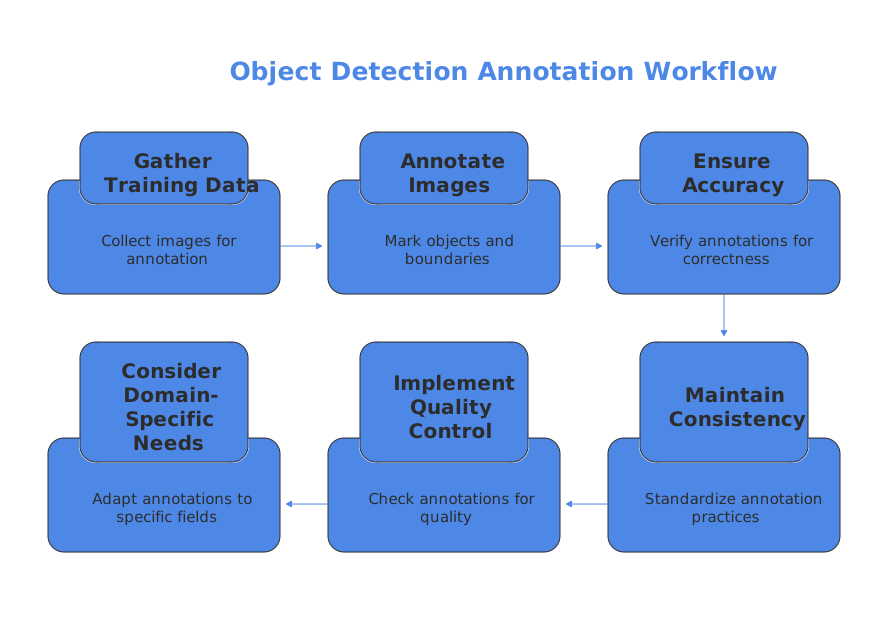
- This article provides a comprehensive explanation of the annotation workflow, focusing on accuracy, consistency, quality control, and domain-specific considerations.
- Readers will learn best practices grounded in technical, clinical, and research-backed principles used by leading universities and AI labs.
Understanding the Role of Annotation in Object Detection
High quality training data determines whether an object detection model succeeds or fails. When experts discuss how to annotate images for object detection, they are referring to a deliberate, multi-step process that ensures every instance of an object is labeled accurately and consistently. Object detection models rely on these annotations to learn what objects look like, how they vary in shape, and how they appear across changing conditions. Because detection outputs must often be used in safety-critical environments, the annotation process carries a high responsibility and must be executed with technical rigor. Whether annotating surgical tools, industrial components, vehicles, wildlife, or consumer goods, the underlying workflow remains rooted in precision and consistency.
Why Proper Annotation Matters in Computer Vision
Object detection is sensitive to even small annotation inconsistencies. If bounding boxes are misaligned, mislabeled, or poorly defined, the model absorbs incorrect spatial patterns that shift its understanding of the world. In medical imaging, for example, bounding boxes around lesions or anatomical structures must be as precise as the modality allows, ensuring radiologists and quality control reviewers can validate the region of interest. In robotics, inaccurate boxes can degrade navigation or manipulation accuracy. For scientific or industrial tasks, poor annotation often leads to higher false positives and false negatives, making downstream systems unreliable. Proper annotation is therefore essential for building trustworthy AI systems with clear operational boundaries.
Building a Strong Foundation for Accurate Object Detection
Defining Objects of Interest
Before annotation begins, teams must define exactly which objects matter and why. This includes creating a clear ontology that lists object classes, their meaning, and the visual characteristics that distinguish them. Engineers often collaborate with domain experts such as radiologists, manufacturing specialists, or agricultural scientists to make sure definitions reflect real-world knowledge. Clarifying the ontology upfront reduces ambiguity and prevents annotators from guessing whether items belong to one category or another. A well-defined ontology is one of the first signs that a project understands how to annotate images for object detection effectively, because it acts as the reference point for every decision downstream.
Establishing Clear Annotation Rules
Annotation guidelines should be exhaustive, unambiguous, and aligned with the model’s intended behavior. These rules define how large or small boxes should be, what to do with occluded objects, and how to handle unusual cases. Each guideline must include examples and counterexamples so that annotators understand both correct and incorrect interpretations. Experienced teams document edge cases because object detection datasets often include rare configurations that significantly affect model performance. When annotators follow consistent rules, the model benefits from stable and predictable learning signals, which is essential for generalization across imaging conditions.
Preparing Images for High Quality Annotation
Standardizing Image Inputs
Different sensors, scanners, and cameras produce images with varying formats, aspect ratios, and resolutions. To annotate efficiently, images must be standardized to avoid unnecessary variability. For instance, medical imaging pipelines may include DICOM preprocessing that standardizes pixel spacing or intensity ranges. Industrial systems might need color correction, lens distortion adjustments, or cropping before annotation. By standardizing inputs, the annotation workflow becomes more predictable and reduces errors. Standardization also helps annotators focus on object location and boundaries rather than being distracted by inconsistent presentation.
Ensuring High Visibility of Objects
Annotators need clear, high quality images to label accurately. If images are blurry, noisy, underexposed, or contain motion artifacts, teams must decide whether to enhance them or exclude them from the dataset. Domain experts may help determine how much noise is acceptable, particularly in modalities like low-dose CT or ultrasound. Poor visibility increases annotation time and reduces consistency across raters. Successful projects that understand how to annotate images for object detection know that image quality has direct downstream effects on model learning, error rates, and edge-case behavior.
The Core Principles of Object Annotation
Identifying All Instances of an Object
Object detection requires annotators to identify every instance of each object class within an image. Missing even a single instance can bias the model, as it may learn that certain cases are unimportant or invisible. This is particularly problematic in medical imaging, where missing a small lesion or instrument can undermine model performance in critical scenarios, especially in the context of image segmentation. In industrial inspection, missing small defects can weaken detection accuracy at scale. Annotators must be trained to systematically scan each image and review it from multiple angles to ensure all objects are captured.
Drawing Accurate Bounding Boxes
Bounding boxes must be tight and aligned with object edges without cutting into the object or leaving excessive padding. Tight boxes help models learn accurate localization, while loose boxes mislead the model into associating unrelated background pixels with the object. Angular or irregularly shaped objects can make this step challenging, particularly when boundaries are ambiguous. Annotators must apply consistent interpretation, relying on established guidelines. Clinical tasks require additional caution when objects gradually transition into surrounding tissue or vary across imaging modalities. Teams that fully understand how to annotate images for object detection dedicate training time to boundary identification and accuracy.
Managing Difficult Annotation Scenarios
Handling Occlusions
Many real-world scenes include objects that are partially hidden by other objects. Annotators must label these objects consistently, even when only part of their shape is visible. Guidelines typically specify whether to draw bounding boxes around the visible portion or estimate the full object extent. These decisions depend on how the model will be used in production settings. In medical or research applications, visible-area annotation may be preferred, whereas robotics tasks may require full-object approximation for better spatial understanding. Each approach carries trade-offs that must be clearly documented for annotators and reviewers.
Dealing With Overlapping Objects
When objects overlap, annotators must avoid merging them or mislabeling boundaries. This is particularly important in environments with dense objects, such as surgical scenes, industrial manufacturing lines, or microscopy images. Overlapping bounding boxes must still remain individually meaningful so that the model can learn to distinguish subtle boundaries. Annotators must learn to identify where one object ends and another begins, even when the transition is ambiguous. Training sessions often use annotated examples to help annotators internalize correct handling of overlaps.
Maintaining Clinical and Technical Accuracy
Working With Domain Specialists
Object detection projects in clinical or scientific environments require close collaboration with radiologists, pathologists, clinicians, or subject matter experts. These experts define what constitutes a valid region of interest and help annotators understand anatomical structures or instrument types. For example, a radiologist can clarify how to annotate surgical tools in fluoroscopy or guide annotators on distinguishing between benign and clinically relevant findings. Teams that understand how to annotate images for object detection at scale integrate expert review early to avoid widespread labeling errors that would otherwise require time-consuming correction.
Reducing Annotation Bias
Bias emerges when annotators introduce systematic errors due to assumptions, misunderstandings, or fatigue. Teams must train annotators to avoid shortcut patterns, such as drawing overly uniform boxes or ignoring small objects. Annotation bias is especially problematic in medical imaging, where rare or subtle findings may be underrepresented. In robotics or industrial tasks, bias can appear when annotators misinterpret complex machinery or repetitive objects. Quality control reviewers help identify and mitigate these biases by providing targeted feedback and reinforcing correct practices.
Ensuring Consistency Across Large Datasets
Developing Clear Escalation Paths
Annotators must know exactly what to do when they encounter ambiguous or unclear cases. A structured escalation path ensures that complex decisions are elevated to senior annotators or domain experts rather than handled inconsistently. Escalation workflows are especially critical when teams must annotate thousands of images with varying complexity. Projects that understand how to annotate images for object detection at scale formalize these escalation pathways to maintain label consistency and reduce confusion among annotators.
Conducting Regular Training and Calibration
Calibration sessions ensure that all annotators apply guidelines consistently. During these sessions, the team reviews annotated samples, discusses challenging cases, and aligns interpretations. Calibration reduces inter-annotator variability, which is essential for datasets used in clinical research or high-stakes AI systems. Refreshing training at regular intervals helps maintain quality, particularly when annotators work with large volumes of data or encounter new scenarios not explicitly covered in the guidelines.
Quality Control as a Core Component of Annotation Workflows
Double-Checking Labels
Quality control reviewers evaluate a sample of annotations or the entire dataset depending on project requirements. Reviewer feedback identifies errors such as misaligned boxes, incorrect classes, or missed objects. A structured QC process ensures that the dataset meets the accuracy standards required for the intended AI application. In medical settings, clinical reviewers may participate to ensure alignment with diagnostic criteria. Projects with strong QC workflows understand not only how to annotate images for object detection but also how to validate the results rigorously.
Ensuring Dataset Reliability
Reliability measures whether the dataset reflects stable and consistent annotation quality across all images. Reliability can be assessed through inter-rater agreement, tests of consistency under noise, or comparison to gold-standard references. Teams working on high-consequence AI systems often implement multi-stage QC pipelines that include primary review, secondary review, consensus building, and expert sign-off. These checks ensure robustness and reproducibility, two essential qualities for any dataset meant for clinical or industrial deployment.
Leveraging High Authority Research for Better Annotation Practices
To improve annotation accuracy and develop advanced methodologies, teams often look to high-quality academic research and best practices. Many leading institutions contribute significantly to the science behind perception, object detection, and image annotation. For example, research from UC San Diego’s Computer Vision Group provides insights into perception algorithms and spatial reasoning. Work from Carnegie Mellon University’s Robotics Institute informs annotation strategies in robotics, manipulation, and autonomous systems. In more clinical or biomedical contexts, centers like the Yale School of Medicine produce imaging datasets and guidelines that influence how researchers annotate detection regions in complex scans.
Advanced Annotation Challenges in Complex Domains
Medical Imaging Annotation Considerations
When annotating medical images for object detection, annotators must understand modality characteristics such as contrast windows, slice thickness, or multi-planar reconstruction. Because models often detect small or subtle abnormalities, annotators must be trained to identify clinically relevant features with high sensitivity. Collaborating with radiologists improves annotation consistency and ensures the dataset aligns with diagnostic practices. Medical projects demonstrate why understanding how to annotate images for object detection requires knowledge that combines clinical insight and technical precision.
Robotics and Autonomous Systems Annotation
In robotics, object detection plays a key role in navigation, manipulation, and perception. Annotating images for these tasks requires an understanding of perspective distortion, sensor noise, and dynamic environments. The Laboratory for Computational Sensing and Robotics at Johns Hopkins provides research insights on how robots perceive and interact with the physical world. Annotators in robotics workflows must account for occlusions, perspective variability, and rapid motion, all of which influence bounding box quality and consistency.
Complex Scene Understanding
Some datasets require annotators to work with highly intricate scenes, such as crowded environments or multi-object interactions. Research from the Institute of Perception, Action and Behaviour at the University of Edinburgh focuses on understanding perception in these challenging contexts. Annotators must learn how to distinguish objects that blend into the background, share similar colors, or exist in dense clusters. Complex scene annotation teaches teams to refine guidelines continually as new edge cases emerge.
Scaling Annotation for Large and Evolving Datasets
Managing Annotation at Scale
Large-scale annotation projects require structured workflows, clear supervision, and consistent communication. Teams must anticipate logistical challenges such as annotator training, capacity planning, and daily throughput tracking. As datasets grow in size, automated quality checks and sampling strategies become essential to maintain consistency. Large projects demonstrate how to annotate images for object detection efficiently while preserving accuracy even when the team expands or the ontology evolves over time.
Continuous Improvement and Feedback Loops
Effective annotation workflows incorporate feedback loops that allow guidelines to evolve based on new insights. When annotators encounter repeated challenges, project managers or domain experts adjust the guidelines to clarify ambiguous cases. These iterative improvements increase consistency and reduce error rates across the entire dataset. Continuous improvement is one of the hallmarks of expert-level annotation, demonstrating both technical understanding and operational discipline.
Would You Like Expert Support With Annotation?
If you are working on an AI or medical imaging project, our team at DataVLab would be glad to support you.
What is How to annotate images for object detection?
High quality training data is the foundation of every successful object detection model. Understanding how to annotate images for object detection is essential for teams working with medical imaging, industrial inspection, robotics, geospatial systems, and complex computer vision pipelines.
Why does proper annotation matter in computer vision?
Object detection is sensitive to even small annotation inconsistencies. If bounding boxes are misaligned, mislabeled, or poorly defined, the model absorbs incorrect spatial patterns that shift its understanding of the world. In medical imaging, for example, bounding boxes around lesions or anatomical structures must be as precise as the modality allows, ensuring radiologists and quality control reviewers can validate the region of interest.
What is involved in building a strong foundation for accurate object detection?
Before annotation begins, teams must define exactly which objects matter and why. This includes creating a clear ontology that lists object classes, their meaning, and the visual characteristics that distinguish them. Engineers often collaborate with domain experts such as radiologists, manufacturing specialists, or agricultural scientists to make sure definitions reflect real-world knowledge.
What is involved in preparing images for high quality annotation?
Different sensors, scanners, and cameras produce images with varying formats, aspect ratios, and resolutions. To annotate efficiently, images must be standardized to avoid unnecessary variability. For instance, medical imaging pipelines may include DICOM preprocessing that standardizes pixel spacing or intensity ranges.
How can teams ensure quality in this topic?
Quality control reviewers evaluate a sample of annotations or the entire dataset depending on project requirements. Reviewer feedback identifies errors such as misaligned boxes, incorrect classes, or missed objects. A structured QC process ensures that the dataset meets the accuracy standards required for the intended AI application.
What are the main challenges of this topic?
When annotating medical images for object detection, annotators must understand modality characteristics such as contrast windows, slice thickness, or multi-planar reconstruction. Because models often detect small or subtle abnormalities, annotators must be trained to identify clinically relevant features with high sensitivity.