What Is AI Detection? Understanding Modern Detection Models and Their Role in Computer Vision
.jpeg)

AI detection refers to the ability of computer vision systems to identify, locate, and interpret objects or events within images and video. It is a foundational capability for applications ranging from security monitoring to industrial automation. This article explains how detection models work, how training data shapes their accuracy, and why annotated examples remain central to their reliability. It also explores how research advancements are expanding detection capabilities across sectors and outlines the technical components that enable robust AI detection at scale. Readers will gain a comprehensive understanding of how detection systems operate and how they fit into broader AI workflows.
- AI detection refers to the ability of computer vision systems to identify, locate, and interpret objects or events within images and video.
- This article explains how detection models work, how training data shapes their accuracy, and why annotated examples remain central to their reliability.
- It also explores how research advancements are expanding detection capabilities across sectors and outlines the technical components that enable robust AI detection at scale.
- Readers will gain a comprehensive understanding of how detection systems operate and how they fit into broader AI workflows.
Understanding AI Detection
AI detection describes the ability of machine learning systems to identify patterns, objects, or events within digital inputs such as images, video sequences, or sensor data. Detection models perform this task by learning from annotated examples and building representations that help them distinguish relevant elements from background noise. These models enable machines to interpret visual information at a scale and speed that exceeds human capability. Research laboratories, such as those highlighted in Apple Machine Learning’s research publications, continue to show how detection architectures evolve to handle increasingly complex real-world environments. As detection technologies become pervasive, understanding their inner logic and training requirements has become essential for any organization building computer vision applications.
Why AI Detection Matters Todaydan
AI detection supports a broad ecosystem of applications across industries. In security, detection models identify people entering restricted areas or track movement across sensitive zones. In transportation, detection supports traffic flow analysis, pedestrian monitoring, and road safety systems. Industrial automation relies on detection models to locate components on assembly lines, ensuring consistency and reducing operational risks. Healthcare imaging uses detection to highlight anomalies or specific structures that require clinical attention. These examples illustrate that detection is not a niche capability but a foundational element of modern intelligent systems that must operate with high reliability.
Detection vs Recognition
Although detection and recognition are related, they represent distinct tasks within computer vision. Detection identifies the presence and location of an object, while recognition classifies what that object is. For instance, detection might identify a person in a frame, whereas recognition determines whether that person is a worker wearing protective equipment. Clear differentiation between these tasks helps developers plan data collection, annotation structures, and model evaluation procedures. Accurate detection is essential because downstream recognition tasks depend on the model’s ability to locate relevant regions consistently.
How AI Detection Works
AI detection models rely on deep learning architectures that extract spatial and contextual cues from visual inputs. During training, the model processes annotated images that indicate where objects appear. Over time, the model learns patterns that correlate with the presence of specific items. These patterns might represent shapes, textures, structural features, or characteristic movement patterns. This training enables models to generalize to new situations, provided that the dataset reflects the diversity of real-world conditions they will encounter. Microsoft’s Vision and Speech research group frequently publishes insights showing how detection systems benefit from improved feature extraction and network optimization.
Feature Hierarchies in Detection Models
Modern detection networks operate at multiple levels of abstraction. Early layers in a neural network focus on small spatial details such as edges and simple textures. Intermediate layers capture more structured features like object parts or human outlines. Deeper layers integrate these fragments into cohesive patterns that represent complete objects. This hierarchical structure allows models to maintain stability even when objects appear in different orientations, lighting conditions, or scales. The breadth and quality of annotated examples directly influence how well these layers reflect real-world variability.
Bounding Boxes and Spatial Localization
Most detection systems rely on bounding boxes to delineate where objects are located within a frame. Annotators draw these rectangular regions to specify the spatial extent of a detected subject. Models learn to predict these coordinates for new inputs. The precision of bounding box annotations affects training outcomes because inaccurate or inconsistent labeling can introduce noise that degrades model performance. Bounding boxes also enable downstream systems to track objects over time or analyze spatial relationships within scenes.
Types of AI Detection
AI detection spans several categories depending on the type of information the system must identify. While all detection tasks follow similar principles, each domain presents unique technical challenges. Understanding these categories clarifies why dataset design and annotation workflows must align with specific application goals.
Object Detection
Object detection is one of the most widely used forms of AI detection. It identifies and locates items within images such as vehicles, tools, humans, equipment, or products. Industrial environments rely on object detection to monitor equipment status or identify misplaced items. Retail environments use it to track inventory or measure customer flow. Research articles on platforms like arXiv, particularly those indexed in the computer vision category, often explore new detection architectures that enhance speed, accuracy, and efficiency for such tasks.
Human Presence Detection
Human presence detection focuses specifically on identifying people within an environment. It is used in security systems, workplace monitoring applications, access control, and service robotics. These models must handle varied body shapes, clothing styles, and occlusion scenarios, making dataset diversity particularly important. Detection must also remain consistent during movement, which requires annotated sequences that represent dynamic scenes.
Anomaly or Event Detection
Some detection tasks involve identifying irregular events or abnormal behavior patterns. In manufacturing, AI detection might identify defective components. In monitoring systems, it may detect unexpected motion or deviations from normal patterns. Because anomalies are rare, building effective detection models requires careful dataset curation and the inclusion of challenging edge cases.
Applications of AI Detection
AI detection has become a foundational capability for many industries. Its adoption continues to grow as organizations explore automation, safety improvements, and data-driven operations. The versatility of detection systems makes them suitable for both simple and highly specialized tasks.
Security and Monitoring
Security systems rely on detection models to identify individuals approaching restricted areas, track crowd density, and monitor sensitive locations. Detection models must perform consistently under varying lighting conditions, weather patterns, and camera qualities. By integrating AI detection into security workflows, organizations improve situational awareness and reduce the need for manual monitoring.
Smart Cities and Transportation
Urban infrastructure increasingly incorporates AI detection to manage traffic flow, support public safety, and optimize transportation systems. Detection enables cities to track vehicle movement, identify congestion, and monitor pedestrian interactions at intersections. It supports real-time decision-making for traffic light control and hazard response. Detection also contributes to long-term planning by providing insights into mobility patterns across districts.
Industrial Automation
AI detection plays a crucial role in manufacturing and logistics. Automated systems use detection to identify components, verify assembly steps, or ensure that workers maintain safe distances from robotic machinery. Detection also helps track inventory, analyze packaging accuracy, and identify potential operational hazards. These capabilities support consistency, safety, and efficiency across industrial environments.
Architecture of Detection Models
Modern detection models employ sophisticated neural architectures that balance accuracy and computational efficiency. The structure of these networks determines how well they process spatial information and generalize to new environments. Architectural innovations have enabled detection systems to operate at real-time speeds without compromising precision.
Convolutional Neural Networks
Most object detection models rely on convolutional neural networks because they efficiently capture spatial correlations. CNNs slide filters across an image to detect local patterns that accumulate into higher-level representations. Their layered structure makes them highly effective for identifying objects of varying sizes and shapes. CNN-based detectors remain popular for real-time applications where fast inference is essential.
Transformer-Based Vision Models
Recent research has introduced transformer architectures to detection tasks. These models capture long-range dependencies and global context, allowing them to reason about entire scenes rather than isolated regions. This improves performance in settings where context is critical, such as distinguishing between similar objects or handling occluded subjects. DeepMind’s research discussions frequently highlight transformer-based innovations that influence detection workflows.
Training Data Requirements for AI Detection
The quality of training data remains the most important factor influencing the success of detection systems. Annotated datasets provide the foundation upon which detection models learn, adapt, and generalize. Building a reliable dataset requires careful planning, structured guidelines, and consistent quality assurance procedures.
Dataset Diversity
A strong detection dataset must encompass a broad range of appearances, lighting conditions, backgrounds, and object variations. Diverse examples prevent models from overfitting to specific patterns and improve their ability to handle unfamiliar scenarios. Environmental diversity, geographic diversity, and cultural diversity all contribute to better model resilience. For human detection tasks, the dataset should include individuals with varied clothing styles, accessories, and body configurations.
Annotation Consistency
Consistent annotations are essential for training stable detection models. Guidelines must define how bounding boxes are drawn, how partial occlusions are handled, and how ambiguous regions are treated. Annotation teams must follow these guidelines to maintain uniformity across large datasets. Quality assurance workflows verify annotation accuracy, resolve discrepancies, and help maintain coherence across thousands of samples.
Evaluation of Detection Models
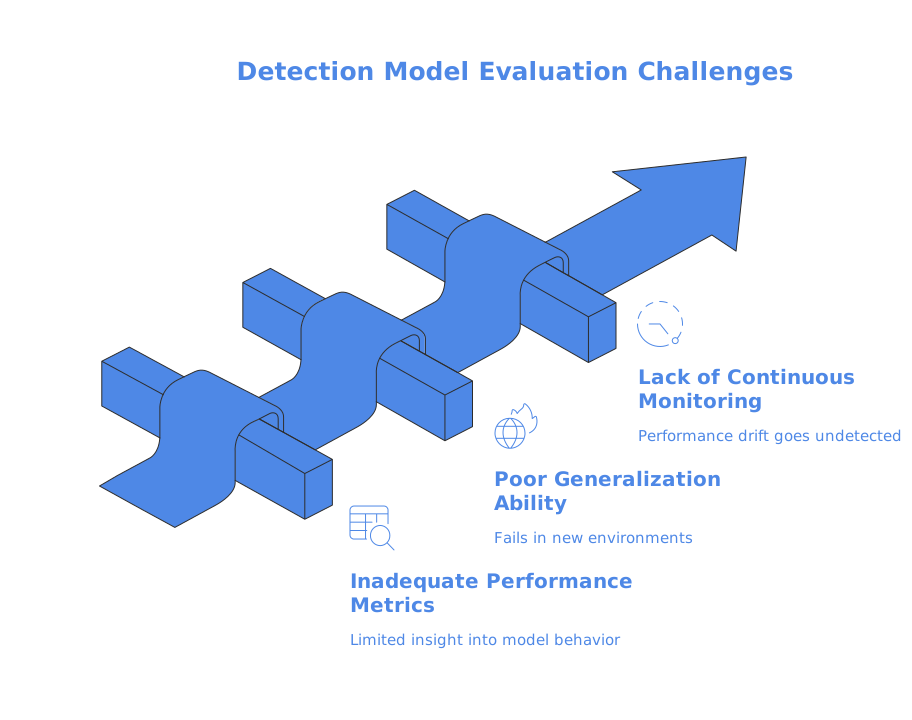
Evaluating detection models requires metrics that examine multiple performance aspects. Precision, recall, and intersection over union (IoU) are commonly used to measure detection accuracy. These metrics help developers understand whether a model is producing false positives, missing relevant detections, or generating bounding boxes that deviate from ground truth. Consistent evaluation ensures that models remain robust across edge cases and meet operational expectations.
Testing Across Domains
Detection models trained in one environment may not perform equally well in another. Testing across multiple domains ensures that models generalize beyond their initial training distributions. Cross-domain testing might include variations in climate, architecture, or even camera hardware. Such evaluations identify performance gaps and guide dataset updates.
Continuous Monitoring and Retraining
Detection models degrade over time as environments evolve. Continuous monitoring helps detect performance drift, while periodic retraining ensures that models adapt to new conditions. Incorporating fresh annotated samples into training cycles minimizes long-term errors and preserves reliability during deployment.
Challenges and Limitations
While AI detection offers significant capabilities, it also presents challenges. Variability in real-world environments introduces complexity, requiring datasets that represent diverse scenarios. Models may struggle with extreme lighting, unusual body positions, or unexpected objects. Annotating edge cases demands careful planning and focused data collection.
Handling Rare Events
Rare events such as anomalies or unusual object appearances present difficulty because they are underrepresented in datasets. These cases require targeted collection strategies and enhanced annotation protocols. Models trained without exposure to such events may produce incorrect or incomplete detections.
Balancing Efficiency and Accuracy
Real-time detection requires models to compute results quickly, often on limited hardware. Balancing speed with accuracy demands thoughtful architecture choices and optimized inference pipelines. Lightweight models may sacrifice accuracy, while heavy models may be unsuitable for edge devices. Developers must evaluate trade-offs carefully to achieve balanced performance.
Future of AI Detection
The future of AI detection is characterized by greater contextual reasoning, multimodal integration, and adaptive learning. Researchers are exploring detection systems that combine video, audio, and depth data to enhance robustness. Emerging trends include self-supervised learning, which reduces dependence on large annotated datasets by leveraging unlabeled data for preliminary training. Resources such as Towards Data Science describe introductory concepts that highlight how fundamental detection approaches continue to evolve with modern innovations.
Edge Computing and Real-Time Detection
Edge computing enables detection systems to operate directly on cameras or embedded devices, minimizing latency and improving privacy. Real-time detection at the edge supports critical use cases such as safety systems and autonomous navigation. Ongoing hardware advances continue to expand the feasibility of high-performance detection on compact devices.
Adaptive and Continual Learning
Future detection systems will incorporate continual learning to adapt to changing environments without forgetting prior knowledge. This approach helps models remain relevant across long-term deployments and reduces the frequency of full retraining cycles. Adaptive detection systems improve scalability and reduce operational costs for organizations using AI in dynamic settings.
If You Are Developing Detection Systems
Reliable AI detection depends on more than algorithms. It requires carefully structured datasets, consistent annotation practices, and workflows tailored to real-world environments. If you are preparing a detection project or refining an existing system, the DataVLab team can help design and manage high-quality training data pipelines that support accurate and scalable model performance. Share your objectives, and we can explore how to strengthen your detection initiatives with dependable annotation expertise.
What is AI detection?
AI detection refers to the ability of computer vision systems to identify, locate, and interpret objects or events within images and video. It is a foundational capability for applications ranging from security monitoring to industrial automation.
Why does AI detection matter Todaydan?
AI detection supports a broad ecosystem of applications across industries. In security, detection models identify people entering restricted areas or track movement across sensitive zones. In transportation, detection supports traffic flow analysis, pedestrian monitoring, and road safety systems.
How does AI detection work?
AI detection models rely on deep learning architectures that extract spatial and contextual cues from visual inputs. During training, the model processes annotated images that indicate where objects appear. Over time, the model learns patterns that correlate with the presence of specific items.
What are the main use cases for AI detection?
AI detection has become a foundational capability for many industries. Its adoption continues to grow as organizations explore automation, safety improvements, and data-driven operations. The versatility of detection systems makes them suitable for both simple and highly specialized tasks.
How can teams ensure quality in AI detection?
Evaluating detection models requires metrics that examine multiple performance aspects. Precision, recall, and intersection over union (IoU) are commonly used to measure detection accuracy. These metrics help developers understand whether a model is producing false positives, missing relevant detections, or generating bounding boxes that deviate from ground truth.
What are the main challenges of AI detection?
While AI detection offers significant capabilities, it also presents challenges. Variability in real-world environments introduces complexity, requiring datasets that represent diverse scenarios. Models may struggle with extreme lighting, unusual body positions, or unexpected objects.