
Bounding Box Annotation Services for Accurate Object Detection Training Data
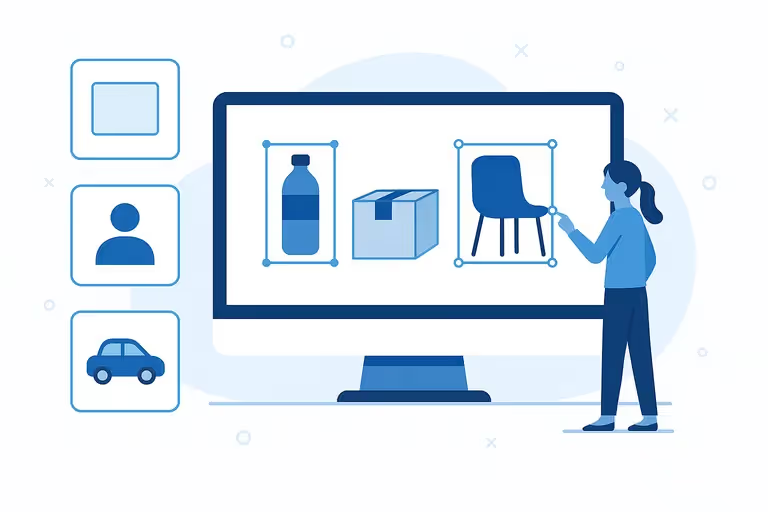

Bounding Box Annotation Services
Built for teams shipping computer vision AI who need reliable labeled video. You get bounding boxes and tracking, stable label guidelines, and QA you can audit, without slowing your roadmap. Bounding Box Annotation Services is delivered with secure workflows and consistent reporting from pilot to production.
High accuracy bounding boxes with consistent class assignments.
Multi step quality control focused on precision, overlap rules, and class consistency.
Support for both image and video bounding box annotation with trained teams.
Bounding boxes are the foundation of many object detection models. They identify the position and scale of each object in an image or video frame. DataVLab provides bounding box annotation services that combine trained annotators, stable workforce continuity, and structured quality control to deliver consistent and accurate datasets. We support single object and multi object detection tasks, class hierarchies, occlusions, small object labeling, overlapping regions, and complex scenes with dense populations.
Annotators are trained to apply your ontology consistently, respect guidelines for minimum box sizes, manage irregular shapes, and handle edge cases where boundaries are not clearly defined. Our teams annotate bounding boxes for robotics, autonomous driving, logistics, retail analytics, medical imaging, manufacturing inspection, smart cities, agriculture, and geospatial applications.
We also support bounding box annotation in video, which requires frame to frame consistency, temporal tracking rules, and object identity stability. For sensitive datasets, DataVLab offers EU only annotation with GDPR aligned workflows.
Whether you need bounding boxes for a proof of concept, a benchmarking dataset, or a large scale production pipeline, we provide reliable annotation quality with predictable turnaround times.
How DataVLab Delivers Reliable Bounding Box Annotation
Our workflows support object detection models that depend on accurate and clean bounding boxes across diverse environments and visual conditions.

Bounding Boxes for Object Detection Models

Accurate box placement for single and multi class datasets
We annotate bounding boxes for vehicles, pedestrians, tools, animals, products, medical structures, industrial components, and many other object types with strict rules for tightness and visibility.
Bounding Box Annotation for Video
Frame consistent labels with stable object identities
Our teams provide bounding boxes across video sequences with attention to temporal smoothness and accurate object tracking to support navigation, monitoring, and behavior analysis models.
Dense Scene and Small Object Annotation
Quality focused workflows for challenging visual environments
We handle dense crowds, cluttered shelves, complex industrial settings, medical frames, and aerial imagery where objects are small or tightly grouped and require careful interpretation.
Industry Specific Bounding Box Annotation
Workflows adapted to sector requirements
Our teams support retail, healthcare, robotics, manufacturing, geospatial analysis, agriculture, and smart city applications with instructions tailored to each domain.
Advanced QA for Bounding Box Precision
Multi layer review with geometric consistency checks
Quality control includes overlap thresholds, tightness checks, class level audits, example refinement, and sampling reviews to keep datasets consistent and reliable.
Flexible Scaling for Large Detection Datasets
Stable teams that support high volume pipelines
We provide dedicated annotators for long term projects and large datasets, ensuring continuity and consistent throughput as you scale.
Discover How Our Process Works

Defining Project
Sampling & Calibration
Annotation
Review & Assurance
Delivery
Explore Industry Applications

We provide solutions to different industries, ensuring high-quality annotations tailored to your specific needs.
We provide high-quality annotation services to improve your AI's performances

Annotation & Labeling for AI
Unlock the full potential of your AI application with our expert data labeling tech. We ensure high-quality annotations that accelerate your project timelines.
Image Annotation Services
Image annotation services for AI teams building computer vision models. DataVLab supports bounding boxes, polygons, segmentation, keypoints, OCR labeling, and quality-controlled image labeling workflows at scale.
Computer Vision Annotation Services
High quality computer vision annotation services for image, video, and multimodal datasets used in robotics, healthcare, autonomous systems, retail, agriculture, and industrial AI.
Object Detection Annotation Services
High quality annotation for object detection models including bounding boxes, labels, attributes, and temporal tracking for images and videos.
Polygon Annotation Services
High accuracy polygon annotation for computer vision teams that require precise object contours across robotics, medical imaging, agriculture, retail, and industrial AI.
Semantic Segmentation Services
High quality semantic segmentation services that provide pixel level masks for medical imaging, robotics, smart cities, agriculture, geospatial AI, and industrial inspection.
FAQs
Here are some common questions we receive from our clients to assist you.
What is bounding box annotation and how is it used in computer vision?
Bounding box annotation draws rectangular boxes around objects of interest in images or video frames to teach computer vision models to detect and locate objects. Each box is defined by its coordinates and tagged with a class label. It is the most widely used annotation method for object detection because it is fast to produce, easy to verify, and compatible with all major detection architectures including YOLO, Faster R-CNN, and SSD.
When should I use bounding boxes versus polygon or segmentation annotation?
For most standard object detection tasks, bounding boxes are the right choice: they are faster to produce, cheaper, and sufficient when the precise shape of the object does not matter. Polygons or segmentation masks are preferable when the application requires pixel-level precision, for example when an autonomous vehicle needs to distinguish exactly where a pedestrian ends and the road begins, or when a medical imaging system needs to measure the precise boundaries of a lesion. If object count and location are the goal, use bounding boxes. If exact object shape matters, use polygons.
What determines the quality of bounding box annotation?
Bounding box quality depends on four things: tightness (boxes should fit the object closely without leaving excess padding), completeness (all instances of the target class must be labeled, not just visible or prominent ones), class accuracy (the label assigned to each box must be correct), and consistency (the same labeling decisions must be applied across all annotators and all images). Quality control typically involves consensus verification on a sample of images, annotator agreement measurement, and edge case guidelines that explicitly address truncated objects, occluded objects, and small instances.
What annotation formats do you deliver for bounding box datasets?
The main annotation formats for bounding boxes are PASCAL VOC (XML with xmin, ymin, xmax, ymax coordinates), COCO JSON (x, y, width, height with category IDs), YOLO TXT (normalized center x, center y, width, height per line), and CSV or custom JSON for proprietary pipelines. DataVLab delivers bounding box datasets in whichever format your training pipeline expects, with validation that coordinates are correct and class IDs match your taxonomy.
How fast is bounding box annotation at scale?
Annotation speed depends on image complexity, number of classes, and image resolution. For standard scenes with a small number of clearly visible objects, experienced annotators produce 200 to 400 boxes per hour. For dense scenes with many small or occluded objects, or for strict quality requirements with double verification, throughput drops to 50 to 150 boxes per hour. Production annotation campaigns benefit from pre-annotation using a baseline model to generate proposals that annotators review and correct, typically doubling throughput without reducing quality.
What bounding box annotation use cases does DataVLab support?
DataVLab provides bounding box annotation for object detection, autonomous driving, retail inventory, security and surveillance, agricultural yield estimation, and medical imaging applications. We support single-class and multi-class annotation, hierarchical taxonomies, attribute annotation (color, material, condition), and temporal annotation across video sequences. For regulated applications requiring traceability and quality documentation, we provide annotator demographics, inter-annotator agreement metrics, and full audit logs.


Custom service offering

Up to 10x Faster
Accelerate your AI training with high-speed annotation workflows that outperform traditional processes.

AI-Assisted
Seamless integration of manual expertise and automated precision for superior annotation quality.

Advanced QA
Tailor-made quality control protocols to ensure error-free annotations on a per-project basis.

Highly-specialized
Work with industry-trained annotators who bring domain-specific knowledge to every dataset.

Ethical Outsourcing
Fair working conditions and transparent processes to ensure responsible and high-quality data labeling.

Proven Expertise
A track record of success across multiple industries, delivering reliable and effective AI training data.

Scalable Solutions
Tailored workflows designed to scale with your project’s needs, from small datasets to enterprise-level AI models.

Global Team
A worldwide network of skilled annotators and AI specialists dedicated to precision and excellence.
Potential Today
Blog & Resources
Explore our latest articles and insights on Data Annotation

We are here to assist in providing high-quality data annotation services and improve your AI's performances