Smart Cities & Public Safety
Traffic monitoring, crowd analysis, incident detection & urban public safety

AI and Computer Vision for Safer and Smarter Cities
Smart cities rely on real-time visibility and automated analysis to keep citizens safe and to improve the flow of people and vehicles. Accurate computer vision models support applications such as traffic optimization, anomaly detection, crowd behavior analysis, and public space monitoring. These models require large, high-quality annotated datasets that can represent the complexity of modern urban environments.
DataVLab provides specialized annotation services for city-scale applications including pedestrian tracking, vehicle detection, incident identification, crowd density estimation, and infrastructure monitoring. Our teams work with video streams from fixed surveillance cameras, traffic cameras, public transport hubs, and mobile devices to produce training data that is consistent across diverse lighting, weather, and density conditions.
We help municipalities, mobility companies, and public safety organizations deploy reliable AI systems that detect risks early, enhance situational awareness, and support smarter city planning.

Pedestrian and Vehicle Detection
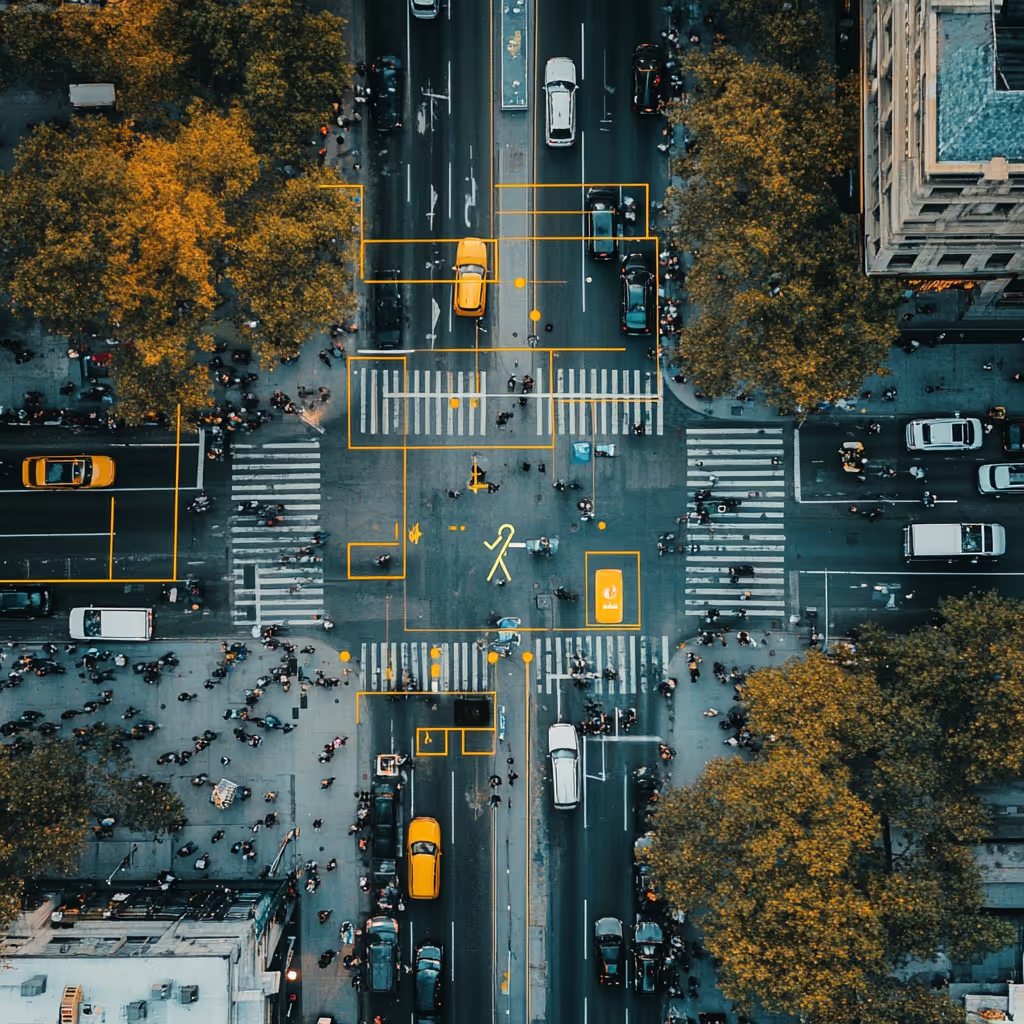
Bounding boxes and tracking for pedestrians, cyclists, cars, and buses to support traffic optimization and mobility analytics
Crowd Density and Movement Analysis
Annotation of people in high density areas to train AI systems for crowd flow modeling, queue analysis, and public safety monitoring
Incident and Anomaly Detection
Frame level labeling of unusual events including falls, collisions, trespassing, and suspicious behavior to support safety and emergency response systems
Intersection and Roadway Monitoring
Detection and classification of vehicles, lane usage, stop line behavior, and turning patterns to power intelligent traffic systems
Public Space Activity Classification
Annotation of activities such as waiting, walking, running, or gathering to improve AI understanding of human behavior in urban environments
Multi Camera Video Synchronization and Tracking
Consistent object IDs across multiple camera feeds to support city wide tracking and large scale mobility analysis


Annotation & Labeling for AI
Unlock the full potential of your AI application with our expert data labeling tech. We ensure high-quality annotations that accelerate your project timelines.

Enhance Computer Vision
with Accurate Image Labeling
Precise labeling for computer vision models, including bounding boxes, polygons, and segmentation.

Unleashing the Potential
of Dynamic Data
Frame-by-frame tracking and object recognition for dynamic AI applications.
Building the Next
Dimension of AI
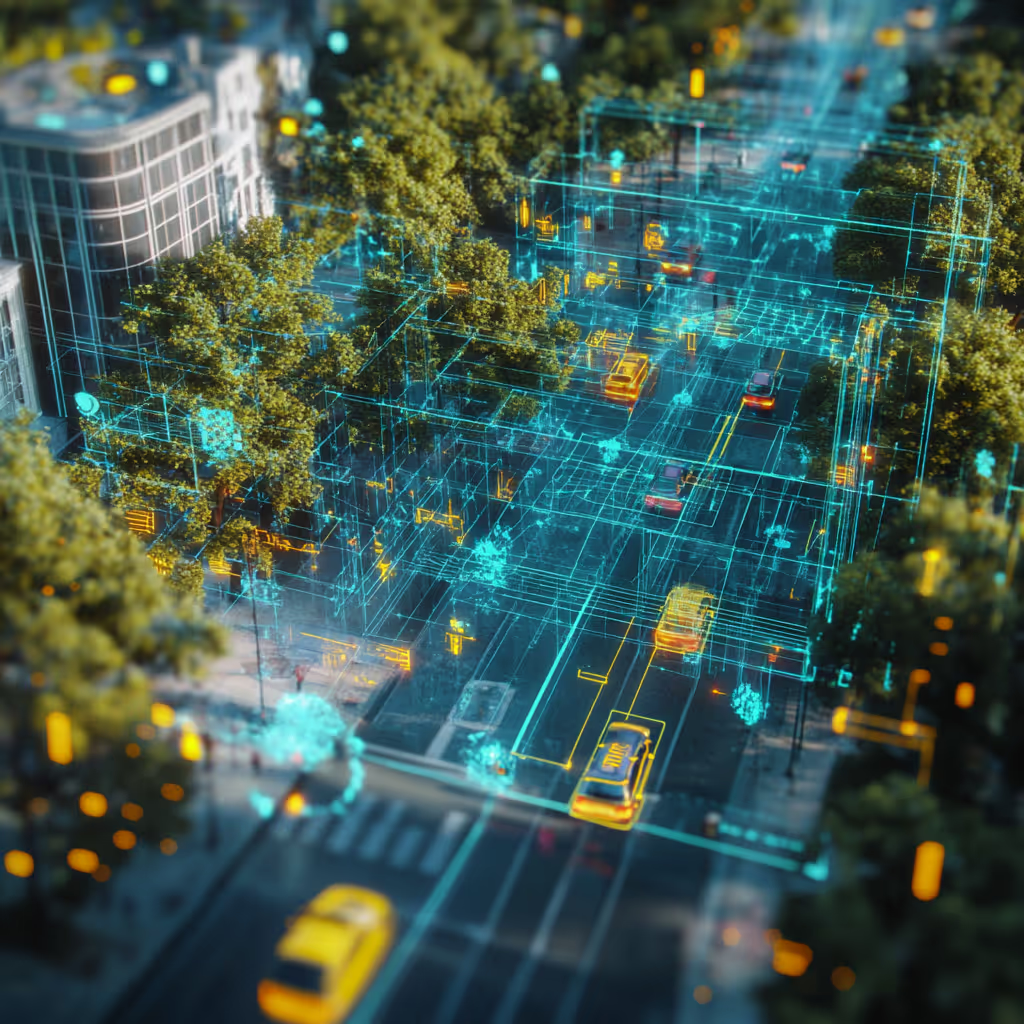
Advanced point cloud and LiDAR annotation for autonomous systems and spatial AI.
Tailored Solutions for Unique Challenges
Tailor-made annotation workflows for unique AI challenges across industries.
NLP & Text Annotation
Get your data labeled in record time.
GenAI & LLM Solutions
Our team is here to assist you anytime.
Surveillance Image Annotation Services
High accuracy annotation for CCTV, security cameras, and surveillance footage to support object detection, behavior analysis, and automated monitoring.
Traffic Labeling Services
High accuracy labeling for traffic videos and images, supporting vehicle detection, pedestrian tracking, congestion analysis, and smart city mobility insights.
Video Annotation
Video annotation services and video labeling for AI teams. DataVLab supports object tracking, action and event labeling, temporal segmentation, frame-by-frame annotation, and sequence QA for scalable model training data.
Object Detection Annotation Services
High quality annotation for object detection models including bounding boxes, labels, attributes, and temporal tracking for images and videos.
Crowd Annotation Services
High accuracy crowd annotation for people counting, density estimation, flow analysis, and public safety monitoring.
Geospatial Data Annotation Services
High quality annotation for satellite imagery, aerial imagery, multispectral data, LiDAR surfaces, and GIS datasets used in geospatial and environmental AI.
Map Annotation Services
Accurate annotation for digital maps, GIS layers, boundaries, POIs, road networks, and 2D cartographic datasets.
We provide high-quality data annotation services and improve your AI's performances

Custom service offering

Up to 10x Faster
Accelerate your AI training with high-speed annotation workflows that outperform traditional processes.

AI-Assisted
Seamless integration of manual expertise and automated precision for superior annotation quality.

Advanced QA
Tailor-made quality control protocols to ensure error-free annotations on a per-project basis.

Highly-specialized
Work with industry-trained annotators who bring domain-specific knowledge to every dataset.

Ethical Outsourcing
Fair working conditions and transparent processes to ensure responsible and high-quality data labeling.

Proven Expertise
A track record of success across multiple industries, delivering reliable and effective AI training data.

Scalable Solutions
Tailored workflows designed to scale with your project’s needs, from small datasets to enterprise-level AI models.

Global Team
A worldwide network of skilled annotators and AI specialists dedicated to precision and excellence.
Potential Today
FAQs
Here are some common questions we receive from our clients to assist you.

What is smart city and public safety AI annotation?
Smart city and public safety AI annotation labels video, imagery, and sensor data from urban environments so that AI systems can support traffic optimization, crowd analysis, incident detection, infrastructure monitoring, and emergency response. It covers annotation of surveillance camera feeds (pedestrian and vehicle detection, crowd density estimation, behavioral anomaly detection), traffic monitoring (vehicle classification, intersection behavior, congestion detection), public space monitoring (queue analysis, incident recognition), and infrastructure condition assessment (road surface defects, bridge condition, utility asset monitoring). Smart city annotation must handle the specific challenges of urban environments: variable lighting, weather conditions, partial occlusions, and the sheer diversity of objects and events in dense urban scenes.
What GDPR constraints apply to smart city surveillance annotation in Europe?
Smart city video annotation in Europe is subject to significant GDPR and human rights law constraints because it involves systematic surveillance of public spaces. GDPR requires legal basis, proportionality, and necessity for processing personal data captured in public surveillance. The Court of Justice of the EU has ruled that indiscriminate mass surveillance of public spaces is incompatible with fundamental rights. For AI training on surveillance footage, this means: documented legal basis for the original data capture, data minimization in annotation workflows (annotators should not be exposed to more personal data than necessary), and anonymization of identifiable individuals where possible before data is used for AI training. DataVLab implements these controls as standard for smart city projects.
What is traffic monitoring annotation for smart city AI?
Traffic monitoring annotation labels vehicles, cyclists, pedestrians, and road elements in urban traffic scenes. Vehicle classification requires distinguishing car, van, truck, bus, motorcycle, bicycle, and special vehicles (emergency, construction) at the level of granularity that traffic management AI requires. Intersection behavior annotation labels lane usage, stop line behavior, turning patterns, and traffic light compliance. For connected vehicle and V2X applications, annotation must additionally label road furniture (signs, traffic lights, bollards, barriers) that vehicles must detect and respond to. Temporal consistency is important: the same vehicle must maintain a consistent ID through the intersection sequence for motion modeling.
What is incident and anomaly detection annotation?
Incident and anomaly detection annotation labels events in urban surveillance video that public safety AI systems must recognize: falls, fights, trespassing, abandoned objects, vehicle collisions, crowd crushes, and unusual behavioral patterns. This requires annotators who can consistently apply policy-defined criteria for what constitutes a reportable incident, which requires explicit guidelines with visual examples for each incident category and borderline cases. For AI systems used by law enforcement or emergency services, the consequences of false positives (unnecessary intervention) and false negatives (missed incidents) have direct public safety implications, making annotation quality particularly consequential.
What rights and regulatory considerations affect smart city AI annotation?
Smart city and public safety AI must balance operational objectives against fundamental rights, particularly the right to privacy, freedom of movement, and freedom of assembly. For European smart city programs, the EU AI Act's risk classification is directly relevant: real-time remote biometric identification in public spaces is prohibited with narrow exceptions, and AI systems used in law enforcement contexts face specific high-risk classification requirements. Annotation programs for public safety AI should document the intended use, legal basis, and human oversight mechanisms as part of the annotation project setup, because this documentation will be required for EU AI Act compliance assessment.
What smart city annotation services does DataVLab provide?
DataVLab provides smart city and public safety annotation for traffic monitoring, pedestrian and crowd analysis, incident and anomaly detection, public space behavioral analysis, infrastructure condition monitoring, and multi-camera tracking. We work with municipalities, mobility companies, public safety technology providers, and smart infrastructure developers. All annotation workflows implement GDPR-compliant personal data handling including anonymization and appropriate legal basis documentation. EU-based annotation teams are available for European smart city programs with sovereignty or regulatory compliance requirements.
We provide high-quality data annotation services and improve your AI's performances
Blog & Resources
Explore our latest articles and insights on Data Annotation