NLP Annotation: Building High-Quality Labels for NER, Intent, SRL and Entity Linking
.jpeg)

This article explores how NLP annotation shapes model performance across tasks such as named entity recognition, intent detection, semantic role labeling and entity linking. It details annotation workflows, quality control processes, dataset design principles and the role of well-defined guidelines in creating consistent language datasets. You will also learn how annotation choices influence generalization, reduce errors and strengthen the reliability of production-grade NLP systems.
- This article explores how NLP annotation shapes model performance across tasks such as named entity recognition, intent detection, semantic role labeling and entity linking.
- It details annotation workflows, quality control processes, dataset design principles and the role of well-defined guidelines in creating consistent language datasets.
- Studies from the Stanford NLP Group underline that annotation quality can influence model outcomes more strongly than dataset size.
- If entity boundaries vary across a dataset or intent categories overlap, the model internalizes conflicting signals that weaken its reasoning.
High-quality NLP annotation is the foundation that supports the accuracy of modern language models. When data is labeled with clarity and consistency, models learn to recognize entities, infer intent, map predicate structures and connect mentions to the right references with greater confidence. Each annotation decision affects how the model interprets language in deployment, which means even small errors can ripple into significant performance issues. Studies from the Stanford NLP Group underline that annotation quality can influence model outcomes more strongly than dataset size. For teams that rely on NLP systems to automate support, analyze documents or extract structured meaning from text, investing in well-organized annotation pipelines is essential.
Why NLP Annotation Matters for Model Performance
Models learn patterns directly from the examples they receive, and annotation guides the formation of these patterns. If entity boundaries vary across a dataset or intent categories overlap, the model internalizes conflicting signals that weaken its reasoning. Teams must therefore maintain clear category definitions, consistent boundary rules and a structured review process to prevent noisy examples from shaping model behavior. Research shared through the ACL Anthology shows that inconsistent labeling lowers accuracy in downstream tasks such as summarization, question answering and sentiment analysis. When annotation quality is high, models learn stable structural cues that support more reliable generalization, especially when exposed to unfamiliar vocabulary or phrasing.
How Annotation Shapes Named Entity Recognition
Named entity recognition depends on annotators correctly identifying entity spans and deciding whether a phrase refers to a real entity, a descriptive expression or a metaphor. The difficulty lies not in identifying typical entities but in handling ambiguous constructions such as company divisions, temporary project names or product subtypes. Annotators must also decide how to treat multiword expressions and when to mark nested entities. Clear rules reduce random variation, especially in large corpora where annotators may interpret similar patterns differently. As noted in educational resources from Hugging Face, entity boundary clarity is a major driver of model stability. When annotation teams use examples to illustrate complex or borderline cases, the resulting datasets produce models that interpret real-world text with stronger precision.
Handling edge cases in NER
Edge cases often reveal inconsistencies in interpretation, and these inconsistencies can expand as the dataset grows. Expressions such as brand slogans or geographic regions used metaphorically require explicit decisions to prevent contradictory labeling. When annotators understand how to handle these unusual structures, they maintain the coherence of the entity taxonomy. Teams can also integrate short reference lists or glossaries that clarify which entities belong to which categories. This reduces confusion and helps annotators avoid interpreting the same terms differently across batches.
Resolving nested or overlapping entities
Nested entities appear when one entity is contained inside another, and incorrect handling of these cases often weakens model understanding of hierarchical structure. Annotators must determine whether the project requires marking all nested spans or only the most informative ones. This choice must remain consistent across the entire dataset. When nested spans are handled systematically, models learn to differentiate between broad and specific entity references. These cases also highlight how important it is for teams to align around a single interpretation strategy before annotation begins.
Importance of context in entity labeling
Context determines the meaning of many entity mentions, especially when terms represent different categories depending on usage. Annotators must examine nearby sentences rather than labeling words in isolation to avoid superficial interpretation. This is particularly important for ambiguous names that refer to multiple possible entities. Providing annotators with document-level visibility reduces the number of incorrect labels. Over time, consistent contextual reasoning teaches the model to infer meaning from broader linguistic cues rather than isolated words.
Annotation Principles for Intent Detection
Intent detection focuses on identifying user goals from sentences or short phrases, which requires annotators to interpret meaning even when phrasing varies significantly. A well-built intent taxonomy avoids overlap between categories and prevents annotators from choosing different labels for semantically identical queries. When categories are unclear or when similar intentions are placed too close to each other, human disagreement increases sharply. Research from Carnegie Mellon University’s LTI (https://lti.cs.cmu.edu) highlights that intent models trained on ambiguous taxonomies fail more frequently in real-world chat environments. Establishing simple and non-overlapping categories helps annotators apply labels consistently, which strengthens the coherence of the training data.
Balancing granularity with clarity
Intent categories must be detailed enough to be useful but simple enough for annotators to apply confidently. Overly granular taxonomies create confusion because annotators must differentiate between intentions that may appear identical in use. When categories strike the right level of granularity, annotators can label examples without excessive cognitive load. Clear distinctions lead to stronger model confidence scores and fewer misclassifications during deployment. Creating this balance requires reviewing sample queries and ensuring category boundaries make sense to both annotators and system designers.
Annotating paraphrases and variations
Users express the same intent in many different ways, and annotators must ensure that meaning is interpreted rather than surface-level phrasing. A dataset with strong paraphrase coverage allows models to understand semantically equivalent expressions, even when vocabulary or sentence structure shifts significantly. Annotators need training to evaluate whether two sentences convey the same intention despite superficial differences. Documenting examples of paraphrases helps build intuition across the annotation team. This process results in models that recognize intent more accurately in unpredictable, real-world input.
Avoiding ambiguous intent categories
Ambiguous intent categories cause annotators to rely on subjective judgment, which weakens dataset reliability. To avoid this, category definitions must include precise descriptions and several examples that illustrate acceptable and unacceptable cases. When overlapping categories are merged or removed, annotators can make decisions with greater confidence. This clarity also lowers disagreement rates, which improves quality control metrics across the dataset. Cleaner category structures ultimately allow models to interpret user goals with fewer false positives.
High-Quality Annotation for Semantic Role Labeling
Semantic role labeling captures the deeper structure of sentences by identifying predicates and the roles associated with each argument. Annotators must understand grammar and semantics well enough to distinguish between agents, patients, instruments and other role types. When guidelines clearly define how to treat each structure, annotators produce consistent predicate-argument mappings. Work from the University of Colorado’s CLIP Lab (https://clip.colorado.edu) shows that high-quality SRL annotation enhances performance in tasks such as summarization and information retrieval by helping models interpret event structure more accurately.
Identifying predicates with precision
Annotators must determine whether a verb is functioning as a predicate or serving another role in the sentence. When predicates are misidentified, the entire argument structure becomes unreliable. Guidelines must include examples of predicates in different syntactic contexts to minimize confusion. Annotators should review challenging cases collectively to establish shared interpretation. This approach maintains consistency and strengthens the clarity of predicate boundaries across the dataset.
Assigning arguments consistently
Argument labels describe how entities participate in events, and inconsistent labeling disrupts model understanding of relationships. Annotators must rely on definitions that clearly explain each role, especially in complex sentences with multiple potential interpretations. Reviewing examples of correct and incorrect assignments helps teams avoid recurring mistakes. When annotators understand the functional meaning behind each label, they can apply them with greater accuracy. Consistent argument annotation allows the model to detect event structure with greater clarity.
Managing complex sentence structures
Long sentences with embedded clauses often challenge annotators because the predicate-argument relationships become harder to interpret. Guidelines should explain how to handle subordinate clauses, passive constructions and idiomatic expressions that influence meaning. Teams benefit from reviewing complex examples together to resolve ambiguous cases. Maintaining this alignment helps create coherent argument structures across the dataset. These efforts ensure that the model learns how to handle complex syntactic patterns with fewer errors.
What Entity Linking Requires from Annotators
Entity linking connects textual mentions to specific entries in a knowledge base, which requires deep contextual reasoning. Annotators must choose the correct referent when multiple entities share the same name or when the text provides subtle clues about the intended reference. Incorrect linking misguides the model and affects applications that rely on structured knowledge retrieval. Annotators therefore need training on how to use the reference database and how to interpret ambiguous phrases that may point to multiple possible entities.
Using reference knowledge bases correctly
Annotators must navigate the knowledge base confidently and verify that the chosen entity matches the context. If the database contains outdated entries or lacks coverage in certain domains, annotators must mark the mention as unknown rather than forcing a match. Projects should provide instructions on how to compare attributes across possible entities. These steps reduce incorrect associations and maintain the integrity of the dataset. Proper use of the knowledge base also supports consistent linking decisions across annotators.
Disambiguating similar entities
When different entities share identical names, annotators must rely on contextual signals such as geographical references, job titles or organizational affiliations. This process requires attention to nuance and a thorough reading of the surrounding text. Clear guidelines help annotators understand which clues matter most when resolving ambiguity. When these decisions are documented, the dataset remains consistent across batches. This clarity also equips models to interpret reference-heavy documents with greater accuracy.
Handling missing or ambiguous entries
Some mentions do not correspond to any existing knowledge base entry, and forcing a match creates long-term errors in the system. Annotators must mark these cases as unknown or unsupported based on the project's labeling scheme. This prevents incorrect associations from entering the model's training data. Teams should document how to treat partial matches or incomplete mentions. When these guidelines are followed consistently, the overall linking accuracy improves noticeably.
Designing Guidelines for Consistent Annotation
Annotation guidelines define the interpretation logic that all annotators must follow. Without clear instructions, even experienced annotators may diverge in their decisions, producing a dataset with inconsistent labels. Guidelines should include definitions, examples, counterexamples and clarifications for ambiguous cases. They should also specify how to handle rare constructions, multiword expressions and domain-specific terminology. Updating guidelines regularly ensures that new patterns discovered during review become standardized.
Providing examples for clarity
Examples illustrate how labels should be applied and help annotators develop intuition. They also serve as references for borderline cases where annotators might hesitate. Including positive and negative examples ensures that annotators understand both correct and incorrect interpretations. Teams should update examples to reflect new challenges as the project evolves. This ongoing refinement strengthens dataset consistency over time.
Documenting decisions about disputed cases
Disputed cases occur when annotators disagree about interpretation, and documenting the resolution helps avoid repeated confusion. These decisions should be compiled in a shared record that annotators can consult. This prevents inconsistent labeling when similar cases reappear later in the dataset. Documenting complex cases also helps refine guidelines and improve training for new annotators. This habit strengthens the reliability of the overall workflow.
Maintaining version control
Guidelines often evolve, and annotators must always use the latest version. Version control ensures that all members of the team remain aligned and that changes are tracked clearly. Annotators should also review past versions when necessary to understand how interpretation rules have evolved. Keeping guidelines updated helps improve dataset quality as new insights emerge. This level of organization reduces confusion and makes the annotation process more predictable.
Quality Control Methods That Improve Dataset Reliability
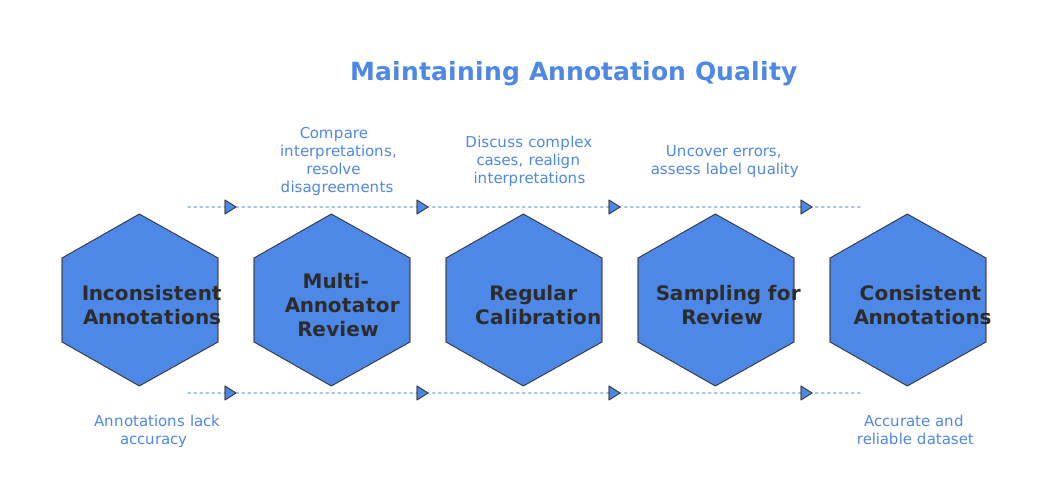
Quality control ensures that annotations remain accurate and consistent across the entire project. Multi-annotator review allows teams to compare interpretations and resolve disagreements. Sampling provides insight into recurring errors or patterns of confusion. Automated validation detects structural issues such as overlapping spans or category mismatches. Combining these strategies creates a resilient workflow that maintains quality throughout the dataset.
Multi-annotator workflows
When multiple annotators label the same sample, disagreements reveal how consistently the guidelines are being applied. These disagreements help identify unclear definitions or categories that may need revision. Analyzing disagreement patterns strengthens the alignment of the annotation team. The process also highlights individual annotation tendencies that may require additional training. Over time, multi-annotator workflows produce higher agreement and cleaner datasets.
Regular calibration sessions
Calibration sessions give teams the opportunity to discuss complex cases and realign their interpretations. Annotators can compare reasoning, clarify uncertainties and update guidelines collaboratively. These sessions are especially valuable for tasks with high ambiguity, such as entity linking or SRL. Regular calibration also supports new annotators by providing direct exposure to expert reasoning. As a result, the entire team becomes more consistent in its application of labels.
Sampling for deep review
Sampling involves reviewing a subset of annotated examples in depth to uncover errors that might not appear in automated checks. Reviewers can assess whether labels follow guidelines, whether boundary rules were respected and whether ambiguous constructions were handled correctly. This strategy helps identify trends in annotation quality and highlights areas where additional training may be required. Deep review also builds confidence that the dataset remains coherent over time. Maintaining a structured sampling process ensures that quality remains high even as the dataset grows.
Integrating NLP Annotation Into Real-World AI Pipelines
Integrating annotated data into production AI systems requires clear dataset structure, balanced distribution across categories and well-organized training, validation and test splits. The quality of annotation directly influences model stability during fine-tuning and deployment. A dataset with consistent labels supports smoother retraining cycles and easier expansion when new categories or domains are introduced. Teams should also monitor how model performance evolves as more annotated data enters the pipeline.
Dataset balancing techniques
Balanced content datasets ensure that all categories receive sufficient representation, preventing models from overfitting to frequent labels. Annotators may need to focus on collecting additional examples for rare classes to maintain this balance. Balanced datasets also support fairer evaluation by reducing skewed performance metrics. Teams should monitor category distribution throughout the project to avoid unintended imbalances. This oversight helps maintain robust generalization across real-world scenarios.
Preparing evaluation benchmarks
Evaluation benchmarks provide an unbiased view of model performance by isolating a portion of the data reserved exclusively for testing. These benchmarks must reflect the variety and complexity of the full dataset to offer meaningful insights. Annotators should ensure that test examples are labeled with the same care applied to training data. Teams must also document how benchmarks were created to maintain reproducibility. Strong evaluation benchmarks give developers confidence that the model behaves reliably under realistic conditions.
Support for iterative improvements
As annotation progresses, teams often discover new patterns or edge cases that require guideline updates or taxonomy adjustments. A well-structured dataset supports this iterative improvement by allowing new examples to be integrated without disrupting existing patterns. Teams should review how newly added examples influence the model’s performance and adjust annotation strategies accordingly. Maintaining flexibility while preserving consistency results in a dataset that evolves steadily alongside system requirements. These practices help ensure that the model continues to improve across cycles of training and refinement.
If you are building or refining an NLP dataset and want support with annotation structure, workflow design or quality assurance, we can explore how DataVLab helps teams develop consistent, scalable and production-grade labeled data for advanced language applications.
What is NLP annotation?
This article explores how NLP annotation shapes model performance across tasks such as named entity recognition, intent detection, semantic role labeling and entity linking. It details annotation workflows, quality control processes, dataset design principles and the role of well-defined guidelines in creating consistent language datasets.
Why does NLP annotation matter for model performance?
Models learn patterns directly from the examples they receive, and annotation guides the formation of these patterns. If entity boundaries vary across a dataset or intent categories overlap, the model internalizes conflicting signals that weaken its reasoning.
What does the article explain about how annotation shapes named entity recognition?
Named entity recognition depends on annotators correctly identifying entity spans and deciding whether a phrase refers to a real entity, a descriptive expression or a metaphor. The difficulty lies not in identifying typical entities but in handling ambiguous constructions such as company divisions, temporary project names or product subtypes.
How can teams ensure quality in NLP annotation?
Semantic role labeling captures the deeper structure of sentences by identifying predicates and the roles associated with each argument. Annotators must understand grammar and semantics well enough to distinguish between agents, patients, instruments and other role types.
What does the article explain about what entity linking requires from annotators?
Entity linking connects textual mentions to specific entries in a knowledge base, which requires deep contextual reasoning. Annotators must choose the correct referent when multiple entities share the same name or when the text provides subtle clues about the intended reference.
What does the section on “Quality control methods that improve dataset reliability” explain?
Quality control ensures that annotations remain accurate and consistent across the entire project. Multi-annotator review allows teams to compare interpretations and resolve disagreements. Sampling provides insight into recurring errors or patterns of confusion.