Named Entity Recognition Annotation: Building Accurate Datasets for High-Performance NER Models
.jpeg)

This article explains how Named Entity Recognition annotation works, why boundary consistency matters and how annotation guidelines shape model accuracy. It explores span selection, entity definitions, nested structures, ambiguity resolution, quality control and dataset design. The article also presents best practices for training annotators, handling complex text and integrating NER datasets into broader NLP pipelines.
- This article explains how Named Entity Recognition annotation works, why boundary consistency matters and how annotation guidelines shape model accuracy.
- It explores span selection, entity definitions, nested structures, ambiguity resolution, quality control and dataset design.
- The article also presents best practices for training annotators, handling complex text and integrating NER datasets into broader NLP pipelines.
- Named Entity Recognition annotation is a foundational step in developing language models that can accurately identify people, organizations, locations and other semantic categories in text.
Named Entity Recognition annotation is a foundational step in developing language models that can accurately identify people, organizations, locations and other semantic categories in text. High-quality NER annotation requires clear boundary rules, strong examples and consistent application across thousands of samples. When these conditions are met, models learn to identify entity spans with strong precision and generalize well to new text sources. Research from the CMU LTI NER Research shows that even minor inconsistencies in entity span selection can influence overall model accuracy. For AI teams working on information extraction or document understanding, NER annotation becomes one of the most critical components of their data pipeline.
Why NER Annotation Matters for Real-World NLP
NER annotation transforms raw text into structured semantic information that models use to understand meaning. The task goes beyond simply tagging proper nouns because entity boundaries are not always obvious. If annotators disagree on where an entity begins and ends, the model receives conflicting signals that weaken its ability to perform reliably. Studies from the Google Research Information Extraction reveal that boundary inconsistency is one of the main sources of error in NER systems across languages. When NER annotation is handled systematically, models can detect explicit entities and infer implicit ones with much stronger confidence.
Defining Entity Categories Before Annotation Starts
Clear category definitions are essential for annotation teams because different domains require different entity types. General-purpose datasets may include categories such as Person, Organization and Location, while specialized corpora include domain-specific types such as Chemical, Disease or Product. The specificity of these categories influences how annotators interpret ambiguous cases and how models learn to extrapolate meaning. Without strict definitions, annotators may rely on personal interpretation, which leads to inconsistency. Resources like Hugging Face’s NER examples illustrate how category definition impacts labeling accuracy.
Evaluating the required taxonomy depth
Some projects require broad categories, while others benefit from fine-grained distinctions. Annotators must understand whether the taxonomy needs to differentiate between political organizations and private firms or whether one unified category is sufficient. Choosing the right level of granularity determines annotation difficulty and model utility. Teams can refine taxonomies through pilot batches that reveal how easily annotators apply category rules. These experiments help avoid overly complex taxonomies that reduce consistency.
Ensuring categories are mutually exclusive
Annotators should never face uncertainty about which category to choose for a given span. If categories overlap too closely, boundary errors increase and model performance declines. Guidelines must show examples where a phrase appears similar to multiple categories but only fits one. When categories are truly distinct, annotation becomes more consistent. This clarity supports stronger precision during training and evaluation.
Providing examples for rare entity types
Some categories appear infrequently, making them harder for annotators to recognize. Providing examples helps annotators build intuition about the characteristics of rare entities. This prevents hesitation and inconsistent labeling across the dataset. Detailed examples make it easier for new annotators to adapt to complex taxonomies. Over time, documenting these cases enhances dataset coherence.
Selecting Entity Spans with Consistency
Entity span selection is one of the most delicate aspects of NER annotation. Spans must capture the complete entity without including unnecessary words. If annotators diverge on boundary selection, the model fails to learn a stable pattern. Teams need clear instructions describing how to treat titles, modifiers, abbreviations and multiword expressions. The consistency of these decisions influences how models interpret new text that does not match training examples perfectly.
Handling modifiers and descriptors
Modifiers such as “former,” “senior” or “international” sometimes appear before entities. Annotation guidelines must explain whether these terms are part of the entity span or serve as contextual descriptors. For example, “President Macron” and “French President Emmanuel Macron” raise boundary questions requiring clarification. When guidelines clearly define how to handle modifiers, annotators label spans confidently without interpretation drift.
Treating punctuation and special characters
Entities sometimes include punctuation, such as hyphens or apostrophes. Annotation teams must decide whether punctuation is part of the entity or separate from it. Incorrect boundary decisions lead to misalignment during tokenization. This affects model predictions when dealing with similar structures in unseen text. Consistent punctuation handling strengthens model robustness across writing styles and formats.
Managing multiword expressions
Multiword entities such as company names or geographical areas require careful labeling. Annotators must determine where the entity begins and ends, especially in cases where a phrase contains embedded context. Guidelines should include examples of multiword spans and describe how to treat variations that appear across the dataset. These details help maintain uniform interpretation.
Handling Nested and Overlapping Entities
Nested entities appear when one entity sits inside another large span. For example, “University of California, Berkeley” includes a broader organization and a specific location. Overlapping entities challenge models because they introduce hierarchical relationships. To avoid confusion, annotation guidelines must decide whether nested entities should be labeled or whether the project focuses solely on the outer span. Consistent treatment of nested cases prevents contradictory learning signals in training.
Defining when nested entities are required
Some projects require annotators to label both the parent entity and the nested component. Others prefer a simplified approach focusing on primary spans. Guidelines must specify which approach is used. This ensures that annotators apply the same logic across documents. Consistency in nested span handling directly affects model interpretation of hierarchical relationships.
Aligning boundaries for multi-level entities
Nested structures often raise questions about where a span begins and how overlapping spans interact. Annotators should understand how to treat phrases containing multiple entities with different roles. Examples showing both correct and incorrect nested span handling help reduce confusion. Well-documented rules preserve coherence within the dataset.
Preventing contradictory nested decisions
Contradictions occur when annotators treat similar structures differently. Documenting edge-case decisions prevents repeating mistakes. When nested entity treatment remains consistent, models learn to differentiate between outer entities and inner components more effectively. This improves performance in tasks requiring hierarchical understanding.
Resolving Ambiguous or Context-Dependent Entities
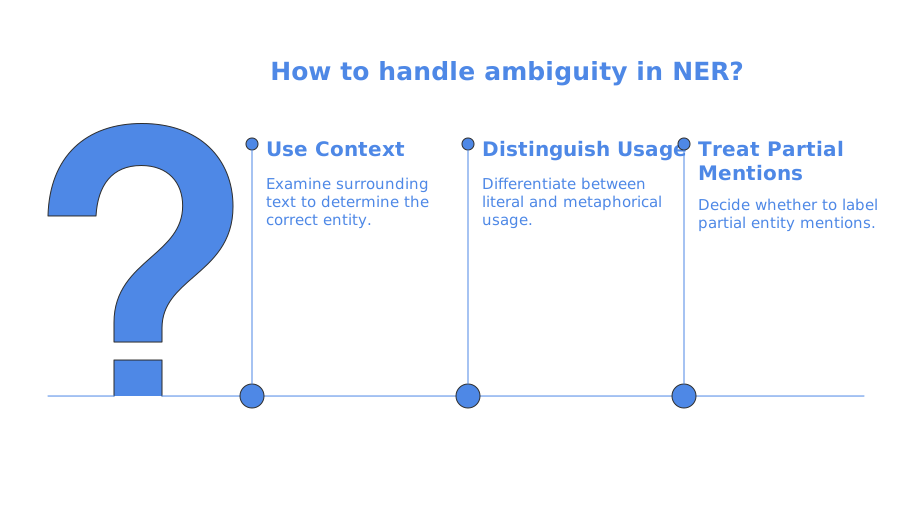
Ambiguity is common in NER because many terms refer to multiple possible entities. Annotators must rely on context to make correct decisions. An ambiguous mention like “Paris” could refer to a city, a person or a business depending on surrounding text. Teams must ensure annotators evaluate context fully before labeling. Ambiguous cases require examples, explanations and clear fallback rules to avoid interpretative inconsistency.
Using context to determine entity roles
Annotators should examine nearby sentences to interpret meaning rather than isolating a single mention. Context often provides the clues necessary for accurate classification. Documenting these cues helps annotators make consistent decisions. This improves model performance in ambiguous real-world situations.
Distinguishing between literal and metaphorical usage
Some phrases appear to reference entities but function metaphorically. Annotators must decide whether these expressions qualify as entities or remain untagged. Guidelines should include several metaphorical examples to reduce confusion. Correct differentiation helps models avoid tagging figurative language incorrectly.
Clarifying how to treat partial entity mentions
Partial mentions represent fragments of entities, such as last names or abbreviations. Annotators must know whether partial mentions should be labeled based on project requirements. Clear guidance prevents inconsistency when the same entity appears in full and partial form. This strengthens coherence across the dataset.
Building Annotation Guidelines for NER Projects
Annotation guidelines act as the reference framework that keeps NER interpretation stable. Without comprehensive guidelines, annotators apply personal judgment inconsistently, weakening the dataset. Guidelines should include definitions, examples, edge-case explanations and documentation of previous decisions. They should evolve as the project scales and reveal new patterns in the text.
Writing precise definitions for each category
Precise definitions help annotators understand which spans qualify within each category. These definitions must remain consistent across all documents. Detailed definitions help reduce uncertainty and strengthen label accuracy. Teams should refine these definitions as new examples emerge. This iterative improvement keeps the taxonomy usable.
Documenting examples and counterexamples
Examples help annotators understand how to apply labels in practice. Counterexamples demonstrate cases where labels should not be applied. Together, these resources create clear interpretative boundaries. Updating examples regularly prevents interpretation drift. They are essential for training new annotators efficiently.
Updating guidelines as the dataset expands
As annotators label more text, they discover new structures that require clarification. Guidelines must be updated to include these discoveries. Stable version control ensures all annotators use the latest rules. Updating guidelines helps maintain label consistency even as project complexity grows. This approach keeps interpretation aligned across the team.
Quality Control to Strengthen NER Dataset Consistency
Quality control prevents mislabeled examples from propagating across large datasets. Multi-annotator review, sampling and disagreement analysis help identify areas where interpretation diverges. Automated checks reveal structural issues such as overlapping spans or invalid categories. Combined together, these tools maintain a high standard of annotation.
Running multi-annotator review batches
Multiple annotators labeling the same sample reveals disagreements that highlight unclear rules. Analyzing these disagreements helps refine guidelines and training practices. This process supports ongoing improvement throughout the project. When disagreements decrease over time, dataset cohesion increases. These reviews contribute to stronger model performance.
Conducting structured sampling audits
Sampling a portion of the dataset for detailed review helps detect recurring issues. Reviewers can look for inconsistencies, unclear spans and ambiguous cases. Findings from sampling should feed into guideline updates. This loop strengthens annotation quality across the dataset. Sampling also builds confidence in long-term consistency.
Using automated validation tools
Automated checks detect errors such as overlapping spans or invalid labels that human reviewers may miss. These tools complement manual review by providing immediate feedback. They also help scale quality control as the dataset grows. When automated validation is integrated early, structural errors decrease significantly. This supports cleaner training data overall.
Integrating NER Datasets Into NLP Pipelines
Once NLP annotation is complete, teams must integrate the dataset into training, validation and evaluation pipelines. Clean splits prevent models from memorizing entity examples, while balanced representation ensures that all categories perform consistently. As the dataset evolves, its integration must remain organized to support retraining and fine-tuning cycles.
Preparing balanced category distributions
Some entity types appear more frequently than others. Balanced sampling helps maintain fair representation in training data. When classes are balanced, models avoid overfitting to dominant categories. Teams should monitor category distribution during annotation. Balanced datasets lead to stronger generalization.
Designing reliable evaluation sets
Evaluation sets must reflect the variety and complexity of the full dataset. These sets give developers a realistic understanding of model performance. Annotators should ensure evaluation labels are correct and consistent. Clear documentation improves reproducibility. Reliable evaluation sets support effective model tuning.
Supporting ongoing dataset refinement
NER datasets evolve as new documents and categories are introduced. Teams should integrate new examples without disrupting existing structure. Updated guidelines ensure that expansion remains coherent. Monitoring model performance across iterations helps detect areas needing additional annotation. This ongoing refinement keeps the dataset aligned with project goals.
If you are developing or scaling an NER dataset and want support with guidelines, annotation workflows or quality control, we can explore how DataVLab helps teams build precise and consistent training data for reliable entity recognition models.
What is Named entity recognition annotation?
This article explains how Named Entity Recognition annotation works, why boundary consistency matters and how annotation guidelines shape model accuracy. It explores span selection, entity definitions, nested structures, ambiguity resolution, quality control and dataset design. The article also presents best practices for training annotators, handling complex text and integrating NER datasets into broader NLP pipelines.
Why does NER annotation matter for Real-World NLP?
NER annotation transforms raw text into structured semantic information that models use to understand meaning. The task goes beyond simply tagging proper nouns because entity boundaries are not always obvious. If annotators disagree on where an entity begins and ends, the model receives conflicting signals that weaken its ability to perform reliably.
What is involved in defining entity categories before annotation starts?
Clear category definitions are essential for annotation teams because different domains require different entity types. General-purpose datasets may include categories such as Person, Organization and Location, while specialized corpora include domain-specific types such as Chemical, Disease or Product.
What is involved in building annotation guidelines for NER projects?
Annotation guidelines act as the reference framework that keeps NER interpretation stable. Without comprehensive guidelines, annotators apply personal judgment inconsistently, weakening the dataset. Guidelines should include definitions, examples, edge-case explanations and documentation of previous decisions.
How can teams ensure quality in Named entity recognition annotation?
Quality control prevents mislabeled examples from propagating across large datasets. Multi-annotator review, sampling and disagreement analysis help identify areas where interpretation diverges. Automated checks reveal structural issues such as overlapping spans or invalid categories.
What is involved in integrating NER datasets into NLP pipelines?
Once NLP annotation is complete, teams must integrate the dataset into training, validation and evaluation pipelines. Clean splits prevent models from memorizing entity examples, while balanced representation ensures that all categories perform consistently. As the dataset evolves, its integration must remain organized to support retraining and fine-tuning cycles.