Event Extraction Datasets: How to Annotate Triggers, Arguments and Relations for NLP
.jpeg)

This article explains how event extraction datasets are built and why precise trigger and argument annotation is essential for structured information retrieval. It covers event type definition, trigger selection, argument identification, guideline design, ambiguity management, multi-event structures and quality control. You will learn how consistent annotation improves downstream NLP tasks such as knowledge graph construction, timeline building and text understanding.
- This article explains how event extraction datasets are built and why precise trigger and argument annotation is essential for structured information retrieval.
- It covers event type definition, trigger selection, argument identification, guideline design, ambiguity management, multi-event structures and quality control.
- Research from the MIT CSAIL shows that high-quality trigger and argument annotation significantly improves performance in event-centric tasks.
- If triggers or arguments are mislabeled, the model misinterprets entire event structures, affecting downstream reasoning tasks.
Event extraction datasets teach NLP systems how to detect events, identify their triggers and understand the roles of involved entities. These datasets break text into structured representations of real-world actions, allowing models to interpret not just entities but also how those entities interact. Event extraction supports applications such as news analysis, fraud detection, biomedical intelligence and knowledge graph construction. Research from the MIT CSAIL shows that high-quality trigger and argument annotation significantly improves performance in event-centric tasks. Creating such datasets requires clear guidelines, strong linguistic intuition and consistent interpretation across annotators.
Why Event Extraction Annotation Matters
Event extraction transforms raw text into structured knowledge by identifying actions, participants, objects, causes and consequences. Models trained on these datasets can detect when something happens, who is involved and how the event unfolds. If triggers or arguments are mislabeled, the model misinterprets entire event structures, affecting downstream reasoning tasks. Resources from the OpenIE (Stanford / UW) emphasize that high-quality event annotation improves model generalization across diverse genres such as news, scientific literature and technical documents. Consistent annotation ensures that events remain interpretable, composable and useful for advanced NLP pipelines.
Defining Event Types Before Annotation Starts
Event types determine how annotators classify triggers and arguments. These definitions must be clear, mutually exclusive and aligned with project objectives. Common event types include movement, communication, conflict, business transactions and biological processes. Domain-specific datasets may include specialized categories for finance, biomedicine or cybersecurity. Clear definitions prevent ambiguous classification and help annotators distinguish between overlapping events.
Evaluating category granularity
Choosing how broad or narrow event types should be affects annotator difficulty and dataset coherence. Broad categories simplify labeling but may obscure important distinctions. Narrow categories capture more detail but increase complexity and disagreement. Pilot labeling helps determine the optimal granularity. Finding a balance ensures both clarity and usefulness for downstream models.
Defining event boundaries clearly
Event types must include rules explaining where an event begins and ends conceptually. Ambiguous boundaries lead to inconsistent trigger labeling. Guidelines should include examples illustrating edge cases, such as multi-stage events or background descriptions. Clear boundaries help annotators maintain stable interpretation across documents.
Including domain-specific event types
Certain domains require specialized event categories, such as molecular interactions in biomedical texts or market anomalies in financial reports. Annotators must understand how to treat domain-specific events to avoid misclassification. Documenting domain examples ensures accurate labeling. This practice strengthens model performance within specialized contexts.
Identifying Event Triggers Consistently
Event triggers are words or phrases that signal the occurrence of an event. Triggers may be verbs, nouns or adjectives, depending on grammatical structure. Annotators must identify which tokens act as triggers and differentiate them from descriptive or contextual terms. Incorrect trigger selection disrupts the entire event structure.
Distinguishing triggers from non-event cues
Some words appear to indicate events but do not actually represent meaningful actions. Annotators must learn to identify genuine triggers by understanding syntactic and semantic cues. Guidelines should include examples of false triggers to avoid mislabeling. Consistent trigger identification helps models detect event boundaries accurately.
Labeling multiword triggers
Some events are expressed through multiword expressions such as “took part in” or “was responsible for.” Annotators must determine how to treat these phrases and whether to label them as unified triggers. Multiword triggers improve model understanding when applied consistently. Examples in guidelines help clarifying interpretation.
Handling nominalized triggers
Events may be expressed through nouns such as “arrival,” “agreement” or “explosion.” Annotators must determine whether nominalized triggers should be labeled and how to treat their arguments. Including clear definitions helps ensure consistent handling across the dataset. These structures add depth to model understanding of abstract events.
Annotating Event Arguments and Their Roles
Arguments represent the participants, objects and contextual factors involved in an event. Annotators must detect each argument and assign it the correct role. Argument roles vary by event type but commonly include agent, target, instrument, location, time and cause. Inconsistent argument labeling reduces model ability to interpret event structure.
Identifying required and optional roles
Some events require specific arguments for completeness, while others include optional roles. Annotators must understand which roles are essential. Guidelines should provide examples that clarify role requirements. This prevents over-labeling or under-labeling. Accurate role assignment produces coherent argument structures.
Using context to determine argument type
Arguments often require contextual reasoning to interpret correctly. Annotators must examine how entities interact with the trigger to determine the appropriate role. Syntactic clues help clarify role boundaries. Documenting common role patterns improves annotation consistency across the dataset.
Treating implicit or inferred roles
Some arguments are implied rather than stated explicitly. Annotators must decide whether these roles should be included or omitted. Guidelines should explain how to treat inferred roles, especially in narrative texts. Consistent treatment strengthens conceptual coherence across documents.
Handling Events in Complex Text Structures
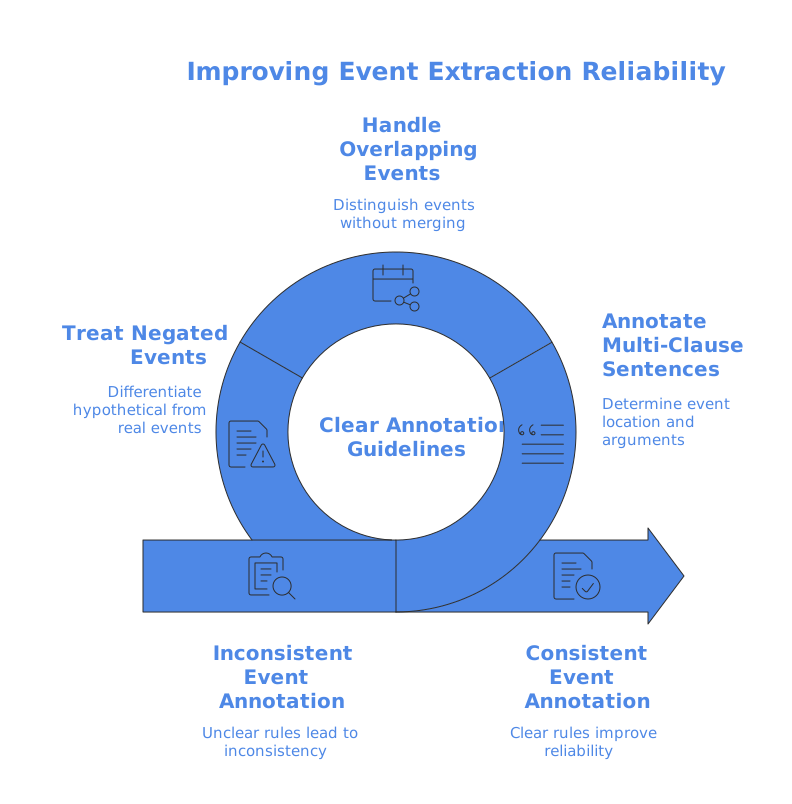
Complex text structures challenge both annotators and models. Event extraction requires careful reading of long sentences, embedded clauses and multi-event sequences. Without clear rules, annotation becomes inconsistent and the dataset loses structural reliability.
Annotating events in multi-clause sentences
Events often appear within subordinate or embedded clauses. Annotators must determine where each event is located and which arguments belong to it. This requires understanding clause structure and syntactic relations. Clear examples help annotators maintain consistent treatment across documents.
Handling overlapping or chained events
Sentences may describe multiple related events that share participants or causes. Annotators must distinguish each event without merging or fragmenting them incorrectly. Guidelines should describe how to treat event chains. Consistent annotation helps models learn relational reasoning across events.
Treating negated or hypothetical events
Some sentences describe events that did not occur or that remain hypothetical. Annotators must understand whether these should be labeled and how to differentiate them from real events. Documenting hypothetical cases prevents inconsistent interpretation. This improves downstream model reliability.
Creating Annotation Guidelines for Event Extraction
Event extraction guidelines must be detailed and accessible. They must explain event type definitions, argument roles, complex structures and examples of difficult cases. Strong guidelines reduce disagreement and accelerate annotation progress.
Defining event types with examples
Examples give annotators concrete illustrations of how events appear in context. They help distinguish between similar event types. Comprehensive examples support faster onboarding. Documentation must include both typical and rare cases.
Documenting trigger identification rules
Trigger identification requires clear criteria to prevent inconsistent labeling. Rules should describe how to treat verbs, nouns and multiword expressions. Annotators need explicit guidance to recognize non-standard triggers. This clarity reduces mislabeling across the dataset.
Recording decision logs for difficult cases
Annotation teams should document challenging cases and explain how they were resolved. These logs help prevent repeated confusion. They also strengthen guideline updates. This iterative approach supports long-term dataset stability.
Quality Control for Event Extraction Datasets
Quality control ensures that event annotation remains accurate and interpretable. Multi-annotator review, sampling audits and automated checks help maintain consistency across complex event structures.
Using multi-annotator comparison to detect inconsistencies
Comparing labels across annotators reveals disagreement patterns that indicate unclear rules. These insights help refine guidelines and improve training. Multi-annotator workflows create cleaner datasets. They also reduce long-term error rates.
Conducting deep sampling reviews
Sampling reviews allow experts to evaluate event structures across varied text types. Reviewers check trigger and argument accuracy and identify unclear edge cases. These insights feed directly into guideline updates. Sampling strengthens dataset reliability.
Running automated checks for structural issues
Automated validation can detect missing arguments, inconsistent event boundaries and invalid categories. These systems complement human review and increase scalability. Automated tools help identify systemic issues early. Combining automation with expert oversight creates the most robust datasets.
Integrating Event Extraction Datasets Into NLP Pipelines
Event extraction datasets must integrate into training and evaluation workflows for information extraction, summarization and reasoning models. Clean event structures improve model interpretability and downstream performance.
Preparing balanced event type distributions
Balanced event type representation prevents models from overfitting to frequent events. Teams must monitor distribution during annotation. Balanced datasets improve generalization across domains. This supports stronger model robustness.
Designing evaluation datasets with diverse event patterns
Evaluation sets should include both simple and complex events to test model resilience. Annotators must label evaluation examples with high precision. Documentation ensures reproducibility. Strong evaluation sets highlight areas for improvement.
Supporting long-term dataset expansion
Event extraction projects evolve as new sources and domains are added. Guidelines must support expansion without losing coherence. Teams should track how new examples affect model performance. Continuous refinement ensures lasting dataset quality.
If you are developing or expanding an event extraction dataset and want support with trigger design, argument labeling or quality workflows, we can explore how DataVLab helps teams build consistent and scalable event-based training data for advanced NLP systems.
What are Event extraction datasets?
This article explains how event extraction datasets are built and why precise trigger and argument annotation is essential for structured information retrieval. It covers event type definition, trigger selection, argument identification, guideline design, ambiguity management, multi-event structures and quality control.
Why does event extraction annotation matter?
Event extraction transforms raw text into structured knowledge by identifying actions, participants, objects, causes and consequences. Models trained on these datasets can detect when something happens, who is involved and how the event unfolds. If triggers or arguments are mislabeled, the model misinterprets entire event structures, affecting downstream reasoning tasks.
What does the section on “Identifying event triggers consistently” explain?
Event triggers are words or phrases that signal the occurrence of an event. Triggers may be verbs, nouns or adjectives, depending on grammatical structure. Annotators must identify which tokens act as triggers and differentiate them from descriptive or contextual terms.
What is involved in creating annotation guidelines for event extraction?
Event extraction guidelines must be detailed and accessible. They must explain event type definitions, argument roles, complex structures and examples of difficult cases. Strong guidelines reduce disagreement and accelerate annotation progress.
How can teams ensure quality in Event extraction datasets?
Quality control ensures that event annotation remains accurate and interpretable. Multi-annotator review, sampling audits and automated checks help maintain consistency across complex event structures. Comparing labels across annotators reveals disagreement patterns that indicate unclear rules.
What is involved in integrating event extraction datasets into NLP pipelines?
Event extraction datasets must integrate into training and evaluation workflows for information extraction, summarization and reasoning models. Clean event structures improve model interpretability and downstream performance. Balanced event type representation prevents models from overfitting to frequent events.