OCR + NLP Annotation: How Combined Labeling Improves Document AI Extraction
.jpeg)

This article explains how OCR and NLP annotation work together to turn scanned or photographed documents into high-quality structured data. It covers text extraction, semantic interpretation, entity consistency, ambiguity resolution, guideline design and quality control. You will also learn how hybrid OCR–NLP datasets improve downstream tasks such as document parsing, classification, entity extraction and enterprise automation.
- This article explains how OCR and NLP annotation work together to turn scanned or photographed documents into high-quality structured data.
- It covers text extraction, semantic interpretation, entity consistency, ambiguity resolution, guideline design and quality control.
- OCR extracts text from scanned documents, handwritten forms or photographed pages, while NLP annotation adds semantic structure by labeling entities, intents, relations and contextual clues inside the extracted text.
- Hybrid annotation requires guidelines that integrate OCR correction, text normalization and semantic labeling.
OCR and NLP annotation form a powerful combination for building robust Document AI systems. OCR extracts text from scanned documents, handwritten forms or photographed pages, while NLP annotation adds semantic structure by labeling entities, intents, relations and contextual clues inside the extracted text. When these two layers are aligned, models learn to interpret documents with greater accuracy and fewer errors. Research from the Stanford AI Lab shows that hybrid datasets outperform text-only datasets significantly in tasks involving complex document layouts. Creating a high-quality OCR–NLP dataset requires careful alignment, consistent annotation rules and detailed quality assurance.
Why OCR + NLP Hybrid Annotation Matters
Document AI systems rely on both accurate text extraction and correct semantic interpretation. Poor OCR output propagates errors into NLP models, while inconsistent NLP annotation makes extracted text harder to understand. Studies published on the ACL Anthology highlight that hybrid OCR–NLP datasets significantly reduce error rates in information extraction tasks compared to using OCR or NLP alone. Document structures such as receipts, contracts, invoices, forms and scanned letters require both layers of annotation to capture their full meaning. Combining OCR and NLP allows models to understand context, resolve ambiguities and interpret key entities reliably.
Annotating OCR Output With NLP Structure
After text has been extracted through OCR, annotators must label semantic elements such as names, dates, amounts, product descriptions or classification categories. The challenge lies in ensuring that OCR output is corrected and standardized before NLP annotation begins. Poorly extracted text leads to inconsistent semantics, so hybrid annotation workflows often include a post-OCR correction step.
Correcting OCR inconsistencies before labeling
OCR may misread characters, invert letters, merge tokens or break words incorrectly. Annotators must correct these issues so that downstream NLP models receive clean input. Teams should document common OCR errors and define how to handle unclear characters. Consistency in correction ensures stable NLP interpretation.
Aligning text normalization with semantic goals
Normalization involves handling case, punctuation, diacritics, abbreviations and spacing. Annotators must normalize text consistently to prevent semantic drift. Guidelines should explain how to treat domain-specific tokens such as reference codes or serial numbers. This standardization improves model reliability.
Handling noisy or low-resolution documents
Scanned documents often contain shadows, blurs or distortions. Annotators must decide how to treat illegible sections, partial words or missing characters. These decisions must remain consistent across the dataset. Documenting common noise patterns strengthens annotation stability.
Labeling Entities, Relations and Context in Extracted Text
Once OCR text is corrected, NLP annotation adds meaning. Entity labeling, relation extraction and contextual interpretation allow the model to understand how elements of a document relate to each other. This semantic layer is necessary for tasks such as classification, fraud detection, workflow automation or indexing.
Identifying key fields across document types
Different documents include domain-specific keywords that must be recognized consistently. Annotators must identify fields such as invoice numbers, totals, dates, parties involved or product lists. Clear examples help reduce ambiguity across similar field types. Accurate entity labeling improves downstream retrieval.
Detecting relations between entities
Document AI requires identifying relationships such as who issued an invoice or which amount corresponds to which item. Annotators must label relations consistently to avoid conflicting interpretations. Structured guidelines help maintain clarity in multi-entity environments.
Interpreting surrounding context
Certain entities require contextual reasoning to interpret correctly. For example, distinguishing between due dates and issue dates depends on nearby terms. Annotators must examine surrounding text to identify the correct label. This contextual understanding makes the dataset more semantically complete.
Handling Layout-Dependent Interpretation
Some documents depend heavily on layout. The structure of forms, tables or sections influences meaning. Even after OCR, spatial information must be preserved or reconstructed for accurate NLP interpretation.
Reconstructing reading order accurately
OCR may extract text in an incorrect order when documents contain columns or multi-section layouts. Annotators must correct reading order to maintain semantic integrity. Clear rules help prevent inconsistent interpretation.
Linking text to layout regions
Annotators may need to associate entities with specific layout zones such as headers, footers, signature areas or itemized fields. This hybrid annotation improves document understanding. It also helps models learn structural cues across document types.
Handling multi-column or irregular layouts
Documents such as newspapers, medical reports or customs forms often contain irregular structures. Annotators must identify how to treat text that diverges from standard left-to-right reading patterns. Proper handling prevents semantic misalignment.
Designing Hybrid Annotation Guidelines
Hybrid annotation requires guidelines that integrate OCR correction, text normalization and semantic labeling. These guidelines must be more detailed than simple surface-level annotation rules because they include multiple layers of interpretation.
Defining correction rules for OCR artifacts
Annotators must know which errors to correct manually and which to mark as uncertain. Documenting these rules prevents inconsistent correction. This improves dataset clarity and makes semantic labeling more stable.
Providing examples of domain-specific documents
Different industries require different annotation logic. For example, invoices, medical records and customs documents each contain unique structures. Including examples from each domain accelerates annotator learning. It also reduces error rates.
Updating guidelines as new document types appear
Hybrid datasets often expand over time. Guidelines must evolve to handle new layouts, token types or domain conventions. Version control ensures all annotators use the latest rules. This prevents long-term drift.
Quality Control in Hybrid OCR–NLP Datasets
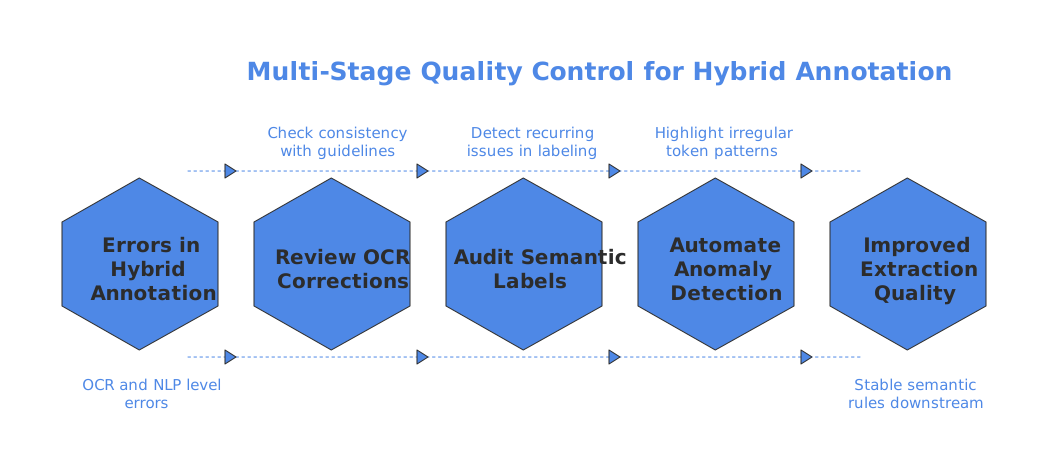
Hybrid annotation requires multi-stage quality control because errors can occur at both the OCR and NLP levels. Quality control must evaluate text correction, semantic labeling and structural interpretation.
Reviewing OCR corrections for consistency
Reviewers must check that annotators corrected OCR issues according to guidelines. Inconsistent correction leads to unpredictable NLP behavior. Structured review templates help maintain quality.
Auditing semantic labels across document samples
Sampling reviews allow experts to detect recurring issues in entity labeling or relation extraction. These audits reveal where guidelines need refinement. Stable semantic rules improve downstream extraction quality.
Using automated tools to detect token-level anomalies
Automated checks can highlight irregular token patterns, misplaced punctuation or suspicious character sequences. These tools speed up error detection. Combined with human review, automation increases reliability at scale.
Integrating Hybrid Datasets Into Document AI Pipelines
Once annotated, hybrid datasets must integrate into training pipelines for document classification, information extraction or workflow automation. Clean splits, stable distributions and metadata tracking support robust model training.
Maintaining balanced representation of document types
No single document type should dominate the dataset, or the model may overfit to that style. Balanced representation ensures generalization across domains. Teams must monitor distribution continuously.
Designing evaluation sets that mimic real-world noise
Evaluation sets should include low-quality scans, varied layouts and difficult edge cases. This reveals model weaknesses early. Annotating evaluation data with extra precision ensures reliable benchmarking.
Supporting iterative dataset expansion
As companies digitize more documents, new layouts and formats appear. Teams must integrate new examples while maintaining consistency. Iterative expansion keeps models aligned with evolving operational needs.
If you are building or refining a hybrid OCR–NLP dataset and want help with alignment, correction workflows or semantic annotation, we can explore how DataVLab supports teams developing accurate and scalable Document AI solutions.
How does Combined labeling improve Document AI extraction?
This article explains how OCR and NLP annotation work together to turn scanned or photographed documents into high-quality structured data. It covers text extraction, semantic interpretation, entity consistency, ambiguity resolution, guideline design and quality control. OCR and NLP annotation form a powerful combination for building robust Document AI systems.
Why does OCR + NLP hybrid annotation matter?
Document AI systems rely on both accurate text extraction and correct semantic interpretation. Poor OCR output propagates errors into NLP models, while inconsistent NLP annotation makes extracted text harder to understand. Studies published on the ACL Anthology highlight that hybrid OCR–NLP datasets significantly reduce error rates in information extraction tasks compared to using OCR or NLP alone.
What is involved in annotating OCR output with NLP structure?
After text has been extracted through OCR, annotators must label semantic elements such as names, dates, amounts, product descriptions or classification categories. The challenge lies in ensuring that OCR output is corrected and standardized before NLP annotation begins.
What does the section on “Labeling entities, relations and context in extracted text” explain?
Once OCR text is corrected, NLP annotation adds meaning. Entity labeling, relation extraction and contextual interpretation allow the model to understand how elements of a document relate to each other. This semantic layer is necessary for tasks such as classification, fraud detection, workflow automation or indexing.
What is involved in designing hybrid annotation guidelines?
Hybrid annotation requires guidelines that integrate OCR correction, text normalization and semantic labeling. These guidelines must be more detailed than simple surface-level annotation rules because they include multiple layers of interpretation. Annotators must know which errors to correct manually and which to mark as uncertain.
How can teams ensure quality in OCR + NLP annotation?
Hybrid annotation requires multi-stage quality control because errors can occur at both the OCR and NLP levels. Quality control must evaluate text correction, semantic labeling and structural interpretation. Reviewers must check that annotators corrected OCR issues according to guidelines.