Entity Linking Datasets: How to Annotate Mentions and Knowledge Base References
.jpeg)

This article explains how entity linking datasets are created and why they are essential for knowledge-aware NLP. It covers mention selection, disambiguation strategies, guideline design, ambiguity handling, quality control and integration into downstream tasks. You will learn how consistent entity linking annotation improves information retrieval, semantic search and AI reasoning.
- This article explains how entity linking datasets are created and why they are essential for knowledge-aware NLP.
- It covers mention selection, disambiguation strategies, guideline design, ambiguity handling, quality control and integration into downstream tasks.
- Entity linking annotation connects textual mentions to unique entries in a knowledge base, allowing NLP systems to interpret text with structured semantic grounding.
- Entity linking datasets support models used for semantic search, question answering, document classification and knowledge retrieval.
Entity linking annotation connects textual mentions to unique entries in a knowledge base, allowing NLP systems to interpret text with structured semantic grounding. Unlike named entity recognition, which focuses on identifying spans, entity linking requires deeper contextual reasoning because many mentions refer to entities with overlapping names or partial forms. Research published through the Google AI Entity Resolution shows that inconsistent linking is one of the biggest contributors to degraded performance in knowledge-intensive tasks. Building a high-quality entity linking dataset therefore requires careful disambiguation, strong guideline design and rigorous quality control.
Why Entity Linking Annotation Matters
Entity linking enables models to retrieve information, understand context and resolve references across documents. Applications such as semantic search, question answering and enterprise knowledge retrieval depend on accurate linking to avoid retrieving the wrong entity. When annotation is inconsistent or knowledge base entries are misused, downstream tasks suffer from cascading errors. Resources highlight the importance of consistent entity alignment for improving model reasoning. High-quality linking datasets allow models to associate mentions reliably with real-world entities and distinguish meaning across ambiguous references.
Detecting Mentions Before Linking Begins
Mention detection is the first step in entity linking. Annotators must identify all spans that correspond to entities referenced in the knowledge base. This includes surface forms, aliases, abbreviations and partial expressions. Incorrect detection leads to missing links or misaligned references. Annotators must distinguish between genuine entity mentions and incidental phrases that resemble entity names but have no referential meaning. Clear guidelines ensure consistent mention detection before linking.
Recognizing full and partial mentions
Entities often appear through shortened forms such as surnames, acronyms or product nicknames. Annotators must understand which partial forms qualify as valid mentions. Guidelines should provide examples demonstrating which cases require linking and which do not. This prevents inconsistent detection across the dataset. Accurate mention identification also improves the reliability of downstream disambiguation.
Distinguishing entities from descriptive language
Some phrases resemble entity names but serve descriptive or metaphorical purposes. Annotators must determine when a phrase refers to a real entity and when it functions as a stylistic expression. Including examples of both cases helps minimize confusion. These distinctions prevent models from learning incorrect associations. Consistent mention detection forms the foundation of clean linking.
Handling multiword mentions
Multiword entity names require precise boundary selection so that the correct span is associated with the knowledge base entry. Annotators must know whether modifiers, titles or qualifiers belong inside the mention. Examples help standardize decisions. Consistent multiword mention treatment improves model alignment to structured databases.
Disambiguating Entities With Context
Disambiguation is the core challenge of entity linking because many mentions refer to entities with identical or similar names. Annotators must examine context to determine the intended referent. This process demands careful reading, cross-reference checking and knowledge of how entities are represented in the database. Studies from IBM Research highlight how context-driven linking improves accuracy in enterprise applications.
Using document context to determine meaning
Annotators must consider nearby sentences and discourse context when selecting the correct entity. Contextual cues often include geographical information, professional roles or domain-specific references. Annotators should examine the entire relevant passage before making a linking decision. This prevents misinterpretation of ambiguous mentions. Consistent use of context strengthens linking reliability.
Comparing candidate entities in the knowledge base
Knowledge bases often contain many entities that share similar names. Annotators must compare attributes such as profession, location or domain to determine which entry matches the mention. This requires familiarity with the knowledge base and clear rules explaining which attributes are most important. Consistent attribute comparison reduces noise in linking decisions.
Resolving deeply ambiguous references
Some mentions remain ambiguous even after reviewing context. Guidelines must provide fallback rules, such as prioritizing the most likely entity or marking the mention as unknown. Documenting ambiguous cases helps annotators avoid contradictory decisions. Structured ambiguity handling ensures that the model learns reliable patterns rather than absorbing inconsistencies.
Aligning Mentions to the Knowledge Base
Once the correct referent is identified, annotators must assign the appropriate knowledge base identifier. The integrity of this step depends on how accurately the knowledge base is maintained and how clearly annotation teams interpret its entries. Misalignment results in incorrect associations that are difficult to correct after training.
Understanding entity attributes and metadata
Annotators must understand how knowledge base entries are structured, including descriptions, aliases, external references and categorical metadata. This helps ensure that the selected entity matches the mention precisely. Studying the metadata reduces the likelihood of incorrect linking. Well-documented databases support faster and more accurate annotation.
Navigating incomplete or outdated knowledge bases
Knowledge bases may lack certain entities or contain outdated information. Annotators must decide when to mark a mention as unknown rather than forcing a match. Guidelines should explain how to treat incomplete data. This prevents incorrect associations from entering the dataset. Maintaining links only to verified entries improves long-term dataset stability.
Linking entities consistently across documents
Annotators must apply the same linking logic across the entire dataset. If one annotator links a mention to a specific entry and another links it elsewhere, the dataset becomes inconsistent. Shared documentation and regular calibration sessions prevent this divergence. Consistent linking supports reliable model learning across varied text sources.
Designing Clear Annotation Guidelines
Annotation guidelines must explain how to detect mentions, resolve ambiguity and use the knowledge base. Entity linking guidelines need to address more complex reasoning than surface-level labeling tasks. They should provide examples of correct and incorrect linking decisions and describe how to evaluate attributes from the knowledge base.
Defining linking criteria precisely
Guidelines should specify whether linking is based on entity identity, shared attributes or domain relevance. This prevents annotators from using different criteria unintentionally. Clear linking criteria help reduce disagreement. These rules also improve model reproducibility.
Documenting decisions for edge cases
Ambiguous or unusual examples should be documented with explanations. This creates a growing reference that helps annotators maintain consistency over time. Documentation also facilitates onboarding for new team members. Maintaining a record of edge cases ensures that similar examples receive identical treatment.
Ensuring guidelines evolve with project needs
As annotation progresses, new patterns and ambiguities emerge. Guidelines must be updated regularly to address these discoveries. Version control ensures that every annotator works with the same information. This ongoing refinement improves dataset quality throughout the project.
Quality Control for Entity Linking Datasets
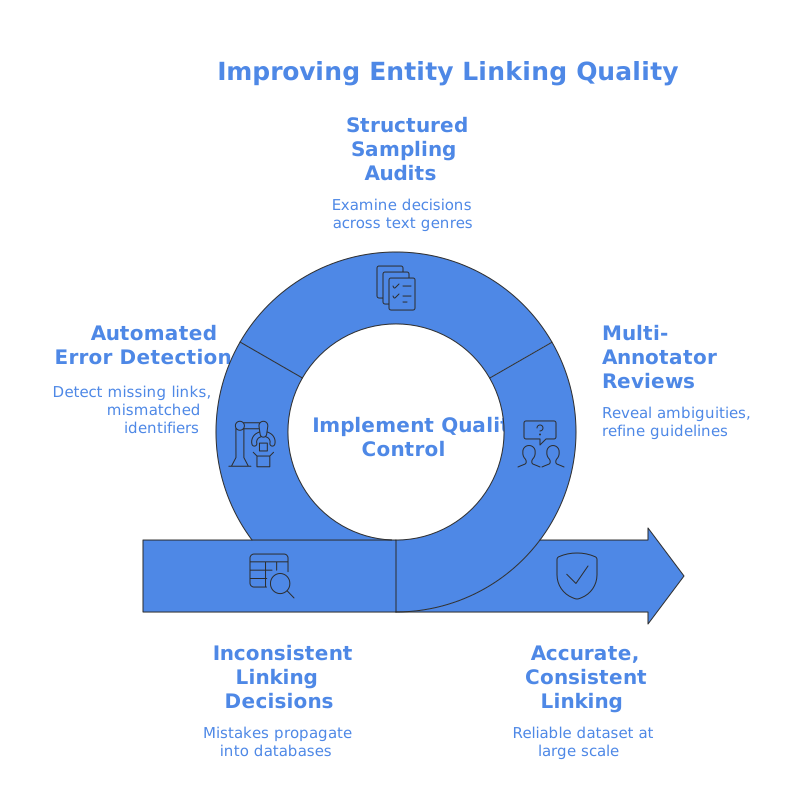
Quality control ensures that linking decisions remain accurate and consistent. Entity linking requires multiple layers of review because mistakes propagate into structured databases and knowledge retrieval tasks. Strong quality procedures maintain dataset reliability even at large scale.
Conducting multi-annotator linking reviews
Multiple annotators linking the same sample helps reveal hidden ambiguities and unclear rules. Reviewing disagreement patterns highlights areas where guidelines need refinement. Multi-annotator review also helps calibrate annotator intuition. This process strengthens long-term dataset consistency.
Running structured sampling audits
Sampling reviews allow teams to examine linking decisions across different text genres, domains and writing styles. Reviewers check that annotators select correct entries and interpret context consistently. These audits help identify recurring mistakes and guideline gaps. Sampling reviews contribute to cleaner and more stable datasets.
Using automated tools to detect linking errors
Automated validation can detect missing links, mismatched identifiers and inconsistent entity selections. These tools complement human review and help maintain accuracy at scale. Automated checks also accelerate feedback loops, allowing annotators to correct errors quickly. Combining automation with expert review yields the strongest results.
Integrating Entity Linking Datasets Into NLP Pipelines
Entity linking datasets support models used for semantic search, question answering, document classification and knowledge retrieval. To integrate smoothly, nlp datasets require careful structuring, balanced entity representation and robust validation. Teams must also monitor how new annotated text affects performance in downstream tasks.
Balancing entity representation across the dataset
Some entities appear frequently while others occur rarely. Balanced representation prevents models from overfitting to high-frequency entities and ignoring long-tail categories. Teams should track entity distribution during annotation. Balanced datasets support more robust entity disambiguation.
Designing evaluation datasets that reflect real-world ambiguity
Evaluation sets must include both clear and ambiguous mentions to test model resilience. Annotators should label evaluation data with strict consistency to maintain its reliability. Documenting evaluation design enhances reproducibility. Strong evaluation sets provide insights into model performance under challenging conditions.
Supporting iterative dataset expansion
As organizations update their knowledge bases or incorporate new domains, entity linking datasets must evolve. Guidelines should support expansion while preserving consistency across versions. Teams must monitor how new examples affect linking accuracy. Iterative refinement ensures that the dataset remains aligned with real-world requirements.
If you are creating or refining an entity linking dataset and want support with disambiguation strategy, knowledge base alignment or quality control, we can explore how DataVLab helps teams build reliable and scalable linking datasets for knowledge-aware NLP systems.
What are Entity linking datasets?
This article explains how entity linking datasets are created and why they are essential for knowledge-aware NLP. It covers mention selection, disambiguation strategies, guideline design, ambiguity handling, quality control and integration into downstream tasks. Entity linking annotation connects textual mentions to unique entries in a knowledge base, allowing NLP systems to interpret text with structured semantic grounding.
Why does entity linking annotation matter?
Entity linking enables models to retrieve information, understand context and resolve references across documents. Applications such as semantic search, question answering and enterprise knowledge retrieval depend on accurate linking to avoid retrieving the wrong entity. When annotation is inconsistent or knowledge base entries are misused, downstream tasks suffer from cascading errors.
What does the section on “Aligning mentions to the knowledge base” explain?
Once the correct referent is identified, annotators must assign the appropriate knowledge base identifier. The integrity of this step depends on how accurately the knowledge base is maintained and how clearly annotation teams interpret its entries.
What is involved in designing clear annotation guidelines?
Annotation guidelines must explain how to detect mentions, resolve ambiguity and use the knowledge base. Entity linking guidelines need to address more complex reasoning than surface-level labeling tasks. They should provide examples of correct and incorrect linking decisions and describe how to evaluate attributes from the knowledge base.
How can teams ensure quality in Entity linking datasets?
Quality control ensures that linking decisions remain accurate and consistent. Entity linking requires multiple layers of review because mistakes propagate into structured databases and knowledge retrieval tasks. Strong quality procedures maintain dataset reliability even at large scale.
What is involved in integrating entity linking datasets into NLP pipelines?
Entity linking datasets support models used for semantic search, question answering, document classification and knowledge retrieval. To integrate smoothly, nlp datasets require careful structuring, balanced entity representation and robust validation. Teams must also monitor how new annotated text affects performance in downstream tasks.