Chatbot Training Datasets: How to Annotate Multi-Turn Conversations for Reliable AI Assistants
.jpeg)
This article explains how chatbot training datasets are created and why annotation quality determines conversational accuracy, context retention and natural interaction. It explores multi-turn annotation, intent labeling, response modeling, ambiguity management, guideline design, sampling, error review and dataset structuring. You will also learn how annotated conversations improve the performance, consistency and reliability of advanced chatbots.
- This article explains how chatbot training datasets are created and why annotation quality determines conversational accuracy, context retention and natural interaction.
- It explores multi-turn annotation, intent labeling, response modeling, ambiguity management, guideline design, sampling, error review and dataset structuring.
- High-quality annotated conversations give models the structure they need to interpret intent, track multi-turn context and produce natural dialogue.
- Intent detection remains central to chatbot datasets, but multi-turn dialogue introduces additional complexity.
Chatbot training datasets shape how conversational AI systems understand user requests, maintain context and deliver coherent responses. High-quality annotated conversations give models the structure they need to interpret intent, track multi-turn context and produce natural dialogue. Studies increasingly show that inconsistent annotation and poorly structured conversation flows are among the leading causes of chatbot misinterpretation. Building a dependable chatbot dataset therefore requires careful design, clear guidelines and consistently annotated examples that reflect real user behavior.
Why Chatbot Training Annotation Matters
Chatbots must manage ambiguity, respond concisely and interpret incomplete or casual phrasing. Unlike single-turn intent classification, chatbot annotation must consider how user messages evolve across dialogue. Models trained on well-annotated datasets perform better in customer support, conversational search, onboarding workflows and interactive tasks. Resources from Rasa Conversational AI highlight that multi-turn examples with strong contextual grounding significantly improve conversational coherence. High-quality annotation teaches models how to extract meaning from context, choose suitable responses and follow multi-step instructions.
Designing Conversation Flows for Annotation
Before annotators label conversations, teams must design conversation structures that reflect realistic user behavior. These structures help define how the chatbot handles clarifications, misunderstandings and multi-step problem solving. A well-structured conversation flow guides annotators toward consistent labeling choices.
Determining permitted turn types
Conversations often contain greetings, clarifying questions, status updates and closing messages. Annotators must know which turn types to include and how to label them. Clear definitions reduce confusion in multi-turn labeling. Structuring these types helps models navigate conversation stages smoothly.
Modeling realistic user behavior
User queries vary in length, tone and clarity. Annotated examples must capture this diversity without becoming chaotic. Guidelines should specify how to represent hesitations, corrections or vague questions. Realistic modeling helps the chatbot handle real-world interactions with higher accuracy.
Including task-oriented and open-ended flows
Chatbots must handle both structured workflows and open conversation patterns. Annotators should include examples of both modes, explaining how to label transitions between them. Balanced representation strengthens the model’s versatility. It also prevents the chatbot from being overly rigid or overly informal.
Annotating User Intent Across Dialogue Turns
Intent detection remains central to chatbot datasets, but multi-turn dialogue introduces additional complexity. Annotators must interpret intent based on both the current message and preceding context. Inconsistent intent labeling leads to incorrect bot behavior during deployment.
Using previous turns to interpret intent
Intent often becomes clearer through context. Annotators must reference earlier messages to determine user goals accurately. Ignoring context introduces noise into the dataset. Consistent context-based interpretation helps models avoid misunderstandings.
Handling evolving or shifting intents
Users may change their goal during a conversation. Annotators must detect these shifts and label them precisely. Guidelines should describe when to update the active intent. This helps the model stay aligned with user expectations.
Distinguishing implicit from explicit intent
Many queries imply intention without stating it directly. Annotators must use domain knowledge and conversation flow to resolve these cases. Documented examples help maintain consistency. This clarity improves the model’s ability to interpret subtle language.
Annotating Bot Responses That Model Ideal Behavior
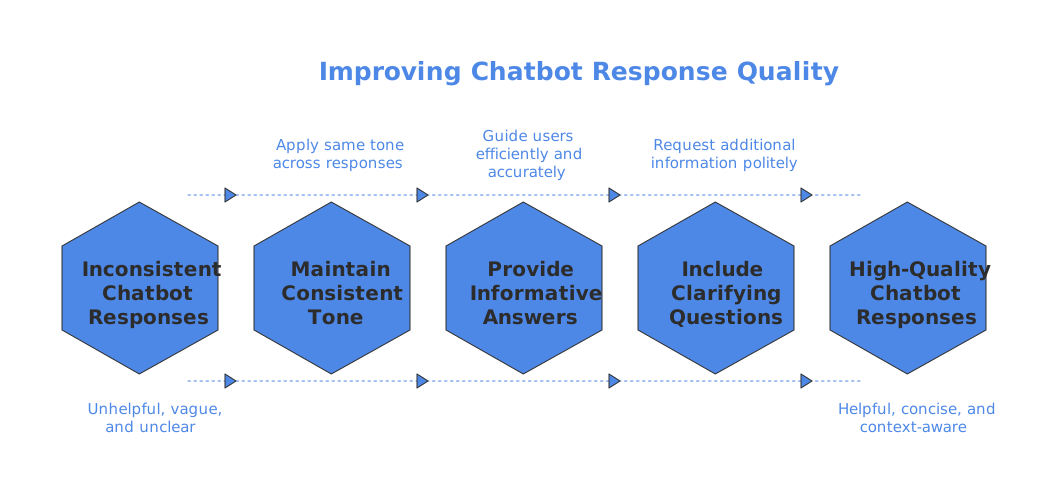
Chatbot responses serve as examples of how the AI should behave. Responses must be helpful, concise, context-aware and aligned with the desired communication style. Annotators must craft responses carefully to demonstrate ideal patterns for the model to learn.
Maintaining consistent tone and clarity
Chatbot tone influences user satisfaction. Annotators must apply the same tone across all responses, whether friendly, neutral or professional. This consistency gives the model a stable stylistic foundation. Clear responses reduce the risk of misinterpretation.
Providing informative and actionable answers
Responses should guide users efficiently while maintaining accuracy. Annotators must avoid vague answers and demonstrate clear, helpful reasoning. Well-structured responses help the model learn actionable communication. This improves chatbot reliability across tasks.
Including clarifying questions when needed
When a user query lacks context, annotators should include clarifying questions. These teach the model how to request additional information politely. Clarifying questions improve conversational flow. They also reduce incorrect assumptions.
Managing Ambiguity and Error Recovery
Chatbots must handle unclear messages, typos, contradictions and misunderstood queries. Annotators must include examples of how the chatbot recovers from ambiguity without frustration or confusion.
Treating ambiguous user messages
Users may send incomplete or contradictory requests. Annotators must demonstrate how the chatbot should respond politely and request clarification. Clear annotation prevents models from producing unsafe or incorrect answers. This improves model robustness.
Correcting misunderstandings in multi-turn dialogue
Miscommunication happens in conversations. Annotators should include examples where the chatbot acknowledges earlier confusion and corrects its response. This models more human-like interaction. It also reduces persistent error loops.
Handling irrelevant or off-topic requests
Chatbots must redirect conversations without breaking flow. Annotators should include natural redirection strategies and examples of how to return to the core topic. These examples teach models to manage unstructured input gracefully.
Creating Annotation Guidelines for Chatbot Datasets
Strong guidelines reduce disagreement, speed up annotation and ensure consistent dataset quality. Chatbot guidelines must address conversation flow, turn dependencies, tone, ambiguity management and safety.
Defining annotation policies for each turn type
Guidelines should specify how to annotate greetings, confirmations, clarifications and closing messages. This minimizes variation in interpretation. Annotators benefit from structured examples. Clear turn-type definitions improve dataset uniformity.
Documenting conversational personas and tone
Chatbots often follow a defined persona, such as supportive, neutral or friendly. Annotators must apply the persona consistently. Documenting tone and persona rules helps achieve coherent training examples. This increases model reliability.
Updating guidelines through conversation analysis
As annotation progresses, new conversational patterns emerge. Guidelines must evolve to address these patterns. Version control ensures annotators use the most recent rules. Updated guidelines maintain consistency during long-term projects.
Quality Control for Chatbot Training Data
Chatbot annotation requires rigorous review because errors in multi-turn dialogue propagate easily. Quality control must evaluate structure, interpretation and response quality across entire conversations.
Reviewing conversation coherence
Reviewers must check that responses align with user messages and that conversation flow remains logical. This reduces contradictory turns. Coherence checks strengthen the underlying logic. They improve downstream model behavior.
Using multi-annotator comparison for complex cases
Multi-turn interactions often produce interpretative disagreement. Comparing annotator work helps identify unclear rules. Multi-annotator review also uncovers hidden biases. These insights feed directly into guideline refinement.
Conducting sampling audits across conversation types
Sampling reviews allow experts to examine conversations spanning various task types and domains. This helps detect systemic errors. Structured audits maintain dataset stability over time. They also help teams detect stylistic drift.
Integrating Chatbot Datasets Into NLP Pipelines
Chatbot datasets support models in customer support, conversational search, onboarding and automated assistance. Integrating these datasets into pipelines requires balanced representation, structured splits and ongoing monitoring.
Structuring training, validation and test sets
Evaluation sets must include complex, ambiguous and multi-turn conversations to test model resilience. Annotators should ensure evaluation examples are especially precise. Balanced splits improve generalization. They also reveal performance gaps.
Monitoring distribution shifts in conversation types
As more conversations are annotated, distribution may shift toward certain task types. Teams must monitor these shifts to maintain dataset balance. Controlled distribution improves model robustness. It also prevents overfitting.
Supporting continuous dataset expansion
Chatbot datasets grow as new features are added or new domains are introduced. Guidelines must scale with these changes. Teams should assess how new examples affect model behavior. Continuous improvement strengthens the dataset over time.
If you are creating or refining a chatbot training dataset and want support with multi-turn annotation, guideline design or quality control, we can explore how DataVLab helps teams build reliable and production-ready conversation datasets for modern AI assistants.
What are Chatbot training datasets?
This article explains how chatbot training datasets are created and why annotation quality determines conversational accuracy, context retention and natural interaction. It explores multi-turn annotation, intent labeling, response modeling, ambiguity management, guideline design, sampling, error review and dataset structuring.
Why does chatbot training annotation matter?
Chatbots must manage ambiguity, respond concisely and interpret incomplete or casual phrasing. Unlike single-turn intent classification, chatbot annotation must consider how user messages evolve across dialogue. Models trained on well-annotated datasets perform better in customer support, conversational search, onboarding workflows and interactive tasks.
What is involved in annotating bot responses that model ideal behavior?
Chatbot responses serve as examples of how the AI should behave. Responses must be helpful, concise, context-aware and aligned with the desired communication style. Annotators must craft responses carefully to demonstrate ideal patterns for the model to learn.
What is involved in creating annotation guidelines for chatbot datasets?
Strong guidelines reduce disagreement, speed up annotation and ensure consistent dataset quality. Chatbot guidelines must address conversation flow, turn dependencies, tone, ambiguity management and safety. Guidelines should specify how to annotate greetings, confirmations, clarifications and closing messages.
How can teams ensure quality in Chatbot training datasets?
Chatbot annotation requires rigorous review because errors in multi-turn dialogue propagate easily. Quality control must evaluate structure, interpretation and response quality across entire conversations. Reviewers must check that responses align with user messages and that conversation flow remains logical.
What is involved in integrating chatbot datasets into NLP pipelines?
Chatbot datasets support models in customer support, conversational search, onboarding and automated assistance. Integrating these datasets into pipelines requires balanced representation, structured splits and ongoing monitoring. Evaluation sets must include complex, ambiguous and multi-turn conversations to test model resilience.