Semantic Role Labeling Datasets: How to Annotate Predicate–Argument Structures for NLP
.jpeg)

This article explains how semantic role labeling datasets are constructed and why accurate predicate–argument annotation is essential for natural language understanding. It covers predicate identification, argument role assignment, guideline design, ambiguity resolution, quality control and how SRL datasets integrate into NLP pipelines. You'll learn the workflows and best practices that ensure consistency and high-quality SRL annotation.
- This article explains how semantic role labeling datasets are constructed and why accurate predicate–argument annotation is essential for natural language understanding.
- It covers predicate identification, argument role assignment, guideline design, ambiguity resolution, quality control and how SRL datasets integrate into NLP pipelines.
- Semantic role labeling datasets give NLP systems the ability to understand how actions, events and relations unfold within sentences.
- Quality control ensures that SRL annotation remains consistent and accurate over time.
Semantic role labeling datasets give NLP systems the ability to understand how actions, events and relations unfold within sentences. While many tasks focus on identifying tokens or phrases, SRL annotation captures the full structure of who did what, to whom, when and how. These datasets are essential for summarization, information extraction, question answering and reasoning because they reveal the deeper semantics behind surface text. Research from Berkeley NLP FrameNet shows that SRL annotation quality strongly influences downstream model accuracy. Building a reliable SRL dataset therefore requires structured guidelines, linguistic rigor and consistent interpretation of complex syntactic patterns.
Why Semantic Role Labeling Annotation Matters for NLP
SRL annotation transforms raw sentences into structured event representations that models use to infer meaning. Each annotation links a predicate to its arguments, revealing the relationships that define the sentence’s logic. When annotation is inconsistent, models receive contradictory signals and fail to generalize across different writing styles. Studies from the University of Colorado PropBank highlight that errors in predicate identification or argument assignment significantly reduce model performance in tasks involving abstraction or reasoning. High-quality SRL datasets allow models to capture meaning beyond lexical patterns and develop a more stable understanding of linguistic structure.
Identifying Predicates With Precision
Predicate identification is the first step in SRL annotation. Annotators must determine which verbs or verbal nouns function as predicates and which serve as descriptive or auxiliary elements. This distinction shapes the entire structure of the annotated sentence. Incorrect predicate selection leads to misaligned arguments, weakening both training data and model reliability. Teams must also account for predicates expressed through multiword expressions or idiomatic phrases. Educational materials from the Stanford NLP Group demonstrate how predicate clarity determines SRL accuracy across corpora.
Differentiating true predicates from descriptive use
Some words appear in verb form without functioning as predicates, such as verbs used in set phrases or descriptive clauses. Annotators must learn to identify which instances carry semantic weight and which do not. Guidelines should include examples showing subtle differences between functional and non-functional uses. This prevents annotators from labeling unnecessary predicates. Accurate predicate selection stabilizes argument labeling throughout the dataset.
Annotating multiword predicates
Multiword predicates create ambiguity because meaning is distributed across multiple tokens. Annotators must treat such expressions as unified predicates when they convey a single conceptual action. Clear rules help ensure that all annotators identify the same span. Documenting these cases reduces disagreement and improves model learning. These decisions also support consistent treatment across long sentences.
Handling nominalized predicates
Some sentences express predicates through nouns derived from verbs. Annotators must decide whether the project requires labeling these nominalizations and how to define their argument structure. Nominal predicates add complexity but often improve model understanding of abstract events. Clear guidelines help annotators treat these structures consistently across the dataset.
Assigning Argument Roles Consistently
Argument labeling describes the relationships between entities and the predicate. Annotators assign roles such as agent, patient, instrument or experiencer based on the predicate’s meaning and syntactic structure. Consistent assignment is essential because argument roles reveal the underlying logic of the sentence. Poorly labeled arguments create confusion in training data and weaken the model’s ability to reason about events.
Understanding core and peripheral roles
Core roles are required for the predicate’s meaning, while peripheral roles provide optional context such as time or manner. Annotators must identify which roles are essential and how to treat contextual information. This prevents over-labeling and keeps argument structures coherent. Stable differentiation between core and peripheral roles strengthens model interpretation.
Using syntactic cues to resolve argument roles
Syntax provides important clues for determining argument roles, especially in complex sentences. Annotators should examine clause structure, verbal complements and modifier placement to choose the correct role. Guidelines should clarify how syntactic cues influence decisions. This reduces guesswork and ensures a consistent relationship between syntax and semantics.
Treating omitted or implicit arguments
Some sentences imply arguments that are not explicitly stated. Annotators must determine whether the project requires labeling implicit roles or ignoring them. If implicit roles are included, guidelines must offer clear criteria for when they apply. Consistent handling of implicit arguments improves the dataset’s conceptual coherence. These decisions also influence model generalization in conversational or informal text.
Handling Complex Sentence Structures
Complex sentences often contain embedded clauses, passive constructions or long-distance dependencies. Annotators must understand how predicates and arguments interact across these structures. Without clear rules, argument assignments become inconsistent and models fail to grasp deeper linguistic relationships. SRL annotation must therefore account for a wide range of grammatical variation.
Annotating passive voice constructions
Passive sentences shift focus from the agent to the patient, which complicates role assignment. Annotators must realign roles based on the underlying action rather than surface form. Guidelines should provide examples showing how to treat passives consistently. Correct handling ensures the model learns the true structure of events.
Managing subordinated and embedded clauses
Embedded clauses introduce nested relations that challenge argument clarity. Annotators must determine which predicate each argument belongs to and avoid misplacing roles across clauses. Documenting common embedded patterns helps reduce confusion. This clarity improves SRL quality across long or technical sentences.
Identifying long-distance dependencies
Some arguments appear far from the predicate they reference, which can lead to incorrect labeling. Annotators must examine the full sentence to locate the correct roles. Guidelines should highlight cues that signal long-distance relationships. Consistent treatment strengthens model understanding in texts with complex structure.
Designing SRL Annotation Guidelines
Well-designed guidelines ensure that annotators follow a shared interpretation strategy. SRL guidelines require more linguistic explanation than basic NLP tasks because argument structure depends on both grammar and semantics. Clear examples, counterexamples and decision trees improve annotator confidence and reduce disagreement.
Defining role inventories clearly
Role inventories must be explained with definitions, examples and typical contexts of use. This helps annotators avoid misclassifying similar roles. Consistent interpretation across the dataset improves model reasoning. Clear role inventories support long-term project scalability.
Documenting predicate behavior across domains
Different domains use predicates differently. Business, medical or legal texts contain complex predicate structures that require specialized examples. Documenting domain-specific patterns reduces error rates. This ensures the dataset reflects real-world usage accurately.
Updating guidelines through iterative review
As annotators encounter new sentence structures, guidelines must evolve to address them. Version control ensures that all annotators follow updated rules. Regular updates improve dataset stability and annotation speed. This process keeps interpretation aligned across the project.
Quality Control for SRL Datasets
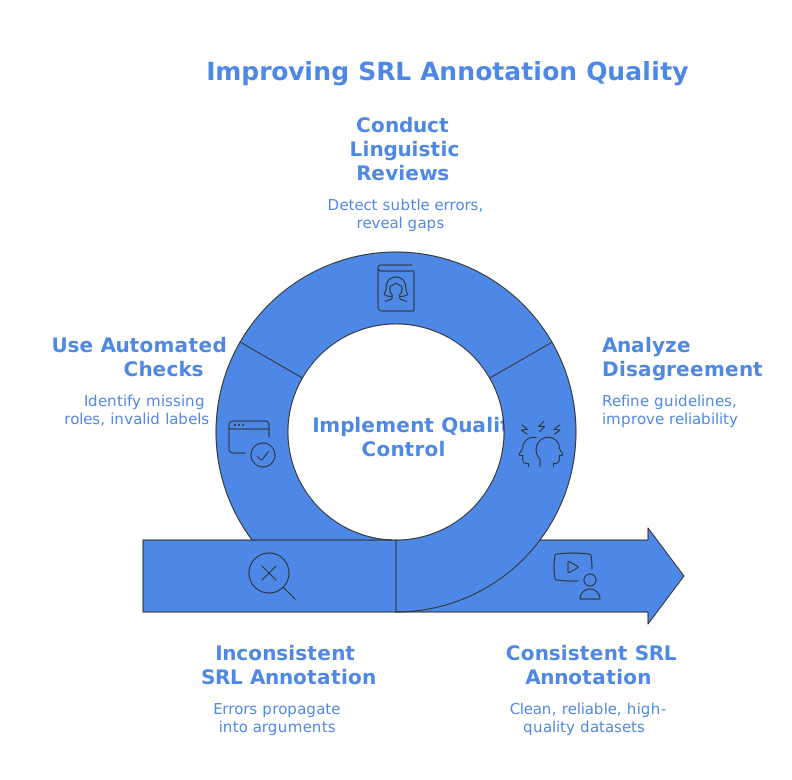
Quality control ensures that SRL annotation remains consistent and accurate over time. Multi-annotator comparisons, sampling procedures and automated tests support clean datasets. SRL quality control is particularly important because errors propagate into multiple argument levels.
Analyzing disagreement to refine guidelines
Disagreement signals unclear definitions or structural ambiguity. By analyzing disagreement patterns, teams can refine guidelines and improve annotation reliability. This process strengthens dataset consistency. Clearer roles and predicate rules lead to fewer future conflicts.
Conducting deep linguistic reviews
Periodic linguistic review helps detect subtle errors in predicate–argument structure. Reviewers examine longer or more complex sentences to check for misaligned roles. These reviews reveal gaps in guidelines and annotator training. Integrating findings ensures long-term dataset quality.
Using automated checks for structural errors
Automated systems can identify missing roles, invalid labels or contradictory argument assignments. These checks complement human review by detecting frequent structural issues. Automated validation accelerates error detection across large datasets. Combining automation with expert review yields the most reliable results.
Integrating SRL Datasets Into NLP Pipelines
SRL datasets must integrate into training, validation and production workflows. They support models used for question answering, summarization and reasoning tasks. To ensure stability, datasets require balanced representation, clear splits and robust documentation. Well-structured SRL data enables smooth fine-tuning and retraining.
Preparing balanced representations of role types
Some roles appear frequently while others occur rarely. Balanced representation ensures the model does not overfit common roles while ignoring important but rare ones. Monitoring role distribution during annotation helps maintain fairness. Balanced datasets support stronger generalization.
Designing evaluation sets that reflect linguistic diversity
Evaluation sets must include varied sentence structures, domains and linguistic patterns. Annotators should label evaluation data with extra care to ensure accuracy. Documenting evaluation design improves transparency and reproducibility. These sets reveal how well the model handles complex structures.
Supporting long-term dataset refinement
As new text sources are annotated, the dataset must adapt without losing consistency. Guidelines should support incremental expansion while preserving structural logic. Teams must monitor how new data affects model performance. Consistent refinement ensures that the dataset remains relevant and effective.
If you are preparing or refining an SRL dataset and want support with annotation design, role inventories or quality control, we can explore how DataVLab helps teams build reliable predicate–argument datasets for advanced language understanding.
What are Semantic role labeling datasets?
This article explains how semantic role labeling datasets are constructed and why accurate predicate–argument annotation is essential for natural language understanding. It covers predicate identification, argument role assignment, guideline design, ambiguity resolution, quality control and how SRL datasets integrate into NLP pipelines.
Why does semantic role labeling annotation matter for NLP?
SRL annotation transforms raw sentences into structured event representations that models use to infer meaning. Each annotation links a predicate to its arguments, revealing the relationships that define the sentence’s logic. When annotation is inconsistent, models receive contradictory signals and fail to generalize across different writing styles.
What does the section on “Assigning argument roles consistently” explain?
Argument labeling describes the relationships between entities and the predicate. Annotators assign roles such as agent, patient, instrument or experiencer based on the predicate’s meaning and syntactic structure. Consistent assignment is essential because argument roles reveal the underlying logic of the sentence.
What does the section on “Handling complex sentence structures” explain?
Complex sentences often contain embedded clauses, passive constructions or long-distance dependencies. Annotators must understand how predicates and arguments interact across these structures. Without clear rules, argument assignments become inconsistent and models fail to grasp deeper linguistic relationships.
What is involved in designing SRL annotation guidelines?
Well-designed guidelines ensure that annotators follow a shared interpretation strategy. SRL guidelines require more linguistic explanation than basic NLP tasks because argument structure depends on both grammar and semantics. Clear examples, counterexamples and decision trees improve annotator confidence and reduce disagreement.
How can teams ensure quality in Semantic role labeling datasets?
Quality control ensures that SRL annotation remains consistent and accurate over time. Multi-annotator comparisons, sampling procedures and automated tests support clean datasets. SRL quality control is particularly important because errors propagate into multiple argument levels.