LLM Annotation and Fine-Tuning: How High-Quality Data Shapes Model Behavior
.jpeg)

This article explains how annotation powers large language model fine-tuning and why carefully designed datasets determine performance, safety and reliability. It explores instruction writing, response annotation, safety labeling, quality control, taxonomy design and multi-phase workflows for building strong LLM datasets. You will also learn how annotation choices influence reasoning, factual consistency and model alignment in real applications.
- This article explains how annotation powers large language model fine-tuning and why carefully designed datasets determine performance, safety and reliability.
- It explores instruction writing, response annotation, safety labeling, quality control, taxonomy design and multi-phase workflows for building strong LLM datasets.
- Building high-quality fine-tuning data therefore requires precise instructions, consistent response annotation and strict quality control to avoid injecting noise.
- Instruction–response pairs form the core of most LLM fine-tuning datasets.
Large language models rely on annotated datasets to learn how to follow instructions, reason through tasks and produce safe, reliable output. Fine-tuning transforms a general-purpose model into a specialized assistant by exposing it to carefully curated examples that demonstrate preferred behavior. Research from the Stanford CRFM shows that LLM performance depends heavily on annotation clarity because the model absorbs patterns directly from the dataset. Building high-quality fine-tuning data therefore requires precise instructions, consistent response annotation and strict quality control to avoid injecting noise.
Why LLM Annotation Matters for Alignment and Reliability
LLMs mimic the patterns found in their training data, which means annotation defines how they behave in real-world scenarios. If instructions are ambiguous or responses contain errors, the model internalizes these flaws and replicates them. Studies highlight that high-quality training pairs improve reasoning accuracy, factual grounding and safety alignment more effectively than simply increasing dataset size. Well-structured examples teach the model not only what to answer but how to reason, when to refuse and how to maintain clarity across diverse contexts.
Designing Instruction–Response Pairs That Guide Model Behavior
Instruction–response pairs form the core of most LLM fine-tuning datasets. These pairs demonstrate how the model should interpret user queries and generate output. High-quality instructions are specific, unambiguous and contextually grounded, while responses model ideal behavior. Annotators must understand how to express requests clearly and provide answers that follow consistent style rules. Resources from OpenAI show that well-designed instructions significantly improve model consistency.
Writing instructions that reduce ambiguity
Ambiguous instructions force annotators to interpret meaning inconsistently, which introduces noise into the dataset. Clear instructions describe the task precisely and specify any constraints that affect the output. Annotators should avoid vague prompts and ensure each instruction aligns with a single intended behavior. This clarity teaches the model how to generalize without confusion.
Ensuring responses follow stylistic and structural rules
Responses must reflect the desired output style for the final model. Teams may define tone, length, formatting preferences or domain-specific conventions. Annotators must apply these rules consistently across all examples. When responses follow clear stylistic guidelines, models produce more predictable output in deployment.
Including reasoning steps when permitted
Some datasets require explicit chain-of-thought reasoning, while others require hidden reasoning. Guidelines must specify which approach is used. Including reasoning helps models learn structured problem-solving but must be applied consistently. Mixed approaches degrade reliability in downstream tasks.
Building Safety Annotations That Reinforce Responsible Behavior
Safety annotation plays a critical role in shaping how the model responds to harmful, sensitive or restricted prompts. Annotators must identify risk categories such as toxic content, dangerous instructions or sensitive personal information. Safety labels help the model refuse inappropriate requests or produce safe alternatives.
Labeling harmful or restricted requests
Annotators must classify prompts that violate safety policies and provide correct refusal responses. These labels teach the model how to set boundaries responsibly. Clear examples of safe refusals improve consistency across the dataset. This process helps prevent misuse in real-world applications.
Annotating sensitive content carefully
Models must be trained to handle sensitive topics such as health, law or personal identity with caution. Annotators should label these cases and demonstrate appropriate, non-directive responses. Consistent treatment of sensitive topics improves trustworthiness and reduces risk.
Documenting safety guidelines explicitly
Safety requirements must be communicated through detailed documentation. Annotators must understand where and how to apply safety-specific labels. Documenting edge cases helps maintain alignment across large teams. This careful annotation reduces variability in safety behavior.
Creating Multi-Turn LLM Conversations for Fine-Tuning
Multi-turn dialogue datasets teach the model how to follow conversational flow, maintain context and handle clarifications. These datasets require additional annotation because each turn depends on previous turns. Annotators must ensure logical coherence and maintain consistent narrative grounding.
Preserving context across turns
Models must understand how earlier messages influence later responses. Annotators should reference previous turns explicitly and ensure continuity. This prevents fragmented or contradictory conversations. Strong multi-turn examples improve long-context reasoning.
Modeling natural conversation patterns
Multi-turn datasets should include clarifications, follow-up questions and gentle redirections. These patterns help models behave more naturally. Annotators must maintain the chosen communication style consistently. This improves model interaction quality.
Avoiding contradictory or circular responses
Multi-turn annotation requires careful review to detect contradictions introduced across turns. Annotators must ensure that each turn advances the conversation coherently. Eliminating circular logic strengthens the model’s ability to track dialogue.
Structuring Datasets for Stability and Generalization
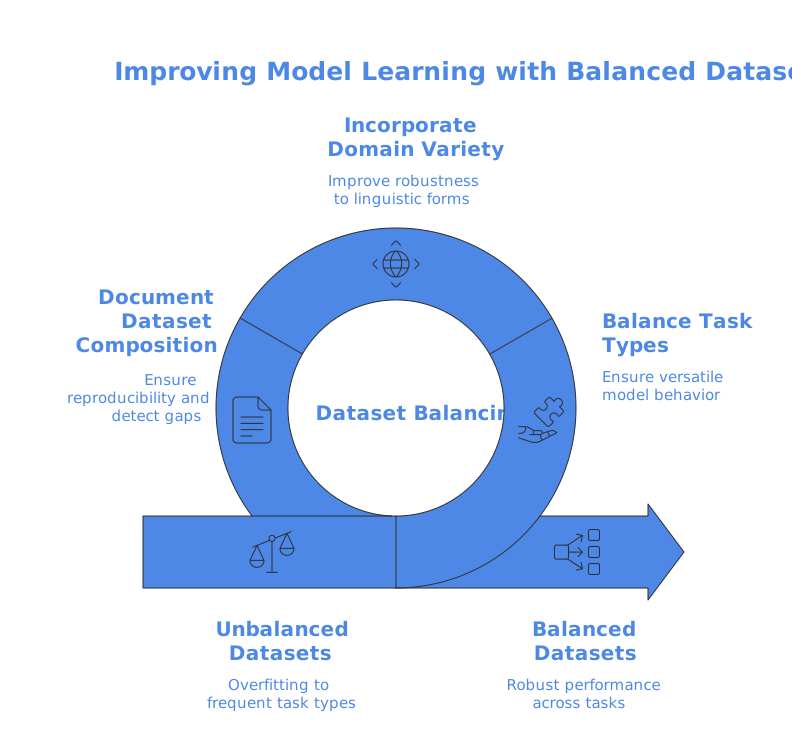
Dataset structure influences how models learn. Fine-tuning data should reflect the full range of tasks and domains the model will encounter. Balanced representation prevents overfitting to frequent task types and ensures robust performance.
Balancing across task types
Datasets often include summarization, classification, reasoning, rewriting and dialogue. Balanced task coverage ensures models learn versatile behavior. Annotators should track task distribution during dataset creation. Balanced datasets generalize more reliably.
Incorporating domain variety
Domain diversity exposes the model to different linguistic forms, improving robustness. Annotators should include examples from multiple sectors such as finance, healthcare, general knowledge and technical writing. This diversity reduces failure cases in specialized applications.
Documenting dataset composition
A clear record of dataset structure helps ensure reproducibility and simplifies future expansion. Documentation also helps detect overrepresentation or gaps. Well-documented datasets improve long-term project stability.
Quality Control for LLM Annotation Projects
High-quality fine-tuning requires rigorous review because small errors can propagate widely during training. Quality control combines multi-annotator checks, guideline refinement and error analysis to maintain dataset integrity.
Conducting multi-annotator review
Reviewing examples across annotators highlights inconsistent interpretations. Disagreement analysis guides guideline updates and improves annotator alignment. Multi-annotator review is essential for scaling high-precision datasets.
Running deep sampling evaluations
Sampling allows expert reviewers to examine instruction quality, response correctness and safety labeling. These evaluations uncover subtle issues that automated tools may miss. Findings from sampling feed into iterative refinement.
Using automated checks for structural consistency
Automated validation can detect formatting errors, missing metadata or incomplete instruction–response pairs. These checks scale efficiently across large datasets. Combining automation with expert review yields stronger results.
Integrating Fine-Tuning Data Into LLM Training Pipelines
Fine-tuning datasets must integrate cleanly with training processes. Structured splits, balanced task types and accurate metadata support predictable model behavior. Teams must also monitor model performance as new data is added.
Designing robust training, validation and test splits
Evaluation sets must represent the full variety of tasks to measure generalization. Annotators should label evaluation data with extra precision. These splits help identify overfitting and support iterative improvements.
Monitoring distribution shifts
As datasets evolve, teams must track shifts in task type frequency, domain coverage and safety categories. Unbalanced shifts can change model behavior unexpectedly. Monitoring these patterns ensures stable performance.
Supporting continuous dataset expansion
LLM datasets grow alongside organizational needs. Guidelines must support expansion without drifting from core design principles. Regular refinement helps maintain alignment across new data additions.
If you are developing an LLM fine-tuning dataset and want support with instruction design, safety labeling or multi-phase annotation workflows, we can explore how DataVLab helps teams build high-quality, scalable datasets for advanced language models.
What is LLM annotation and Fine-Tuning?
This article explains how annotation powers large language model fine-tuning and why carefully designed datasets determine performance, safety and reliability. It explores instruction writing, response annotation, safety labeling, quality control, taxonomy design and multi-phase workflows for building strong LLM datasets.
Why does LLM annotation matter for alignment and reliability?
LLMs mimic the patterns found in their training data, which means annotation defines how they behave in real-world scenarios. If instructions are ambiguous or responses contain errors, the model internalizes these flaws and replicates them. Studies highlight that high-quality training pairs improve reasoning accuracy, factual grounding and safety alignment more effectively than simply increasing dataset size.
What is involved in designing Instruction–Response pairs that guide model behavior?
Instruction–response pairs form the core of most LLM fine-tuning datasets. These pairs demonstrate how the model should interpret user queries and generate output. High-quality instructions are specific, unambiguous and contextually grounded, while responses model ideal behavior.
What is involved in creating Multi-Turn LLM conversations for Fine-Tuning?
Multi-turn dialogue datasets teach the model how to follow conversational flow, maintain context and handle clarifications. These datasets require additional annotation because each turn depends on previous turns. Annotators must ensure logical coherence and maintain consistent narrative grounding.
How can teams ensure quality in LLM annotation and Fine-Tuning?
High-quality fine-tuning requires rigorous review because small errors can propagate widely during training. Quality control combines multi-annotator checks, guideline refinement and error analysis to maintain dataset integrity. Disagreement analysis guides guideline updates and improves annotator alignment.
What is involved in integrating Fine-Tuning data into LLM training pipelines?
Fine-tuning datasets must integrate cleanly with training processes. Structured splits, balanced task types and accurate metadata support predictable model behavior. Teams must also monitor model performance as new data is added.