Text Classification Datasets: How to Annotate Categories for Accurate NLP Models
.jpeg)

This article explains how text classification datasets are annotated and why clear category definitions, consistent labeling and strong quality control are essential for high-performing NLP models. It covers taxonomy design, label application, ambiguity resolution, guideline writing, sampling, multi-label workflows and dataset integration. You will learn how accurate annotation directly impacts model generalization and real-world reliability.
- This article explains how text classification datasets are annotated and why clear category definitions, consistent labeling and strong quality control are essential for high-performing NLP models.
- It covers taxonomy design, label application, ambiguity resolution, guideline writing, sampling, multi-label workflows and dataset integration.
- High-quality annotation requires clear taxonomy design, consistent category application and strong guideline support.
- Consistent labeling ensures that models learn strong boundaries between categories, which improves generalization, reduces hallucination and prevents misclassification in real applications such as customer support automation or enterprise search.
Text classification datasets form the backbone of many NLP systems, from email filtering to sentiment analysis and document sorting. These datasets assign categories to text samples so that models learn to recognize patterns and classify new content accurately. High-quality annotation requires clear taxonomy design, consistent category application and strong guideline support. Research from the University of Illinois NLP Resources shows that classification performance is highly sensitive to labeling noise, making consistency one of the most important factors in dataset quality. Well-structured classification datasets help models understand intent, tone, topic or functional purpose across various text types.
Why Text Classification Annotation Matters
Classification models learn from the examples they are given. If annotators apply categories inconsistently or if taxonomy definitions are unclear, the model absorbs these inconsistencies and produces unreliable predictions. Studies published on the arXiv Topic Classification Benchmarks indicate that classification accuracy drops sharply when datasets contain disagreement that guidelines could have prevented. Consistent labeling ensures that models learn strong boundaries between categories, which improves generalization, reduces hallucination and prevents misclassification in real applications such as customer support automation or enterprise search.
Designing a Classification Taxonomy Before Annotation
A well-designed taxonomy provides the structure annotators need to label text consistently. Categories should be mutually exclusive, meaningful and aligned with the project’s objectives. The taxonomy must also account for domain-specific nuances that influence category interpretation. Taxonomy clarity prevents confusion, reduces disagreement and accelerates annotation.
Determining category granularity
Granularity determines how specific categories are. Fine-grained taxonomies capture detailed distinctions but increase annotation difficulty. Coarse-grained taxonomies are easier to apply but may oversimplify content. Pilot runs help determine the right balance. When teams calibrate granularity correctly, annotators perform labeling with greater confidence.
Avoiding overlapping category boundaries
Categories must not overlap, or annotators will struggle to choose between them. Guidelines must highlight the specific features that distinguish categories. Examples and counterexamples support intuitive pattern recognition. Clear separation reduces labeling noise and improves model training stability.
Including domain-specific categories
Some projects require specialized categories such as legal domain classification, medical triage categories or financial topic segmentation. Including domain-specific examples helps annotators interpret complex cases consistently. They also allow models to learn content-specific cues with greater precision.
Applying Categories to Text Consistently
Annotators must decide which category best matches each text sample. Consistent application ensures that the model learns correct patterns rather than relying on coincidental associations. Annotators must understand both category intent and linguistic structure to apply labels accurately.
Using semantic cues to identify category boundaries
Annotators must interpret meaning and tone rather than focusing solely on keywords. This prevents superficial labeling and strengthens model generalization. Guidelines with examples help annotators recognize semantic signals that define each category. This leads to more accurate annotation.
Handling incomplete or ambiguous samples
Text samples may be vague, contradictory or too short to classify easily. Annotators must follow documented rules for handling such cases, including fallback categories or “uncertain” flags when applicable. Careful treatment of ambiguity prevents annotators from improvising inconsistent solutions.
Treating multi-topic text with consistent logic
Some samples contain overlapping themes. Annotators must understand which theme dominates and how to resolve mixed-content cases. Guidelines should include examples of multi-topic decisions. Consistent handling of overlap prevents category drift.
Working With Multi-Label Classification
Many modern NLP systems require multi-label classification where a text can belong to multiple categories at once. Annotators must apply labels carefully to preserve logical combinations.
Defining allowed label combinations
Not all categories are compatible in multi-label settings. Guidelines should specify permitted and disallowed combinations. Clearly documented rules reduce incorrect tagging. This improves model learning during training.
Ensuring annotators apply all relevant labels
Annotators must identify every category that applies, not just the most obvious one. They need training to detect secondary or subtle themes. Comprehensive labeling strengthens the model’s ability to interpret complex content.
Avoiding excessive label assignment
Over-labeling reduces clarity and usability. Annotators must know how to balance completeness with precision. Examples of correct restraint help maintain label quality across large datasets.
Designing Annotation Guidelines for Text Classification
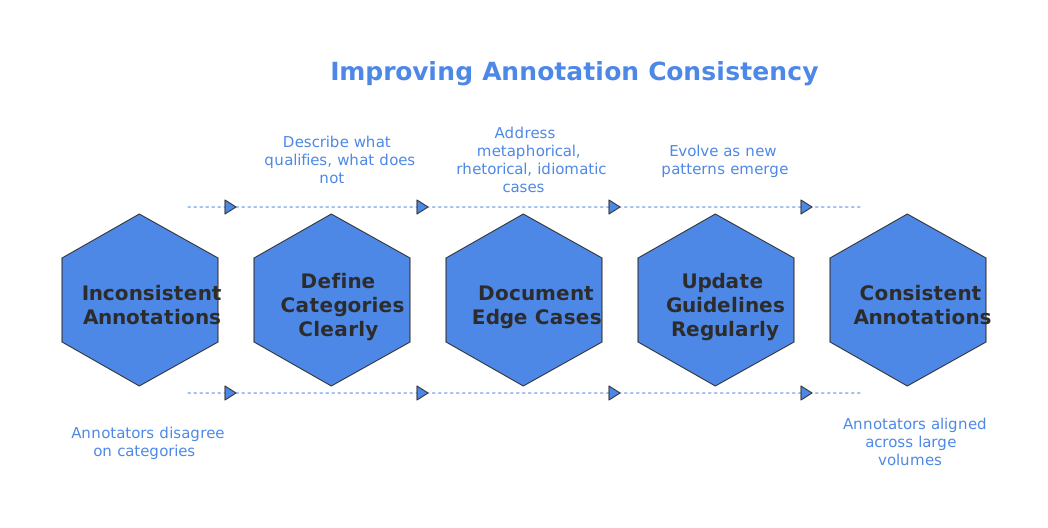
Guidelines help annotators stay aligned across large volumes of text. They must define categories clearly, document examples and provide rules for handling ambiguous or multi-topic cases.
Writing clear definitions for each category
Definitions should describe what qualifies and what does not. Good definitions include characteristic phrases, topics and structural cues. Annotators rely on these definitions to maintain consistency.
Documenting frequent edge cases
Edge cases such as metaphorical phrasing, rhetorical questions or idiomatic expressions must be addressed. Documenting how each case should be treated reduces disagreement. This guidance improves dataset quality.
Updating guidelines as patterns emerge
Annotation guidelines must evolve as annotators encounter new linguistic patterns. Version control ensures all annotators work from the same rules. Updating guidelines improves the dataset’s long-term integrity.
Quality Control for Text Classification Datasets
Quality control ensures that categories remain consistent across annotators and across time. Without strong quality measures, classification noise quickly accumulates.
Running multi-annotator comparison
Comparing labels from multiple annotators reveals unclear categories or misunderstood rules. These comparisons highlight areas where guidelines require refinement. Multi-annotator workflows lead to cleaner and more reliable datasets.
Conducting sampling audits
Reviewing random samples reveals recurring issues in labeling logic, category application or guideline adherence. Sampling audits ensure consistency and reduce long-term errors. These audits support continuous improvement.
Using automated checks to detect anomalies
Automated tools can flag out-of-distribution categories, inconsistent label formats or missing metadata. These checks do not replace expert review but accelerate the detection of structural issues. Together, automation and expert oversight improve dataset stability.
Integrating Text Classification Datasets Into NLP Pipelines
Classification datasets must integrate seamlessly into training workflows. Proper structuring, balanced categories and high-quality splits support robust and reliable model development.
Structuring training, validation and test sets
Evaluation sets must reflect the full range of category difficulty and content types. Annotators should apply labels with extra precision in these sets. Consistent splits support performance measurement and iterative tuning.
Ensuring category balance
Highly imbalanced datasets cause models to overfit dominant categories. Teams must track distribution throughout annotation. Balanced datasets strengthen generalization and reduce biased predictions.
Supporting continuous dataset expansion
As classification needs evolve, new categories may be added. Teams must integrate new data without disrupting consistency. Updated guidelines and regular calibration sessions maintain alignment across versions.
If you are preparing or refining a text classification dataset and want support with taxonomy design, annotation structure or quality control, we can explore how DataVLab helps teams build accurate and scalable classification datasets for real-world NLP applications.
What are Text classification datasets?
This article explains how text classification datasets are annotated and why clear category definitions, consistent labeling and strong quality control are essential for high-performing NLP models. It covers taxonomy design, label application, ambiguity resolution, guideline writing, sampling, multi-label workflows and dataset integration.
Why does text classification annotation matter?
Classification models learn from the examples they are given. If annotators apply categories inconsistently or if taxonomy definitions are unclear, the model absorbs these inconsistencies and produces unreliable predictions. Studies published on the arXiv Topic Classification Benchmarks indicate that classification accuracy drops sharply when datasets contain disagreement that guidelines could have prevented.
What does the section on “Applying categories to text consistently” explain?
Annotators must decide which category best matches each text sample. Consistent application ensures that the model learns correct patterns rather than relying on coincidental associations. Annotators must understand both category intent and linguistic structure to apply labels accurately.
What is involved in designing annotation guidelines for text classification?
Guidelines help annotators stay aligned across large volumes of text. They must define categories clearly, document examples and provide rules for handling ambiguous or multi-topic cases. Definitions should describe what qualifies and what does not.
How can teams ensure quality in Text classification datasets?
Quality control ensures that categories remain consistent across annotators and across time. Without strong quality measures, classification noise quickly accumulates. Comparing labels from multiple annotators reveals unclear categories or misunderstood rules.
What is involved in integrating text classification datasets into NLP pipelines?
Classification datasets must integrate seamlessly into training workflows. Proper structuring, balanced categories and high-quality splits support robust and reliable model development. Evaluation sets must reflect the full range of category difficulty and content types.