Intent Detection Datasets: How to Annotate Queries for Accurate NLP Classification
.jpeg)

This article explains how intent detection datasets are created, why annotation consistency matters and how taxonomy design influences model accuracy. It covers paraphrase variation, ambiguous intent resolution, labeling workflows, quality control, dataset structuring and best practices for building dependable intent classifiers. You will also find guidance on training annotators, refining categories and integrating intent datasets into real-world NLP pipelines.
- This article explains how intent detection datasets are created, why annotation consistency matters and how taxonomy design influences model accuracy.
- It covers paraphrase variation, ambiguous intent resolution, labeling workflows, quality control, dataset structuring and best practices for building dependable intent classifiers.
- Research from the Microsoft Research Conversational AI shows that intent classification accuracy drops sharply when annotators interpret similar queries differently.
- Building a strong dataset therefore requires clear intent definitions, strong paraphrase coverage and structured workflows that eliminate ambiguity before training begins.
Intent detection datasets give NLP systems the ability to understand what a user wants, regardless of how the request is phrased. High-quality annotation is essential because the same intention can appear through hundreds of different linguistic forms, and only consistent labeling teaches models to capture meaning rather than surface-level patterns. Research from the Microsoft Research Conversational AI shows that intent classification accuracy drops sharply when annotators interpret similar queries differently. Building a strong dataset therefore requires clear intent definitions, strong paraphrase coverage and structured workflows that eliminate ambiguity before training begins.
Why Intent Detection Annotation Matters
Intent detection models power chatbots, customer support automation, conversational search and voice assistants. These systems must interpret meaning from short, informal and sometimes incomplete queries, which makes training data crucial. If annotators apply categories inconsistently, the model learns unclear boundaries and produces unpredictable classifications. Studies published on the PapersWithCode Intent Detection Benchmarks highlight that unclear intent taxonomies are a common reason for misclassification in production systems. Clean annotation gives the model stable semantic cues and allows it to generalize across different writing styles and user behaviors.
Designing Intent Taxonomies Before Annotation Begins
A successful intent dataset starts with a taxonomy that clearly defines each intent category. Categories must be meaningful, mutually exclusive and distinct enough to avoid confusion. A well-designed taxonomy reflects how real users express their needs and prevents annotators from mixing overlapping interpretations. Teams often begin with broad categories and refine them through pilot batches to discover where additional clarity or category restructuring is needed. Resources such as the Hugging Face NLP course illustrate how taxonomy design influences linguistic consistency in downstream tasks.
Ensuring categories are easy to apply
Annotators must be able to choose the correct label quickly and confidently. If categories require complex interpretation, disagreement increases, and the dataset becomes noisier. Categories must be defined with examples that reflect both typical and unusual user queries. This clarity reduces ambiguity and speeds up annotation. Over time, teams can adjust category descriptions as new patterns arise.
Avoiding overlapping intent boundaries
Overlapping categories are a frequent cause of low model accuracy. When two intents appear similar, annotators may choose labels inconsistently. Guidelines should include clear rules that explain how to differentiate between categories that share semantic proximity. Removing or restructuring overlapping categories improves overall dataset coherence. This clarity is essential for reliable classification.
Testing taxonomy through pilot labeling
Before full-scale annotation begins, a pilot dataset allows teams to identify confusing categories or unclear definitions. Annotators can highlight ambiguous queries, and guidelines can be refined accordingly. Pilot testing also reveals whether the taxonomy captures the full spectrum of user needs. Feedback from this phase helps build a taxonomy that is both practical and precise.
Annotating User Queries with Consistency
Query labeling is central to intent detection. Annotators must determine what the user is trying to achieve, even if the query is vague or grammatically incomplete. Consistent labeling requires training, clear examples and well-defined boundaries. Annotators should focus on meaning rather than specific words, ensuring the model learns generalizable patterns.
Interpreting meaning rather than keywords
Users often express the same intention using entirely different vocabulary. Annotators must learn to look beyond keywords and examine the underlying meaning. This requires understanding synonyms, context and conversational cues. Encouraging annotators to analyze meaning reduces noise and improves the model's ability to handle unfamiliar phrasing.
Handling short or incomplete queries
Short queries such as “cancel” or “status?” require contextual imagination because they lack explicit structure. Guidelines should explain how to treat these minimal expressions by linking them to the most probable intent category. When annotators follow consistent rules for terse queries, the dataset remains coherent. This consistency enables models to perform well in real-world chat environments.
Clarifying ambiguous instructions
Some queries contain multiple possible interpretations. Annotators must rely on rules that define how to resolve ambiguity or assign fallback labels. Documenting these rules prevents inconsistent classification. When ambiguity resolution is well defined, annotators apply the same reasoning across the dataset. This leads to stronger model performance.
Building Paraphrase Coverage to Improve Model Generalization
High-quality intent detection datasets must include broad paraphrase coverage. Users express intentions in countless ways, and models trained on narrow phrasing perform poorly when faced with real-world queries. Paraphrase coverage helps models understand meaning independently of phrasing and increases resilience to linguistic variation.
Collecting diverse paraphrases for each intent
Teams should gather a wide range of paraphrases representing different dialects, syntactic structures and vocabulary levels. This helps annotators understand the semantic boundaries of each category. Diverse paraphrases also reduce the model’s dependence on specific wording. These examples should be integrated throughout the dataset, not clustered in isolated segments.
Distinguishing paraphrase variation from category drift
Not all phrasing differences reflect the same intent, and annotators must avoid categorizing unrelated requests as paraphrases. Guidelines should describe clear differences between similar intentions and explain when two queries do not belong together. This prevents category drift and maintains dataset integrity. Distinguishing these boundaries strengthens model reliability.
Using paraphrases to reveal weak category definitions
Unexpected paraphrases sometimes reveal flaws or gaps in the taxonomy. When annotators struggle to classify certain variations, teams should examine whether categories need clearer definitions. This feedback loop improves both taxonomy structure and annotation consistency. Over time, paraphrase analysis strengthens dataset design.
Managing Ambiguous, Indirect and Multi-Intent Queries
Real users frequently express intentions indirectly, inconsistently or through multi-step requests. High-quality intent datasets must include well-defined strategies for interpreting these cases. Annotators need guidance to avoid applying personal judgment inconsistently across the dataset.
Understanding indirect expressions of intent
Indirect queries such as “I can’t log in again” indicate a problem rather than a request. Annotators must map these expressions to appropriate intent categories, which requires evaluating the implied goal. Guidelines should provide examples of indirect intent patterns. This helps annotators apply consistent reasoning and prevents divergent labeling behavior.
Handling multi-intent or compound requests
A single query may express multiple goals, which requires clear rules for how to label them. Projects typically choose between primary-intent labeling and multi-label annotation depending on system requirements. Annotators should follow a single strategy for all compound requests. This prevents inconsistent handling of similar patterns.
Clarifying the role of sentiment in intent labeling
Some queries contain strong emotion that could influence interpretation. Annotators must separate sentiment from intention to avoid misclassification. Guidelines should specify whether sentiment is relevant for labeling decisions. This reduces subjective bias and improves classification accuracy.
Writing Annotation Guidelines That Reduce Ambiguity
Well-written guidelines are essential for consistent intent detection annotation. These guidelines define how to interpret short queries, ambiguous cases, paraphrases and multi-intent structures. They must evolve throughout the project to incorporate new patterns and clarify confusing scenarios. Stable guidelines reduce disagreement and support faster annotation.
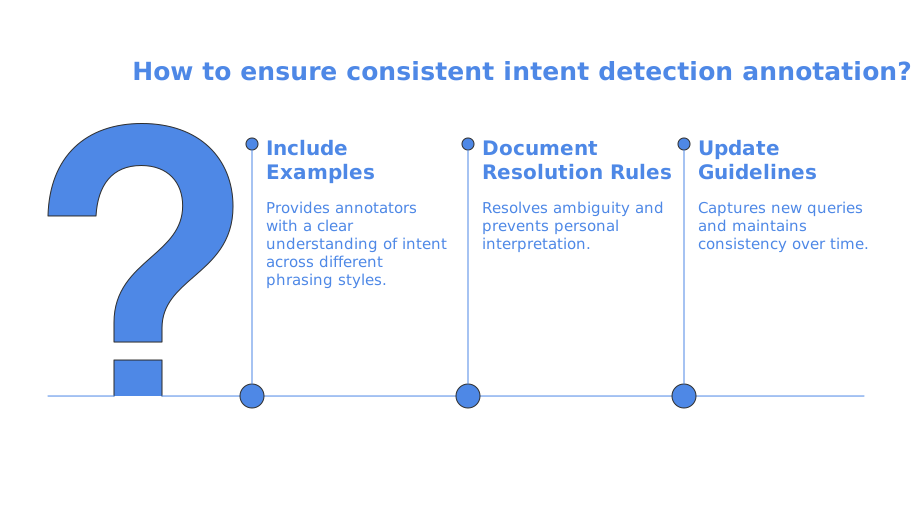
Including examples across phrasing styles
Examples help annotators understand how intent appears in different linguistic forms. They should cover formal expressions, slang, shorthand and incomplete queries. This variety helps annotators build strong intuition. Documenting both typical and unusual examples strengthens consistency across large datasets.
Documenting resolution rules for ambiguous queries
Ambiguous cases must have documented rules that annotators follow consistently. These rules help resolve uncertainty and prevent personal interpretation from influencing labels. Documenting choices also provides transparency for future reviewers. A complete ambiguity guide becomes one of the most important parts of the project.
Keeping guidelines updated as new queries emerge
As annotation progresses, teams encounter unfamiliar phrasing or new patterns of expression. Guidelines must be updated to capture these cases and avoid inconsistent labeling. Version control ensures that all annotators are aligned. Regular updates keep taxonomy and interpretation stable over time.
Quality Control for Intent Detection Datasets
Quality control is essential for detecting annotation issues early and ensuring dataset reliability. Multi-annotator review, sampling, error analysis and automated checks help maintain high accuracy. These processes also reveal where guidelines need clarification or where annotators need additional training.
Using disagreement analysis to refine categories
Disagreement between annotators often reveals ambiguous categories or unclear definitions. By analyzing disagreement patterns, teams can refine category descriptions and update guidelines. This process reduces long-term noise and strengthens the dataset. Disagreement analysis also helps highlight frequent edge cases. Addressing these cases improves annotator performance.
Creating calibration loops for annotation teams
Calibration sessions help annotators align interpretations and review challenging examples. They reduce inconsistency and prevent interpretation drift over time. These sessions also help teams identify recurring thematic confusion. Incorporating feedback from calibration strengthens both guidelines and dataset quality.
Conducting structured sampling reviews
Sampling reviews provide deep inspection of randomly selected queries to detect recurring issues. Reviewers evaluate whether annotators applied guidelines consistently and whether the taxonomy remains usable. These reviews feed into guideline updates and training adjustments. Sampling helps maintain quality across long-term projects. This consistency supports stable model behavior.
Integrating Intent Datasets Into NLP Pipelines
Once NLP annotation is complete, the dataset must be integrated into training, validation and evaluation workflows. Balanced representation, clear test sets and robust documentation help models learn stable patterns and maintain strong performance during deployment. Intent datasets often evolve, and teams should prepare for iterative refinement.
Maintaining balanced representation across intents
Some intents appear more frequently in real-world data, creating imbalanced categories. Balanced sampling helps prevent models from overfitting to common intents while neglecting rare ones. Teams should monitor frequency distribution throughout annotation. Balanced representation supports stronger generalization.
Designing robust evaluation sets
Evaluation sets must capture the diversity of phrasing styles and query structures present in real data. Annotators must label these queries with particular care to ensure accurate evaluation. Documenting how evaluation sets were created helps maintain reproducibility. These sets provide a reliable benchmark for model performance.
Supporting iterative improvements as new intents evolve
Intent taxonomies often evolve as businesses introduce new features or observe new user patterns. Datasets must adapt without disrupting existing categories. Teams should regularly review how new examples influence model performance. Iterative refinement ensures that the dataset remains aligned with real-world use cases.
If you're working on an intent detection dataset and want support with taxonomy design, annotation strategy or quality assurance, we can explore how DataVLab helps teams build reliable and scalable classification datasets for conversational AI and language understanding.
What are Intent detection datasets?
This article explains how intent detection datasets are created, why annotation consistency matters and how taxonomy design influences model accuracy. It covers paraphrase variation, ambiguous intent resolution, labeling workflows, quality control, dataset structuring and best practices for building dependable intent classifiers.
Why does intent detection annotation matter?
Intent detection models power chatbots, customer support automation, conversational search and voice assistants. These systems must interpret meaning from short, informal and sometimes incomplete queries, which makes training data crucial. If annotators apply categories inconsistently, the model learns unclear boundaries and produces unpredictable classifications.
What is involved in managing ambiguous, indirect and Multi-Intent queries?
Real users frequently express intentions indirectly, inconsistently or through multi-step requests. High-quality intent datasets must include well-defined strategies for interpreting these cases. Annotators need guidance to avoid applying personal judgment inconsistently across the dataset.
What are the best practices for Intent detection datasets?
Well-written guidelines are essential for consistent intent detection annotation. These guidelines define how to interpret short queries, ambiguous cases, paraphrases and multi-intent structures. They must evolve throughout the project to incorporate new patterns and clarify confusing scenarios.
How can teams ensure quality in Intent detection datasets?
Quality control is essential for detecting annotation issues early and ensuring dataset reliability. Multi-annotator review, sampling, error analysis and automated checks help maintain high accuracy. These processes also reveal where guidelines need clarification or where annotators need additional training.
What is involved in integrating intent datasets into NLP pipelines?
Once NLP annotation is complete, the dataset must be integrated into training, validation and evaluation workflows. Balanced representation, clear test sets and robust documentation help models learn stable patterns and maintain strong performance during deployment. Intent datasets often evolve, and teams should prepare for iterative refinement.