AI in Agriculture: A Practical Guide to Plant Classification
.jpeg)

Plant classification has become one of the most influential applications of agriculture AI, powering automated crop monitoring, fruit sorting, yield prediction and disease detection across the farming sector. Modern systems depend on high quality labeled data to understand plant structures, species variations and environmental conditions. This guide explains how plant classification works, how computer vision models are trained, and how datasets should be prepared to support reliable applications in the field. It also provides a comprehensive look at the latest techniques and challenges that innovators face when deploying agriculture AI at scale.
- Plant classification has become one of the most influential applications of agriculture AI, powering automated crop monitoring, fruit sorting, yield prediction and disease detection across the farming sector.
- Modern systems depend on high quality labeled data to understand plant structures, species variations and environmental conditions.
- This guide explains how plant classification works, how computer vision models are trained, and how datasets should be prepared to support reliable applications in the field.
- It also provides a comprehensive look at the latest techniques and challenges that innovators face when deploying agriculture AI at scale.
The Role of Plant Classification in Modern Agriculture
Plant classification is now a foundation of agriculture AI, enabling automated understanding of crops, fruits and plant structures at a speed that would be impossible for human operators alone. Farmers and agritech companies use classification systems to identify plant species, detect growth anomalies and monitor fields across large areas. Research labs such as Wageningen University and CGIAR have shown that these systems help reduce input waste and improve yield forecasting accuracy using image based analysis. As agriculture becomes more data driven, plant classification is turning into a strategic capability across both research and industrial operations.
How Computer Vision Enables Plant Identification
Computer vision models learn to classify plants by detecting patterns in annotated datasets. These datasets contain thousands of labeled images that show leaves, stems, fruits or entire crop fields from different angles and under various lighting conditions. Models learn to associate these features with known categories, whether they represent species, growth stages or health states. Advances in agriculture focused research from institutions such as the University of California Davis have shown that deep learning improves accuracy when trained on well curated agricultural datasets. The quality of these annotations determines how reliably a model can generalize to real environments.
The Importance of Diverse Image Sources
Effective plant classification depends on data diversity, especially when dealing with outdoor environments where conditions vary widely. Images captured from drones, smartphones, greenhouse sensors and field cameras all contribute unique perspectives. Multiple angles help models detect leaf shape and structure, while variations in illumination strengthen robustness against shadows or reflections. Research from NASA Harvest highlights how multispectral imaging enhances classification by capturing data beyond visible wavelengths. By combining diverse image sources, agriculture AI developers build systems that perform reliably across seasons and locations.
Labeling Categories for Agricultural Understanding
Annotation categories play a critical role in defining what a model learns. In plant classification projects, labels may include species, varieties, leaf shapes or phenological stages. Each category must be clearly defined so annotators, agronomists and researchers follow consistent guidelines. When categories are ambiguous or overlapping, model performance decreases because the system receives conflicting examples. Industry best practices from organizations like the FAO encourage using hierarchical taxonomies for greater clarity. Clear labeling instructions ensure that datasets represent agricultural reality with high fidelity.
Imaging Conditions and Environmental Variability
Environmental conditions introduce noise that influences model accuracy. Images of crops and plants can differ significantly depending on sunlight, humidity, soil type or even the presence of dust on sensors. Many agricultural AI projects must account for this variability through both data collection and augmentation techniques. Studies from Stanford’s AI for Agriculture group have demonstrated that exposure changes, rotations and controlled distortions help models generalize to field conditions. Without enough variation, even high quality datasets may perform poorly when deployed outdoors.
Seasonal and Geographic Differences
Plant appearance changes throughout the year as crops grow, flower or reach maturity. Leaves may darken, fruit may enlarge or stems may change posture under heat or wind. These shifts can cause misclassification if training data does not cover multiple stages. Geographic variation adds further complexity since the same species may look different in different regions. Developers should aim to gather data across seasons and climates to avoid overfitting. Agricultural datasets built for broad use cases benefit significantly from this temporal diversity.
Noise, Occlusion and Field Constraints
Plants often overlap or are partially hidden by soil, farm equipment or other plants. These occlusions challenge classification models because they obscure critical visual cues. In addition, field environments include non plant elements such as insects, weeds or shadows that may confuse algorithms. High resolution imagery helps reduce these issues, but strategic annotation is equally important. Marking partially visible plants and distinguishing them from background elements teaches the model to make robust predictions even in complex scenes.
Dataset Foundations for Plant Classification
Dataset quality determines the reliability of agricultural computer vision systems. High resolution images, consistent annotation rules and sufficient variations all contribute to long term performance. Most models require thousands of samples per category, although difficult species or subtle differences may require even more. Institutions such as the European Space Agency have emphasized that large, high quality datasets lead to more stable crop monitoring applications. Developers should plan data collection and annotation workflows early in the project to avoid costly redesigns later on.
Preparing High Quality Plant Images
Quality image preparation improves both annotation accuracy and model performance. Factors such as focus, sharpness, camera sensor quality and vantage point consistency influence how well a model learns. Blurry or low contrast images introduce noise that may reduce accuracy in real deployments. If images come from drone flights, altitude and angle must remain consistent across sessions. When using handheld cameras, lighting conditions should be controlled where possible. Clean and varied imagery accelerates annotation and strengthens the dataset.
Annotation Guidelines and Labeling Protocols
Clear annotation guidelines ensure consistency across large teams. These guidelines define category definitions, edge cases and labeling tools. Teams must specify whether annotators should mark individual leaves, whole plants or grouped clusters depending on the use case. For fruit classification, boundaries around fruit clusters must be drawn consistently even when the fruit overlaps. For crop fields, annotators may classify entire patches rather than individual plant elements. Detailed protocols reduce confusion, improve labeling consistency and lower error rates during quality assurance.
Quality Control and Dataset Validation
Quality control procedures filter out errors before the dataset reaches the model training stage. Multi stage review systems catch mislabels, blurry images or inconsistent category definitions. Developers often assign expert agronomists to validate samples for scientific accuracy, especially for taxonomy heavy datasets. Sampling strategies and statistical checks help verify that categories remain balanced. Incremental validation during dataset construction prevents costly model re training and improves downstream reliability.
Techniques and Methods Used in Plant Classification Models
Advances in computer vision have opened new possibilities for analyzing agricultural imagery. Modern models classify plants using deep neural networks that detect patterns in texture, color and shape. These systems can handle subtle botanical differences when trained on well structured datasets. Research from Google’s AI for Agriculture initiatives has shown that convolutional architectures adapt well to plant imagery because they capture spatial relationships within leaves and stems. By combining robust datasets with modern architectures, developers achieve reliable agricultural classification at scale.
Convolutional Neural Networks for Plant Recognition
Convolutional neural networks remain the core architecture for plant classification tasks. They analyze pixels in small regions, extracting features such as leaf veins, edges or shape contours. Stacked convolutional layers progressively learn more complex structures such as whole plant silhouettes or fruit patterns. When trained with enough diverse data, CNNs generalize well to outdoor conditions and variable lighting. They form the basis of many commercial plant recognition systems deployed in agriculture and horticulture.
Transfer Learning and Pretrained Models
Transfer learning accelerates development by using models already trained on large image datasets. Developers fine tune these models using agricultural images, allowing them to adapt to plant specific patterns. This reduces training time and improves performance when datasets are small. Pretrained models often serve as a backbone architecture before being modified for agricultural tasks. The technique is widely used in research and commercial applications to reduce costs and speed up experimentation.
Multi Modal Approaches for Agricultural AI
Beyond standard RGB images, multi modal data enhances plant classification accuracy. Infrared, multispectral and hyperspectral data capture plant stress, moisture levels and photosynthetic activity. These modalities help models detect subtle differences that are invisible to traditional sensors. Combining multiple modalities provides a more complete representation of plant health and species variations. Researchers in precision agriculture frequently rely on these extended datasets to improve detection of early stress conditions.
Linking Plant Classification to Crop and Fruit Applications
Plant classification often forms the foundation for more specialized models in crop and fruit analysis. Once a model can distinguish plant species or varieties, additional layers can detect fruit stages, growth differences or potential diseases. This modular approach accelerates development for multiple agricultural use cases. Projects in commercial agriculture often rely on this shared backbone to scale across orchards, greenhouses and open fields. Each additional task benefits from the robust classification learned at the base.
Crop Classification and Field Level Monitoring
Crop classification allows models to identify crop types across large fields. These systems support automated mapping, area measurement and plant growth estimation. When deployed at scale with drone or satellite imagery, they help farmers plan irrigation, fertilizer application and harvest timing. By combining plant level understanding with field level observation, these systems guide precision agriculture decisions. High quality annotations and geospatial consistency are essential for accurate field monitoring.
Fruit Recognition and Sorting
Fruit classification supports automated grading and sorting systems in orchards and packing facilities. Models identify fruit types, ripeness stages and surface defects. When trained on annotated datasets with clear category boundaries, they achieve high sorting accuracy even in fast paced operations. Many commercial systems rely on image sensors integrated into conveyor belts. Fruit recognition models help reduce manual labor and improve quality control in agricultural supply chains.
Growth Monitoring and Phenotyping
Phenotyping models analyze plant traits to measure growth patterns, identify stress factors or track development stages. These systems rely heavily on accurate plant classification as a baseline. When combined with temporal datasets, they reveal insights into plant behavior over time. Research labs and breeding programs increasingly use these tools to accelerate crop development cycles. Reliable annotation and image consistency are vital for multi day or multi week growth monitoring.
Challenges in Deploying Plant Classification Models
Despite the advancements in AI for agriculture, plant classification faces several operational challenges. Field conditions are highly variable, with fluctuations in weather, soil and lighting affecting model performance. Farmers may use different camera types or collection methods, creating inconsistencies that must be handled gracefully. Models must also operate in real time under changing conditions while maintaining accuracy. These challenges highlight the importance of robust annotation and dataset design from the beginning.
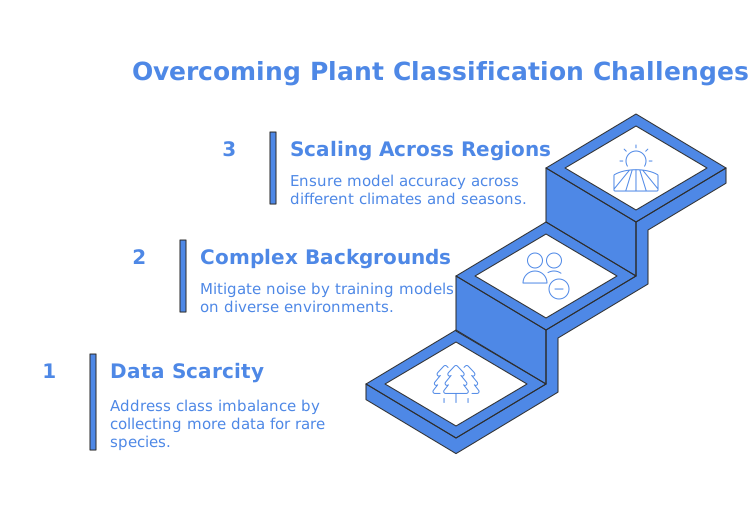
Data Scarcity and Class Imbalance
Certain plant species or growth stages may appear less frequently in datasets, leading to class imbalance. This imbalance can cause models to favor majority classes and underperform on minority categories. Developers must use targeted data collection or augmentation techniques to address the issue. Collecting additional samples for rare classes and balancing annotations helps improve accuracy. In agricultural contexts, this problem is common due to natural asymmetries in plant development cycles.
Complex Backgrounds and Variation
Background elements such as soil, weeds or debris frequently appear in agricultural images. These elements introduce noise that models may mistake for plant features. When backgrounds vary significantly across datasets, classification systems must learn to ignore irrelevant details. Data augmentation and careful annotation help mitigate this challenge. Training models on diverse environments strengthens robustness against unpredictable field conditions.
Scaling Across Regions and Seasons
Scaling plant classification models across farms, regions or countries requires extensive dataset diversity. Without representation from multiple climates and soil types, models may overfit to specific locations. Seasonal variation further complicates deployment, as plant appearance may differ markedly across months. Continuous dataset updates and incremental retraining maintain accuracy as environmental conditions evolve. This long term strategy ensures that plant classification models remain relevant across agricultural cycles.
The Future of Plant Classification in Agriculture
Plant classification is evolving rapidly as new sensors, data sources and AI architectures emerge. The integration of multispectral imaging, drone automation and real time analysis promises to transform precision agriculture. As datasets grow larger and more diverse, models become more capable of understanding subtle botanical differences. Collaboration between research institutions, agritech companies and annotation specialists will accelerate this progress. The next generation of agricultural AI will rely heavily on scalable and accurate plant classification systems.
Opportunities for Advanced Applications
As sensor technologies improve, plant classification models will support advanced agricultural applications such as nutrient deficiency prediction, automated irrigation control and early disease detection. These systems require highly detailed pixel level understanding of plant structures. Improved datasets and annotation tools will help developers capture this complexity. The coming years will see increasing demand for high precision agricultural computer vision solutions.
Integrating Robotics and Autonomous Systems
Agricultural robotics relies heavily on accurate plant classification. Robots must recognize crops and navigate fields without damaging plants. Classification systems guide robotic harvesters, weeding tools and inspection vehicles. By combining real time perception with robust AI models, robotics can automate time consuming tasks and reduce labor shortages. This integration represents a major frontier in agricultural innovation.
Building Scalable Annotation Pipelines
To support future demand, annotation workflows must become more standardized and scalable. Large agricultural datasets require efficient quality assurance, expert involvement and automated pre labeling. Companies that can deliver consistent, high fidelity annotations will play a critical role in advancing agriculture AI. Scalable pipelines ensure that plant classification models receive the data quality they need to perform reliably in production environments.
How DataVLab Helps Teams Build Agricultural AI
If you are developing plant classification systems or building large scale agricultural datasets, we can help you assemble high quality labeled data that supports accurate and reliable model performance. Our teams specialize in annotation workflows for agricultural images, including species classification, fruit recognition, crop mapping and plant phenotyping. Whether you work with drone data, greenhouse imagery or field captured datasets, we provide structured annotation, quality control and scale ready pipelines to accelerate your project.
What is AI in agriculture?
Plant classification has become one of the most influential applications of agriculture AI, powering automated crop monitoring, fruit sorting, yield prediction and disease detection across the farming sector. Modern systems depend on high quality labeled data to understand plant structures, species variations and environmental conditions.
How does Computer vision enable Plant identification?
Computer vision models learn to classify plants by detecting patterns in annotated datasets. These datasets contain thousands of labeled images that show leaves, stems, fruits or entire crop fields from different angles and under various lighting conditions.
What is involved in preparing high quality plant images?
Quality image preparation improves both annotation accuracy and model performance. Factors such as focus, sharpness, camera sensor quality and vantage point consistency influence how well a model learns. Blurry or low contrast images introduce noise that may reduce accuracy in real deployments.
What are the main use cases for AI in agriculture?
Plant classification often forms the foundation for more specialized models in crop and fruit analysis. Once a model can distinguish plant species or varieties, additional layers can detect fruit stages, growth differences or potential diseases. This modular approach accelerates development for multiple agricultural use cases.
What are the main challenges of AI in agriculture?
Despite the advancements in AI for agriculture, plant classification faces several operational challenges. Field conditions are highly variable, with fluctuations in weather, soil and lighting affecting model performance. Farmers may use different camera types or collection methods, creating inconsistencies that must be handled gracefully.
What is the future of AI in agriculture?
Plant classification is evolving rapidly as new sensors, data sources and AI architectures emerge. The integration of multispectral imaging, drone automation and real time analysis promises to transform precision agriculture. As datasets grow larger and more diverse, models become more capable of understanding subtle botanical differences.