Fruit Classification With Machine Learning
.jpeg)

Fruit classification is one of the most widespread applications of agricultural computer vision, powering everything from automated sorting lines to ripeness prediction, farm monitoring and supply chain quality control. High quality annotated datasets are essential for training reliable fruit recognition systems capable of handling real world variability in shape, size, color and lighting conditions. This guide explains how fruit classification works, how to design categories, how to annotate images, and how to build datasets that support robust machine learning performance. It also examines operational challenges, environmental constraints and recommended quality control workflows for teams building agricultural AI.
- Fruit classification is one of the most widespread applications of agricultural computer vision, powering everything from automated sorting lines to ripeness prediction, farm monitoring and supply chain quality control.
- High quality annotated datasets are essential for training reliable fruit recognition systems capable of handling real world variability in shape, size, color and lighting conditions.
- This guide explains how fruit classification works, how to design categories, how to annotate images, and how to build datasets that support robust machine learning performance.
- It also examines operational challenges, environmental constraints and recommended quality control workflows for teams building agricultural AI.
Why Fruit Classification Is Critical in Agricultural AI
Fruit classification plays a central role in modern agriculture because it supports automated decisions across harvesting, sorting and quality control. Accurate fruit recognition enables producers to grade fruit based on size, color and ripeness, reducing manual labor and improving consistency in supply chains. Research from the International Food Policy Research Institute has highlighted how modern fruit sorting technologies contribute to food system efficiency and reduce post harvest losses. As computer vision systems gain traction across orchards and processing centers, annotated datasets become vital for training models to recognize the full spectrum of fruit characteristics encountered in practice.
How Machine Learning Understands Fruits
Machine learning models learn to classify fruit by analyzing annotated images that show variations in surface texture, color, shape and maturity. These examples teach the model to associate visual cues with specific fruit categories or ripeness levels. Different lighting conditions, backgrounds and occlusions help the model generalize beyond controlled environments. Research from the University of Florida’s IFAS Horticultural Sciences department has demonstrated the importance of diverse field and laboratory images when training robust fruit classification systems. The depth and quality of annotated data ultimately define the accuracy of fruit recognition models in real world conditions.
Types of Images Used in Fruit Classification
Fruit classification datasets may contain images captured in orchards, greenhouses, factories or distribution centers. Outdoor images help models understand natural variability, including sunlight, shadows and weather effects. Indoor images from controlled environments support consistent grading tasks where lighting remains uniform. Close range photography highlights texture, defects or surface irregularities, while drone and tractor mounted imagery may capture fruit clusters at scale. Combining multiple image sources strengthens the dataset and improves the model’s ability to handle different production settings.
What Models Learn From Fruit Images
Models learn structural patterns such as the roundness of apples, the elongated form of bananas or the segmented surface of citrus. They also detect color gradients associated with ripeness, such as green to yellow transitions in mangoes or pale to deep red tones in strawberries. These visual signals help models classify fruit types and maturity levels accurately. Well annotated datasets ensure the model observes consistent examples that reflect real agricultural conditions.
Designing a Fruit Classification Taxonomy
A fruit classification taxonomy defines the labels used in the dataset. These labels must be consistent, mutually exclusive and aligned with the intended application. Without a clear taxonomy, annotators may interpret fruit categories differently, leading to inconsistent data and poor model performance. Taxonomy design should consider fruit types, varieties, ripeness stages and quality grades depending on project goals. The Royal Horticultural Society provides detailed plant and fruit reference materials that support accurate classification design.
High Level Fruit Categories
Most fruit classification projects begin with high level categories such as apple, orange, banana, grape or strawberry. These broad categories work well for sorting tasks and visual recognition systems. For example, automatic grading machines may only need to distinguish among a handful of common fruit types. High level categories simplify annotation and reduce errors, but may not capture the full diversity required for advanced applications.
Variety Level Annotation
Some use cases require differentiation between fruit varieties, such as identifying Fuji versus Gala apples or Valencia versus Navel oranges. These subclass labels support targeted breeding programs, premium product grading or research applications. Variety level annotation requires high resolution imagery and clear visual examples. Annotators must understand the specific traits that distinguish varieties to avoid mislabeling.
Ripeness and Quality Stages
Ripeness stages indicate the maturation level of fruit and are essential for harvest planning and supply chain optimization. Annotating stages such as underripe, mid ripe or fully ripe allows models to predict harvest readiness. Quality stages may include categories like blemished, bruised or defect free. The University of California Agriculture and Natural Resources provides resources on ripeness indicators and quality evaluation that can help teams design accurate taxonomies.
Collecting Images for Fruit Classification Datasets
Dataset creation begins with collecting images that represent the range of conditions in which fruit appears. These conditions vary widely between orchards, packing houses and markets. To build a robust dataset, developers must consider geographic diversity, lighting variability, background elements and crop seasonality. High quality images ensure that annotations are clear and models can learn effectively.
Field and Orchard Photography
Outdoor images capture natural fruit conditions, including variation in color due to sunlight, shadows and environmental factors. Orchard photography helps models recognize fruit growing among leaves, branches or uneven clusters. These images highlight occlusions and partial views that models must learn to interpret. Collecting orchard photos across different times of day improves the dataset’s resilience to lighting shifts.
Factory and Sorting Line Images
Processing facilities provide controlled lighting conditions that support consistent image acquisition. Factory images often capture fruit on conveyor belts, where orientation, alignment and background remain predictable. These images are useful for training grading and classification systems for sorting lines. Controlled environments allow precise calibration, making it easier to compare fruit across seasons.
Market and Retail Context Photography
Retail images introduce additional variability through packaging, labeling and mixed fruit displays. Models trained on these images learn to recognize fruit outside controlled agricultural environments. This supports commercial applications such as automated checkout systems or inventory monitoring tools. Retail photography adds complexity but increases the generalization capability of fruit classification systems.
Preprocessing Images for Annotation
Image preprocessing ensures that the dataset remains consistent and ready for annotation. Preprocessing may include cropping, resizing, adjusting brightness or normalizing color profiles. Removing unnecessary background clutter helps annotators focus on fruit objects. Consistent preprocessing reduces annotation time and improves data uniformity across the dataset.
Normalizing Lighting and Color
Normalizing lighting conditions helps reduce variation across outdoor and indoor images. Brightness, contrast and color balance adjustments ensure that fruit details remain visible. Although diversity is beneficial for training, excessive variability may confuse annotators or degrade model performance. Normalizing images before labeling makes annotations more consistent and reliable.
Correcting Perspective and Orientation
Images captured at unusual angles may need rotation or alignment to ensure consistent orientation. This is especially important for fruit varieties with distinctive shapes or symmetry. Correcting perspective helps annotators apply consistent bounding boxes or segmentation masks. It also aids models in learning shape based cues.
Removing Noise and Artifacts
Noise in images may come from reflections, debris or camera sensor interference. Preprocessing removes or reduces these artifacts to maintain dataset clarity. Noise reduction techniques improve annotation clarity, especially when precise boundaries are needed. Clean images lead to higher quality labels and better model performance.
Annotation Methods for Fruit Classification Datasets
Annotation methods depend on the model architecture and classification goals. Fruit datasets may require bounding boxes, segmentation masks, classification labels or keypoint markers. Selecting the right annotation method ensures efficient labeling and effective model training.
Bounding Box Annotation
Bounding boxes mark the area containing each fruit. This method is suitable for object detection and helps models localize multiple fruits in a single image. Boxes must be tight, consistent and aligned across annotators. Bounding box annotations work well for conveyor belt environments and orchard settings where fruit is easily separable.
Segmentation Masks for Detailed Analysis
Segmentation outlines the precise shape of each fruit using pixel level accuracy. Segmentation masks are essential for advanced tasks like defect detection, size estimation or ripeness analysis. Pixel level labeling is more labor intensive but provides the highest detail. It is particularly useful for clustering fruits that overlap or for distinguishing fruit from leaves or branches.
Classification Labels for Whole Image Tasks
Some fruit classification tasks require only a single label for each image, especially in laboratory settings where each image contains one fruit. This method saves time and allows rapid dataset scaling. Single label classification is suitable for controlled environments where variability is minimal.
Creating Annotation Guidelines for Reliability
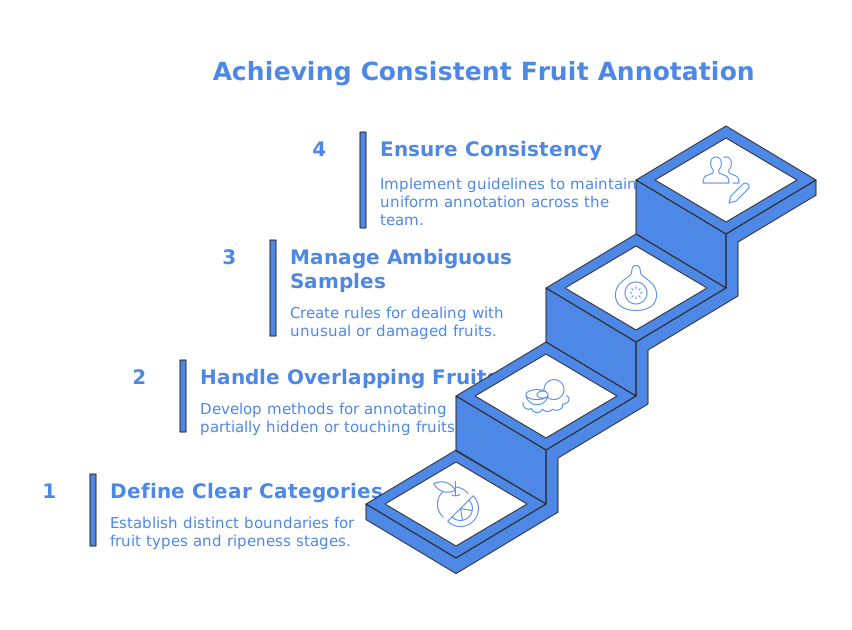
Annotation guidelines ensure consistency across large teams. Guidelines must explain labeling rules, edge cases, category definitions and visual examples. Without clear instructions, annotators may interpret fruit characteristics differently, leading to inconsistencies. Well designed guidelines improve annotation quality and reduce error rates.
Defining Clear Category Boundaries
Annotators must understand how to identify fruit types, varieties and ripeness stages. Clear category boundaries reduce confusion and ensure uniform labeling. Guidelines should include images showing typical appearance, common defects and borderline cases. When classification involves subtle differences, expert input becomes essential.
Handling Overlapping and Partially Visible Fruits
Overlapping fruit clusters present a challenge for annotation. Guidelines must define how to label fruit that is partially hidden or touching another fruit. In segmentation tasks, annotators may need to outline individual boundaries even when fruit areas overlap. Consistent treatment of occlusions ensures that models learn accurate shape and boundary cues.
Managing Ambiguous Samples
Ambiguous samples may include fruit with unusual coloration, damaged surfaces or irregular shapes. Annotators must know how to handle these cases to avoid inconsistent labeling. Guidelines may define separate categories for damaged fruit or provide rules for excluding low quality samples. Uniform handling of ambiguous images strengthens dataset integrity.
Quality Control for Fruit Classification Datasets
Quality control ensures that annotated datasets meet required standards before model training. Multi stage review processes catch mistakes, inconsistencies or mislabels. Expert oversight improves scientific accuracy, especially when annotations involve subtle features. Quality control must remain a continuous process as the dataset grows.
Multi Stage Annotation Review
A multi stage review process typically includes initial checks, secondary validation and expert review. Reviewers verify that labels match category definitions and adhere to guidelines. They inspect bounding boxes for alignment, segmentation masks for accuracy and classification labels for correctness. Regular reviews help maintain a high quality dataset despite team size or complexity.
Expert Agronomist Input
Agronomists provide critical knowledge when labeling varieties, ripeness levels or intricate fruit structures. Their expertise ensures that annotations reflect agricultural reality. Experts may review a sample of annotations or validate complex categories. Incorporating expert review reduces errors that less experienced annotators might overlook.
Automated Validation Tools
Automated validation tools can identify anomalies such as incorrect box dimensions, missing labels or irregular shapes. These tools support human reviewers by flagging potential issues early. While they cannot replace human oversight, they help streamline the quality control process and reduce the time needed for manual checks.
Challenges in Fruit Classification Annotation
Fruit datasets present specific challenges due to variability in environmental conditions, fruit appearance and imaging setups. Understanding these challenges helps teams design better datasets and anticipate issues during annotation.
Variability in Color and Ripeness
Fruit color changes dramatically with ripeness, leading to a wide range of hues within the same category. These variations can confuse models if not represented adequately in the dataset. Annotators must ensure that ripeness stages are labeled consistently. Balanced representation across stages improves model robustness.
Reflections and Surface Gloss
Many fruits exhibit natural gloss or reflective surfaces, especially under strong lighting. Reflections may obscure texture or distort color, making annotation more difficult. Image preprocessing helps reduce glare, but some reflection patterns remain unavoidable. Training models on diverse lighting conditions mitigates performance issues.
Occlusions From Leaves or Packaging
Fruit may be partially hidden by leaves, stems, packaging materials or other fruit. Annotators must distinguish fruit boundaries even when visibility is limited. Occlusions introduce ambiguity that requires precise guidelines. High resolution images help reduce annotation errors in these situations.
Scaling Fruit Classification Datasets
Scaling annotation workflows is crucial for large fruit classification projects involving thousands of images. Efficient tools, pre labeling techniques and streamlined quality control processes are necessary to handle complexity. Scalability ensures that datasets grow alongside the needs of machine learning models.
Using Pre Labeling to Accelerate Annotation
Pre labeling tools use initial model predictions to speed up annotation. Annotators correct these predictions rather than creating labels from scratch. This method accelerates the workflow and standardizes annotations across large teams. Pre labeling is especially useful for bounding box and segmentation tasks.
Leveraging Efficient Annotation Tools
Advanced annotation tools support polygon drawing, mask creation and bounding box adjustments. Tools with shortcuts, zooming features and automated suggestions improve annotator productivity. Choosing the right tool reduces annotation time and increases consistency, particularly on large datasets.
Continuous Dataset Expansion
Fruit classification models improve as datasets grow. Continuous expansion ensures that the model adapts to new conditions, varieties and imaging contexts. Regularly incorporating fresh data prevents model drift and maintains performance over time. Developers must track dataset versions to manage updates effectively.
How Fruit Classification Models Use Annotated Data
Annotated fruit datasets support a variety of machine learning models designed for detection, classification and quality assessment. These models rely on consistent, high quality labels to learn meaningful patterns. The US National Agriculture Library provides extensive documentation on fruit characteristics that can help inform model design and data preparation.
Training Deep Learning Models
Deep learning architectures such as convolutional neural networks analyze fruit images by detecting low level features like edges and textures. These networks gradually learn complex representations such as shape or color patterns associated with ripeness. Balanced datasets ensure that models learn unbiased features across categories.
Evaluation and Testing
Evaluation involves testing models on unseen data to measure accuracy, precision and recall. Developers must create test sets that represent the full variability of fruit appearance and conditions. Proper evaluation prevents unexpected failures during deployment. Cross validation helps assess the model’s ability to generalize.
Deployment in Industrial and Agricultural Settings
Fruit classification systems operate in orchards, greenhouses, factories and retail environments. Deployments must account for environmental variability, camera consistency and processing speed. Robust models handle visual challenges such as movement, glare or overlapping fruit. Annotated datasets provide the foundation for successful real world deployment.
How DataVLab Supports Fruit Classification Projects
If you are building fruit classification or fruit recognition models, we can help you structure, annotate and validate large datasets that support reliable agricultural AI. Our teams specialize in segmentation, bounding box annotation, ripeness labeling and quality assessment workflows for orchard, factory and retail environments. If you want support assembling a scalable fruit classification dataset, feel free to reach out anytime.
What is Fruit classification with machine learning?
Fruit classification is one of the most widespread applications of agricultural computer vision, powering everything from automated sorting lines to ripeness prediction, farm monitoring and supply chain quality control. High quality annotated datasets are essential for training reliable fruit recognition systems capable of handling real world variability in shape, size, color and lighting conditions.
Why is Fruit classification Critical in agricultural AI?
Fruit classification plays a central role in modern agriculture because it supports automated decisions across harvesting, sorting and quality control. Accurate fruit recognition enables producers to grade fruit based on size, color and ripeness, reducing manual labor and improving consistency in supply chains.
What does the article explain about how machine learning understands fruits?
Machine learning models learn to classify fruit by analyzing annotated images that show variations in surface texture, color, shape and maturity. These examples teach the model to associate visual cues with specific fruit categories or ripeness levels.
How can teams ensure quality in Fruit classification with machine learning?
Quality control ensures that annotated datasets meet required standards before model training. Multi stage review processes catch mistakes, inconsistencies or mislabels. Expert oversight improves scientific accuracy, especially when annotations involve subtle features.
What are the main challenges of Fruit classification with machine learning?
Fruit datasets present specific challenges due to variability in environmental conditions, fruit appearance and imaging setups. Understanding these challenges helps teams design better datasets and anticipate issues during annotation. Fruit color changes dramatically with ripeness, leading to a wide range of hues within the same category.
What does the article explain about how fruit classification models use annotated data?
Annotated fruit datasets support a variety of machine learning models designed for detection, classification and quality assessment. These models rely on consistent, high quality labels to learn meaningful patterns. The US National Agriculture Library provides extensive documentation on fruit characteristics that can help inform model design and data preparation.