Plant Tissue Classification for AI: How to Build High-Granularity Botanical Datasets
.jpeg)

Plant tissue classification is becoming a critical component of agricultural and botanical AI, enabling precise analysis of leaves, stems, roots and cellular structures for research, breeding and crop monitoring. High-granularity datasets are essential for training models that can distinguish subtle morphological differences and support laboratory diagnostics, plant physiology studies and advanced phenotyping. This article explains how plant tissue classification works, how to build and annotate datasets, and how to ensure scientific accuracy through expert review and rigorous quality control. It also explores imaging techniques, dataset design strategies and the unique challenges of working with microscopic botanical data.
- Plant tissue classification is becoming a critical component of agricultural and botanical AI, enabling precise analysis of leaves, stems, roots and cellular structures for research, breeding and crop monitoring.
- High-granularity datasets are essential for training models that can distinguish subtle morphological differences and support laboratory diagnostics, plant physiology studies and advanced phenotyping.
- This article explains how plant tissue classification works, how to build and annotate datasets, and how to ensure scientific accuracy through expert review and rigorous quality control.
- It also explores imaging techniques, dataset design strategies and the unique challenges of working with microscopic botanical data.
Why Plant Tissue Classification Matters
Plant tissue classification allows AI systems to identify and interpret biological structures at both macroscopic and microscopic levels. This ability supports agricultural research, plant pathology, breeding programs and environmental monitoring. By training models to recognize tissue types, researchers can detect cellular abnormalities, analyze nutrient transport patterns or evaluate stress responses in plants. Institutions such as the Royal Botanic Gardens Kew have shown how tissue level understanding contributes to conservation science and genetic research. As demand for plant biology insights increases, annotated datasets become essential for enabling machine learning in this domain.
Understanding Plant Tissues in AI Systems
Machine learning models analyze plant tissues by learning visual cues from annotated images. These cues include cellular shapes, epidermal textures, vascular arrangements and structural differences among tissue layers. When datasets contain enough high quality examples, models can accurately classify tissues under varied laboratory conditions. The American Society of Plant Biologists highlights how tissue analysis supports the study of metabolism, growth regulation and plant development. Reliable annotations ensure the model learns biologically meaningful patterns rather than superficial visual noise.
What Tissue Types Models Commonly Learn
Plant tissues generally fall into categories such as dermal, vascular and ground tissues. Dermal tissues include epidermis and protective layers, while vascular tissues encompass xylem and phloem. Ground tissues include parenchyma, collenchyma and sclerenchyma. At the cellular level, datasets may label specific cell types such as guard cells, trichomes or vessels. The clearer these categories are defined, the more accurately the model can interpret microscopic structures.
How Microscopic Images Are Used
Microscopy provides detailed views of cellular organization, enabling high precision classification. Optical, fluorescence and electron microscopy each reveal different structural layers. These modalities help models learn fine grained distinctions that support high level biological analysis. Proper imaging conditions, consistent magnification and clean slide preparation significantly affect dataset quality.
Designing a Taxonomy for Plant Tissue Classification
A well structured taxonomy determines how tissues and cells are categorized during annotation. Categories must reflect the scientific objectives of the project, whether for research, pathology or physiological analysis. Clear taxonomy reduces confusion among annotators and ensures biological accuracy across the dataset. Resources from the Missouri Botanical Garden provide foundational references for plant anatomy that support taxonomy design.
Establishing High Level Tissue Categories
High level tissue categories simplify annotation and form the basis of most plant anatomy datasets. These categories usually include vascular, dermal and ground tissues. High level classification is useful for broad research applications and helps model architectures generalize well across plant species. When categories are kept simple, annotators can work efficiently without ambiguity.
Adding Subcategories for Higher Resolution
Researchers may require subclass labels to differentiate between vessel elements, sclerenchyma fibres, palisade mesophyll or spongy mesophyll. These fine grained distinctions capture subtle anatomical differences essential for advanced biological analysis. Subcategories must be clearly defined using reference images and precise descriptions to avoid inconsistencies.
Linking Categories to Functional Analysis
Some datasets classify tissues based on functional attributes, such as nutrient transport capacity or protective roles. This approach supports ecological and physiological studies. Functional classifications must align with observable visual features so annotators can apply labels reliably. Functional taxonomies work well for research seeking to link tissue structure with biological processes.
Collecting Images for Tissue Classification Datasets
High quality images are the foundation of reliable plant tissue datasets. Image collection must be standardized, especially when working with microscopes, since small inconsistencies in lighting or magnification can affect annotation quality. Botanical researchers often follow strict laboratory protocols to ensure image uniformity. The Botanical Society of America offers guidance on imaging standards for plant anatomy.
Microscopy Techniques for Tissue Imaging
Different microscopy techniques reveal different anatomical layers. Light microscopy shows cell walls and basic tissue organization. Fluorescence microscopy highlights proteins or specific cellular components using markers. Electron microscopy captures ultrastructural details at nanometer resolution. Selecting the appropriate technique depends on the classification granularity required for the dataset.
Preparing Samples for Imaging
Clean slide preparation ensures that cellular structures remain visible. Tissue samples must be cut with consistent thickness and stained correctly to highlight specific features. Stains such as safranin or fast green help differentiate tissue layers. Proper hydration and mounting prevent artifacts that contaminate the dataset. Consistent preparation leads to more accurate annotations.
Capturing Images Under Consistent Conditions
Lighting variability affects color, contrast and the visibility of tissue boundaries. Consistent illumination settings improve image comparability across samples. Using fixed magnification ensures that scale remains uniform throughout the dataset. These factors help annotators apply labels consistently and enable models to learn reliable patterns.
Preprocessing Images Before Annotation
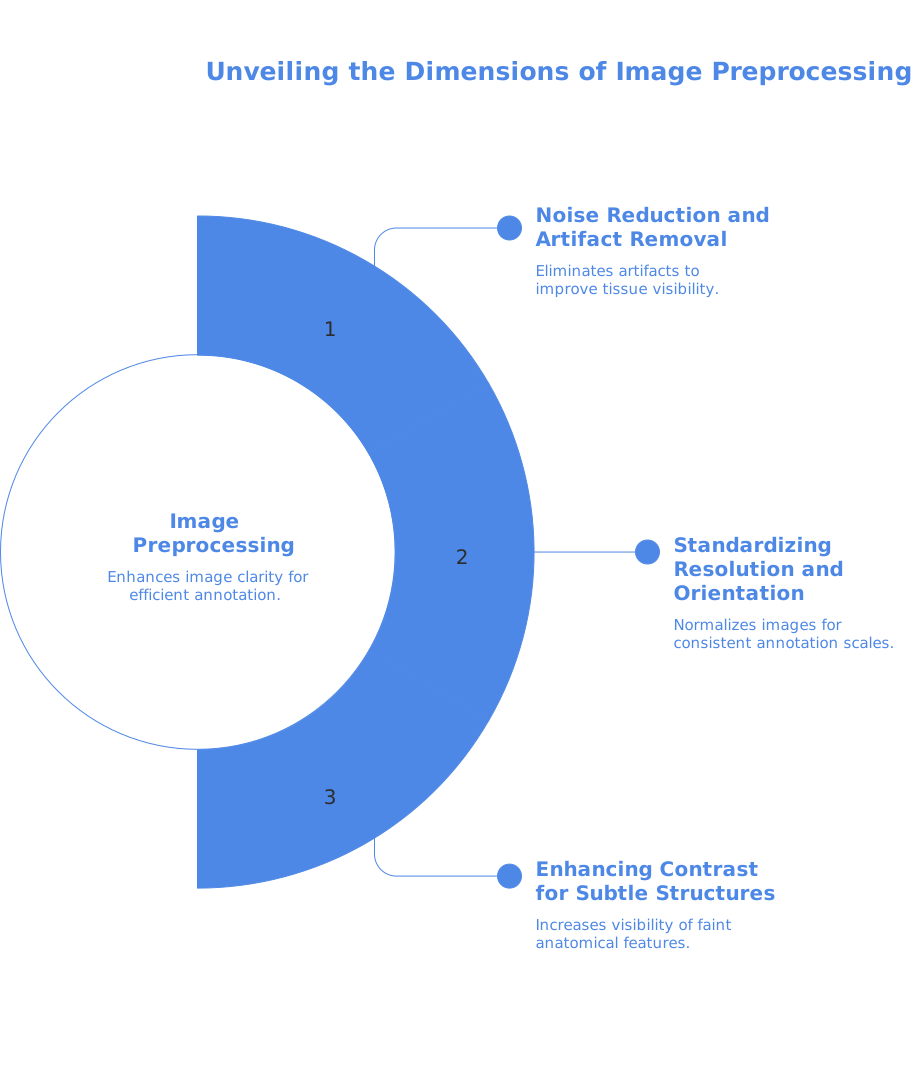
Preprocessing improves image clarity and prepares the dataset for efficient annotation. Tissue images may require brightness correction, noise reduction or contrast adjustments to expose fine details. Although diversity strengthens model performance, uncontrolled variability can hinder annotation and reduce label consistency.
Noise Reduction and Artifact Removal
Microscopy images may contain dust particles, slide scratches or sensor noise. Reducing these artifacts improves tissue visibility and decreases confusion during annotation. Digital filters help clarify boundaries without altering biological structures. Clean images reduce annotation errors and produce more reliable model training data.
Standardizing Resolution and Orientation
Images captured at different resolutions or orientations must be normalized before annotation. Standardized resolution ensures that tissues appear at comparable scales. Orientation adjustments prevent inconsistencies in label boundaries, especially when tissues exhibit directional patterns such as elongated fibres or phloem cells.
Enhancing Contrast for Subtle Structures
Certain tissues or cell types may appear faint under standard lighting. Contrast enhancement makes anatomical features more visible without modifying biological accuracy. When annotators can clearly see structures, they produce more precise masks and bounding boxes.
Annotation Methods for Plant Tissue Classification
Different annotation methods serve different classification goals. Tissue datasets may require segmentation, cell level labeling or object level classification. The method chosen depends on the level of granularity necessary for downstream analysis.
Pixel Level Segmentation for Tissue Layers
Segmentation assigns each pixel to a tissue category, providing the highest level of detail. This method is essential when analyzing complex tissue arrangements or studying transitions between layers. Pixel level segmentation requires specialized tools and detailed guidelines. It is the most time intensive but yields the most precise dataset.
Cell Level Annotation for Microscopy
Cell level annotation focuses on identifying specific cell types, such as parenchyma, guard cells or trichomes. This method supports physiological studies and detailed biological modeling. Because cells vary widely in shape and orientation, annotators must follow precise rules and rely on expert review. High resolution images are required to label cells accurately.
Whole Structure Classification
Some datasets classify larger tissue structures without marking individual cells. This approach is suitable for high level research where coarse classification is sufficient. Whole structure labeling accelerates annotation but requires careful taxonomy design to avoid ambiguity. It is commonly used in educational datasets and preliminary research.
Creating Annotation Guidelines for Scientific Accuracy
Annotation guidelines ensure consistency and biological correctness across the dataset. Guidelines must include definitions, visual references and instructions for handling complex or ambiguous samples. A well written guideline document reduces annotator confusion and improves dataset reliability.
Defining Tissue Boundaries and Transitions
Many plant tissues blend gradually into one another, such as the transition between palisade and spongy mesophyll. Annotators must know exactly where to draw boundaries or how to label transitional areas. Reference images help clarify these distinctions. Clear boundary definitions prevent inconsistent labeling across samples.
Handling Staining Variability
Staining intensity may vary between samples depending on preparation conditions. Guidelines must clarify how to identify tissues even when color saturation differs. Annotators should rely on structural cues rather than color alone. Consistent rules help maintain accuracy across variable staining conditions.
Addressing Ambiguous Structures
Some tissues exhibit irregular or atypical traits due to stress, damage or developmental anomalies. Guidelines must specify how to label such abnormalities to avoid inconsistent classification. If abnormal tissues require their own labels, categories must be clearly defined. Proper handling of ambiguity strengthens dataset integrity.
Quality Control in Plant Tissue Datasets
Quality control ensures scientific accuracy and consistency across the dataset. Tissue classification requires rigorous review, especially for fine grained categories. Expert involvement is essential to validate annotations and preserve biological correctness.
Multi Stage Review Pipelines
A multi stage review system ensures that annotations meet quality standards. First level reviewers check consistency and boundary accuracy, while senior reviewers examine biological fidelity. Final expert validation resolves complex or uncertain cases. These review stages prevent low quality labels from entering the training dataset.
Expert Botanist Collaboration
Botanists provide the scientific expertise necessary for accurate tissue identification. Their review helps refine category definitions, correct mislabeled samples and guide annotators. Collaboration with experts from institutions like the Journal of Experimental Botany ensures that annotations align with current research standards.
Dataset Audits and Statistical Checks
Periodic audits help detect inconsistencies, class imbalances or annotation drift. Statistical checks measure inter-annotator agreement and identify categories that may require guideline updates. Regular audits sustain long term dataset reliability.
Challenges in Plant Tissue Classification
Plant tissue datasets present several unique challenges due to biological variability, microscopic imaging complexity and preparation inconsistencies. Understanding these challenges helps teams design better workflows.
High Variability Across Species
Different plant species exhibit diverse tissue structures and cellular arrangements. Datasets must represent this diversity to train models that generalize well across botanical domains. Lack of species diversity may lead to overfitting. Broad sampling strategies improve dataset robustness.
Microscopy Artifacts and Stain Differences
Small artifacts such as air bubbles, staining irregularities or blade marks affect tissue visibility. These artifacts complicate annotation and may confuse models. Preprocessing reduces artifact impact, but some cases require annotator judgment. Clear guidelines help maintain accuracy.
Difficulty of Labeling Subtle Boundaries
Thin or partially differentiated layers may be hard to label even for experts. Subtle boundaries require high resolution images and detailed annotation protocols. Training annotators thoroughly reduces boundary inconsistencies.
How Plant Tissue Classification Supports Advanced Applications
High quality tissue datasets support a wide range of applications across agricultural and biological research. These datasets enable models to estimate physiological traits, detect stress symptoms or analyze developmental processes. Tissue level understanding forms the basis of many advanced AI systems in plant science.
Phenotyping and Growth Analysis
Phenotyping systems rely on tissue classification to analyze leaf structures, photosynthetic layers or vascular density. These insights help breeders select desirable traits and optimize crop varieties. Tissue level AI accelerates breeding cycles by automating complex analyses.
Stress and Disease Detection
Changes in tissue structure often indicate stress, infection or nutrient deficiencies. Tissue classification datasets help models detect abnormalities at early stages. Early detection enables timely intervention and reduces crop loss. Tissue level AI is particularly useful in research and laboratory diagnostics.
Anatomical Research and Education
Educational institutions use tissue datasets to teach plant anatomy and microscopy skills. AI models trained on high quality annotations assist with automated labeling or specimen identification. These tools support learning and research in plant biology and physiology.
How DataVLab Supports Tissue and Cell-Level Annotation
If you are developing plant tissue classification models or creating microscopic botanical datasets, we can help you structure, annotate and validate your data with scientific precision. Our teams specialize in high granularity labeling, expert review workflows and scalable QA systems tailored to plant anatomy and microscopy. If you want support building your next tissue classification dataset, feel free to reach out anytime.
What is Plant tissue classification for AI?
Plant tissue classification is becoming a critical component of agricultural and botanical AI, enabling precise analysis of leaves, stems, roots and cellular structures for research, breeding and crop monitoring. High-granularity datasets are essential for training models that can distinguish subtle morphological differences and support laboratory diagnostics, plant physiology studies and advanced phenotyping.
Why does plant tissue classification matter?
Plant tissue classification allows AI systems to identify and interpret biological structures at both macroscopic and microscopic levels. This ability supports agricultural research, plant pathology, breeding programs and environmental monitoring. By training models to recognize tissue types, researchers can detect cellular abnormalities, analyze nutrient transport patterns or evaluate stress responses in plants.
What does the section on “Preprocessing images before annotation” explain?
Preprocessing improves image clarity and prepares the dataset for efficient annotation. Tissue images may require brightness correction, noise reduction or contrast adjustments to expose fine details. Although diversity strengthens model performance, uncontrolled variability can hinder annotation and reduce label consistency.
How can teams ensure quality in Plant tissue classification for AI?
Quality control ensures scientific accuracy and consistency across the dataset. Tissue classification requires rigorous review, especially for fine grained categories. Expert involvement is essential to validate annotations and preserve biological correctness.
What are the main challenges of Plant tissue classification for AI?
Plant tissue datasets present several unique challenges due to biological variability, microscopic imaging complexity and preparation inconsistencies. Understanding these challenges helps teams design better workflows. Different plant species exhibit diverse tissue structures and cellular arrangements.
How does Plant tissue classification support Advanced applications?
High quality tissue datasets support a wide range of applications across agricultural and biological research. These datasets enable models to estimate physiological traits, detect stress symptoms or analyze developmental processes. Tissue level understanding forms the basis of many advanced AI systems in plant science.