Plant Growth Datasets for AI: How to Annotate Time-Series Images for Yield and Phenotyping Models
.jpeg)

Plant growth datasets power some of the most advanced agricultural AI systems, including yield prediction models, phenotyping tools and plant development analysis engines. Annotating plant growth requires time series images, consistent labeling across stages and clear protocols for handling environmental variability. This guide explains how plant growth datasets are collected, structured and annotated, how to define category systems for developmental stages, and how to maintain quality and scientific accuracy over long observation periods. It also explores the major challenges of dealing with temporal data, environmental noise and biological variation across species. The article concludes with best practices, scaling methods and quality control strategies for production-ready agricultural AI.
- Plant growth datasets power some of the most advanced agricultural AI systems, including yield prediction models, phenotyping tools and plant development analysis engines.
- Annotating plant growth requires time series images, consistent labeling across stages and clear protocols for handling environmental variability.
- This guide explains how plant growth datasets are collected, structured and annotated, how to define category systems for developmental stages, and how to maintain quality and scientific accuracy over long observation periods.
- The article concludes with best practices, scaling methods and quality control strategies for production-ready agricultural AI.
Why Plant Growth Datasets Matter
Plant growth datasets are crucial in agricultural AI because they capture the changes plants undergo across days, weeks or entire seasons. This temporal information allows AI systems to measure development rates, detect stress early and predict yields accurately. Research from the American Society of Agronomy shows how time series imaging supports phenotyping studies that track developmental patterns across diverse crop varieties. High quality growth datasets provide the foundation for models that must not just recognize plants, but understand how they change over time. When properly annotated, these datasets help farmers and researchers anticipate growth issues and optimize cultivation strategies.
Understanding Plant Growth for AI Models
AI models analyze plant growth by learning patterns from sequential images that document structural, color and form changes. The model identifies trends such as leaf expansion, stem elongation or canopy formation as plants move through developmental phases. The Crop Science Society of America highlights how stage based analysis provides valuable insights into vigor, nutrient response and stress tolerance. For AI to interpret these changes reliably, annotations must be consistent across time and supported by a clear taxonomy that reflects both biological and visual cues. The dataset must represent growth as a continuous process rather than a collection of unrelated images.
How Time Series Enhance Model Learning
Time series datasets allow models to learn transitions rather than static characteristics. This helps AI recognize early indicators of stress, estimate growth rates and project future development. By comparing differences across consecutive frames, models can detect subtle patterns such as leaf angle adjustments or early chlorosis. Time series data improves predictive accuracy, especially for yield estimation or stress diagnostics.
Developmental Features Models Commonly Learn
Common growth indicators include leaf count, leaf length expansion, stem height, branching structure, canopy density and color transitions. These features provide insight into plant health and potential yield. Precise annotation of these traits across time ensures that AI models develop a robust understanding of developmental trajectories. Consistent labeling reveals growth curves that support advanced phenotyping and forecasting applications.
Designing a Taxonomy for Growth Stages
A growth stage taxonomy organizes the dataset according to the developmental phases plants undergo. Stages must reflect observable traits so annotators can label images accurately. Phenology frameworks from groups like the International Society for Horticultural Science provide useful references for defining growth stages based on developmental milestones. By aligning visual cues with biological processes, taxonomies help structure the dataset in a way that supports model learning.
High Level Growth Stage Categories
High level categories typically include germination, early vegetative, mid vegetative, late vegetative, reproductive and maturation phases. These broad stages allow models to understand growth progression across major developmental boundaries. High level categories simplify annotation and help models detect transitions between phases.
Subclasses for Detailed Phenotyping
For research and breeder focused projects, finer subclasses may be required. These subclasses can include leaf emergence stages, internode elongation phases or specific reproductive markers. Detailed categories allow high precision phenotyping and support tasks such as trait analysis or genotype comparison. Clear definitions ensure that annotators differentiate among similar looking stages reliably.
Linking Stages to Visual Cues
Each growth stage must be associated with clear visual cues such as leaf number thresholds, color changes or stem posture. These cues ensure that annotators interpret stages consistently even when working with multiple species. Linking taxonomy to specific visual traits minimizes ambiguity and improves dataset alignment with biological realities.
Collecting Images for Growth Datasets
Plant growth datasets require consistent imaging sessions carried out at regular intervals. The frequency of image capture depends on the target species and the pace of development. Environmental conditions must be controlled or documented to prevent noise or bias. Growth studies found in journals such as Frontiers in Plant Science emphasize the importance of stable imaging protocols across long observation periods.
Greenhouse and Controlled Environment Imaging
Controlled environments offer consistent lighting, camera placement and temperature regulation. This consistency reduces noise and enables more precise growth measurements. Greenhouse imaging supports detailed phenotyping, especially during early developmental phases. Consistent environmental conditions allow clear and stable time series data.
Field Imaging for Real World Conditions
Field based growth datasets capture natural environmental variability, including sunlight shifts, temperature changes and wind movement. These datasets are essential for models that must operate under real farm conditions. Field images improve robustness but increase annotation complexity due to environmental unpredictability. They reveal how growth interacts with weather, soil and external stress factors.
Multi Angle and Multi Sensor Imaging
Using multiple camera angles or spectral sensors enriches the dataset with different perspectives on growth. Side views capture height progression, while top views show canopy expansion. Spectral imaging reveals physiological changes before they appear visually. Combining imaging modalities creates a more complete representation of plant development and supports advanced phenotyping tasks.
Preprocessing Time Series Before Annotation
Preprocessing ensures that time series images remain comparable across days or weeks. Consistency is essential because models analyze subtle differences between consecutive frames.
Aligning Images Across Time
Plants may shift position due to growth or movement. Alignment algorithms ensure that key features remain spatially consistent across the time series. Without alignment, annotators may struggle to track specific areas, and models may misinterpret structural changes.
Normalizing Lighting and Exposure
Lighting variability can distort perceived growth. Preprocessing normalizes brightness, contrast and exposure to prevent false signals. Normalization helps annotators identify real growth patterns rather than lighting artifacts and improves model stability.
Cleaning Background Noise
Background elements such as soil, pots or support structures may distract both annotators and models. Removing or masking these elements creates a cleaner dataset and improves annotation accuracy. Background cleaning is especially important in controlled environments where conditions allow for consistent preprocessing.
Annotation Methods for Growth Datasets
Growth dataset annotation differs from static image annotation because each label must maintain temporal consistency. Annotators must track objects across time and apply stage labels consistently as plants evolve.
Stage Labeling for Each Time Point
Annotators assign growth stage labels to each frame in the time series. These labels must reflect the plant’s development and remain consistent with previous frames. Stage labeling enables AI to learn temporal transitions and detect key developmental shifts.
Keypoint and Measurement Annotation
For certain species, annotators may mark keypoints such as leaf tips, stem nodes or branching points. These keypoints support morphometric analyses and help AI track shape changes precisely. Measurement annotation reveals growth rates and structural expansion patterns.
Segmentation for Canopy or Organ Growth
Segmentation enables models to analyze changes in leaf area, canopy spread or organ size. Pixel level segmentation provides detailed insights into structural evolution and supports high precision phenotyping. Segmenting consecutive frames helps models quantify temporal changes in dimensional traits.
Creating Annotation Guidelines for Time Series
Annotation guidelines must address not just visual identification, but temporal consistency. Annotators must apply rules uniformly across all time points.
Defining Stage Boundaries
Stage boundaries must be clear to avoid inconsistent labeling across frames. Guidelines should specify exact leaf counts, color thresholds or structural traits that define each stage. These boundaries ensure alignment across long observation periods.
Handling Ambiguous Transitions
Some transitions between stages may be gradual or difficult to detect. Guidelines must describe how to label intermediate phases or how to handle ambiguous frames. Consistency across annotators is crucial for preserving the integrity of the time series.
Tracking Repeated Structures
Plants develop repeated structures such as new leaves or branches. Guidelines must clarify how annotators should identify and track these structures over time. Consistent tracking helps AI interpret cumulative growth.
Quality Control for Growth Datasets
Growth datasets require rigorous quality control because errors propagate across the time dimension. A mistake in early frames affects subsequent labels and may mislead models.
Multi Layer Review Across Time
Reviewers must examine not just individual frames, but sequences of images. Reviewing time sequences ensures that labeling remains consistent across developmental transitions. Multi layer review improves long term dataset stability.
Expert Validation for Biological Accuracy
Plant physiologists and agronomists validate the accuracy of growth stage assignments. Journals such as Plant Physiology emphasize the importance of expert oversight for developmental studies. Expert review ensures that annotations reflect biological reality and not merely visual assumptions.
Automated Consistency Checks
Automated tools can identify sudden, implausible label changes or detect inconsistent segmentation patterns between adjacent frames. These checks help maintain smooth progression across the time series. Automation complements expert review and speeds up quality assurance.
Challenges of Time Series Growth Annotation
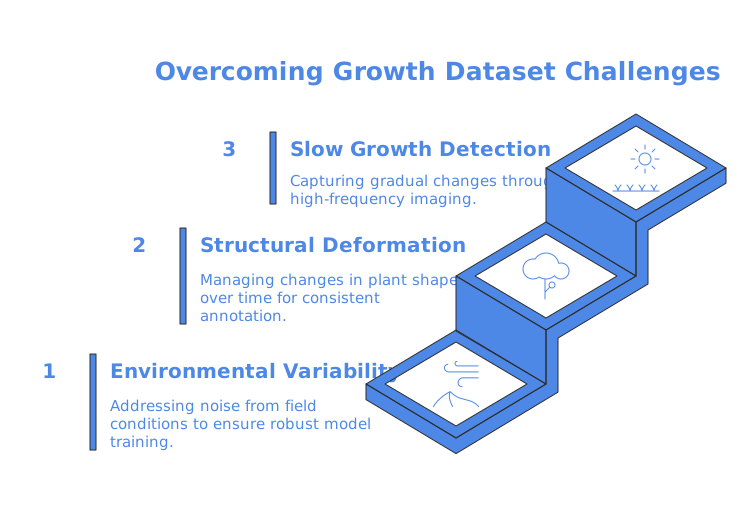
Growth datasets present unique challenges not encountered in static image annotation. These challenges stem from biological variability, environmental shifts and the complexity of tracking temporal change.
Environmental Variability in Field Settings
Field conditions introduce noise such as wind, varying sunlight or weather events. These changes may distort the appearance of growth and complicate segmentation. Datasets must represent enough variability to train models robustly.
Structural Deformation Over Time
Plants naturally change shape as they grow. Leaves droop, stems bend and canopies shift. These deformations affect annotation consistency and require careful guideline design. Models must learn that these changes reflect development, not structural anomalies.
Slow Growth Detection
Some growth changes occur gradually, making them difficult to detect visually. Annotators may need reference sequences or side by side comparisons to confirm subtle transitions. High frequency imaging helps capture slow changes.
Scaling Growth Datasets for AI
As growth datasets expand, annotation workflows must scale efficiently while maintaining consistency across long observation periods.
Leveraging Pre Labeling for Time Series
Pre labeling models provide preliminary growth stage predictions to accelerate annotation. Annotators refine these predictions instead of manually labeling each frame. Pre labeling is particularly effective when dealing with long time series.
Managing Long Term Dataset Versions
Growth datasets evolve over time as new seasons or species are added. Proper version control ensures continuity and comparability across growing datasets. Tracking metadata such as imaging conditions or sensor calibration strengthens downstream analysis.
Expanding Multi Species Representation
Including multiple species improves model generalization and supports broader agricultural applications. Growth patterns vary significantly across crops, so multi species datasets provide richer training data. This diversity enhances phenotyping and yield prediction models.
How Growth Datasets Support Advanced AI Applications
High quality growth datasets enable AI systems to perform sophisticated analyses across agricultural domains.
Yield Prediction Models
Growth trajectories provide signals that correlate with future yield. AI models trained on annotated time series can anticipate production outcomes before harvest. Early yield forecasting helps optimize resource allocation and supply chain planning.
Stress Detection and Diagnostics
Changes in growth rate, leaf color or structural posture may indicate stress or disease. Growth datasets help AI detect these signals early, enabling timely intervention. Temporal patterns reveal anomalies that static images may miss.
Phenotyping and Trait Analysis
Growth datasets support breeding programs by revealing genetic differences in growth patterns. AI models analyze these patterns to identify desirable traits or detect deficiencies. Phenotyping at scale accelerates the development of improved varieties.
Supporting Your Time Series Agricultural Projects
If you are building plant growth datasets or developing time series AI models for yield prediction or phenotyping, we can help you design structured annotation workflows, set up temporal QA pipelines and produce biologically consistent labels across entire seasons. Our team specializes in high resolution agricultural datasets, multi stage growth annotation and scalable quality systems tailored to research and industry. If you want support building your next agricultural dataset, feel free to reach out anytime.
What is Plant growth datasets for AI?
Plant growth datasets power some of the most advanced agricultural AI systems, including yield prediction models, phenotyping tools and plant development analysis engines. Annotating plant growth requires time series images, consistent labeling across stages and clear protocols for handling environmental variability.
What does the article explain about why plant growth datasets matter?
Plant growth datasets are crucial in agricultural AI because they capture the changes plants undergo across days, weeks or entire seasons. This temporal information allows AI systems to measure development rates, detect stress early and predict yields accurately.
What does the section on “Preprocessing time series before annotation” explain?
Preprocessing ensures that time series images remain comparable across days or weeks. Consistency is essential because models analyze subtle differences between consecutive frames. Plants may shift position due to growth or movement.
What is involved in creating annotation guidelines for time series?
Annotation guidelines must address not just visual identification, but temporal consistency. Annotators must apply rules uniformly across all time points. Stage boundaries must be clear to avoid inconsistent labeling across frames.
What are the main challenges of Plant growth datasets for AI?
Growth datasets present unique challenges not encountered in static image annotation. These challenges stem from biological variability, environmental shifts and the complexity of tracking temporal change. Field conditions introduce noise such as wind, varying sunlight or weather events.
What does the article explain about how growth datasets support advanced AI applications?
High quality growth datasets enable AI systems to perform sophisticated analyses across agricultural domains. Growth trajectories provide signals that correlate with future yield. AI models trained on annotated time series can anticipate production outcomes before harvest.