
Medical Annotation Services for Imaging, Video, Clinical NLP, and Biosignals


Medical Annotation Services
DataVLab provides medical annotation services for teams building AI in radiology, pathology, clinical NLP, and biomedical signal processing. We label MRI, CT, X-ray, ultrasound, microscopy, medical video, clinical documents, and biosignals with project-specific guidelines and multi-stage quality review. Workflows support secure delivery and compliance-ready processing for sensitive medical datasets.
Medical annotation services across imaging, video, clinical NLP, and biosignals.
Domain-aware workflows with multi-stage QA and consistent review.
Secure handling for sensitive healthcare datasets (GDPR-aligned, EU-only options).
Medical annotation is the process of labeling healthcare data so models can detect findings, segment anatomy, extract entities, or classify clinical events. It requires precise guidelines, domain-aware review, and consistent QA to reduce noise in training and evaluation datasets.
We annotate radiology images (MRI, CT, X-ray, ultrasound), pathology and microscopy, procedural video, clinical text and EHR-derived documents, and biosignals (ECG, EEG, EMG). Label types include segmentation, bounding boxes, landmarks, classification, and structured clinical NLP labels.
Use cases include detection and triage, organ and lesion segmentation, pathology region labeling, clinical entity extraction, cohort building, and signal event detection. We adapt ontologies and guidelines to your clinical objectives and evaluation criteria.
Quality controls include multi-stage review, sampling audits, inter-annotator consistency checks, and targeted adjudication in ambiguous cases. Sensitive datasets can be handled under GDPR-aligned workflows with EU-only annotation options where required.
Medical annotation capabilities
Structured labeling across modalities with trained teams and quality review designed for medical AI.

Annotation for Radiology Imaging Datasets

Structured labeling for MRI, CT, and X-ray
We annotate organs, anatomical regions, lesions, vessels, spine structures, lung fields, and other radiological features using guidelines aligned with your clinical taxonomy.
Medical Video Annotation
Frame consistent labeling for procedures and movement patterns
We annotate endoscopy, ultrasound motion, surgical workflows, and technical medical procedures with temporal consistency and detailed labeling rules.
Pathology and Microscopy Annotation
Region based labeling for research and diagnostic support
We annotate tissue regions, cell areas, structures of interest, and visual indicators in histopathology and microscopy images with fine grained boundaries.
Medical Text and Clinical NLP Annotation
Entity extraction and structured labeling for clinical data
We annotate clinical notes, OCR extracted text, medical terms, entities, ICD style categories, and custom taxonomies to support document AI systems.
Biosignal and Waveform Annotation
Structured labeling for ECG, EEG, EMG, and biomedical signals
We label waveform segments, intervals, events, and morphological patterns that support biosignal classification or anomaly detection models.
Medical Dataset QA and Review
Human in the loop quality validation
We apply multi stage review, correction cycles, and consistency checks to clean or refine existing datasets and strengthen their training value.
Discover How Our Process Works

Defining Project
Sampling & Calibration
Annotation
Review & Assurance
Delivery
Explore Industry Applications
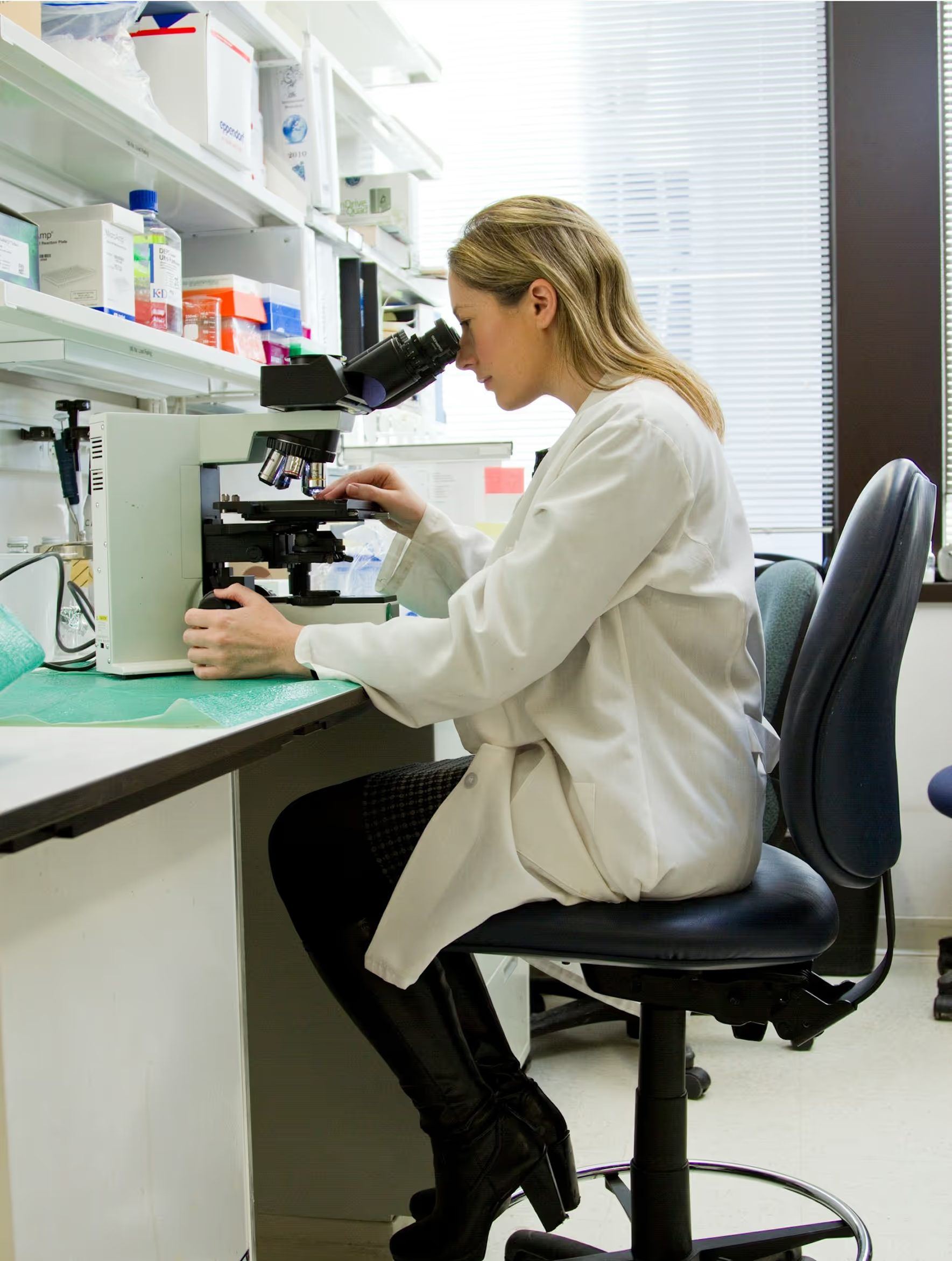
We provide solutions to different industries, ensuring high-quality annotations tailored to your specific needs.
We provide high-quality annotation services to improve your AI's performances

Annotation & Labeling for AI
Unlock the full potential of your AI application with our expert data labeling tech. We ensure high-quality annotations that accelerate your project timelines.
Medical Data Labeling Services
High quality labeling for medical imaging, clinical documents, biosignals, and multimodal datasets used in healthcare and biomedical AI development.
Medical Image Annotation Services
High accuracy annotation for MRI, CT, X-ray, ultrasound, and pathology imaging used in diagnostic support, research, and medical AI development.
Radiology Image Annotation Services
High accuracy annotation for radiology imaging including MRI, CT, X-ray, PET, and specialized scans used in diagnostic support and medical AI development.
Pathology Annotation Services
High accuracy annotation for pathology and microscopy datasets including whole slide images, tissue regions, cellular structures, and oncology research features.
MRI Annotation Services
High accuracy MRI annotation for neuroimaging, musculoskeletal imaging, soft tissue segmentation, organ labeling, and research grade AI development.
FAQs
Here are some common questions we receive from our clients to assist you.
What is medical image annotation and what does it include?
Medical image annotation is the process of labeling medical imaging data, including MRI, CT, X-ray, ultrasound, pathology slides, endoscopy, and fundus photography, so that AI models can learn to interpret clinical content. This includes drawing contours around anatomical structures and pathological regions, classifying findings, marking keypoints on anatomical landmarks, and tagging image-level diagnoses. High-quality medical image annotation is the foundational data work that makes AI-assisted diagnosis, surgical planning, treatment monitoring, and medical device AI possible.
Why does medical image annotation require clinical expertise?
Medical image annotation requires genuine clinical expertise that general annotators cannot provide. Distinguishing a benign cyst from a malignant lesion in a CT scan, correctly tracing the boundaries of a tumor in an MRI, or accurately classifying a histopathological finding under a microscope requires knowledge that only trained medical professionals possess. Errors in medical annotation can directly translate to errors in AI diagnostic tools, with potential patient safety consequences. For clinical-grade datasets, annotation must be performed or validated by licensed clinicians with relevant specialization.
What medical imaging modalities do you annotate?
DataVLab annotates across the major medical imaging modalities. Radiology: CT, MRI, X-ray, and PET for organ segmentation, lesion detection, bone analysis, and pathology localization. Pathology: whole slide images (WSI) for cell segmentation, tissue classification, cancer grading, and morphological feature extraction. Ophthalmology: fundus photography and OCR for retinal structure analysis and disease staging. Cardiology: echocardiography and cardiac MRI for chamber segmentation and function assessment. Gastroenterology: endoscopy for polyp detection and mucosal analysis. Each modality requires specialists with domain-specific training.
How does the EU AI Act affect medical AI annotation requirements?
EU AI Act classification for medical AI depends on the system's intended purpose and regulatory pathway. Medical AI systems used as safety components in medical devices regulated under MDR or IVDR are classified as high-risk under Annex I of the EU AI Act, requiring the full compliance stack: documented risk management, data governance, technical documentation, human oversight, accuracy and cybersecurity evidence, and quality management system. This means the annotation methodology, annotator qualifications, inter-annotator agreement, and data governance documentation must all meet the requirements of Article 10, making professional annotation with rigorous quality documentation an EU AI Act requirement rather than a best practice.
How is patient data privacy handled in medical annotation projects?
Medical annotation datasets are subject to strict patient data privacy regulations including GDPR in Europe and HIPAA in the United States. Standard practice requires data anonymization before annotation (removing patient identifiers from DICOM headers and image content), signed data processing agreements with annotation service providers, data localization requirements specifying where data can be processed and stored, and documented data handling procedures. For European medical AI teams, working with EU-based annotation services under GDPR-compliant workflows eliminates the cross-border data transfer complexity that US-based annotation providers create.
How is quality controlled in medical image annotation?
Medical annotation projects typically use 2 to 5 annotators per image for critical structures, with adjudication by a senior clinician on cases where annotators disagree. Inter-annotator agreement is measured using Dice coefficient for segmentation tasks (a Dice score above 0.85 is typically required for clinical-grade datasets) and Cohen's kappa for classification tasks. For high-stakes applications such as cancer detection or surgical planning, annotation is often performed by board-certified specialists in the relevant subspecialty, with disagreements resolved through consensus review rather than simple majority.


Custom service offering

Up to 10x Faster
Accelerate your AI training with high-speed annotation workflows that outperform traditional processes.

AI-Assisted
Seamless integration of manual expertise and automated precision for superior annotation quality.

Advanced QA
Tailor-made quality control protocols to ensure error-free annotations on a per-project basis.

Highly-specialized
Work with industry-trained annotators who bring domain-specific knowledge to every dataset.

Ethical Outsourcing
Fair working conditions and transparent processes to ensure responsible and high-quality data labeling.

Proven Expertise
A track record of success across multiple industries, delivering reliable and effective AI training data.

Scalable Solutions
Tailored workflows designed to scale with your project’s needs, from small datasets to enterprise-level AI models.

Global Team
A worldwide network of skilled annotators and AI specialists dedicated to precision and excellence.
Potential Today
Blog & Resources
Explore our latest articles and insights on Data Annotation




We are here to assist in providing high-quality data annotation services and improve your AI's performances