Medical Text Classification Datasets: How Annotated Clinical Documents Train Healthcare NLP Models
.jpeg)

Medical text classification datasets provide the annotated clinical documents required to train NLP models that categorize medical text into meaningful clinical or operational categories. This article explains how these datasets are constructed, how annotation teams label medical documents, and why classification-specific labels are essential for tasks such as triage automation, clinical coding, and document routing. It examines dataset structure, category design, annotation workflows, and quality assurance processes. Readers will also learn how classification datasets differ from general clinical NLP corpora and why they support a distinct set of healthcare AI applications. The article concludes with a detailed look at evaluation methods and emerging trends in supervised classification for clinical text.
- Medical text classification datasets provide the annotated clinical documents required to train NLP models that categorize medical text into meaningful clinical or operational categories.
- This article explains how these datasets are constructed, how annotation teams label medical documents, and why classification-specific labels are essential for tasks such as triage automation, clinical coding, and document routing.
- Readers will also learn how classification datasets differ from general clinical NLP corpora and why they support a distinct set of healthcare AI applications.
- The article concludes with a detailed look at evaluation methods and emerging trends in supervised classification for clinical text.
Medical Text Classification Datasets: Structuring Annotated Clinical Documents for Healthcare NLP
Understanding Medical Text Classification
Medical text classification is the task of assigning clinical documents or document segments to predefined categories that reflect meaning, purpose, or clinical relevance. Classification provides the structure needed for automated triage, clinical coding, routing, quality reporting, and decision support. Medical text classification datasets contain collections of annotated documents where each document or segment is labeled according to a defined taxonomy. These datasets help machine learning models learn the patterns associated with specific clinical categories. Research communities represented in repositories such as PubMed Central highlight how supervised classification has become a central method for processing large volumes of clinical documentation.
Why Classification Is a Foundational Task in Clinical NLP
Classification allows healthcare systems to manage complex clinical content efficiently. By assigning categories to clinical notes, diagnostic reports, or administrative records, classification models help systems retrieve relevant information and support clinical decision-making. Classification also enables automated routing, ensuring that documents reach the correct clinical teams or workflows. Classification datasets give models the examples they need to learn how clinical categories are expressed in text, including subtle differences in clinical terminology, context, and style.
How Classification Differs From General Clinical NLP
Medical text classification is distinct from broader clinical NLP tasks such as information extraction or concept recognition. Classification focuses on identifying the overarching category or purpose of a document or segment. Unlike extraction tasks that label specific phrases or entities, classification organizes text into meaningful groups. This distinction ensures that classification datasets support applications such as document triage, coding, and quality reporting without overlapping with event annotation or extraction workflows. The dataset’s structure and focus must reflect this specific set of objectives.
Types of Medical Text Classification Datasets
Medical text classification datasets include various types of clinical documents. Each type of dataset reflects particular classification goals and supports different healthcare applications.
Diagnostic and Clinical Note Classification
Datasets that classify clinical notes focus on identifying categories such as encounter type, medical specialty, diagnosis category, or clinical priority. These classifications help healthcare organizations manage documentation and support clinicians who work across multiple departments. Included documents range from admission notes to progress notes and follow-up summaries. The diversity of note types ensures that models learn to differentiate categories across a wide range of clinical contexts.
Radiology and Pathology Report Classification
Radiology and pathology classification datasets categorize reports based on imaging modality, diagnostic finding, anatomical region, or pathology outcome. These datasets help automate workflows related to diagnostic coding, follow-up recommendations, and subspecialty routing. Imaging-related datasets often include structured impressions and narrative descriptions. Annotators must identify how specific findings influence report categorization.
Administrative and Operational Document Classification
Medical classification also applies to administrative documents such as billing notes, safety reports, and operational messages. These documents require classification into categories that reflect workflow purpose rather than clinical meaning. Annotators label documents that relate to reimbursement, quality reporting, or patient safety. Classification helps ensure that operational documents reach appropriate review teams efficiently.
Annotation Workflows for Classification Datasets
Annotation workflows for medical text classification focus on assigning categories that reflect document purpose or clinical content. These workflows must be consistent, objective, and aligned with classification goals.
Designing Category Taxonomies
The first step in creating a classification dataset is defining the taxonomy of categories. Categories must reflect clinical meaning, regulatory requirements, or operational workflows. They may be hierarchical or flat, depending on dataset goals. Taxonomy design requires input from clinicians, informatics professionals, and domain experts. Resources that describe clinical document structures, such as guidelines published by medical institutions like the Mayo Clinic, help teams design accurate and relevant taxonomies.
Document-Level Annotation
Annotators label entire documents with one or more categories. Document-level annotation helps models understand the overall purpose of a clinical text. Annotators must read documents carefully to identify key themes and determine appropriate labels. Document-level classification is useful for routing and triage applications where the entire document’s purpose drives decision-making.
Segment-Level Classification
Some classification tasks require annotators to label segments or sections within documents. Annotators classify specific paragraphs or sentences based on their clinical function or content. Segment-level classification supports granular tasks such as identifying symptom descriptions, procedural statements, or diagnostic impressions. Segment annotation requires attention to detail and clear guideline definitions.
Challenges in Creating Medical Text Classification Datasets
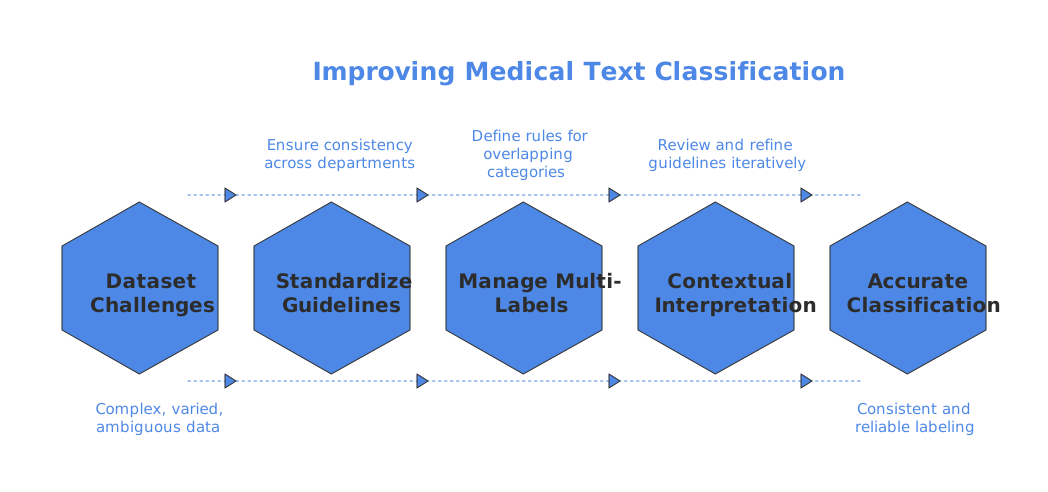
Medical text classification datasets face unique challenges due to the complexity of clinical documents, varying documentation styles, and regulatory constraints.
Variability Across Clinical Departments
Documentation styles differ across departments such as emergency medicine, oncology, and radiology. Annotators must recognize how similar concepts may be expressed differently across specialties. This variability complicates classification and requires carefully designed guidelines. Classification systems must support variation without sacrificing consistency.
Multi-Label and Overlapping Categories
Some documents or segments belong to multiple categories simultaneously. A radiology report may address multiple anatomical regions or findings. An encounter note may contain information relevant to several clinical specialties. Annotators must determine which labels apply and follow rules that manage multi-label scenarios. Overlapping categories require precise annotation instructions to avoid inconsistent classification.
Ambiguity and Contextual Interpretation
Clinical text often contains ambiguous phrases or incomplete statements. Annotators must interpret context to assign accurate labels. Ambiguity arises when a document includes multiple possible themes or when clinical reasoning is implicit rather than explicit. Addressing ambiguity requires careful review and iterative guideline refinement.
Creating Annotation Guidelines
Annotation guidelines define how annotators classify clinical documents. They specify categories, decision rules, and examples that support consistent labeling.
Defining Classification Criteria
Guidelines describe criteria for each classification category. These criteria help annotators distinguish between related categories. For example, a guideline may define the difference between an imaging report focused on screening versus one focused on diagnostic evaluation. Clear criteria ensure consistent label application.
Providing Representative Examples
Guidelines include sample documents that illustrate correct category assignments. Examples help annotators understand category boundaries and interpret complex clinical content. Review teams develop examples that reflect realistic clinical scenarios across multiple specialties. These examples serve as reference points during annotation.
Evaluating Medical Text Classification Datasets
Evaluation ensures that classification datasets support accurate, reliable model development. Evaluation processes examine label quality, representational diversity, and category distribution.
Annotation Consistency and Agreement
Reviewers assess annotation consistency by comparing labels across annotators. High agreement indicates that guidelines are clear and actionable. Low agreement prompts guideline revision. Evaluation methodologies described in medical research standards emphasize the importance of inter-annotator reliability for producing trustworthy classification datasets.
Distribution and Category Balance
Datasets must represent categories in balanced quantities to support effective model training. Skewed category distributions can cause models to overfit to common categories and underperform on rare ones. Evaluators review category counts and adjust sampling strategies to ensure balanced coverage. Category balance is particularly important for multi-label tasks where representation influences model performance.
Applications of Medical Text Classification Datasets
Medical text classification datasets support a variety of healthcare applications that require reliable categorization of clinical content.
Automated Triage and Document Routing
Classification models help route clinical documents to the correct teams or departments. Automated routing reduces administrative burden and improves workflow efficiency. Datasets that include category labels for document routing help models understand which themes or clinical areas a document pertains to.
Clinical Coding and Quality Reporting
Medical text classification supports the assignment of billing codes and quality reporting metrics. Annotated datasets help models learn patterns that correspond to specific coding categories or reporting requirements. Classification assists coders by identifying relevant documents and highlighting key themes.
Safety and Incident Classification
Healthcare organizations use classification models to analyze safety reports and identify patterns in adverse events. Datasets labeled with safety-related categories help models detect high-risk scenarios and support safety improvement initiatives. Agencies such as AHRQ emphasize the importance of structured documentation for patient safety research.
Future Directions in Medical Text Classification
Medical text classification continues to evolve as clinical NLP models incorporate more advanced architectures and integrate diverse data sources.
Integration With Multimodal Clinical Data
Future classification systems may incorporate images, structured patient data, or genomic information alongside clinical text. Multimodal datasets enhance classification by providing richer context for clinical decision-making. Integrating modalities requires new classification strategies and expanded annotation schemas.
AI-Assisted Classification Workflows
AI-assisted annotation tools support faster dataset creation by suggesting document categories. Human annotators validate or correct suggestions, improving efficiency while maintaining accuracy. Assisted workflows enable rapid expansion of classification datasets and support adaptation to new clinical categories.
If You Are Building Medical Text Classification Datasets
Medical text classification requires high-quality annotated documents that reflect the structure and complexity of clinical communication. If you are preparing datasets for document routing, coding assistance, or classification-based decision support, the DataVLab team can help structure annotation workflows that ensure accurate and consistent labeling. Share your objectives, and we can support your clinical NLP development with precisely annotated classification datasets.
What are Medical text classification datasets?
Medical text classification datasets provide the annotated clinical documents required to train NLP models that categorize medical text into meaningful clinical or operational categories. This article explains how these datasets are constructed, how annotation teams label medical documents, and why classification-specific labels are essential for tasks such as triage automation, clinical coding, and document routing.
Why is Classification a foundational task in clinical NLP?
Classification allows healthcare systems to manage complex clinical content efficiently. By assigning categories to clinical notes, diagnostic reports, or administrative records, classification models help systems retrieve relevant information and support clinical decision-making. Classification also enables automated routing, ensuring that documents reach the correct clinical teams or workflows.
What does the article explain about how classification differs from general clinical NLP?
Medical text classification is distinct from broader clinical NLP tasks such as information extraction or concept recognition. Classification focuses on identifying the overarching category or purpose of a document or segment. Unlike extraction tasks that label specific phrases or entities, classification organizes text into meaningful groups.
What does the section on “Annotation workflows for classification datasets” explain?
Annotation workflows for medical text classification focus on assigning categories that reflect document purpose or clinical content. These workflows must be consistent, objective, and aligned with classification goals. The first step in creating a classification dataset is defining the taxonomy of categories.
What are the main challenges of Medical text classification datasets?
Medical text classification datasets face unique challenges due to the complexity of clinical documents, varying documentation styles, and regulatory constraints. Documentation styles differ across departments such as emergency medicine, oncology, and radiology. Annotators must recognize how similar concepts may be expressed differently across specialties.
What is the future of Medical text classification datasets?
Medical text classification continues to evolve as clinical NLP models incorporate more advanced architectures and integrate diverse data sources. Future classification systems may incorporate images, structured patient data, or genomic information alongside clinical text. Multimodal datasets enhance classification by providing richer context for clinical decision-making.