Clinical NLP Datasets : How Annotated Clinical Text Powers Healthcare Language Models
.jpeg)

Clinical NLP datasets provide the annotated clinical text required to train natural language processing systems that interpret medical documents. This article explains how these datasets are constructed, what types of clinical content they contain, and how annotation teams label patient notes, reports, and clinical narratives. It discusses dataset structure, de-identification requirements, annotation workflows, and quality assurance. Readers will also learn how clinical NLP models use these datasets to support information extraction, cohort identification, and clinical decision support. The article concludes with a look at future directions in multimodal clinical datasets and large-scale clinical text corpora.
- Clinical NLP datasets provide the annotated clinical text required to train natural language processing systems that interpret medical documents.
- This article explains how these datasets are constructed, what types of clinical content they contain, and how annotation teams label patient notes, reports, and clinical narratives.
- Readers will also learn how clinical NLP models use these datasets to support information extraction, cohort identification, and clinical decision support.
- The article concludes with a look at future directions in multimodal clinical datasets and large-scale clinical text corpora.
Understanding Clinical NLP Datasets
Clinical NLP datasets are structured collections of clinical text annotated for use in natural language processing tasks. These datasets include de-identified patient notes, discharge summaries, radiology reports, pathology narratives, and other clinical documents that capture patient encounters. Annotation teams apply labels that help NLP models extract concepts, identify clinical events, and interpret medical meaning. The i2b2 initiative, which hosts numerous clinical NLP challenges, has demonstrated how annotated clinical datasets contribute to progress in clinical text processing and medical informatics. These datasets form the foundation for training models that support healthcare workflows.
Preparing these corpora for model training requires domain-aware medical annotation services for entities, relations, and clinical context.
Why Clinical Text Requires Special Handling
Clinical text differs from general text because it contains domain-specific terminology, abbreviations, structured fragments, and context-dependent meaning. These characteristics create unique challenges for NLP systems. Clinical narratives often contain shorthand expressions, temporal references, and complex clinical reasoning that require specialized annotation. The variability in documentation styles across departments and institutions adds complexity to dataset design. Clinical NLP datasets must accurately capture these variations while maintaining structure that supports machine learning.
The Role of Clinical NLP in Healthcare
Clinical NLP enables systems to extract structured information from unstructured text, improving access to clinical knowledge. Applications include problem list generation, medication extraction, cohort identification, and clinical decision support. To support these applications, NLP models require annotated examples of clinical expressions, entity relationships, and domain-specific syntax. Clinical NLP datasets provide these examples and help models achieve reliable performance. Because clinical text often influences downstream medical decisions, model accuracy depends on the quality of the dataset.
Types of Text Found in Clinical NLP Datasets
Clinical NLP datasets include diverse clinical documents that reflect different aspects of patient care. Each document type contains specific patterns of language and structure that influence annotation strategies.
Electronic Health Record Notes
Electronic health record notes include histories, progress notes, and care summaries. These notes provide detailed views of patient encounters. They contain a mixture of narrative text, shorthand, and clinical observations that require careful annotation. De-identified examples drawn from clinical research databases, such as resources aggregated through national research collaboratives, demonstrate the linguistic variability present in these documents.
Diagnostic Reports
Radiology, pathology, and laboratory reports contain structured conclusions, diagnostic impressions, and contextual observations. Annotation tasks for diagnostic reports may include identifying findings, uncertainties, anatomical sites, or diagnostic statements. These reports often contain domain-specific terminology that requires specialized linguistic knowledge. Annotators must recognize how diagnostic phrases relate to clinical meaning.
Discharge Summaries
Discharge summaries provide comprehensive overviews of hospital stays, including diagnoses, treatments, and follow-up instructions. These summaries require annotation of clinical events, key findings, medications, and procedural details. Their structured narrative format makes them valuable for training models that interpret longitudinal clinical information. Annotators must identify transitions between sections and clarify temporal relationships.
Annotation Workflows for Clinical NLP Datasets
Annotation workflows define how annotators review clinical text, assign labels, and ensure the dataset supports NLP objectives. These workflows require medical knowledge, linguistic skills, and carefully designed guidelines.
Clinical Concept Extraction
Annotators identify and label clinical concepts such as conditions, medications, tests, or procedures. They classify each concept according to established medical categories. Annotators must understand clinical terminology and differentiate between similar concepts that occupy distinct clinical roles. This process helps NLP models learn to detect concepts reliably across varied documentation styles.
Relationship and Event Annotation
Clinical narratives contain relationships between entities, such as medication dosages, laboratory values, or symptom associations. Relationship annotation captures these connections to support more advanced NLP tasks. Event annotation labels clinical events such as admissions, discharges, procedures, and symptom progression. Annotating relationships and events requires understanding of clinical context and domain-specific logic.
Section and Structure Labeling
Clinical documents contain implicit or explicit section structures that influence interpretation. Annotators label section boundaries, headings, and transitions to help models understand document organization. This structural annotation supports tasks such as information extraction and summarization. It also helps models distinguish between subjective assessments and objective findings.
Challenges in Creating Clinical NLP Datasets
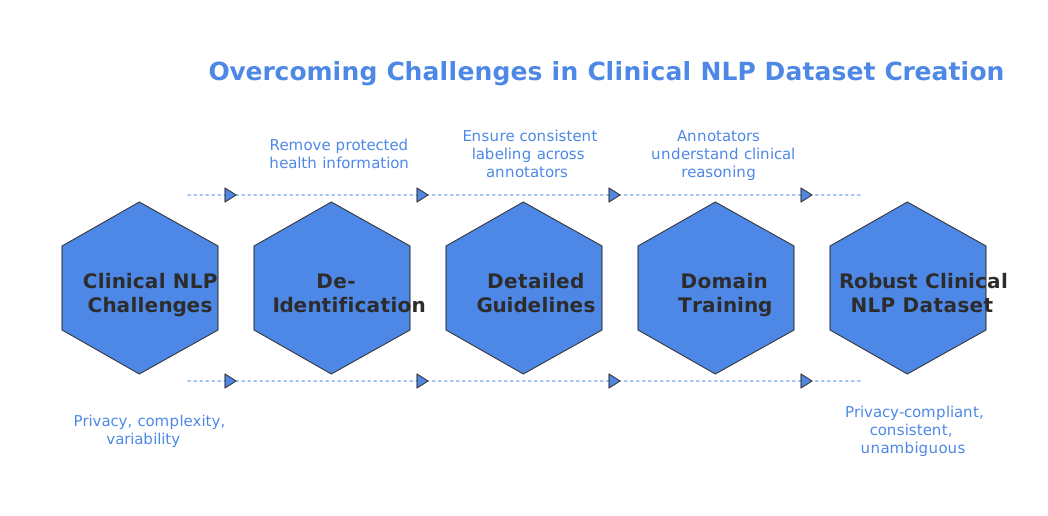
Clinical NLP dataset creation presents unique challenges due to privacy regulations, data complexity, and documentation variability. Addressing these challenges requires careful planning and execution.
De-Identification Requirements
Because clinical text contains protected health information, datasets must be de-identified before annotation. De-identification removes patient names, dates, locations, and other identifiers. This process ensures that datasets comply with privacy regulations. Projects such as the MIMIC database demonstrate how de-identification can preserve clinical meaning while protecting patient identity. Maintaining data utility after de-identification remains a central challenge for dataset developers.
Variation in Clinical Terminology
Clinical terminology varies across specialties, institutions, and documentation styles. Annotators must navigate these variations while applying consistent labels. This challenge requires detailed guidelines and domain training. Variation in terminology can also affect model generalization, making coverage diversity crucial for dataset robustness.
Ambiguity in Clinical Narratives
Clinical narratives contain ambiguous phrases that require interpretation. A term may refer to a finding, a symptom, or a negated condition depending on context. Annotators must understand clinical reasoning to determine correct labels. Ambiguity complicates annotation workflows and requires iterative clarification. Detailed guidelines help reduce confusion and align interpretations across annotators.
Designing Annotation Guidelines
Annotation guidelines ensure consistent and accurate annotations. They define categories, decision rules, and examples that help annotators navigate clinical narratives.
Concept Category Guidelines
Guidelines describe clinical concept categories and how annotators should apply them. These categories may include diagnoses, medications, symptoms, and procedures. Clear definitions help annotators differentiate between related concepts. Guidelines also specify edge cases and provide examples that illustrate proper classification. This structure ensures that annotators produce consistent labels that reflect clinical meaning.
Relationship Annotation Rules
Relationship annotation guidelines define how annotators should capture connections between entities. They describe how to identify relationships such as dosage associations, causal dependencies, or anatomical links. These rules help annotators capture clinical reasoning and contextual meaning within the narrative. Structured relationship annotation supports more complex NLP models that require deeper contextual understanding.
Evaluating Clinical NLP Datasets
Evaluating clinical NLP datasets involves reviewing annotation accuracy, consistency, and representational coverage. Evaluation ensures that datasets support reliable model development.
Annotation Quality Audits
Reviewers perform quality audits by examining annotated samples and checking for label accuracy and consistency. They compare annotations across annotators to identify disagreements or inconsistencies. Audits also verify that annotations follow guideline definitions. This process maintains data quality and supports training robust models.
Coverage and Representational Diversity
Datasets must include diverse clinical documents that represent different specialties, departments, and patient populations. Evaluators examine whether the dataset covers a wide range of clinical scenarios and documentation styles. Diversity improves model generalization and avoids bias toward specific clinical subdomains. Clinical informatics research, such as publications from AMIA, highlights the importance of representational diversity for effective clinical NLP.
Applications of Clinical NLP Datasets
Clinical NLP datasets support a variety of applications across clinical care, research, and healthcare operations. These applications rely on structured clinical text to generate reliable outputs.
Information Extraction
NLP models trained on clinical datasets extract key information such as diagnoses, symptoms, and medications from clinical notes. This extraction supports tasks such as problem list maintenance, clinical decision support, and population health analytics. Accurate extraction requires high-quality annotated datasets that represent real clinical text.
Cohort Identification
Clinical NLP datasets support cohort identification by helping models detect relevant clinical information that determines patient inclusion or exclusion. These datasets enable more efficient clinical research and trial screening processes. Models can identify patients who meet specific criteria based on annotated clinical narratives, reducing manual screening time.
Future Directions for Clinical NLP Datasets
As clinical NLP evolves, dataset development will incorporate new modalities, expanded concept coverage, and more advanced annotation strategies.
Multimodal Clinical Datasets
Future clinical NLP datasets may integrate clinical text with imaging, genomics, or structured EHR data. This multimodal approach supports more comprehensive patient analysis. Integrating modalities requires refined annotation guidelines that capture relationships between different data sources. Multimodal datasets help models learn richer clinical representations.
Scalable Annotation with AI Assistance
AI-assisted annotation tools can accelerate dataset creation by suggesting concept labels or highlighting candidate relationships. Human annotators refine these suggestions to ensure accuracy. Assisted annotation reduces workload and improves consistency across large datasets. As tools become more sophisticated, assisted workflows will play a larger role in clinical NLP development.
If You Are Preparing Clinical NLP Datasets
Reliable clinical NLP depends on high-quality annotated clinical text that reflects real-world documentation styles and clinical reasoning. If you are building datasets for concept extraction, relationship classification, or clinical decision support, the DataVLab team can help design and manage annotation workflows that ensure accuracy and consistency. Share your objectives, and we can support your clinical NLP development with precisely annotated clinical data.
How does Annotated clinical text power Healthcare language models?
Clinical NLP datasets provide the annotated clinical text required to train natural language processing systems that interpret medical documents. This article explains how these datasets are constructed, what types of clinical content they contain, and how annotation teams label patient notes, reports, and clinical narratives.
What does the article explain about why clinical text requires special handling?
Clinical text differs from general text because it contains domain-specific terminology, abbreviations, structured fragments, and context-dependent meaning. These characteristics create unique challenges for NLP systems. Clinical narratives often contain shorthand expressions, temporal references, and complex clinical reasoning that require specialized annotation.
What does the section on “Annotation workflows for clinical NLP datasets” explain?
Annotation workflows define how annotators review clinical text, assign labels, and ensure the dataset supports NLP objectives. These workflows require medical knowledge, linguistic skills, and carefully designed guidelines. Annotators identify and label clinical concepts such as conditions, medications, tests, or procedures.
What are the main challenges of Clinical NLP datasets?
Clinical NLP dataset creation presents unique challenges due to privacy regulations, data complexity, and documentation variability. Addressing these challenges requires careful planning and execution. Because clinical text contains protected health information, datasets must be de-identified before annotation.
What are the main use cases for Clinical NLP datasets?
Clinical NLP datasets support a variety of applications across clinical care, research, and healthcare operations. These applications rely on structured clinical text to generate reliable outputs. NLP models trained on clinical datasets extract key information such as diagnoses, symptoms, and medications from clinical notes.
What is the future of Clinical NLP datasets?
As clinical NLP evolves, dataset development will incorporate new modalities, expanded concept coverage, and more advanced annotation strategies. Future clinical NLP datasets may integrate clinical text with imaging, genomics, or structured EHR data. This multimodal approach supports more comprehensive patient analysis.