Car Damage Assessment : How Insurance AI Automates Claims and Vehicle Damage Detection
.jpeg)
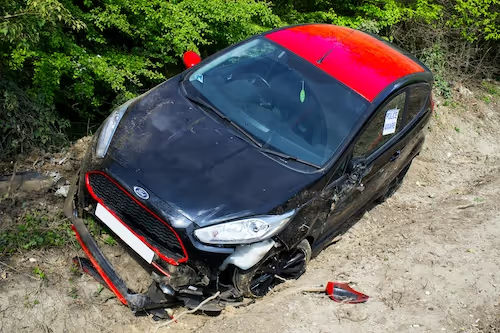
Car damage assessment has become one of the fastest growing applications of insurance AI. By analysing accident photos, identifying damaged parts, and assessing severity, machine learning models help insurers reduce manual workload and speed up claim settlement. This article explains how car damage assessment works, why annotated datasets are essential, and what challenges insurers face when deploying AI in real accident conditions. It also explores damage detection techniques, vehicle part segmentation, data quality standards, model evaluation, regulatory implications, and the practical workflow for building insurance grade AI systems. The goal is to give insurance professionals, AI teams, and enterprise leaders a complete understanding of the technical and operational foundations behind modern damage assessment automation.
- By analysing accident photos, identifying damaged parts, and assessing severity, machine learning models help insurers reduce manual workload and speed up claim settlement.
- This article explains how car damage assessment works, why annotated datasets are essential, and what challenges insurers face when deploying AI in real accident conditions.
- It also explores damage detection techniques, vehicle part segmentation, data quality standards, model evaluation, regulatory implications, and the practical workflow for building insurance grade AI systems.
- The goal is to give insurance professionals, AI teams, and enterprise leaders a complete understanding of the technical and operational foundations behind modern damage assessment automation.
Car damage assessment refers to the automated analysis of vehicle images to detect, classify, and estimate the severity of physical damage. Insurers often receive thousands of accident photos per week, and each must be reviewed by claim handlers or adjusters. AI enhances this workflow by identifying the damaged parts, understanding collision severity, predicting repair complexity, and recommending next steps. These systems do not replace human experts but accelerate the process and triage simple claims so adjusters can focus on complex ones.
Across the insurance industry, digital claims processing has become a strategic priority. Industry research from the National Association of Insurance Commissioners highlights how automation improves settlement times and customer satisfaction, especially when combined with structured damage detection models. AI powered damage assessment is now considered essential for reducing operational costs and increasing consistency.
To achieve reliable performance, car damage assessment requires several interconnected components: accurate annotations, curated vehicle damage datasets, robust part level segmentation, and model architectures tuned for real world conditions. This article breaks down the full pipeline and describes the specific considerations that differentiate automotive damage analysis from standard computer vision projects.
Why Insurers Need Automated Damage Assessment
Rising volume of digital claims
Policyholders now submit photos through mobile apps, agent portals, or automated kiosks. With this surge in digital documentation, adjusters face a growing burden of manual review. AI helps pre screen claims and highlight cases requiring escalation.
Consistency and standardisation
Human review varies across adjusters and geographic regions. AI systems help provide consistent assessments, ensuring similar damage types receive similar evaluations regardless of who processes the claim.
Faster settlement for low complexity claims
Minor accidents or cosmetic damage represent a large portion of claims. Automated systems can approve or pre evaluate these cases in seconds, allowing insurers to offer immediate decisions.
Fraud detection support
AI models can identify inconsistencies such as reused images, mismatched environments, or anomalies that may indicate fraudulent activity. Fraud prevention units benefit from automated flagging mechanisms.
Cost reduction
By accelerating case handling and reducing manual review requirements, insurers reduce administrative expenses. The Boston Consulting Group reports that claims automation is one of the strongest levers for operational efficiency in insurance transformation programs.
Automated car damage assessment is not simply a convenience. It directly impacts customer experience, operational efficiency, and competitive differentiation in a crowded market.
How Car Damage Assessment Works
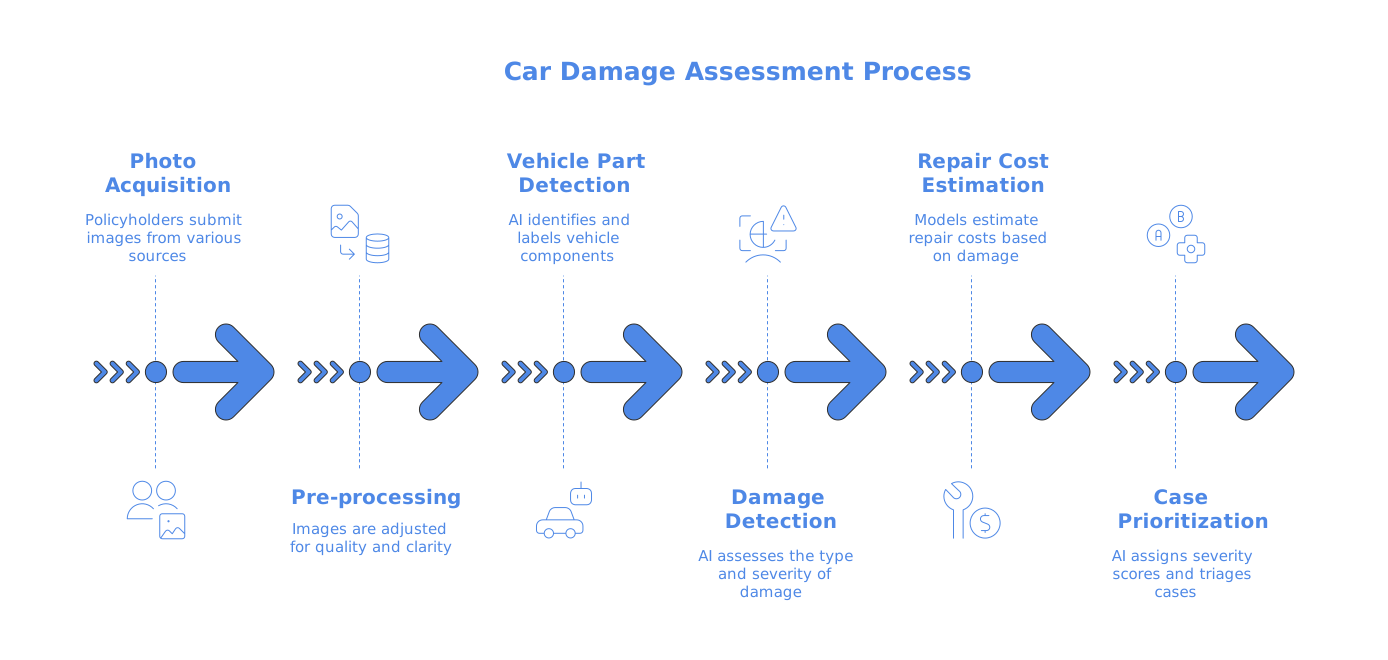
Step 1: Photo acquisition
Policyholders submit images from mobile phones, repair centers, or roadside capture systems. Quality varies widely, and AI must handle poor lighting, unusual angles, occlusions, reflections, and low resolution.
Step 2: Pre processing
Before damage detection, the system performs image adjustments, including denoising, cropping, and correcting orientation. Some systems run object detection to isolate the vehicle from the background.
Step 3: Vehicle part detection
The first major step is identifying the vehicle’s structural components. The model must label doors, bumpers, fenders, the hood, the trunk, headlights, mirrors, and other components. This typically requires polygon segmentation or keypoint mapping.
Step 4: Damage detection
Once parts are localized, the AI assesses the type of damage. Categories often include scratches, dents, cracks, broken parts, deformation, missing components, and paint damage. Severity prediction is trained through a regression or classification approach.
Step 5: Repair cost estimation (optional)ge
Some insurers integrate repair cost estimation models. These models map detected damage to historical repair data. While accuracy varies, they help generate initial estimates for adjusters to review.
Step 6: Case prioritisation
AI assigns a severity score and triages the case. Low severity claims can move to fast track. High severity cases are sent to specialists. Extreme cases, such as total loss, can be flagged for immediate manual review.
Car damage assessment models require sophisticated annotation and high quality training data. Without these, accuracy drops dramatically when exposed to real accident photos.
Understanding Vehicle Damage Datasets
A vehicle damage dataset is a structured collection of accident images, annotated to identify damaged parts and classify severity. The dataset forms the foundation for training insurance grade damage detection models.
Dataset composition
A strong dataset contains:
- A wide variety of vehicles: sedans, SUVs, trucks, vans, fleet vehicles, luxury vehicles
- Multiple lighting conditions
- Front, rear, and side collisions
- Minor and major damages
- Rare scenarios such as rollovers or crushed frames
- Weather variations including rain, snow, fog, and night conditions
The impact of dataset diversity
If the dataset only includes clean photos from ideal angles, the model will fail in real world insurance conditions. Industry case studies from the MIT Center for Information Systems Research note that insurance AI struggles without “messy, real world” datasets that reflect actual customer submissions.
Damage class imbalance
Minor scratches appear far more often than catastrophic damage. Models trained on imbalanced data may overpredict common classes. Balancing strategies or targeted data collection can mitigate this.
Part level annotation
Accurate part level labeling enables precise damage detection. Annotators map vehicle components with polygons, segmentations, or keypoints. These annotations must follow consistent guidelines to avoid introducing noise into the data.
Privacy and regulatory constraints
Insurance photos often include license plates, personal items, or identifiable backgrounds. Data must be processed under strict privacy frameworks, especially when handled within the European Union. GDPR requires safe, audited environments and controlled workforce access.
A well curated dataset improves accuracy, reliability, and fairness, making it one of the most important components of a successful insurance AI initiative.
Annotation Strategies for Insurance Damage Assessment
Damage assessment relies heavily on high quality annotation. Even small errors can train the model to misinterpret damage patterns.
Bounding boxes for coarse localization
Bounding boxes mark general vehicle regions but are rarely sufficient for insurance grade systems. They are used mainly during early dataset exploration.
Polygon segmentation for part outlines
Polygon segmentation provides accurate structural outlines. This format allows the model to learn part geometry and detect subtle deformations or fractures.
Semantic segmentation for entire vehicles
Semantic segmentation divides the image into pixel classes: door, bumper, window, tire, and more. It is one of the most powerful formats for detailed damage assessment.
Instance segmentation for multi car accidents
When multiple vehicles appear in one image, instance segmentation helps distinguish between them. This is critical in multi vehicle collision scenarios.
Damage labeling and severity classification
Annotators tag each part with a damage label and severity rating. Common severity levels include:
- Minor cosmetic damage
- Moderate structural deformation
- High severity damage
- Total loss indicators
Keypoints for structural reference
Keypoints help models determine alignment issues, identifying whether a bumper has shifted or a frame is bent.
Annotation QA processes
Insurance annotation demands strict QA. Supervisors review complex cases manually, ensuring high confidence labels. Automated QA tools detect inconsistencies such as overlapping segmentation masks or mislabeled parts.
Without robust annotation workflows, no model can generalise well to real accident conditions.
Model Architectures for Damage Detection
Convolutional neural networks for feature learning
CNNs such as EfficientNet, DenseNet, or MobileNet remain central for extracting structural features from vehicle images. These models capture texture, geometry, and damage patterns.
Vision Transformers for part segmentation
Transformers have gained popularity in damage detection because they capture global context. Severe damage often spans multiple parts, and transformers model these relationships effectively.
Hybrid models for classification and regression
Damage assessment requires classifying damage type and estimating severity. Hybrid loss functions combine classification and regression to optimize for both outcomes.
Part based relational models
Some insurers use part relational networks to understand how individual components interact. For example, damage to the front bumper may correlate with damage to headlights or fenders. These relationships can improve predictions.
Inference at production scale
Insurance companies may process thousands of photos per hour. Models must be efficient, with low latency and robust performance. Techniques such as model quantisation, pruning, or GPU acceleration help achieve production level speeds.
External research published by the Society of Automotive Engineers (SAE International) offers insights on AI powered vehicle inspection systems and their architectural design.
Challenges in Car Damage Assessment
Low quality user submitted photos
Users often send photos with poor framing, reflections, glare, or obstructions. AI must compensate for missing detail and inconsistent angles.
Multiple vehicles in a single scene
Accident photos frequently capture more than one car. Models need strong instance segmentation to avoid cross contamination of predictions.
Non standard environments
Photos may include cluttered backgrounds, roadside debris, shadows, or emergency responders. These complexities make classification more difficult.
Damage ambiguity
Some damage types are hard to detect visually. Internal structural damage is not always visible, and models must avoid overestimating or underestimating severity.
Rare but critical cases
Extreme damage scenarios such as rollovers or severe frontal crashes may appear rarely in training data. Models struggle with such edge cases unless datasets are carefully supplemented.
Regulatory expectations
Regulators increasingly expect explainability in automated decision systems. Insurers must demonstrate that AI assessments are fair, transparent, and traceable.
These limitations shape the design of insurance grade AI models and the workflows needed to support them.
Evaluating Accuracy in Insurance AI
Evaluating car damage assessment models requires more than standard computer vision metrics.
Damage detection accuracy
The model must correctly identify damaged versus undamaged parts. False negatives can delay claims, while false positives can inflate repair estimates.
Severity prediction accuracy
Severity estimation is often evaluated through regression or ordinal classification. Models require stable predictions across a wide range of damage types.
Part segmentation quality
Segmentation masks must align accurately with part boundaries. Small errors in mask placement can lead to incorrect damage classifications.
Cross environment generalisation
Models must perform consistently across:
- Different lighting conditions
- Mobile versus DSLR cameras
- Outdoor versus indoor repair shop environments
- High and low resolution images
Human in the loop validation
Most insurers deploy AI as part of a hybrid workflow. Human adjusters validate AI predictions and provide feedback. This feedback can be used to refine the model in continuous learning loops.
External guidance from the Organisation for Economic Co operation and Development (OECD) describes best practices for evaluating AI reliability in regulated industries.
Operational Deployment for Insurance Car Damage Assessment
Integration with claims management systems
AI outputs must connect seamlessly to the insurer’s claim management platform, routing cases automatically and updating dashboards.
Explainability requirements
Insurers need visual overlays that highlight damaged regions so adjusters understand how decisions were made.
Scalability and performance
Large insurers may handle millions of images annually. Infrastructure must support horizontal scaling, GPU inference, and fast response times.
Continuous dataset updates
Vehicle designs evolve and repair trends shift. Insurers must update datasets to reflect new models, materials, and damage patterns.
Compliance and audit trails
Every automated assessment must include metadata, timestamps, model version numbers, and traceability for compliance audits.
Car damage assessment is not just a model. It is an entire operational ecosystem requiring strong engineering, governance, and data workflows.
Real World Applications in Insurance
Digital self service claims
Customers submit photos directly through mobile apps, and the AI generates a preliminary assessment instantly. This reduces customer frustration and speeds up claim initiation.
Repair shop triage
Repair shops use damage detection models to estimate parts required, reducing the time between vehicle intake and repair start.
Fleet insurance and commercial claims
Fleet operators submit large batches of vehicle photos for periodic inspection. AI identifies issues early, preventing costly breakdowns.
Accident reconstruction support
AI helps identify points of impact, which can support adjusters interpreting complex crashes.
Underwriting and risk scoring
Underwriters use damage detection tools to analyse historical claim photos and correlate patterns with risk factors.
External insurance innovation resources from The Geneva Association provide strategic insights on how AI is reshaping global insurance workflows.
Future Directions
3D damage modeling
Future systems will generate 3D reconstructions of vehicles, giving adjusters a complete view of collision geometry.
Integration with telematics
Combining telematics data with image based damage assessment will improve accuracy in estimating impact severity.
Self improving models
Feedback loops will refine models continuously as insurers process more claims. Over time, AI becomes more robust and accurate.
Real time roadside assessment
Tow trucks, patrol vehicles, or police units may soon carry AI tools that assess damage immediately after an accident, accelerating the claims process dramatically.
Generative AI for repair estimation
Generative modeling could predict how a damaged component looked pre accident, improving cost estimates and fairness analysis.
Conclusion
Car damage assessment represents one of the most transformative applications of insurance AI. With strong vehicle damage datasets, precise annotation workflows, robust model architectures, and continuous data curation, insurers can dramatically improve claims processing speed and consistency. While challenges remain, especially in handling complex accident images and ensuring regulatory compliance, the trend toward automated damage detection is accelerating across global insurance markets. Organisations investing early in high quality datasets and structured AI workflows will lead the next wave of digital claims innovation.
Contact us at DataVLab
What is Car damage assessment?
Car damage assessment has become one of the fastest growing applications of insurance AI. By analysing accident photos, identifying damaged parts, and assessing severity, machine learning models help insurers reduce manual workload and speed up claim settlement.
What does the article explain about why insurers need automated damage assessment?
Policyholders now submit photos through mobile apps, agent portals, or automated kiosks. With this surge in digital documentation, adjusters face a growing burden of manual review. AI helps pre screen claims and highlight cases requiring escalation.
How does Car damage assessment work?
Policyholders submit images from mobile phones, repair centers, or roadside capture systems. Quality varies widely, and AI must handle poor lighting, unusual angles, occlusions, reflections, and low resolution. Before damage detection, the system performs image adjustments, including denoising, cropping, and correcting orientation.
What are the main challenges of Car damage assessment?
Users often send photos with poor framing, reflections, glare, or obstructions. AI must compensate for missing detail and inconsistent angles. Accident photos frequently capture more than one car.
What are the main use cases for Car damage assessment?
Customers submit photos directly through mobile apps, and the AI generates a preliminary assessment instantly. This reduces customer frustration and speeds up claim initiation. Repair shops use damage detection models to estimate parts required, reducing the time between vehicle intake and repair start.
What is the future of Car damage assessment?
Future systems will generate 3D reconstructions of vehicles, giving adjusters a complete view of collision geometry. Combining telematics data with image based damage assessment will improve accuracy in estimating impact severity. Feedback loops will refine models continuously as insurers process more claims.