Gesture Recognition in Automotive AI: How In Car Vision Systems Understand Driver Intent
.jpeg)
Gesture recognition automotive technology enables vehicles to interpret driver hand movements, body posture, and in cabin interactions without requiring physical buttons or touchscreens. As automakers redesign vehicle interiors around safety, convenience, and distraction free experiences, gesture recognition has become a key component of advanced human machine interfaces. This article explains how automotive gesture recognition works, how datasets and annotation shape performance, and why in cabin sensing requires extremely robust and privacy compliant AI. It also covers architectures, deployment considerations, and use cases across connected vehicles, premium automotive brands, and fleet safety systems. The goal is to provide a comprehensive technical and strategic overview of how gesture recognition systems are transforming the driving experience.
- Gesture recognition automotive technology enables vehicles to interpret driver hand movements, body posture, and in cabin interactions without requiring physical buttons or touchscreens.
- As automakers redesign vehicle interiors around safety, convenience, and distraction free experiences, gesture recognition has become a key component of advanced human machine interfaces.
- This article explains how automotive gesture recognition works, how datasets and annotation shape performance, and why in cabin sensing requires extremely robust and privacy compliant AI.
- It also covers architectures, deployment considerations, and use cases across connected vehicles, premium automotive brands, and fleet safety systems.
Gesture recognition automotive systems allow cars to interpret human gestures inside the cabin using computer vision. These gestures may include swiping movements, rotational motions, pinch gestures, pointing actions, or predefined signs used to control vehicle functions. Instead of relying on touchscreens or physical buttons, drivers can interact with the vehicle naturally. This has become increasingly important as modern car interiors incorporate larger screens and complex infotainment systems. Gesture based interfaces help minimise distraction by allowing drivers to keep their eyes on the road while interacting with the system through intuitive motions.
The technology relies on a combination of monocular or stereo cameras, infrared sensors, depth mapping, and machine learning models capable of recognising subtle variations in hand shape, speed, and trajectory. Research from the Fraunhofer Institute for Optronics and Information Systems describes how gesture interfaces reduce cognitive load and enhance safety when integrated properly into vehicle UX design. As more automakers adopt digital control systems, gesture recognition has become a critical element in next generation human machine interfaces.
Automotive gesture recognition covers many tasks, from simple gesture classification to complex spatiotemporal analysis. It must handle variation in lighting, driver height, seat position, and environmental conditions. This makes the problem substantially more difficult than general gesture recognition in controlled environments like game consoles or mobile apps.
Why Gesture Recognition Matters in Vehicles
Reducing driver distraction
Gesture recognition helps drivers control climate settings, media playback, navigation, or communication functions without touching a screen. This reduces distraction risk and creates a more fluid interaction flow. Automotive UX studies from the University of Michigan Transportation Research Institute show that gesture interfaces can reduce glance time away from the road when designed correctly.
Improving accessibility
Drivers with mobility limitations or reduced dexterity benefit significantly from gesture systems. A gesture based interface can serve as an alternative to physical knobs or small touch areas.
Supporting in cabin monitoring
Gesture recognition integrates with driver monitoring systems. If a driver makes a distress gesture or shows signs of impaired attention, the system can trigger alerts or prepare safety responses.
Enhancing premium and futuristic UX
Luxury car brands have adopted gesture control as part of a premium, high tech interior experience. It positions the vehicle as advanced, connected, and user friendly.
Building the foundation for autonomous interaction
As vehicles progress toward higher levels of automation, gesture recognition will support in cabin communication between passengers and vehicle systems, especially when traditional controls are removed.
The relevance of gesture recognition extends beyond convenience. It plays a direct role in safety, accessibility, and future vehicle design.
How Gesture Recognition Automotive Systems Work
Sensor setup inside the cabin
Gesture recognition systems typically rely on cameras positioned near the dashboard, A pillar, rear view mirror module, or center console. Some systems also use infrared cameras for night time performance. Depth sensors help interpret 3D movements, reducing ambiguity in gesture interpretation.
Hand and body detection
The first step in the pipeline is locating the driver’s hand or body region. Detection models isolate the hand from the background, accounting for seat position, clothing variation, and illumination changes.
Keypoint estimation
Keypoint models identify the structure of the hand by locating joints such as fingertips, knuckles, and the wrist. This skeletal representation enables precise interpretation of gesture shape and angle.
Temporal gesture classification
Gestures unfold over time, so the model must analyse the sequence rather than a single frame. Temporal convolution networks, recurrent networks, and transformer based architectures are commonly used to classify gestures based on motion trajectories.
Decision logic and system integration
Once a gesture is recognized, the system maps it to a control command such as lowering volume, accepting a call, or toggling climate settings. This decision layer often includes user context, preventing accidental gestures from triggering unwanted actions.
Gesture recognition is fundamentally a spatiotemporal computer vision problem. It requires robust models that can interpret motion reliably under a wide variety of cabin conditions.
Datasets for Gesture Recognition in Cars
Datasets are essential for training reliable gesture recognition models. They must capture a wide range of scenarios to ensure robust generalisation in real world conditions.
Dataset diversity
An automotive gesture dataset should include:
- Different hand shapes and sizes
- Various driver demographics
- Day and night conditions
- Multiple camera perspectives
- Drivers wearing gloves, rings, or accessories
- Varying cabin materials and reflections
- Situations where hands overlap with backgrounds or objects
Depth and infrared modalities
Many gesture datasets include depth maps or infrared frames. Depth helps disambiguate hand movements from background objects. Infrared ensures reliable detection in low light conditions.
Temporal annotation
Training gesture recognition requires frame level labels and precise segmentation of gesture start and end points. Temporal annotation is time consuming and requires skilled annotators following strict guidelines.
Multi class gesture annotation
Datasets must cover a rich variety of gestures, including:
- Swipe left or right
- Pinch or zoom motions
- Push forward or pull backward gestures
- Circular rotations
- Pointing gestures
- Stop or emergency gestures
Studies from the Max Planck Institute for Intelligent Systems document how temporal annotation quality impacts gesture recognition accuracy, particularly in complex multi gesture datasets.
Privacy considerations
Because gesture datasets involve in cabin video, privacy compliance is essential. Data must be processed under strict consent frameworks, especially in Europe under GDPR.
Building and curating a strong gesture recognition dataset is one of the most challenging aspects of developing an automotive grade solution.
Annotation for Gesture Recognition
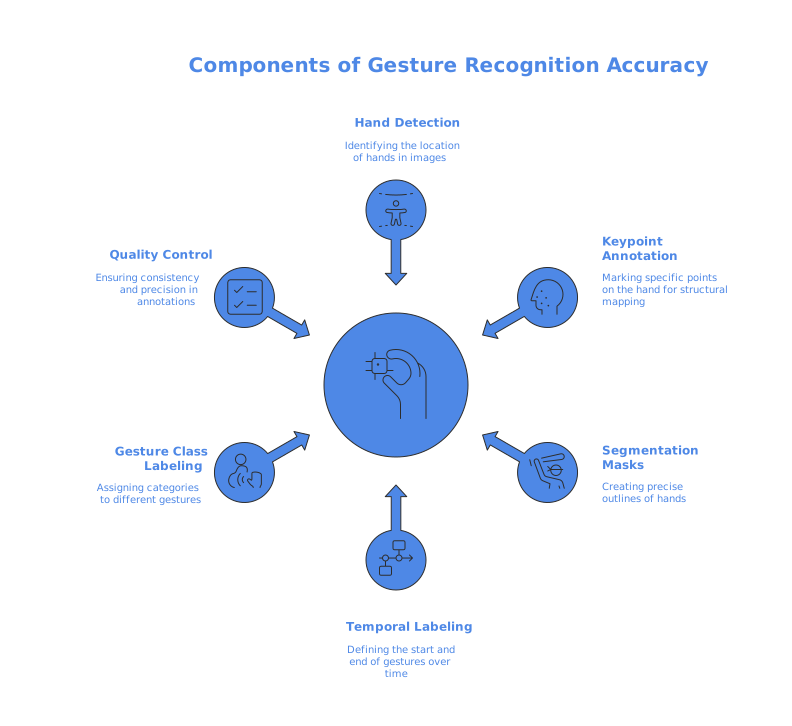
Hand detection annotation
Bounding boxes help the model learn where hands are located. These annotations must remain consistent across lighting variations.
Keypoint annotation for hand joints
Keypoints for fingertips, knuckles, and the wrist form a structural map. Annotators must follow strict geometry guidelines to avoid inconsistencies that confuse the model.
Segmentation masks for hand shape
Pixel precise segmentation helps the model learn the silhouette of the hand, improving performance when the background blends with skin tone or clothing.
Temporal gesture boundary labeling
Annotators mark the start and end of each gesture. This ensures the temporal model does not misinterpret casual movements as commands.
Gesture class labeling
Every gesture segment receives a class label. Teams need detailed definitions to avoid overlap or ambiguity between similar gestures.
Quality control for gesture annotation
Gesture annotation requires high levels of precision. Multi step review processes ensure that hand shapes, keypoints, and gesture boundaries remain consistent across the dataset.
Annotation is the foundation of gesture recognition accuracy. Without strong annotation workflows, gesture models break down in real world conditions.
Model Architectures for Gesture Recognition Automotive
Convolutional neural networks
CNNs are used for hand detection, segmentation, and early frame level feature extraction. They remain essential building blocks even in more advanced architectures.
3D convolution networks
3D CNNs analyze space and time simultaneously, allowing the model to interpret motion directly from temporal sequences. This is effective for simple gestures and short interactions.
Recurrent neural networks
LSTM and GRU networks interpret gestures as temporal patterns. They capture long term dependencies and have historically been widely used.
Transformers for gesture sequences
Transformer models excel at handling long and complex gesture sequences. They capture subtle differences between gestures that may look similar in isolated frames. Research from the Swiss AI Lab IDSIA shows that transformer architectures outperform traditional time series models in gesture classification tasks.
Hybrid detection and gesture models
Some systems use separate hand detection networks and gesture classification networks. Others combine them into end to end systems with shared encoders.
Edge optimised gesture models
Automotive systems require real time inference on embedded hardware. Lightweight models or quantised versions ensure low latency performance.
The choice of model architecture affects accuracy, robustness, and deployment feasibility. Automotive environments demand architectures that handle noise, low light, and unpredictable movement.
Challenges in Automotive Gesture Recognition
Lighting variation
Cabin lighting varies dramatically between day and night. Reflections from windows or screens can distort hand silhouettes. Models must be trained to handle these variations.
Occlusions and overlapping objects
The driver’s hand may overlap with the steering wheel, dashboard, or other objects. Robust segmentation helps mitigate these challenges.
False positives from casual movements
Drivers naturally move their hands while talking or adjusting their position. Gesture systems must distinguish intentional commands from random movement.
Variation across drivers
Differences in hand size, wrist shape, body posture, and driving style all affect gesture appearance. Dataset diversity helps models generalise.
Camera placement constraints
Cameras mounted in different positions capture the hand from different angles. Systems must remain robust even when the viewpoint shifts.
Regulatory and privacy requirements
In cabin monitoring systems fall under strict privacy guidelines. Manufacturers must ensure that gesture data is processed securely and transparently.
These challenges influence how datasets are built, how models are trained, and how systems are deployed in production vehicles.
Real World Applications of Gesture Recognition in Cars
Infotainment control
Cars use gesture recognition to control media playback, adjust volume, browse menus, or switch navigation views. This reduces reliance on touchscreens and improves driver focus.
Climate and comfort interactions
Drivers can adjust climate settings, seat heating, or cabin lighting using simple gestures. This makes the interface more intuitive and reduces physical contact points.
Hands free communication
Accepting or rejecting calls with gestures allows drivers to maintain attention on the road while interacting with the communication system.
Driver monitoring integration
Gesture recognition works alongside driver monitoring to detect signs of distraction or distress. If a driver signals for help, the system can automatically initiate emergency protocols.
Fleet safety systems
Commercial fleets use in cabin gesture recognition to monitor unsafe behaviors or detect when a driver shows signs of fatigue or frustration.
Studies from the Center for Automotive Research at Ohio State University highlight how gesture based interfaces enhance ergonomics and cabin design in modern vehicle interiors.
Future Directions for Gesture Recognition Automotive
Multimodal gesture systems
Future systems will combine gesture recognition with voice, eye tracking, and biometrics to build richer human vehicle interaction models. This multimodal approach improves accuracy and creates a seamless user experience.
Adaptive gesture personalization
Gestures will adapt to the driver’s unique motion style. Machine learning will personalise the gesture vocabulary to reduce false positives and improve comfort.
Gesture recognition for autonomous cabin layouts
As cabin layouts become more flexible in autonomous vehicles, gesture systems will handle interactions between passengers and vehicle systems in various seating arrangements.
Privacy preserving gesture models
Edge based processing and on device inference will reduce the need for cloud communication, aligning with strict privacy expectations and regulations.
Gesture forecasting
Future models may anticipate gestures before they fully unfold, reducing latency and improving system responsiveness.
Gesture recognition is moving toward a future where in cabin human computer interaction becomes smooth, personalised, and deeply integrated into vehicle intelligence.
Conclusion
Gesture recognition automotive technology is reshaping how drivers interact with their vehicles. By interpreting hand movements, posture, and motion patterns, gesture systems reduce distraction, enhance accessibility, and create more intuitive in cabin experiences. Successful deployment requires high quality datasets, robust annotation workflows, sophisticated temporal models, and rigorous attention to privacy and safety. As vehicles evolve toward higher automation and digital integration, gesture recognition will continue to play a central role in shaping the interface between humans and intelligent automotive systems.
Contact us at DataVLab
What is Gesture recognition in automotive AI?
Gesture recognition automotive technology enables vehicles to interpret driver hand movements, body posture, and in cabin interactions without requiring physical buttons or touchscreens. As automakers redesign vehicle interiors around safety, convenience, and distraction free experiences, gesture recognition has become a key component of advanced human machine interfaces.
Why does gesture recognition matter in vehicles?
Gesture recognition helps drivers control climate settings, media playback, navigation, or communication functions without touching a screen. This reduces distraction risk and creates a more fluid interaction flow. Automotive UX studies from the University of Michigan Transportation Research Institute show that gesture interfaces can reduce glance time away from the road when designed correctly.
What does the article explain about how gesture recognition automotive systems work?
Gesture recognition systems typically rely on cameras positioned near the dashboard, A pillar, rear view mirror module, or center console. Some systems also use infrared cameras for night time performance. Depth sensors help interpret 3D movements, reducing ambiguity in gesture interpretation.
What are the main challenges of Gesture recognition in automotive AI?
Cabin lighting varies dramatically between day and night. Reflections from windows or screens can distort hand silhouettes. Models must be trained to handle these variations.
What are the main use cases for Gesture recognition in automotive AI?
Cars use gesture recognition to control media playback, adjust volume, browse menus, or switch navigation views. This reduces reliance on touchscreens and improves driver focus. Drivers can adjust climate settings, seat heating, or cabin lighting using simple gestures.
What is the future of Gesture recognition in automotive AI?
Future systems will combine gesture recognition with voice, eye tracking, and biometrics to build richer human vehicle interaction models. This multimodal approach improves accuracy and creates a seamless user experience. Gestures will adapt to the driver’s unique motion style.