Music Genre Classification Dataset: How AI Learns Musical Style Recognition
.jpeg)

Music genre classification datasets provide curated audio samples labeled with genre categories such as jazz, classical, rock, electronic, hip hop, folk, and many others. These datasets help AI models learn statistical, spectral, and temporal patterns that define each musical style. They include raw audio files, spectrograms, multi-label metadata, and annotations describing instrumentation, tempo, rhythm, and expressive characteristics. This article explains how music genre datasets are constructed, why genre boundaries are often ambiguous, how annotators define genre labels, and what challenges arise when collecting diverse musical samples across cultures and eras. It also covers how dataset quality influences model performance in streaming platforms, recommendation systems, content moderation, and automated tagging tools used across the music and audio AI ecosystem.
- Music genre classification datasets provide curated audio samples labeled with genre categories such as jazz, classical, rock, electronic, hip hop, folk, and many others.
- They include raw audio files, spectrograms, multi-label metadata, and annotations describing instrumentation, tempo, rhythm, and expressive characteristics.
- This article explains how music genre datasets are constructed, why genre boundaries are often ambiguous, how annotators define genre labels, and what challenges arise when collecting diverse musical samples across cultures and eras.
- It also covers how dataset quality influences model performance in streaming platforms, recommendation systems, content moderation, and automated tagging tools used across the music and audio AI ecosystem.
Why Music Genre Classification Datasets Matter
Teaching AI How to Recognize Musical Style
Music genre classification datasets give AI systems the examples they need to distinguish between musical categories based on characteristic audio patterns. The Music Information Retrieval Lab at Queen Mary University of London describes how genre analysis requires recognizing spectral signatures, rhythmic motifs, and timbral cues that vary significantly across genres. Without structured datasets, AI models lack the diversity and annotated examples needed to learn these patterns.
Supporting Recommendation and Discovery Platforms
Streaming platforms rely on genre classification to power personalized recommendations, playlist generation, speech enhancement and content organization. Datasets help models identify stylistic relationships between tracks and assign accurate labels to new or emerging genres. By training on broad datasets, models can detect nuanced similarities that improve user experience across different listening contexts.
Enabling Automated Tagging and Audio Indexing
Media companies and content platforms use genre classification to tag newly uploaded audio, filter large music catalogs, and organize sound libraries. High-quality genre datasets allow automatic categorization at scale, reducing manual tagging effort and improving the consistency of musical metadata across platforms.
Core Components of Music Genre Classification Datasets
Raw Audio and High-Resolution Samples
Genre datasets include raw audio recordings in formats such as WAV or FLAC to preserve full spectral detail. High-resolution audio gives models access to subtle timbral features that are essential for distinguishing similar genres. Raw waveforms are often paired with precomputed spectrograms and mel-frequency representations.
Genre Labels and Multi-Genre Annotations
Genre labeling can be single-label or multi-label (and/or multilingual). Many modern tracks blend styles, so datasets often include multi-genre tags to represent hybrid styles accurately. Clear labeling guidelines help annotators assign consistent tags even when boundaries between genres are subjective.
Spectral and Rhythmic Metadata
Some datasets include metadata such as tempo, beat structure, chord progression, and instrumentation. This additional information supports model training by emphasizing the structural features that define musical genres. Metadata also improves interpretability for downstream applications.
Variability That Strengthens Genre Classification Models
Cultural and Regional Genre Representation
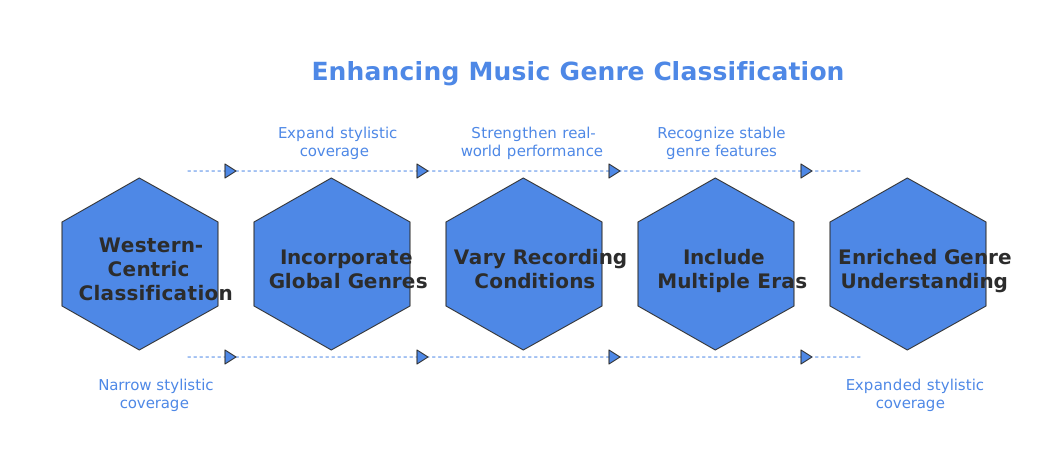
Music genres vary globally, and strong datasets include styles from diverse cultures such as Arabic classical, Indian classical, Japanese folk, Afrobeat, and Latin genres. The International Council for Traditional Music highlights how regional diversity enriches genre understanding by expanding stylistic coverage. Incorporating global genres helps models avoid narrow Western-centric classification.
Wide Range of Recording Conditions
Tracks recorded in studios differ significantly from those recorded in live settings or captured using consumer devices. Dataset diversity across recording environments helps models generalize and reduces bias toward cleaner audio samples. Noise and reverb variations help strengthen real-world performance.
Multiple Time Periods and Production Styles
Music genres evolve across decades. Including tracks from different eras introduces variation in production styles, timbre, and audio quality. This temporal diversity allows models to recognize genre features that remain stable even when recording techniques change.
Techniques Used to Build Genre Classification Datasets
Curated Music Collections
Many datasets are created by curating existing music libraries and licensing audio samples for research or commercial use. Curators select representative tracks, verify metadata accuracy, and ensure coverage across genres. This method produces diverse, high-quality datasets with clear licensing.
Audio Segmentation for Training Efficiency
Long tracks are often segmented into short clips, allowing models to learn patterns from multiple excerpts of the same piece (e.g. for detecting voice activity). Segmenting improves training efficiency and increases data volume without requiring additional music sources. Segments capture local spectral patterns that are key to genre identification.
Spectrogram and Feature Extraction
Dataset creators compute spectrograms, mel-frequency cepstral coefficients, and other audio features to support model training. These representations highlight the spectral and rhythmic elements that differentiate musical styles. Precomputed features reduce computational overhead during training and support a variety of machine learning architectures.
Annotation and Quality Assurance for Genre Data
Genre Definition and Label Consistency
Annotators must follow strict genre definitions to ensure consistency. Some genres share overlapping characteristics, making annotation subjective. Multi-annotator labeling and consensus reviews help maintain label reliability across large datasets.
Balancing Genre Representation
Some genres have far more available recordings than others. Dataset creators must balance representation to prevent models from overfitting to popular genres while ignoring niche styles. Balanced sampling ensures that each genre contributes meaningful training examples.
Metadata Accuracy Verification
Metadata such as tempo or instrumentation must be verified, especially when sourced from third-party libraries. Incorrect metadata introduces noise that can distort model understanding of genre-specific patterns.
Applications Enabled by Music Genre Classification Datasets
Personalized Music Recommendations
Streaming services use genre classifiers to match users with tracks that suit their tastes. Accurate genre tagging forms the foundation of recommendation algorithms and playlist curation tools.
Automated Content Organization
Media platforms rely on genre and more generally sound classification to categorize large audio libraries. Automatically organizing content reduces manual work and improves searchability across collections.
Music Analysis and Creative Tools
Music producers, composers, and analysts use genre-aware AI to understand stylistic patterns, generate new music, or analyze similarities between tracks. Genre classification supports creative workflows and musicological research.
Supporting Music Genre Dataset Development
Music genre classification datasets are essential for training AI systems that understand musical styles, detect patterns, and support streaming, indexing, and creative applications. Their quality depends on diverse musical representation, meticulous annotation, spectrogram preparation, and rigorous quality assurance. If your team needs help creating or annotating music genre datasets, we can explore how DataVLab supports high-quality audio and music AI projects with expert dataset development workflows.
How does AI learn Musical style recognition?
Music genre classification datasets provide curated audio samples labeled with genre categories such as jazz, classical, rock, electronic, hip hop, folk, and many others. These datasets help AI models learn statistical, spectral, and temporal patterns that define each musical style.
What does the article explain about why music genre classification datasets matter?
Music genre classification datasets give AI systems the examples they need to distinguish between musical categories based on characteristic audio patterns. The Music Information Retrieval Lab at Queen Mary University of London describes how genre analysis requires recognizing spectral signatures, rhythmic motifs, and timbral cues that vary significantly across genres.
What does the section on “Variability that strengthens genre classification models” explain?
Music genres vary globally, and strong datasets include styles from diverse cultures such as Arabic classical, Indian classical, Japanese folk, Afrobeat, and Latin genres. The International Council for Traditional Music highlights how regional diversity enriches genre understanding by expanding stylistic coverage.
How can teams ensure quality in Music genre classification dataset?
Annotators must follow strict genre definitions to ensure consistency. Some genres share overlapping characteristics, making annotation subjective. Multi-annotator labeling and consensus reviews help maintain label reliability across large datasets.
What are the main use cases for Music genre classification dataset?
Streaming services use genre classifiers to match users with tracks that suit their tastes. Accurate genre tagging forms the foundation of recommendation algorithms and playlist curation tools. Media platforms rely on genre and more generally sound classification to categorize large audio libraries.
What does the section on “Supporting music genre dataset development” explain?
Music genre classification datasets are essential for training AI systems that understand musical styles, detect patterns, and support streaming, indexing, and creative applications. Their quality depends on diverse musical representation, meticulous annotation, spectrogram preparation, and rigorous quality assurance.