Speaker Identification Dataset: Training AI to Recognize Individual Speakers
.jpeg)

Speaker identification datasets contain audio samples labeled with unique speaker identities, enabling AI systems to recognize individuals within large pools of speakers. These datasets include diverse speech recordings from various environments, devices, languages, and speaking styles. They support applications in media indexing, meeting transcription, customer analytics, call-center automation, forensic audio, and multi-speaker interaction systems. This article explains how speaker identification datasets are built, how identity labels are assigned, why balanced representation across speakers matters, and how speech variability helps models generalize. It also discusses the challenges of multilingual identification, background noise, overlapping speech, and device mismatch, along with the annotation and quality assurance workflows that ensure reliable speaker identification at scale.
- Speaker identification datasets contain audio samples labeled with unique speaker identities, enabling AI systems to recognize individuals within large pools of speakers.
- They support applications in media indexing, meeting transcription, customer analytics, call-center automation, forensic audio, and multi-speaker interaction systems.
- This article explains how speaker identification datasets are built, how identity labels are assigned, why balanced representation across speakers matters, and how speech variability helps models generalize.
- It also discusses the challenges of multilingual identification, background noise, overlapping speech, and device mismatch, along with the annotation and quality assurance workflows that ensure reliable speaker identification at scale.
Why Speaker Identification Datasets Matter
Recognizing Individuals Across Large Speaker Pools
Speaker identification datasets allow AI to map audio samples to specific individuals. Unlike verification, which compares pairs, identification requires the model to choose one identity from a large set. Research from the Centre for Speech Technology Research at the University of Edinburgh highlights that speaker identity features must be consistent across conditions to achieve reliable identification.
Powering Media Indexing and Meeting Analysis
Media platforms and enterprise meeting tools use speaker identification to determine who is speaking in long audio streams. Identification datasets support automatic labeling of participants, enabling searchability, analytics, and organized transcripts. These capabilities are essential for content creators, legal workflows, and enterprise knowledge management.
Supporting Customer Analytics and Multi-Speaker Systems
Organizations use speaker identification to analyze customer interactions, detect repeated callers, and understand engagement patterns. Speaker ID also supports voice interfaces that interact with multiple users, allowing personalized responses based on identity.
Core Components of Speaker Identification Datasets
Unique Speaker Identity Labels
Each audio sample is labeled with a unique speaker ID. This label remains consistent across all recordings from the same individual. Identity reliability is crucial to model performance, and mislabeled identities can significantly distort training.
Multi-Condition and Multi-Session Audio Samples
Identification datasets include recordings captured across multiple sessions, environments, and acoustic settings. Multi-condition sampling helps the model learn stable speaker characteristics despite external variation such as noise or reverberation.
Metadata for Speaker and Audio Characteristics
Datasets include metadata such as speaker age range, gender, accent, recording location, microphone type, and language. Metadata helps researchers evaluate model performance across demographics and acoustic conditions.
Variability That Strengthens Identification Models
Accent and Language Diversity
Speakers vary in accent and linguistic patterns including multilingual and regional speech samples improves model robustness and reduces bias toward specific languages. The Language Resources and Evaluation Conference highlights multilingual coverage as a critical factor for global speaker identification systems.
Device and Channel Mismatch
Different microphones, codecs, and transmission channels affect acoustic signatures. Including cross-device and cross-channel recordings prevents models from overfitting to specific hardware conditions and ensures accuracy across telecommunication platforms.
Vocal Style, Emotion, and Behavior
Speech varies based on emotional state, fatigue, pace, and speaking style. Recordings that capture expressive diversity help identification models maintain stability in real-world conversations and spontaneous speech.
Techniques Used to Build Speaker Identification Datasets
Large-Scale Crowdsourced Speech Collection
Crowdsourcing offers access to thousands of speakers from diverse backgrounds. Large speaker pools improve generalization and allow the dataset to reflect realistic diversity in identity traits.
Scripted and Unscripted Speech Recording
Scripted speech provides consistency across speakers and supports structured identity comparison. Unscripted speech captures natural vocal patterns that improve the model’s understanding of identity cues during spontaneous conversation.
Long-Form Speech Extraction and Segmentation
Dataset creators extract speech segments from long recordings, ensuring that identity labels remain consistent across time. Segmentation prevents redundant or overly long samples and focuses training on identity-rich audio sections.
Annotation and Quality Assurance for Identification Data
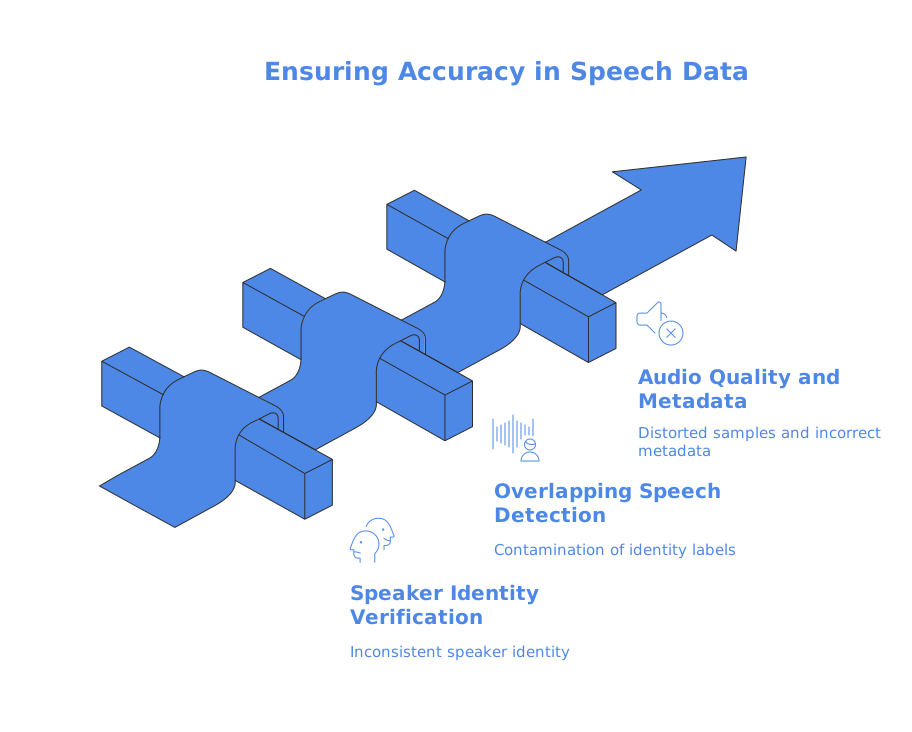
Speaker Identity Verification
Annotators validate that recordings attributed to the same speaker are consistent in identity. Identity drift, mix-ups, or mislabeled samples must be corrected through multi-reviewer validation.
Overlapping Speech Detection
In multi-speaker recordings, annotators separate overlapping speech or label segments that contain multiple voices. This avoids contamination of identity labels and preserves dataset integrity.
Audio Quality and Device Metadata Checks
Quality assurance includes reviewing audio clarity, removing clipped or distorted samples, and verifying that device metadata corresponds to actual recording conditions.
Applications Enabled by Speaker Identification Datasets
Media Search, Indexing, and Archive Organization
Platforms that host large audio libraries use speaker identification to index content by speaker identity. This enhances searchability and accelerates content workflows.
Meeting Transcription and Analytics
Speaker identification supports automatic speaker labeling in meetings, enabling detailed conversation analysis, attribution, and participation metrics.
Customer Experience and Personalization
Contact centers and voice-enabled systems use speaker identification to personalize interactions based on user identity. This improves engagement and supports CRM integration.
Supporting Speaker Identification Dataset Development
Speaker identification datasets form the backbone of identity-aware audio applications that require accurate mapping between voices and individuals. Their success depends on diverse speaker pools, multi-condition recordings, reliable identity labels, and multi-stage quality assurance. If your team needs help building, annotating, or validating speaker identification datasets for large-scale audio systems, we can explore how DataVLab supports high-quality dataset development across complex speech and speaker recognition scenarios.
What is Speaker identification dataset?
Speaker identification datasets contain audio samples labeled with unique speaker identities, enabling AI systems to recognize individuals within large pools of speakers. These datasets include diverse speech recordings from various environments, devices, languages, and speaking styles.
What does the article explain about why speaker identification datasets matter?
Speaker identification datasets allow AI to map audio samples to specific individuals. Unlike verification, which compares pairs, identification requires the model to choose one identity from a large set. Research from the Centre for Speech Technology Research at the University of Edinburgh highlights that speaker identity features must be consistent across conditions to achieve reliable identification.
What does the section on “Variability that strengthens identification models” explain?
Speakers vary in accent and linguistic patterns including multilingual and regional speech samples improves model robustness and reduces bias toward specific languages. The Language Resources and Evaluation Conference highlights multilingual coverage as a critical factor for global speaker identification systems.
How can teams ensure quality in Speaker identification dataset?
Annotators validate that recordings attributed to the same speaker are consistent in identity. Identity drift, mix-ups, or mislabeled samples must be corrected through multi-reviewer validation. In multi-speaker recordings, annotators separate overlapping speech or label segments that contain multiple voices.
What are the main use cases for Speaker identification dataset?
Platforms that host large audio libraries use speaker identification to index content by speaker identity. Speaker identification supports automatic speaker labeling in meetings, enabling detailed conversation analysis, attribution, and participation metrics. Contact centers and voice-enabled systems use speaker identification to personalize interactions based on user identity.
What does the section on “Supporting speaker identification dataset development” explain?
Speaker identification datasets form the backbone of identity-aware audio applications that require accurate mapping between voices and individuals. Their success depends on diverse speaker pools, multi-condition recordings, reliable identity labels, and multi-stage quality assurance.