Sound Classification Dataset: Training AI to Recognize Environmental and Acoustic Events
.jpeg)
Sound classification datasets contain audio samples of everyday acoustic events, ranging from footsteps, alarms, machines, and environmental sounds to natural phenomena such as rain, wind, and wildlife. These datasets provide the foundational training material for AI systems used in smart devices, public safety, robotics, industrial automation, and environmental monitoring. They include raw audio clips, spectrogram representations, multi-class labels, and metadata that describe context, duration, location, and acoustic properties. This article explains how sound classification datasets are curated, what annotation strategies they require, how overlapping sounds are managed, and why environmental diversity is essential for real-world reliability. It also covers the challenges of event segmentation, handling ambiguous audio, ensuring geographic diversity, and applying strict quality assurance to build stable models for complex acoustic recognition tasks.
- Sound classification datasets contain audio samples of everyday acoustic events, ranging from footsteps, alarms, machines, and environmental sounds to natural phenomena such as rain, wind, and wildlife.
- These datasets provide the foundational training material for AI systems used in smart devices, public safety, robotics, industrial automation, and environmental monitoring.
- This article explains how sound classification datasets are curated, what annotation strategies they require, how overlapping sounds are managed, and why environmental diversity is essential for real-world reliability.
- It also covers the challenges of event segmentation, handling ambiguous audio, ensuring geographic diversity, and applying strict quality assurance to build stable models for complex acoustic recognition tasks.
Why Sound Classification Datasets Matter
Teaching AI to Understand Non-Speech Audio
AI systems require structured datasets to learn the patterns associated with real-world sounds. Environmental audio events have varied spectral and temporal signatures that must be captured consistently. The Audio Research Group at the University of Surrey highlights that environmental acoustics are far less uniform than speech, making high-quality datasets essential. Without curated examples, models cannot reliably differentiate similar sounds such as wind versus rain or footsteps versus soft impacts.
Supporting Smart Devices and Everyday Applications
Consumer devices use sound classification to detect alarms, household appliances, knocks, and movement. These features depend on broad and diverse sound datasets that reflect real-world recording conditions. Strong datasets allow devices to react appropriately to non-speech cues, enhancing user experience and contextual awareness.
Enabling Robotics, Surveillance, and Industrial Monitoring
Robots, drones, and public safety systems rely on sound classification to detect events that may not be visible. Environmental audio offers an additional layer of perception that complements vision-based models. Research from the Acoustic Society of America shows that multi-sensor systems demonstrate significantly improved situational awareness when sound classification is integrated.
Core Components of Sound Classification Datasets
Diverse Audio Clips and Natural Recordings
Sound datasets include thousands of short audio clips recorded across different environments. Natural recordings capture the unpredictable variations that models must learn to navigate. These clips often represent multiple categories, from mechanical noises to environmental sounds and human-created acoustic events.
Multi-Class Labels and Event Metadata
Each clip is labeled with the primary sound event, and many datasets include metadata such as recording device, location, and environmental conditions. Consistent labeling ensures that models recognize the defining acoustic characteristics of each event.
Spectrograms and Precomputed Acoustic Features
Sound classification models often rely on spectrograms or mel-frequency cepstral coefficients. Precomputed features highlight the temporal and spectral patterns that differentiate events. These formats simplify model training and improve performance across simple and advanced architectures.
Variability That Strengthens Sound Classification Models
Indoor and Outdoor Environmental Diversity
Environmental audio varies significantly across locations. Indoor sounds include echoes, appliance noise, and human activity, while outdoor sounds include wind, vehicles, wildlife, and weather. Geographic diversity is essential to avoid overfitting to specific acoustic environments.
Background Noise, Overlapping Events, and Distortion
Real-world audio rarely contains isolated events. Overlapping sounds and background noise introduce complexity that models must learn to resolve. Including diverse noise patterns strengthens robustness, especially for safety-critical applications.
Device and Microphone Diversity
Recordings vary depending on microphone quality, placement, and device type. Strong datasets include recordings from smartphones, dedicated microphones, cameras, IoT devices, and industrial audio sensors. This diversity helps models generalize across hardware platforms.
Techniques Used to Build Sound Classification Datasets
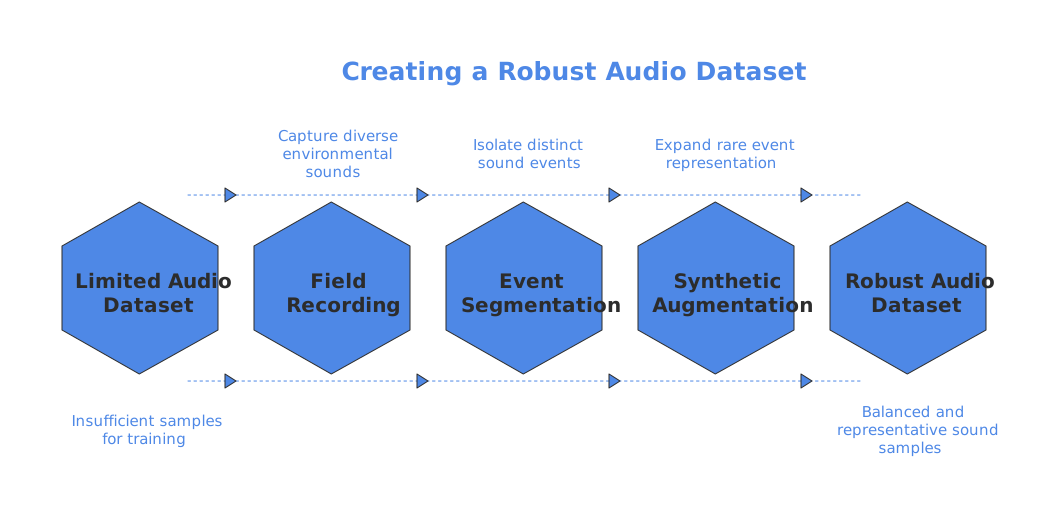
Field Recording Across Multiple Locations
Dataset creators collect audio samples from varied environments such as homes, factories, streets, forests, and transportation hubs. Field recording ensures authentic sound patterns that cannot be fully replicated in controlled settings. Location variability supports better generalization.
Event Segmentation and Isolation
Long recordings are segmented into individual sound events based on temporal cues or manual annotation. Segmenting complex audio streams ensures each sample represents a distinct label, improving dataset reliability and helping models learn clear event boundaries.
Synthetic Augmentation for Rare Events
Some sound events occur infrequently, such as specific alarms, mechanical failures, or wildlife calls. Synthetic augmentation or controlled simulation expands representation for rare categories while preserving naturalistic characteristics. Augmentation increases dataset balance without relying solely on field data.
Annotation and Quality Assurance for Sound Data
Precise Event Labeling
Annotators must identify the dominant sound event in each clip. Ambiguous events or overlapping sounds require clear criteria to determine which label applies. Annotation guidelines ensure consistency across large datasets and prevent subjective labeling drift.
Start and End Time Validation
Annotators validate the temporal boundaries of each sound event, ensuring that labeled clips start at the onset and stop at the offset of the intended event. Precise segmentation helps models learn accurate temporal cues.
Cross-Labeler Agreement and Noise Verification
Quality assurance processes include reviewer agreement checks, consistency audits, and audible inspections for distortion or recording artifacts. Noisy data must be filtered or labeled appropriately to prevent misleading models.
Applications Enabled by Sound Classification Datasets
Smart Home and IoT Device Intelligence
Sound classification enables devices to detect alarms, appliance activity, or unusual noises. These systems enhance safety and automation by interpreting acoustic cues in context.
Robotics and Autonomous Systems
Robots and autonomous vehicles use sound recognition to identify obstacles, detect mechanical anomalies, or interact with humans. Audio perception complements vision systems and improves overall environmental understanding.
Public Safety and Environmental Monitoring
Acoustic monitoring systems detect hazardous events, wildlife activity, or environmental threats. Sound datasets power models that classify events quickly and reliably in real-time scenarios.
Supporting Sound Classification Dataset Development
Sound classification datasets are crucial for training AI systems that understand everyday acoustic events and operate effectively in dynamic environments. Their quality depends on diverse field recordings, precise segmentation, consistent annotation, and robust quality assurance. If your team needs support building, annotating, or validating sound classification datasets, we can explore how DataVLab contributes high-quality audio dataset development for advanced acoustic AI systems.
What is Sound classification dataset?
Sound classification datasets contain audio samples of everyday acoustic events, ranging from footsteps, alarms, machines, and environmental sounds to natural phenomena such as rain, wind, and wildlife. These datasets provide the foundational training material for AI systems used in smart devices, public safety, robotics, industrial automation, and environmental monitoring.
What does the article explain about why sound classification datasets matter?
AI systems require structured datasets to learn the patterns associated with real-world sounds. Environmental audio events have varied spectral and temporal signatures that must be captured consistently. The Audio Research Group at the University of Surrey highlights that environmental acoustics are far less uniform than speech, making high-quality datasets essential.
What are the main use cases for Sound classification dataset?
Consumer devices use sound classification to detect alarms, household appliances, knocks, and movement. These features depend on broad and diverse sound datasets that reflect real-world recording conditions. Strong datasets allow devices to react appropriately to non-speech cues, enhancing user experience and contextual awareness.
What does the section on “Variability that strengthens sound classification models” explain?
Indoor sounds include echoes, appliance noise, and human activity, while outdoor sounds include wind, vehicles, wildlife, and weather. Geographic diversity is essential to avoid overfitting to specific acoustic environments. Overlapping sounds and background noise introduce complexity that models must learn to resolve.
How can teams ensure quality in Sound classification dataset?
Annotators must identify the dominant sound event in each clip. Ambiguous events or overlapping sounds require clear criteria to determine which label applies. Annotation guidelines ensure consistency across large datasets and prevent subjective labeling drift.
What does the section on “Applications enabled by sound classification datasets” explain?
Sound classification enables devices to detect alarms, appliance activity, or unusual noises. These systems enhance safety and automation by interpreting acoustic cues in context. Robots and autonomous vehicles use sound recognition to identify obstacles, detect mechanical anomalies, or interact with humans.