
Audio Annotation
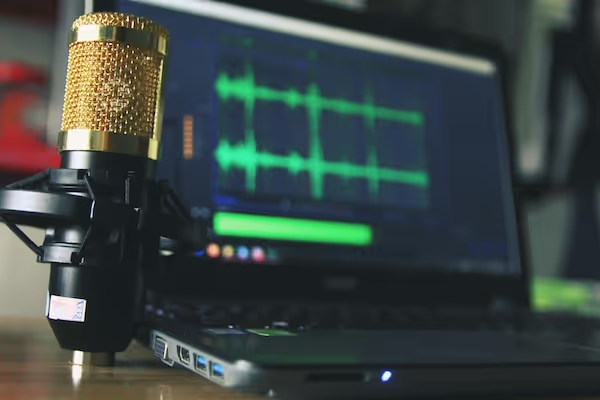

Audio Annotation
Built for teams shipping audio AI who need reliable labeled audio. You get stable label guidelines and QA you can audit, without slowing your roadmap. Audio Annotation is delivered with secure workflows and consistent reporting from pilot to production.
Reliable annotations for speech, environmental sounds, and domain specific audio.
Flexible workflows for segmentation, classification, speaker labeling, and acoustic event detection.
Strong multi step quality control for large and complex audio datasets.
Audio annotation turns raw sound into structured labels that audio and multimodal AI models can learn from. DataVLab supports teams building speech, sound event, and environmental audio systems with clear guidelines and consistent labeling across large datasets.
We annotate diverse sources including voice commands, call recordings, meetings, podcasts, in vehicle audio, and sensor synced audio streams. The goal is to reduce label noise and improve model robustness in real world conditions such as background noise, overlap, and device variability.
We adapt the labeling scope to your model objective and target deployment. Common deliverables include transcription, timestamps, speaker diarization, intent and sentiment tags, keyword spotting labels, and acoustic event classification.
Depending on the project, we can also provide segmentation at the utterance or event level, structured metadata, and normalization rules for numbers, punctuation, abbreviations, and domain specific terms. Output formats can be aligned to your pipeline for training and evaluation.
Audio annotation is used for ASR training, voice assistants, call center analytics, meeting intelligence, and safety monitoring. It also supports multimodal systems where audio is combined with video, telemetry, or contextual metadata.
We work with multilingual datasets and accent variation, and we can define rules for edge cases like overlapping speech, disfluencies, short commands, and low quality recordings. If you maintain a benchmark subset, we can keep a gold set to monitor consistency and drift over time.
Quality comes from calibration, multi pass review, and measurable checks. We run guideline alignment at the start, then apply sampling and audits to catch systematic errors early, especially on difficult segments like crosstalk, noise, and ambiguous intent.
Audio data can contain personal information, so we follow secure handling practices and can integrate redaction steps when required. This may include removing identifiers from transcripts, masking sensitive spans, and controlling access to raw audio and derived outputs. We can align documentation and processes with GDPR oriented workflows for regulated use cases.
Examples of Audio Annotation Workflows
We support audio based AI projects across speech, acoustics, and machine listening.

Speech Segmentation

Identifying sentence and speaker boundaries
We segment recordings by speech turns and sentence boundaries to support natural language models, conversational AI, and call center analytics.
Speaker Labeling
Distinguishing speakers in multi voice recordings
We annotate speaker identities, changes, and overlaps across long audio sequences for diarization and speaker recognition models.
Acoustic Event Detection
Labeling sound events within recordings
We identify and classify events such as alarms, footsteps, machinery, background noises, or environmental sounds.
Emotional and Sentiment Annotation
Tagging tone and affect in speech
We annotate emotional tones including frustration, urgency, politeness, or positive engagement for conversational systems.
Noise and Background Labeling
Categorizing non speech audio
We tag ambient sounds, interference, and environmental noises to help models separate speech from noise.
Transcript Alignment
Matching text to audio timelines
We align transcripts to audio segments for ASR training datasets and time coded indexing.
Discover How Our Process Works

Defining Project
Sampling & Calibration
Annotation
Review & Assurance
Delivery
Explore Industry Applications

We provide solutions to different industries, ensuring high-quality annotations tailored to your specific needs.
We provide high-quality annotation services to improve your AI's performances

Annotation & Labeling for AI
Unlock the full potential of your AI application with our expert data labeling tech. We ensure high-quality annotations that accelerate your project timelines.
NLP Data Annotation Services
NLP annotation services for chatbots, search, and LLM workflows. Named entity recognition, intent classification, sentiment labeling, relation extraction, and multilingual annotation with QA.
Text Data Annotation Services
Reliable large scale text annotation for document classification, topic tagging, metadata extraction, and domain specific content labeling.
Speech Annotation
Speech annotation services for voice AI: timestamp segmentation, speaker diarization, intent and sentiment labeling, phonetic tagging, and ASR transcript alignment with QA.
LLM Data Labeling and RLHF Annotation Services
Human in the loop data labeling for preference ranking, safety annotation, response scoring, and fine tuning large language models.
Multimodal Annotation Services
High quality multimodal annotation for models combining image, text, audio, video, LiDAR, sensor data, and structured metadata.
FAQs
Here are some common questions we receive from our clients to assist you.
What is audio annotation and what types of labeling does it include?
Audio annotation is the process of labeling audio recordings so that machine learning models can learn to understand, transcribe, classify, or generate sound. It includes speech transcription (converting spoken audio to text), speaker diarization (identifying and labeling who is speaking when), audio event detection (marking timestamps for specific sounds like car horns, alarms, or speech), emotion and sentiment annotation in speech, accent and dialect tagging, keyword spotting annotation, and quality assessment of synthesized or recorded speech for text-to-speech and voice AI applications.
Why does audio annotation require native-speaker annotators?
Speech transcription quality depends on native-speaker annotators, not just accurate typists. Native speakers correctly handle contractions, ellipsis, regional vocabulary, and the implicit decisions about how to represent informal speech in text. For multilingual audio annotation, non-native transcribers make systematic errors on phonemes that do not exist in their native language, on homophone disambiguation, and on culturally-specific references. For speaker diarization in multi-speaker recordings, annotators must reliably distinguish voices, including similar voices, overlapping speech, and speaker re-entry after silence. DataVLab provides audio annotation with native speakers for European languages.
What formats do you support for audio annotation datasets?
Common audio annotation formats include JSON with timestamp arrays (for event detection and diarization), WebVTT and SRT subtitle formats (for transcription with timing), ELAN format (for multi-tier linguistic annotation), PRAAT TextGrid (for phoneme and prosodic annotation), and custom JSON or CSV for speech AI training pipelines. For ASR training, transcripts are typically delivered as paired audio and text files in format conventions compatible with Kaldi, ESPnet, or HuggingFace datasets. For emotion and sentiment audio annotation, labels are often delivered alongside timestamp boundaries and confidence scores.
How long does audio annotation take?
Transcription throughput for clear single-speaker audio is typically 4 to 6 hours of transcription time per hour of audio for accurate verbatim transcription. For technical or accented speech, medical audio, or multi-speaker recordings, this increases to 8 to 15 hours per hour of audio. Emotion annotation and speaker diarization add additional time on top of transcription. Model-assisted transcription (ASR output corrected by human annotators) reduces total annotation time by 40 to 60 percent for clean audio, less for audio with significant noise or accents not well-covered by the ASR model.
What are the main use cases for audio annotation?
Audio annotation is used across several growing AI application categories. Voice assistants and conversational AI require large transcription and intent annotation datasets. Speech emotion recognition for customer service analytics, mental health monitoring, and automotive systems requires emotion-labeled speech at scale. ASR training and evaluation requires diverse multilingual transcription with accent, dialect, and speaker demographic coverage. Audio event detection for smart home, industrial monitoring, and security applications requires timestamped labels for specific sound events. Text-to-speech quality assessment requires human ratings of naturalness, intelligibility, and prosody for synthesized speech.
How is GDPR compliance handled for audio annotation projects?
Audio annotation raises specific data handling requirements. Recordings often contain personally identifiable information (names mentioned in speech, voice as a biometric identifier) that falls under GDPR personal data definitions. Voice data is classified as biometric data under GDPR when used for speaker identification purposes, which triggers additional processing requirements. For European audio annotation projects, GDPR-compliant workflows including appropriate legal basis, data minimization, retention limits, and EU-based processing are required. DataVLab operates audio annotation workflows within EU jurisdiction for projects where voice data GDPR compliance is a requirement.


Custom service offering

Up to 10x Faster
Accelerate your AI training with high-speed annotation workflows that outperform traditional processes.

AI-Assisted
Seamless integration of manual expertise and automated precision for superior annotation quality.

Advanced QA
Tailor-made quality control protocols to ensure error-free annotations on a per-project basis.

Highly-specialized
Work with industry-trained annotators who bring domain-specific knowledge to every dataset.

Ethical Outsourcing
Fair working conditions and transparent processes to ensure responsible and high-quality data labeling.

Proven Expertise
A track record of success across multiple industries, delivering reliable and effective AI training data.

Scalable Solutions
Tailored workflows designed to scale with your project’s needs, from small datasets to enterprise-level AI models.

Global Team
A worldwide network of skilled annotators and AI specialists dedicated to precision and excellence.
Potential Today
Blog & Resources
Explore our latest articles and insights on Data Annotation

We are here to assist in providing high-quality data annotation services and improve your AI's performances