
Multimodal Annotation Services for Vision Language and Multi Sensor AI Models


Multimodal Annotation Services
Built for teams shipping multimodal AI who need reliable labeled video. You get point cloud labels, stable label guidelines, and QA you can audit, without slowing your roadmap. Multimodal Annotation Services is delivered with secure workflows and consistent reporting from pilot to production.
Aligned labeling across images, text, audio, video, and sensor modalities for complex AI workflows.
Custom schemas for vision language training, multimodal reasoning, and instruction based models.
Scalable annotation with multilevel QA to ensure consistent alignment across datasets.
Multimodal AI systems combine visual, textual, audio, and sensor information to understand complex real world scenarios. These models require carefully structured datasets where every modality is aligned, synchronized, and annotated in a consistent way. DataVLab supports companies building advanced multimodal models such as vision language models, recommendation systems, robotics perception, and autonomous systems. Our teams work across images, videos, transcripts, audio clips, LiDAR scans, human feedback data, and metadata.
We design workflows that ensure each modality is annotated with compatible labels and linked to the correct frames, timestamps, or segments. Our multimodal annotation services cover a wide range of use cases such as interpreting user queries paired with images, labeling video and text sequences for instruction following, linking audio cues to events, or aligning structured data with visual observations.
All annotations are processed through multistage quality control to guarantee consistency across every modality.
How DataVLab Supports Multimodal and Vision Language Model Development
Our workflows are designed to help teams train models that rely on multiple inputs such as images paired with text, audio aligned with video, or sensor streams combined with metadata.

Image and Text Pair Annotation

Labeling input pairs for vision language models
We annotate images with captions, instructions, answers, or classifications to support training of multimodal reasoning systems.
Video and Transcript Alignment
Synchronizing spoken or written content
We align transcripts with video frames, annotate speaker turns, and mark relevant segments.
Audio Event Labeling
Linking sound cues to context
We annotate audio segments and connect them to corresponding moments in video or metadata.
LiDAR and Image Co Annotation
Multisensor labeling workflows
We annotate LiDAR point clouds and match them with camera frames for robotics or navigation systems.
Instruction and Response Dataset Preparation
Creating multimodal prompt datasets
We pair prompts, images, and expected answers to support instruction based multimodal models.
Metadata and Visual Alignment
Structuring labels across heterogeneous inputs
We match structured data with corresponding image, video, or text elements to support advanced classifiers and retrieval systems.
Discover How Our Process Works

Defining Project
Sampling & Calibration
Annotation
Review & Assurance
Delivery
Explore Industry Applications
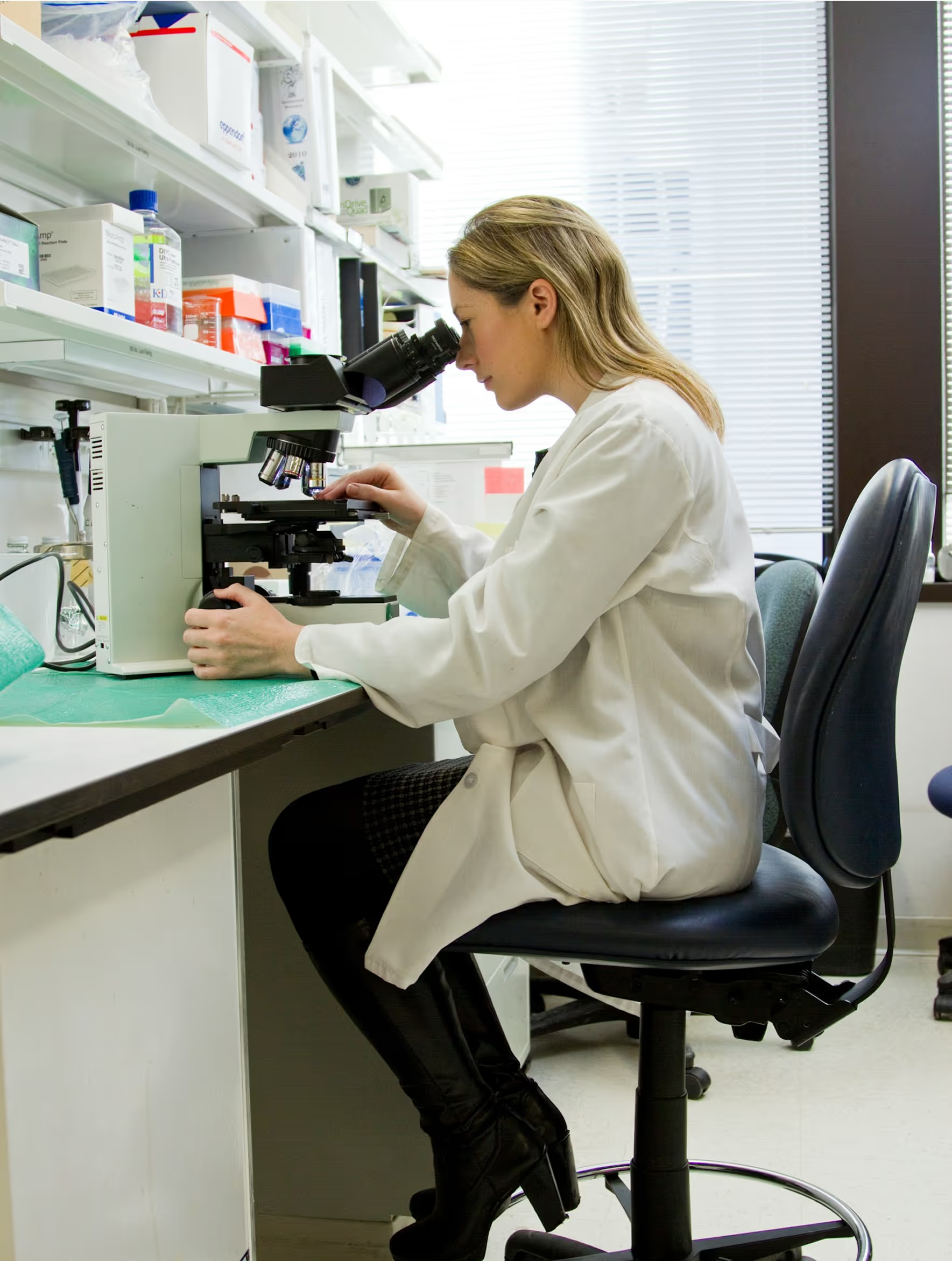
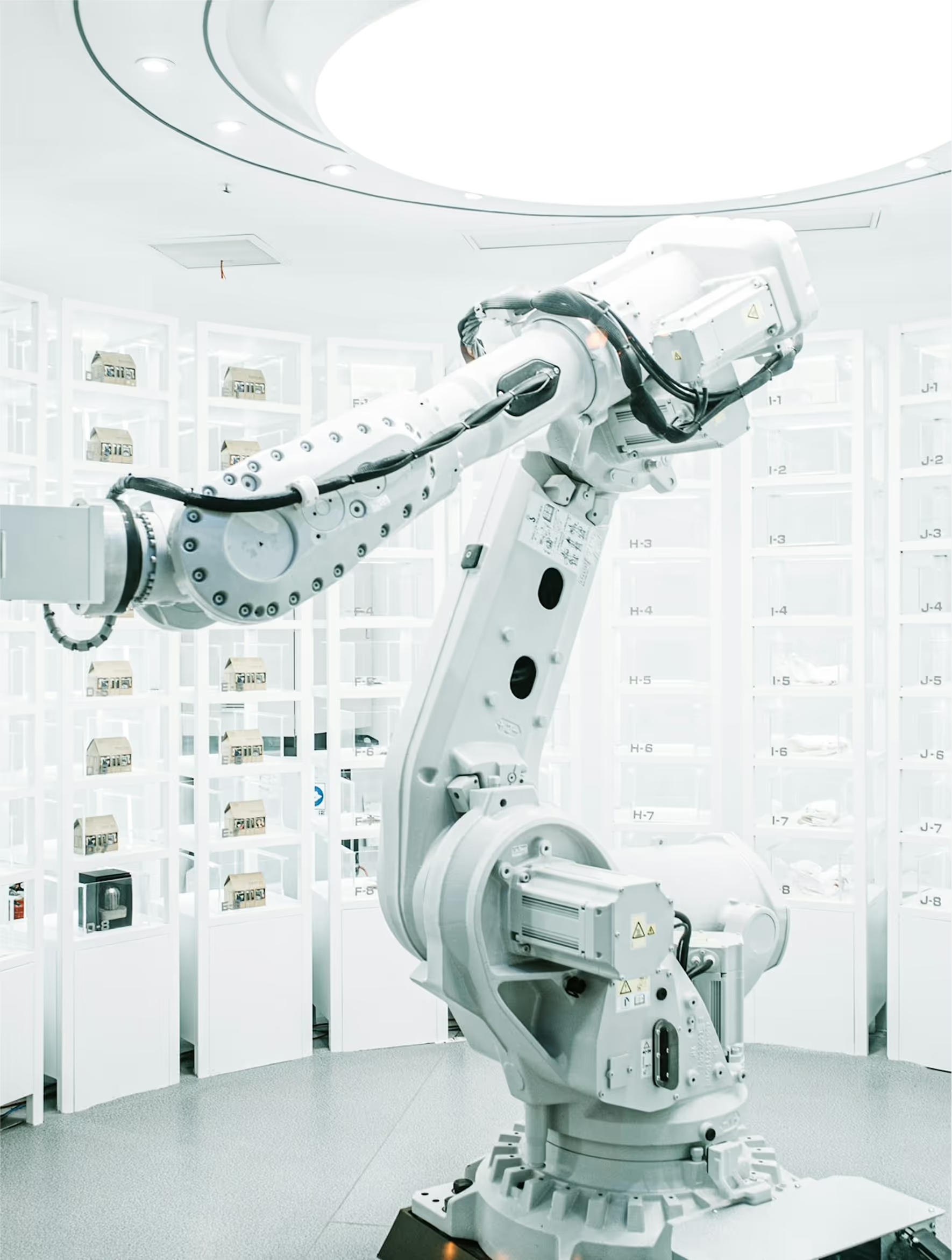


We provide solutions to different industries, ensuring high-quality annotations tailored to your specific needs.
We provide high-quality annotation services to improve your AI's performances

Annotation & Labeling for AI
Unlock the full potential of your AI application with our expert data labeling tech. We ensure high-quality annotations that accelerate your project timelines.
LLM Evaluation Services
Human evaluation of large language models with expert reviewers, calibrated rubrics, and reliable inter-annotator agreement. EU-based teams for projects that require quality and sovereignty.
LLM Red Teaming Services
Adversarial evaluation of large language models by safety and domain experts. Jailbreaks, prompt injection, harmful outputs, hallucinations, and bias discovery for AI teams shipping production systems.
Model Benchmarking Services
Independent benchmarking of LLMs across domains, languages, and use cases to support vendor selection, procurement, and strategic AI decisions. Custom evaluation frameworks built around your actual requirements.
RAG Evaluation Services
End-to-end evaluation of retrieval-augmented generation systems across retrieval quality, context relevance, groundedness, faithfulness, and answer utility. For teams shipping RAG to production.
Preference Dataset Creation for RLHF & DPO
Custom preference datasets for RLHF, DPO, and reward model training. Pairwise rankings with rationales, calibrated reviewers, measurable inter-annotator agreement, and delivery in your training format.
FAQs
Here are some common questions we receive from our clients to assist you.
What is multimodal annotation and why is it different from single-modality labeling?
Multimodal annotation labels datasets that combine multiple data types simultaneously, such as images paired with text descriptions, audio synchronized with transcripts, video with audio and captions, or sensor data fused with camera feeds. Multimodal models learn to understand and generate content across these modalities together. Annotation for multimodal AI requires labeling the relationships between modalities, not just labeling each modality independently: does the image match the text description, does the audio match the visual action, do the sensor readings match the visual observations?
What is cross-modal alignment and why is it the central challenge in multimodal annotation?
The central challenge in multimodal annotation is cross-modal alignment: ensuring that labels from different modalities correctly correspond to each other and are temporally or semantically synchronized. In video-audio annotation, this means ensuring that speech transcription timestamps align precisely with the audio signal, that speaker diarization matches the visual speaker identification, and that visual events are synchronized with corresponding audio events. In image-text annotation, this means ensuring that text descriptions accurately and completely describe the visual content without adding information not present in the image or missing salient visual details.
What are the main use cases for multimodal annotation?
Multimodal annotation is primarily used in training and evaluating foundation models and large vision-language models (LVLMs). Image-text pair annotation (image captioning, visual question answering, image-text alignment scoring) is foundational for models like CLIP, GPT-4V, and similar. Video-audio annotation supports multimodal understanding models, video captioning, and audio-visual speech recognition. Sensor fusion annotation (LiDAR-camera alignment) supports autonomous driving perception. Document AI annotation combining OCR, layout analysis, and semantic understanding supports document intelligence models. Medical multimodal annotation combining imaging with clinical text supports clinical AI applications.
How does multimodal annotation throughput compare to single-modality annotation?
Multimodal annotation throughput is substantially lower than single-modality annotation because annotators must process and cross-reference multiple data streams simultaneously. Image-text alignment scoring takes 1 to 3 minutes per pair depending on image and caption complexity. Video-audio annotation that requires both transcription and visual event labeling takes 6 to 10 hours per hour of video. Sensor fusion annotation for autonomous driving that requires aligning LiDAR and camera annotations takes 2 to 4 times longer than equivalent single-modality annotation. Model-assisted pre-annotation (automatic caption generation reviewed by humans, automatic transcription corrected by native speakers) significantly reduces multimodal annotation cost.
What formats do you support for multimodal datasets?
The main formats for multimodal datasets depend on the modality combination. For image-text datasets, COCO captions JSON, VisualQA JSON, and custom JSON schemas with image ID, text, and label fields are standard. For video-text datasets, ActivityNet JSON, TVSum format, and custom JSON with frame-level annotations and transcript alignments are common. For sensor fusion, nuScenes JSON with synchronized LiDAR, camera, and radar data is standard for autonomous driving. For medical multimodal, DICOM with linked clinical text and annotation files is typical. DataVLab delivers multimodal datasets in the format your training pipeline expects, with validated cross-modal alignment.
What multimodal annotation use cases does DataVLab support?
DataVLab supports multimodal annotation for vision-language model training, video understanding, audio-visual synchronization, document AI, medical multimodal AI, and autonomous driving sensor fusion. We provide image captioning and visual QA annotation, video-audio transcript alignment, LiDAR-camera annotation alignment, document layout and text extraction annotation, and multimodal preference annotation for RLHF pipelines. EU-based multimodal annotation teams are available for projects with sovereignty, GDPR, or EU AI Act compliance requirements, particularly for medical and defense multimodal AI applications.


Custom service offering

Up to 10x Faster
Accelerate your AI training with high-speed annotation workflows that outperform traditional processes.

AI-Assisted
Seamless integration of manual expertise and automated precision for superior annotation quality.

Advanced QA
Tailor-made quality control protocols to ensure error-free annotations on a per-project basis.

Highly-specialized
Work with industry-trained annotators who bring domain-specific knowledge to every dataset.

Ethical Outsourcing
Fair working conditions and transparent processes to ensure responsible and high-quality data labeling.

Proven Expertise
A track record of success across multiple industries, delivering reliable and effective AI training data.

Scalable Solutions
Tailored workflows designed to scale with your project’s needs, from small datasets to enterprise-level AI models.

Global Team
A worldwide network of skilled annotators and AI specialists dedicated to precision and excellence.
Potential Today
Blog & Resources
Explore our latest articles and insights on Data Annotation


We are here to assist in providing high-quality data annotation services and improve your AI's performances