Age Estimation and Gender Classification Datasets: How Demographic AI Is Trained
.jpeg)

Age estimation and gender classification datasets form the core of demographic AI systems that categorize individuals based on facial appearance. These datasets include thousands of faces labeled with age ranges, precise age values, gender attributes, and demographic metadata. They are widely used in retail analytics, safety monitoring, security applications, sentiment analysis, and user-personalization systems. This article explains the structure of demographic datasets, the annotation practices needed to ensure label consistency, the challenges associated with age progression, makeup, occlusion, and cultural variation, and the ethical considerations that determine whether demographic AI performs reliably and responsibly. We also cover best practices in dataset curation, demographic balancing, and quality assurance that influence model accuracy and fairness across different population groups.
- Age estimation and gender classification datasets form the core of demographic AI systems that categorize individuals based on facial appearance.
- These datasets include thousands of faces labeled with age ranges, precise age values, gender attributes, and demographic metadata.
- They are widely used in retail analytics, safety monitoring, security applications, sentiment analysis, and user-personalization systems.
- We also cover best practices in dataset curation, demographic balancing, and quality assurance that influence model accuracy and fairness across different population groups.
Why Demographic AI Depends on Specialized Datasets
The Role of Age Estimation in Modern AI
Age estimation datasets allow models to predict approximate age or age range from facial features. These datasets support retail applications, safety assessment, access-control filtering, and content personalization. Research from Microsoft’s Facial Age Estimation projects highlights how age prediction becomes increasingly complex beyond youth because facial aging varies across individuals. Strong datasets must therefore capture subtle age-related changes across many demographics.
Why Gender Classification Requires Careful Dataset Design
Gender classification datasets contain labels describing perceived gender presentation. Many organizations use these datasets for analytics, customer segmentation, or security screening. The University of Oxford’s Visual Geometry Group discusses how gender prediction can be sensitive to illumination, pose, and cultural variation. This makes annotation consistency and demographic representation fundamental to dataset reliability.
Serving Demographic AI Across Multiple Industries
Demographic AI supports retail footfall analytics, transportation monitoring, smart city platforms, targeted digital experiences, and certain types of safety systems. The quality of these applications depends on whether datasets mirror the visual and demographic diversity of the environments where models will operate. Without proper balancing, demographic AI produces uneven results, limiting real-world usefulness.
Core Components of High-Quality Age and Gender Datasets
Accurate Age Labels and Age Ranges
Age estimation datasets may include exact age labels or categorized age brackets. Precise labels require verified metadata, while age-range labels depend on consistent interpretation guidelines. Age mislabeling is one of the most common sources of error, so datasets must include reliable sourcing and cross-verification. Accurate age annotation becomes especially important when training models for regulatory or safety-sensitive applications.
Consistent and Interpretable Gender Labels
Gender annotations must follow clearly defined, consistent labeling guidelines. Because gender expression varies culturally and individually, datasets often use the concept of perceived gender rather than identity-based categories. Clear rules prevent annotators from interpreting ambiguous samples inconsistently. Reliability depends on training annotators to recognize contextual cues without over generalizing.
Balanced Representation Across Demographic Groups
Demographic imbalance in datasets leads to performance gaps in age and gender models. For example, overrepresentation of certain age clusters can cause models to underperform for underrepresented groups. Public demographic datasets such as the UTKFace benchmark emphasize the need for balanced sampling and appropriate age distribution. Well-structured datasets ensure that models do not favor specific demographics over others.
Sources of Variability That Strengthen Demographic AI Models
Skin Tone and Ethnic Diversity
Skin tone affects how facial features are captured under different lighting conditions. Facial structure also varies across ethnic groups. To ensure wide generalization, datasets must include comprehensive representation across the full spectrum of skin tones and global populations. Without this diversity, demographic AI becomes biased and unreliable beyond narrow regions.
Age Progression and Lifespan Coverage
Capturing aging patterns from childhood to senior adulthood is challenging. Age progression varies due to genetics, lifestyle, and environmental factors. Dataset designers must collect samples from all life stages to produce stable models. This is especially important for applications that categorize broad age ranges, such as security screening or audience analytics.
Real and Synthetic Variation in Appearance
Makeup, hairstyle, facial hair, and accessories all influence appearance and may distort age or gender cues. Including these variations helps models avoid overfitting to clean or highly controlled datasets. Even small differences in appearance can shift perceived age or gender, which makes this variability necessary for robust performance.
Techniques Used to Build Age and Gender Datasets
Controlled Capture for Baseline Face Images
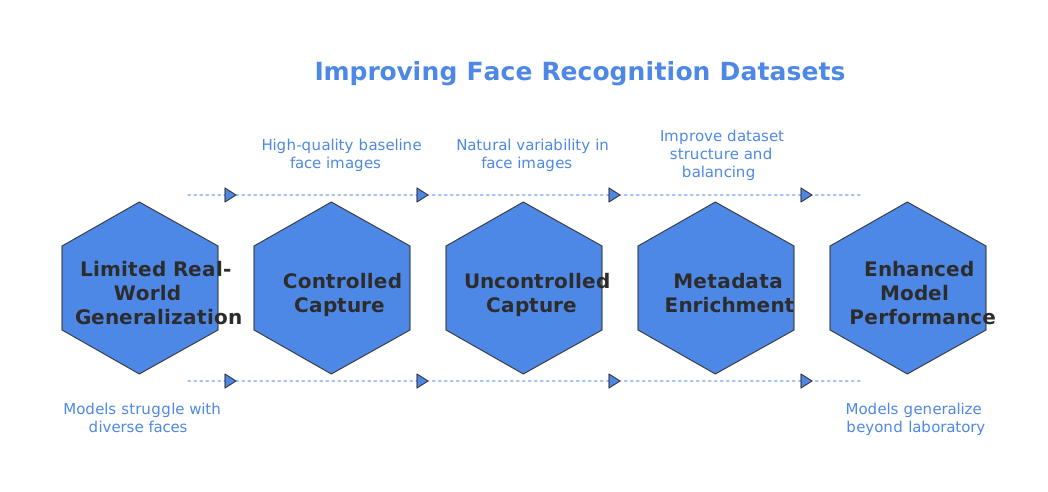
Controlled environments allow dataset creators to collect high-quality baseline images with consistent lighting and frontal pose. These images help models learn core facial features without environmental noise. Controlled samples typically serve as reference anchors when training models for broad demographic tasks.
Uncontrolled Capture for Real-World Conditions
Uncontrolled images add natural variability and represent how faces appear in everyday contexts. These samples include diverse backgrounds, angles, and expressions. Including both controlled and uncontrolled samples ensures that models generalize well beyond laboratory conditions. Many industry projects rely heavily on uncontrolled imagery because it matches operational environments.
Metadata Enrichment for Better Model Interpretability
Age and gender datasets often include metadata such as lighting type, pose angle, location type, or camera setting. Metadata improves dataset structure, helps with balancing, and supports advanced model training techniques. High-quality metadata enables teams to understand performance differences and refine training pipelines more effectively.
Challenges in Developing Age and Gender Classification Datasets
Subjectivity and Visual Interpretation
Age estimation is inherently subjective in certain conditions. Humans themselves often misjudge age when viewing faces under unusual lighting or at specific angles. This subjectivity can introduce error during annotation unless strict guidelines and multi-annotator review processes are used.
Cultural Differences in Gender Perception
Gender presentation varies widely across cultures. A dataset captured in one region may not generalize to another. Ensuring geographic diversity prevents the model from learning region-specific assumptions that fail elsewhere. Balanced global representation is essential for fair outcomes.
Ethical and Privacy Considerations
Demographic datasets require careful privacy management and ethical design. Data collection must comply with regional regulations and adhere to principles of fairness and transparency. Institutions such as Stanford HAI emphasize responsible AI development practices that ensure demographic prediction is used appropriately. High-quality demographic datasets incorporate privacy, fairness, and compliance at every step.
Building Annotation Pipelines for Demographic AI
Multi-Annotator Consensus for Reliability
To reduce label noise, demographic labels often use consensus from multiple annotators. Aggregating interpretations reduces individual bias and increases dataset reliability. This method is especially valuable when labeling ambiguous samples that require subjective judgment.
Quality Assurance Across Demographic Subgroups
QA must check whether errors are concentrated in specific demographic groups. If a model performs unevenly, dataset designers must adjust representation or refine annotation guidelines. Monitoring demographic performance ensures the dataset supports fairness across all groups.
Dataset Versioning and Ongoing Refinement
Demographic models must evolve as new data becomes available. Age distribution, cultural trends, and environmental contexts change over time. Dataset versioning and structured updates ensure that the dataset remains relevant and continues to support accurate predictions.
Where Organizations Use Age and Gender Classification Models
Retail and Audience Analytics
Retail environments use demographic AI to understand audience composition, improve store layout, or tailor customer engagement. Age and gender estimation provide non-intrusive analytics that inform decision-making while respecting privacy constraints.
Safety Monitoring and Public Environments
Security systems use demographic AI to detect individuals of interest, monitor occupancy, and enhance access control. Accurate demographic prediction helps operators recognize unusual activity patterns across environments.
Personalization and User Experience Optimization
Digital systems adapt content or interface features based on demographic predictions. Entertainment platforms, smart displays, and interactive marketing tools often rely on demographic AI to improve user interaction.
Supporting Demographic AI Development
Age and gender classification datasets define the reliability, fairness, and real-world applicability of demographic AI. Their strength depends on consistent annotation, diverse representation, controlled and uncontrolled sampling, and rigorous quality assurance. If your team is building demographic prediction systems and needs dataset creation, annotation workflows, or demographic balancing, we can explore how DataVLab supports high-quality demographic AI projects across industries.
What are Age estimation and gender classification datasets?
Age estimation and gender classification datasets form the core of demographic AI systems that categorize individuals based on facial appearance. These datasets include thousands of faces labeled with age ranges, precise age values, gender attributes, and demographic metadata.
What does the article explain about why demographic AI depends on specialized datasets?
Age estimation datasets allow models to predict approximate age or age range from facial features. These datasets support retail applications, safety assessment, access-control filtering, and content personalization. Research from Microsoft’s Facial Age Estimation projects highlights how age prediction becomes increasingly complex beyond youth because facial aging varies across individuals.
What does the article explain about why gender classification requires careful dataset design?
Gender classification datasets contain labels describing perceived gender presentation. Many organizations use these datasets for analytics, customer segmentation, or security screening. The University of Oxford’s Visual Geometry Group discusses how gender prediction can be sensitive to illumination, pose, and cultural variation.
How can teams ensure quality in Age estimation and gender classification datasets?
Age estimation datasets may include exact age labels or categorized age brackets. Precise labels require verified metadata, while age-range labels depend on consistent interpretation guidelines. Age mislabeling is one of the most common sources of error, so datasets must include reliable sourcing and cross-verification.
What are the main challenges of Age estimation and gender classification datasets?
Age estimation is inherently subjective in certain conditions. Humans themselves often misjudge age when viewing faces under unusual lighting or at specific angles. This subjectivity can introduce error during annotation unless strict guidelines and multi-annotator review processes are used.
What does the article explain about where organizations use age and gender classification models?
Retail environments use demographic AI to understand audience composition, improve store layout, or tailor customer engagement. Age and gender estimation provide non-intrusive analytics that inform decision-making while respecting privacy constraints. Security systems use demographic AI to detect individuals of interest, monitor occupancy, and enhance access control.