Face Occlusion Dataset: How AI Learns to Recognize Masked and Partially Covered Faces
.jpeg)

Face occlusion datasets are essential for facial recognition models that must operate in real-world environments where faces are rarely fully visible. Masks, glasses, scarves, hair, hats, medical coverings, and environmental obstruction all impact how facial features appear, making occlusion one of the most challenging problems in biometric AI. These datasets include controlled and uncontrolled images with diverse occlusion types, degrees of coverage, lighting conditions, and face orientations. This article explains how face occlusion datasets are constructed, which annotation strategies they require, how occlusion categories are defined, and why they are crucial for security, access control, transportation hubs, retail analytics, and mobile authentication. It also covers the challenges of collecting high-quality occlusion data, the quality assurance needed to validate labels, and the techniques used to build models that remain reliable even when large portions of the face are hidden.
- Face occlusion datasets are essential for facial recognition models that must operate in real-world environments where faces are rarely fully visible.
- Masks, glasses, scarves, hair, hats, medical coverings, and environmental obstruction all impact how facial features appear, making occlusion one of the most challenging problems in biometric AI.
- These datasets include controlled and uncontrolled images with diverse occlusion types, degrees of coverage, lighting conditions, and face orientations.
- It also covers the challenges of collecting high-quality occlusion data, the quality assurance needed to validate labels, and the techniques used to build models that remain reliable even when large portions of the face are hidden.
Why Face Occlusion Datasets Matter Today
Real-World Conditions Rarely Offer Full Visibility
In everyday environments, faces are obscured by masks, scarves, sunglasses, hair movement, or accessories. Public research from Nanyang Technological University shows that even partial occlusion can drastically reduce recognition accuracy when models are trained only on clean, unoccluded faces. This makes occlusion datasets essential for any system deployed in uncontrolled settings.
Regulatory and Operational Demands Require Higher Robustness
Security and authentication systems often operate in transportation hubs, retail environments, workplaces, and outdoors. These contexts introduce unavoidable occlusions that must be modeled explicitly. Airports and border-control agencies, informed by studies from the International Organization for Migration, note that mask-wearing and cultural coverings significantly impact biometric reliability. Strong occlusion datasets enable models to retain accuracy across these scenarios.
Supporting Safety, Convenience, and Frictionless User Experiences
Mobile devices, access-control terminals, and payment systems increasingly rely on facial authentication. Users expect instant recognition, even when wearing masks or accessories. High-quality occlusion datasets help ensure that user-facing technologies work consistently without forcing people to adjust their appearance.
Core Components of Face Occlusion Datasets
Categorized Occlusion Types
Datasets typically categorize occlusions into classes such as masks, sunglasses, eyeglasses, hats, hair occlusion, hand-over-face, and object obstruction. Categorization allows models to learn different visual distortions and compensate for missing features appropriately. These categories must be defined clearly so annotators apply them consistently across frames.
Degrees of Occlusion and Coverage Level
Some occlusions cover large facial regions, while others interfere with only small areas. Datasets must include mild, moderate, and severe coverage levels. Labeling coverage degree helps models understand how much of the face is missing and adjust inference accordingly. This granularity is essential for applications such as identity verification, where small errors can cause disproportionate impact.
Controlled and Uncontrolled Capture Conditions
A strong occlusion dataset includes studio shots with consistent lighting as well as real-world images captured outdoors, in public spaces, and in varied environments. The presence of mixed conditions makes models far more stable during deployment, especially when working with dynamic video streams or surveillance feeds.
Variability That Strengthens Occlusion-Resilient Models
Lighting and Shadow Variations
Occlusions often create unexpected shadows and lighting artifacts that distort facial geometry. Datasets must include natural and artificial lighting, backlit conditions, and shadow-intense environments. Research from the IEEE Biometrics Council shows that lighting has a dramatic effect on occlusion detection performance. Comprehensive lighting variability is therefore essential.
Pose, Motion, and Orientation
When a face is occluded, angle variation exacerbates visibility issues. Hair covers more of the face when the head is tilted, masks shift position during speech, and glasses can reflect external light sources. Including pose diversity prevents models from overfitting to rigid, frontal-angle occlusions.
Cultural and Environmental Occlusion Differences
Dataset diversity must include cultural coverings such as veils, turbans, or ceremonial accessories, as well as environmental occlusions like wind-blown hair, scarves, or snow gear. This ensures that the model remains reliable across international deployments and different climate conditions.
Techniques Used to Build Occlusion Datasets
Mixed Acquisition Campaigns
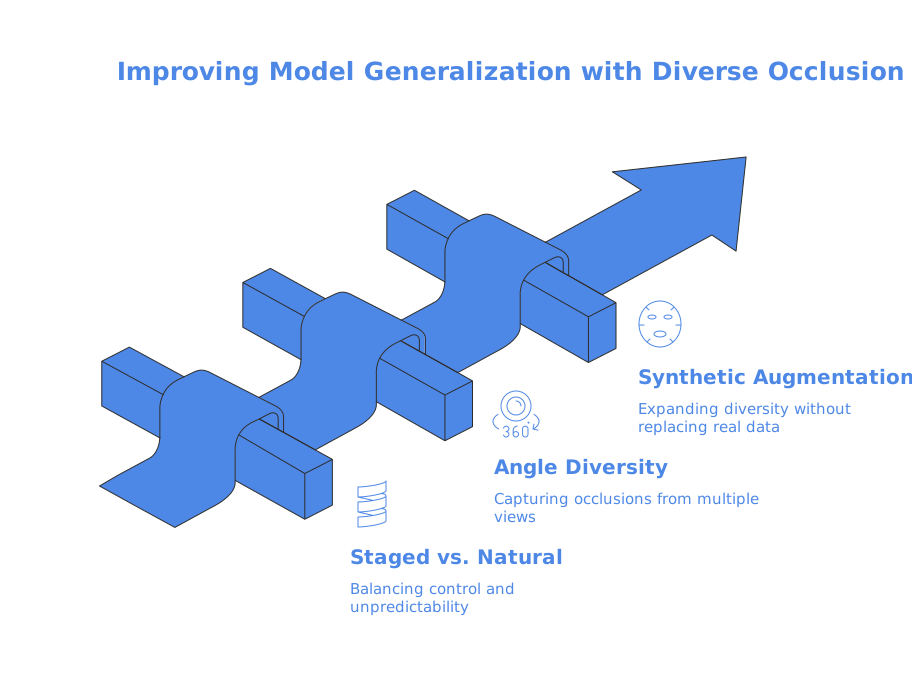
Dataset creators combine staged occlusions with naturally occurring ones. Staged occlusions give precise control over category variation, while natural occlusions reflect everyday unpredictability. Together, they produce models that generalize rather than memorize.
Multi-Camera Capture for Angle Diversity
To capture complex occlusions from multiple perspectives, some datasets use synchronized cameras arranged around the subject. This setup provides several views of the same occluded face, teaching models how features persist or disappear depending on angle.
Synthetic Occlusion Augmentation
Synthetic augmentation overlays masks, hair, or object shapes onto normal face images to expand dataset diversity. When done carefully, synthetic augmentation increases robustness without replacing real occlusion data. It is especially useful for rare occlusion types that are difficult to capture.
Annotation and Quality Assurance for Occlusion Data
Occlusion Boundary and Region Annotation
Annotators often mark occlusion masks, bounding regions, or segmentation maps to indicate exactly which parts of the face are covered. These labels help models differentiate between true facial structure and occluding elements. Precise boundary labeling is particularly important for glasses, scarves, and hands.
Class Labeling for Occlusion Types
Every image must be labeled with the correct occlusion category. In multi-occlusion cases, annotators may apply multiple labels. Consistency across categories is crucial, as misclassifying an occlusion type can make the model learn incorrect compensation patterns. Clear taxonomies reduce ambiguity during annotation.
QA Across Difficult Frames
Quality assurance includes checking identity consistency, verifying occlusion boundaries, and validating that labels match the visual patterns. Difficult frames such as partial reflections, transparent eyewear, or fast motion require extra review. Multi-reviewer validation helps reduce subjective interpretation and prevents annotation drift.
Applications Enabled by Occlusion-Resilient Datasets
Secure Authentication Under Real Conditions
Face occlusion datasets enable biometric authentication systems to operate with masks, glasses, or partial coverings. Mobile authentication, access-control terminals, and smart kiosks rely on occlusion-aware models to reduce false rejects and improve user experience.
Surveillance and Public Safety Systems
In transportation hubs, retail environments, and public spaces, occlusions are unavoidable. Surveillance systems built on occlusion datasets maintain recognition accuracy despite accessories or environmental interference.
Industrial and Safety Monitoring
In workplaces requiring protective equipment, such as construction, laboratories, or medical facilities, occlusions are common. AI models trained on occlusion datasets allow these environments to integrate biometric monitoring without forcing workers to remove safety gear.
Supporting Face Occlusion Dataset Development
Face occlusion datasets are indispensable for biometric systems that must function under real-world conditions where full visibility cannot be guaranteed. Their success depends on clear occlusion taxonomies, precise boundary annotation, robust diversity, and multi-stage quality assurance. If your team is building face recognition or analysis models that must handle partial occlusion, we can explore how DataVLab supports the creation, annotation, and QA of high-quality occlusion datasets for advanced biometric AI.
How does AI learn to recognize masked and partially covered faces?
Face occlusion datasets are essential for facial recognition models that must operate in real-world environments where faces are rarely fully visible. Masks, glasses, scarves, hair, hats, medical coverings, and environmental obstruction all impact how facial features appear, making occlusion one of the most challenging problems in biometric AI.
What does the article explain about why face occlusion datasets matter today?
In everyday environments, faces are obscured by masks, scarves, sunglasses, hair movement, or accessories. Public research from Nanyang Technological University shows that even partial occlusion can drastically reduce recognition accuracy when models are trained only on clean, unoccluded faces.
What does the section on “Controlled and uncontrolled capture conditions” explain?
A strong occlusion dataset includes studio shots with consistent lighting as well as real-world images captured outdoors, in public spaces, and in varied environments. The presence of mixed conditions makes models far more stable during deployment, especially when working with dynamic video streams or surveillance feeds.
How can teams ensure quality in Face occlusion dataset?
Annotators often mark occlusion masks, bounding regions, or segmentation maps to indicate exactly which parts of the face are covered. These labels help models differentiate between true facial structure and occluding elements. Precise boundary labeling is particularly important for glasses, scarves, and hands.
What are the main use cases for Face occlusion dataset?
Face occlusion datasets enable biometric authentication systems to operate with masks, glasses, or partial coverings. Mobile authentication, access-control terminals, and smart kiosks rely on occlusion-aware models to reduce false rejects and improve user experience. In transportation hubs, retail environments, and public spaces, occlusions are unavoidable.
What does the section on “Supporting face occlusion dataset development” explain?
Face occlusion datasets are indispensable for biometric systems that must function under real-world conditions where full visibility cannot be guaranteed. Their success depends on clear occlusion taxonomies, precise boundary annotation, robust diversity, and multi-stage quality assurance.