Facial Expression and Emotion Recognition Datasets: How AI Learns Human Affect
.jpeg)

Facial expression, emotion recognition, and micro-expression datasets form the foundation of affective computing, enabling AI systems to interpret human emotion, engagement, and subtle facial cues. These datasets contain labeled images and video sequences that capture expressions such as happiness, anger, surprise, fear, disgust, and more nuanced affective states. Micro-expression datasets include extremely brief and involuntary facial movements that reveal underlying emotional reactions. This article explains how affective facial datasets are structured, which types of annotations they require, the challenges involved in capturing authentic emotional data, and the methods used to ensure accuracy across cultural, environmental, and behavioral differences. It also covers the role of lighting, motion, identity diversity, and scenario variation in building robust datasets for AI systems used in healthcare, education, customer analytics, workplace safety, and human-computer interaction.
- Facial expression, emotion recognition, and micro-expression datasets form the foundation of affective computing, enabling AI systems to interpret human emotion, engagement, and subtle facial cues.
- These datasets contain labeled images and video sequences that capture expressions such as happiness, anger, surprise, fear, disgust, and more nuanced affective states.
- Micro-expression datasets include extremely brief and involuntary facial movements that reveal underlying emotional reactions.
- It also covers the role of lighting, motion, identity diversity, and scenario variation in building robust datasets for AI systems used in healthcare, education, customer analytics, workplace safety, and human-computer interaction.
Why Affective Facial Datasets Matter
Understanding Human Emotion Through Visible Facial Cues
Facial expression datasets teach models to identify common emotional categories based on visible muscle movements. Research from the University of Cambridge’s Affective Intelligence Labs shows that consistent labeling of facial action units is essential for accuracy across cultures and age groups. Models trained on these datasets support applications ranging from mental health screening to customer experience analytics.
Detecting Subtle Emotional Shifts Through Micro-Expressions
Micro-expression datasets include rapid, involuntary facial movements that often occur in less than 200 milliseconds. These fleeting expressions can reveal emotional states that individuals do not consciously display. Studies from the Paul Ekman Group highlight how micro-expressions convey genuine emotions even in controlled contexts. Capturing and labeling these events requires high frame-rate video and skilled annotators trained in subtle action-unit interpretation.
Supporting Affective AI Across Industries
Affective datasets enable AI to interpret engagement levels in classrooms, analyze customer sentiment in retail, assist in driver monitoring, and support therapeutic or assistive technologies. Many human-interaction systems depend on the accuracy and richness of underlying emotional datasets to deliver trustworthy insights.
Core Components of High-Quality Expression and Emotion Datasets
Action Unit Annotation for Facial Muscle Movements
Strong affective datasets include labels based on the Facial Action Coding System (FACS), which describes muscle activations known as action units. These labels provide precise descriptions of facial mechanics rather than broad emotion categories. Detailed action-unit annotation allows models to detect complex expressions with higher granularity.
Emotion-Class Labels and Intensity Scales
Datasets often include labels for basic emotions such as happiness, sadness, anger, fear, disgust, surprise, and neutral. Some also include intensity ratings that describe how strongly each emotion is expressed. Intensity scales help models understand subtle variations rather than oversimplifying emotional categories into binary labels.
High Frame-Rate Video for Micro-Expression Capture
Micro-expression datasets require cameras capable of capturing rapid facial movements. High frame-rate video allows annotators to isolate micro-expressions frame by frame. Low frame-rate footage cannot reliably capture these events, making it unsuitable for training micro-expression models.
Variability That Strengthens Affective Facial Models
Lighting, Shadow, and Environment Diversity
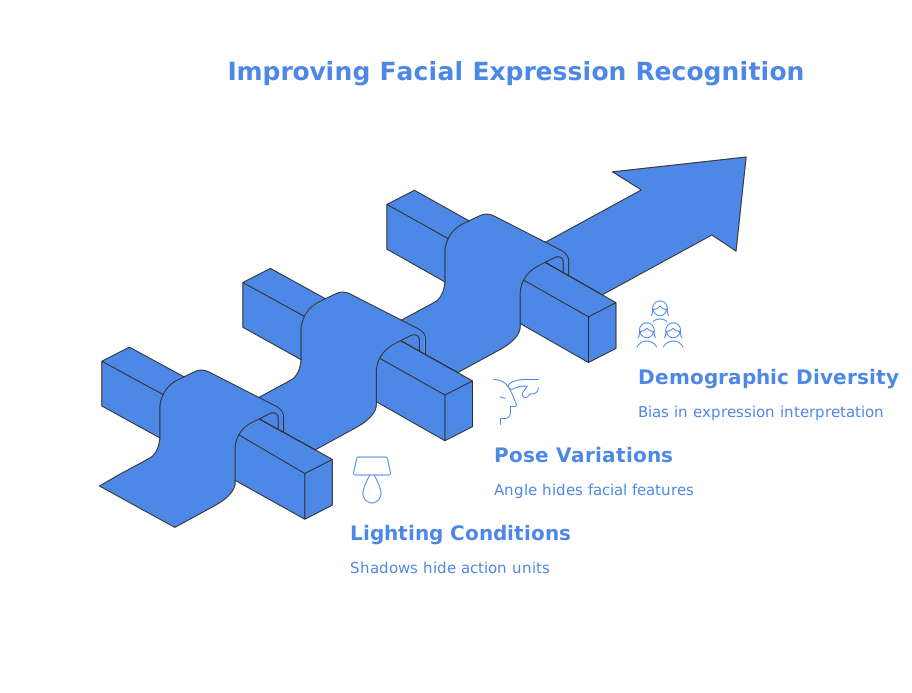
Expression visibility depends on lighting conditions. Shadows can hide critical action units, while bright lights distort subtle facial details. Datasets must include variable lighting environments to ensure robustness. Research compiled by the Association for Psychological Science shows that lighting plays a major role in cross-context emotional perception.
Pose and Head Movement Variations
Expressions appear differently depending on the camera angle. When the head is slightly rotated, action units may be partially hidden. Including multi-angle samples, natural movements, and head rotations prevents models from becoming too dependent on frontal-view expressions.
Cultural, Age, and Gender Representation
Facial expression interpretation varies across cultures and age groups. Affective datasets must include diverse participants to avoid bias and ensure generalization. Models that rely on homogeneous datasets tend to misinterpret expressions outside their training demographic.
Techniques Used to Build Emotion and Micro-Expression Datasets
Induced Emotion Capture
Some datasets use controlled scenarios to elicit natural emotional responses, such as exposure to emotional video clips, social prompts, or cognitive tasks. These methods produce authentic expressions rather than forced or exaggerated ones. Authenticity is crucial for micro-expression accuracy, as involuntary movements cannot be reliably acted.
Staged Expressions With Expert Guidance
To ensure balanced class distribution, participants sometimes perform staged expressions under the guidance of trained annotators. Staged samples improve dataset completeness and help models learn rare or subtle expressions. However, they must be combined with natural responses to avoid bias toward exaggerated displays.
Use of FACS-Certified Annotators
Micro-expression labeling requires annotators trained to identify specific muscle activations. FACS-certified annotators maintain consistency across complex expressions. Their annotations form the gold standard for affective dataset accuracy.
Annotation and Quality Assurance for Affective Facial Data
Frame-Level Annotation for Subtle Expressions
Micro-expression datasets often require frame-by-frame annotation to identify the onset, apex, and offset of each micro-expression. This level of detail ensures that models detect rapid changes correctly and do not confuse them with noise or lighting variations.
Emotion Consistency and Cross-Annotator Agreement
To ensure reliability, multiple annotators label each sample and resolve disagreements through consensus (e.g. occluded face or areas). Emotion-labeling subjectivity requires structured processes to maintain consistency and avoid annotation drift.
Action Unit Verification and Sequence QA
Action units must be verified across entire video sequences, not just single frames. Sudden label changes without corresponding muscle movement may indicate annotation errors. QA includes checking temporal stability, emotion intensity progression, and facial-region visibility.
Applications Enabled by Expression and Emotion Datasets
Mental Health and Wellness Technologies
AI systems use affective datasets to support early detection of emotional distress, monitor therapeutic progress, or assist in telehealth settings. These applications require highly accurate interpretation of subtle affective cues.
Customer Sentiment and Behavioral Analytics
Retail and service environments use expression analysis to understand customer reactions, measure satisfaction, and optimize user experiences. Emotion-aware systems help businesses tailor interactions based on real-time feedback.
Automotive and Safety Monitoring
Driver monitoring systems detect fatigue, distraction, and emotional states that could impair driving. Understanding micro-expressions and affective signals helps reduce risk and enhance safety features.
Supporting Affective Dataset Development
Facial expression, emotion recognition, and micro-expression datasets are central to affective computing and human-centric AI. Their strength depends on detailed annotation, demographic diversity, high-resolution capture, and robust quality assurance. If your team is building affective models and needs help creating, annotating, or validating expression and micro-expression datasets, we can explore how DataVLab supports high-precision biometric data projects across industries.
How does AI learn Human affect?
Facial expression, emotion recognition, and micro-expression datasets form the foundation of affective computing, enabling AI systems to interpret human emotion, engagement, and subtle facial cues. These datasets contain labeled images and video sequences that capture expressions such as happiness, anger, surprise, fear, disgust, and more nuanced affective states.
What does the article explain about why affective facial datasets matter?
Facial expression datasets teach models to identify common emotional categories based on visible muscle movements. Research from the University of Cambridge’s Affective Intelligence Labs shows that consistent labeling of facial action units is essential for accuracy across cultures and age groups.
How can teams ensure quality in Facial expression and emotion recognition datasets?
Strong affective datasets include labels based on the Facial Action Coding System (FACS), which describes muscle activations known as action units. These labels provide precise descriptions of facial mechanics rather than broad emotion categories. Detailed action-unit annotation allows models to detect complex expressions with higher granularity.
What does the section on “Techniques used to build emotion and Micro-Expression datasets” explain?
Some datasets use controlled scenarios to elicit natural emotional responses, such as exposure to emotional video clips, social prompts, or cognitive tasks. These methods produce authentic expressions rather than forced or exaggerated ones. Authenticity is crucial for micro-expression accuracy, as involuntary movements cannot be reliably acted.
What does the section on “Annotation and quality assurance for affective facial data” explain?
Micro-expression datasets often require frame-by-frame annotation to identify the onset, apex, and offset of each micro-expression. This level of detail ensures that models detect rapid changes correctly and do not confuse them with noise or lighting variations.
What are the main use cases for Facial expression and emotion recognition datasets?
AI systems use affective datasets to support early detection of emotional distress, monitor therapeutic progress, or assist in telehealth settings. These applications require highly accurate interpretation of subtle affective cues. Retail and service environments use expression analysis to understand customer reactions, measure satisfaction, and optimize user experiences.