Face Identification Dataset: How AI Teams Build High-Quality Biometric Training Data
.jpeg)

Face identification datasets are the backbone of biometric AI, enabling systems to match identities across images, video streams, and surveillance footage. These datasets include thousands or millions of labeled face samples, each with consistent identity tags, controlled and uncontrolled lighting conditions, varied poses, occlusions, and demographic diversity. This article explains how face identification datasets are structured, why identity consistency is critical for model performance, what challenges arise when collecting and annotating facial data, and how organizations use these datasets for access control, security, fraud prevention, and large scale biometric systems. It also explores best practices in dataset design, annotation workflows, quality assurance, and ethical considerations that determine whether AI-powered face identification performs reliably in real-world environments.
- Face identification datasets are the backbone of biometric AI, enabling systems to match identities across images, video streams, and surveillance footage.
- These datasets include thousands or millions of labeled face samples, each with consistent identity tags, controlled and uncontrolled lighting conditions, varied poses, occlusions, and demographic diversity.
- It also explores best practices in dataset design, annotation workflows, quality assurance, and ethical considerations that determine whether AI-powered face identification performs reliably in real-world environments.
- Organizations use face identification datasets for security systems, user authentication, customer analytics, passport control, fraud prevention, and workforce management.
What Face Identification Datasets Are Designed to Do
Supporting Identity Matching Across Large Populations
Face identification datasets are used to teach models how to match a face to a known identity across thousands or millions of samples. Unlike verification datasets that compare two images, identification datasets require the model to map a face to the correct identity in a large gallery. Research from Carnegie Mellon University describes how gallery-based identification becomes harder as population size grows and variations increase. Strong datasets therefore must contain many images per identity captured under different conditions.
Handling Real-World Variability in Facial Appearance
Facial appearance changes with lighting, expression, hairstyle, aging, and environmental factors. Datasets must represent all these variations so that models do not become brittle. Public benchmarks such as the Face Recognition Vendor Test (FRVT) from NIST highlight how even small changes in lighting or pose can cause dramatic drops in performance. By incorporating diverse samples, dataset designers ensure that models understand identity beyond superficial visual cues.
Serving Applications Across Private and Public Sectors
Organizations use face identification datasets for security systems, user authentication, customer analytics, passport control, fraud prevention, and workforce management. The reliability of these applications depends on whether the dataset captures the real conditions in which faces will appear. When dataset design aligns with operational requirements, biometric systems become accurate, consistent, and trustworthy.
Core Components of a High-Quality Face Identification Dataset
Identity Labels Applied With Strict Consistency
Every image in the dataset must be labeled with the correct identity, and identity naming conventions must remain stable across the entire dataset. Mislabeling a single image can propagate errors during training and cause identity drift. Identity consistency is confirmed through multi-stage validation and cross-annotator review. Large-scale facial datasets often require repeated audits to ensure that identity labels have not accidentally merged or split between similar-looking individuals.
Sufficient Image Volume Per Identity
Models need many samples per identity to understand the natural variation in facial appearance. A dataset that contains only one or two photos per person cannot represent these changes. Collecting multiple samples under different angles, backgrounds, and expressions helps the model learn stable identity features. The most successful biometric models are trained on datasets where each identity contains dozens or even hundreds of images.
Including Controlled and Uncontrolled Capture Conditions
Face identification datasets typically mix controlled images, such as passport-like photos, with uncontrolled images captured in daily life. This combination teaches the model to generalize beyond rigid environments. Controlled images improve baseline recognition, while uncontrolled ones account for real-world unpredictability. Balancing both types increases robustness across diverse deployment scenarios.
Capture Variability That Strengthens Identification Models
Lighting Diversity and Shadow Conditions
Lighting changes drastically affect how faces appear. Harsh shadows distort facial geometry, while backlighting reduces visibility. By capturing faces in bright daylight, artificial lighting, indoor environments, and low-light conditions, datasets produce models that perform well across a wide range of scenarios. Poor lighting representation is one of the most common reasons biometric systems struggle after deployment.
Pose Variation and Rotational Differences
Since people rarely face the camera directly in daily life, datasets must include side angles, tilted heads, partial rotations, and natural movements. This variety trains models to extract identity features even when the face is partially rotated or not perfectly aligned. High-performing models learn to focus on identity attributes rather than orientation.
Expression and Micro-Movement Variation
Facial expressions subtly alter shape and proportion. Even small changes in eyebrow position or mouth shape can influence recognition. Including smiling, neutral, talking, or frowning expressions ensures that identity features remain stable across emotional variance. Without expression diversity, models overfit to neutral expressions and fail under realistic conditions.
Challenges in Building Face Identification Datasets
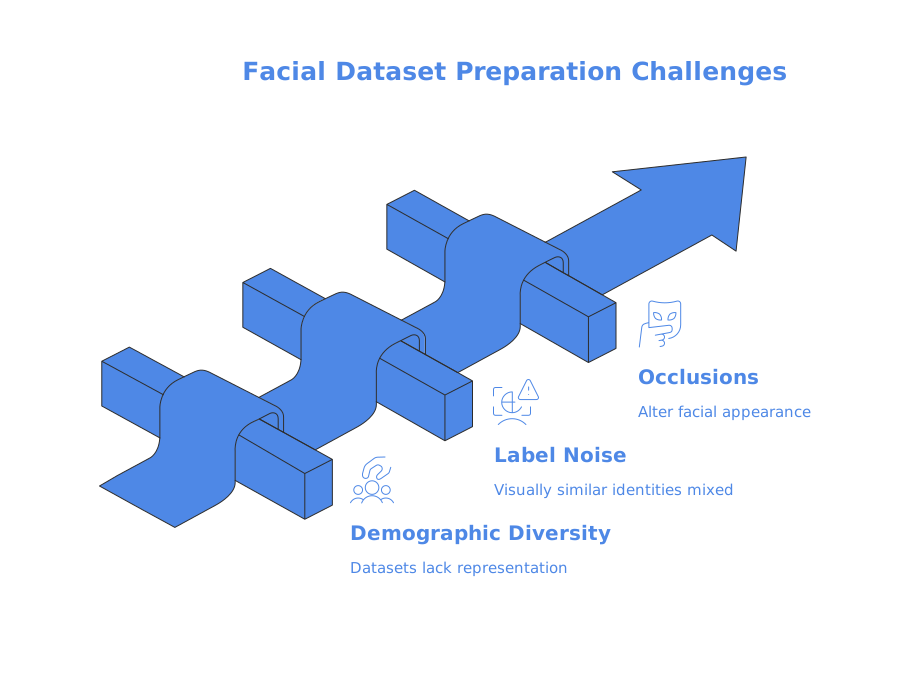
Ensuring Demographic Diversity
Biometric models perform differently across demographic groups unless datasets are carefully balanced. Studies from NIST FRTE have shown performance gaps when datasets lack representation across age ranges, skin tones, and gender groups. Accurate representation requires careful dataset sourcing and annotation to prevent demographic biases that limit generalization.
Avoiding Label Noise and Identity Leakage
Large facial datasets are prone to label noise, where visually similar identities are mixed or mislabeled. Confusion between siblings or colleagues with similar features is common. To avoid identity leakage, annotations must follow strict guidelines, include manual verification, and undergo audit cycles. Cleaning identity noise is one of the most time-consuming tasks in dataset preparation.
Managing Occlusions and Accessories
Glasses, hats, masks, scarves, and hair changes introduce occlusions that alter facial appearance. Datasets must handle these intentionally instead of excluding them. Including occluded samples trains models to interpret incomplete facial information and improves reliability in everyday environments. However, annotators must ensure that occlusions do not mistakenly merge identities.
Building and Annotating Face Identification Datasets
Annotation Pipelines Focused on Identity
Unlike other facial datasets that require landmarks or segmentation masks, identification datasets focus mainly on identity labeling. Annotators must follow a strict identity taxonomy and avoid introducing inconsistencies. When dataset sizes reach hundreds of thousands of samples, annotation management systems and traceable workflows become critical for maintaining accuracy.
Quality Assurance and Identity Validation
Quality assurance involves both visual checks and automated validation. Embedding-based clustering algorithms can help identify identity conflicts, while manual reviewers confirm ambiguous cases. High-stakes biometric systems require multi-stage validation steps that track label quality across the entire development cycle.
Maintaining Dataset Integrity Over Time
As organizations expand their biometric systems, they often add new identities or collect additional samples. Dataset versioning, identity tracking, and structured update pipelines ensure that the dataset grows without introducing label drift. Consistent metadata practices help maintain dataset quality as scale increases.
Deploying Identification Models Built on Reliable Datasets
Testing Across Real-World Scenarios
Models trained on high-quality datasets must be evaluated under multiple real-world conditions to identify blind spots. Testing should include varied lighting, different camera types, environmental interference, and demographic variation. Field testing ensures that the dataset represents actual deployment conditions.
Integrating Models Into Operational Pipelines
Face identification systems become effective when integrated into security tools, access-control systems, user-facing applications, or analytics dashboards. Organizations must ensure consistency between training data and inference environments to maintain accuracy across operational workflows.
Updating Models As New Data Arrives
Biometric environments evolve, and new identities or environmental conditions appear over time. Continuous dataset updates and periodic retraining help maintain the accuracy and relevance of identification systems.
Supporting High-Quality Face Identification Data
Face identification datasets are essential to the reliability, fairness, and accuracy of biometric AI. Their strength depends on identity consistency, demographic diversity, structured annotation, and rigorous quality assurance. If your team is building or expanding a face identification system and needs expert support with dataset creation, annotation workflows, or large-scale identity validation, we can explore how DataVLab helps develop robust facial datasets tailored to your operational requirements.
What is Face identification dataset?
Face identification datasets are the backbone of biometric AI, enabling systems to match identities across images, video streams, and surveillance footage. These datasets include thousands or millions of labeled face samples, each with consistent identity tags, controlled and uncontrolled lighting conditions, varied poses, occlusions, and demographic diversity.
What does the article explain about what face identification datasets are designed to do?
Face identification datasets are used to teach models how to match a face to a known identity across thousands or millions of samples. Unlike verification datasets that compare two images, identification datasets require the model to map a face to the correct identity in a large gallery.
How can teams ensure quality in Face identification dataset?
Every image in the dataset must be labeled with the correct identity, and identity naming conventions must remain stable across the entire dataset. Mislabeling a single image can propagate errors during training and cause identity drift.
What does the section on “Including controlled and uncontrolled capture conditions” explain?
Face identification datasets typically mix controlled images, such as passport-like photos, with uncontrolled images captured in daily life. This combination teaches the model to generalize beyond rigid environments. Controlled images improve baseline recognition, while uncontrolled ones account for real-world unpredictability.
What are the main challenges of Face identification dataset?
Biometric models perform differently across demographic groups unless datasets are carefully balanced. Studies from NIST FRTE have shown performance gaps when datasets lack representation across age ranges, skin tones, and gender groups. Accurate representation requires careful dataset sourcing and annotation to prevent demographic biases that limit generalization.
What does the section on “Supporting High-Quality face identification data” explain?
Face identification datasets are essential to the reliability, fairness, and accuracy of biometric AI. Their strength depends on identity consistency, demographic diversity, structured annotation, and rigorous quality assurance.