Face Verification and Recognition Datasets: Training AI for Identity Matching
.jpeg)

Face verification and recognition datasets provide the labeled facial data required to train AI systems that determine whether two images belong to the same person or identify individuals within large galleries. These datasets include controlled still images, natural images collected from the wild, and video sequences with frame-level identity labels. They are used in authentication, surveillance, payments, security applications, and large public biometric systems. This article explains how these datasets are structured, what types of identity annotations they require, how video identity propagation works, and why they must include variations in lighting, pose, demographics, occlusions, and environmental conditions. It also explores the challenges of identity consistency, dataset balancing, label noise removal, and the quality assurance methods necessary to build trustworthy identity-matching AI systems.
- Face verification and recognition datasets provide the labeled facial data required to train AI systems that determine whether two images belong to the same person or identify individuals within large galleries.
- These datasets include controlled still images, natural images collected from the wild, and video sequences with frame-level identity labels.
- This article explains how these datasets are structured, what types of identity annotations they require, how video identity propagation works, and why they must include variations in lighting, pose, demographics, occlusions, and environmental conditions.
- It also explores the challenges of identity consistency, dataset balancing, label noise removal, and the quality assurance methods necessary to build trustworthy identity-matching AI systems.
Why Identity-Matching Datasets Are Critical
Matching Identities Across Pairs Through Face Verification
Face verification datasets train AI systems to decide whether two images belong to the same person. Verification tasks underpin authentication systems used in fintech, mobile devices, and secure access. Research from the University of Surrey's Centre for Vision, Speech and Signal Processing shows that identity-pair labeling greatly reduces ambiguity in biometric similarity learning. Verification datasets must represent both positive and negative pairs to train models effectively.
Identifying People in Large Galleries Through Face Recognition
Recognition datasets scale beyond pairs by mapping each face to a unique identity. These datasets often contain thousands of identities and millions of samples. The pattern of intra-class variation and inter-class separation across identities determines whether recognition models generalize well. Institutions like the Chinese Academy of Sciences emphasize that recognition datasets must reflect real-world face variability for accurate deployment.
Supporting Long-Form Identity Persistence Through Video Datasets
Face recognition video datasets extend identity-matching tasks into time. They provide frame-level identity labels, capture movement, and include environmental variability that is not possible in still images. The AI Hub at Carnegie Mellon University notes that video-based recognition improves continuity and robustness in dynamic environments. Video datasets enable tracking, long-term monitoring, and sequence-based identity confirmation.
Core Structure of Strong Identity Datasets
Identity Labels With Zero Ambiguity
For recognition datasets, each image must be labeled with a unique identity. Identity integrity is the foundation of the entire dataset. Mislabeling or identity collisions cause models to learn incorrect relationships, reducing accuracy and increasing false matches. Multi-stage review ensures that identities do not merge inadvertently.
Positive and Negative Pair Construction
Verification datasets must include both matching and non-matching pairs. Balanced pair construction helps the model understand similarity boundaries. If negative pairs overwhelm the dataset, the model becomes overly conservative; if positive pairs dominate, it becomes too permissive. Balanced sampling ensures stable learning.
Temporal Continuity in Video Sequences
Video datasets require consistent identity labeling across frames. These sequences include head rotations, lighting changes, motion blur, expressions, and occlusions. Temporal continuity teaches models to maintain identity through real-world variation rather than relying on clean static imagery.
Sources of Variability That Improve Identity Recognition
Lighting and Environmental Differences
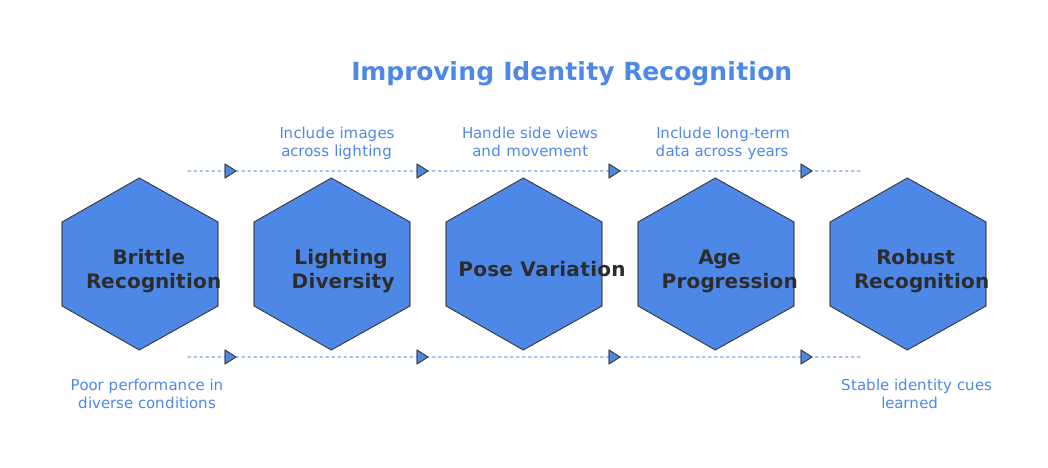
Faces appear vastly different in bright sunlight, low indoor lighting, fluorescent illumination, and partial shadow. Recognition datasets must include images across these conditions to prevent brittle performance. Environmental diversity strengthens feature extraction across lighting distortions.
Pose, Motion Blur, and Camera Angles
Real-world footage contains significant pose variation and movement. Recognition systems must handle side views, tilted angles, and natural head movement. Including pose diversity ensures that models do not overfit to frontal, studio-style imagery.
Age Progression and Style Changes
Faces change with age, hairstyle, makeup, facial hair, and weight fluctuation. Recognition datasets that include long-term data across multiple years outperform those built from single-session collections. These variations help models learn stable identity cues despite superficial appearance changes.
Techniques Used to Build Verification and Recognition Datasets
Multi-Session Image Capture
High-quality datasets conduct multiple recording sessions for each identity. This introduces natural appearance changes between sessions that enrich the dataset. Multi-session imagery prevents models from learning session-specific patterns that reduce generalization.
Unconstrained Image Collection for Realism
Unconstrained or "in-the-wild" images capture natural variability, including uncontrolled lighting, movement, accessories, and spontaneous expressions. These samples reflect real-world deployment conditions far better than controlled laboratory images. Many high-performing recognition systems emphasize mixture datasets combining both.
Structured Identity Verification Protocols
Verification datasets follow structured protocols to generate balanced and meaningful identity pairs. These protocols define how pairs are chosen, how many images per identity are required, and how negative pairs are sampled across demographics and environments.
Annotation and Quality Assurance for Identity Datasets
Identity Consistency Checks
Automated clustering and similarity scoring help identify mislabeled faces. Manual reviewers then confirm ambiguous clusters and correct identity drift (for example in the case of liveness detection). Identity consistency must be preserved across still images, multi-session captures, and video sequences.
Frame-Level Video Annotation
Video datasets demand precise frame-level annotations that maintain identity through occlusion, movement, and lighting changes. Annotators verify that identity remains consistent across transitions such as turning, bending, or partial obstruction.
Balanced Sampling Across Identities
Datasets must ensure that each identity has representative samples. Overrepresentation of a few identities leads to model bias during training. Balanced identity distributions increase the reliability of recognition performance in large galleries.
Applications Enabled by Identity-Matching Datasets
Authentication and Access Control
Face verification datasets support login systems, secure access gates, and identity validation workflows. They provide the foundation for rapid and reliable authentication across devices and environments.
Surveillance and Public Safety
Face recognition datasets enable identification across crowded environments, camera networks, and complex scenes. Video datasets support persistent tracking and event-based alerting for safety operations.
Financial Security and Fraud Prevention
Identity-matching systems used in financial onboarding rely heavily on verification datasets. Accurate pair matching reduces fraud risk and ensures compliance with identity verification regulations.
Supporting Identity Dataset Development
Face verification, recognition, and video identity datasets are essential to high-stakes biometric systems deployed across security, finance, enterprise, and public environments. Their success depends on identity consistency, balanced sampling, diverse capture conditions, and multi-stage annotation workflows. If your team is building identity-matching AI and needs help with dataset creation, verification pipelines, or video identity labeling, we can explore how DataVLab supports robust biometric datasets at scale.
What are Face verification and recognition datasets?
Face verification and recognition datasets provide the labeled facial data required to train AI systems that determine whether two images belong to the same person or identify individuals within large galleries. These datasets include controlled still images, natural images collected from the wild, and video sequences with frame-level identity labels.
Why are Identity-Matching datasets Critical?
Face verification datasets train AI systems to decide whether two images belong to the same person. Verification tasks underpin authentication systems used in fintech, mobile devices, and secure access. Research from the University of Surrey's Centre for Vision, Speech and Signal Processing shows that identity-pair labeling greatly reduces ambiguity in biometric similarity learning.
What does the section on “Sources of variability that improve identity recognition” explain?
Faces appear vastly different in bright sunlight, low indoor lighting, fluorescent illumination, and partial shadow. Recognition datasets must include images across these conditions to prevent brittle performance. Environmental diversity strengthens feature extraction across lighting distortions.
What does the section on “Techniques used to build verification and recognition datasets” explain?
High-quality datasets conduct multiple recording sessions for each identity. This introduces natural appearance changes between sessions that enrich the dataset. Multi-session imagery prevents models from learning session-specific patterns that reduce generalization.
How can teams ensure quality in Face verification and recognition datasets?
Automated clustering and similarity scoring help identify mislabeled faces. Manual reviewers then confirm ambiguous clusters and correct identity drift (for example in the case of liveness detection). Identity consistency must be preserved across still images, multi-session captures, and video sequences.
What are the main use cases for Face verification and recognition datasets?
Face verification datasets support login systems, secure access gates, and identity validation workflows. They provide the foundation for rapid and reliable authentication across devices and environments. Face recognition datasets enable identification across crowded environments, camera networks, and complex scenes.