Liveness Detection Dataset: Training AI to Detect Spoofing and Fake Faces
.jpeg)

Liveness detection datasets provide the training material required for biometric systems to distinguish real human faces from spoofing attacks such as printed photos, digital displays, masks, replay attacks, and deepfake content. These datasets contain controlled and uncontrolled samples that capture subtle cues of “liveness,” including micro-movements, natural blinking, surface texture, lighting response, and depth variation. This article explains how liveness detection datasets are structured, which attack types they must include, how video sequences are annotated for liveness cues, and why environmental diversity is essential for preventing bypass of facial authentication systems. It also covers the quality assurance processes needed to ensure dataset integrity, the importance of multi-modal sensing, and the operational challenges organizations face when deploying liveness AI in high-risk environments.
- Liveness detection datasets provide the training material required for biometric systems to distinguish real human faces from spoofing attacks such as printed photos, digital displays, masks, replay attacks, and deepfake content.
- These datasets contain controlled and uncontrolled samples that capture subtle cues of “liveness,” including micro-movements, natural blinking, surface texture, lighting response, and depth variation.
- It also covers the quality assurance processes needed to ensure dataset integrity, the importance of multi-modal sensing, and the operational challenges organizations face when deploying liveness AI in high-risk environments.
- Liveness detection datasets teach AI systems to differentiate between a real human face and spoofing attempts such as printed photos, screen replays, and realistic silicone masks.
Why Liveness Detection Matters for Modern Biometrics
Protecting Facial Authentication From Spoofing
Liveness detection datasets teach AI systems to differentiate between a real human face and spoofing attempts such as printed photos, screen replays, and realistic silicone masks. Without proper training data, facial authentication becomes vulnerable to increasingly sophisticated attacks. Standards from the International Biometric Standards group emphasize the need for robust anti-spoofing benchmarks. Strong datasets ensure that authentication systems remain secure under real-world threat conditions.
Addressing New Threats Like Mask Attacks and Deepfakes
As spoofing techniques evolve, attackers use 3D masks, AI-generated faces, and deepfake video streams to bypass biometric systems. Research from Carnegie Mellon University shows how deepfake-quality improvements require more advanced liveness cues, including texture analysis and micro-expression detection. Liveness datasets must include modern attack methods to remain effective against emerging threats.
Supporting High-Stakes Industries
Financial services, smartphone manufacturers, border control agencies, and enterprise security teams rely on liveness detection to prevent identity fraud. Organizations in these sectors require datasets that reflect real operational environments and potential attack vectors. Liveness models trained on shallow or outdated datasets cannot provide sufficient protection.
Core Components of Liveness Detection Datasets
Multi-Class Attack Categories
Datasets must include multiple spoofing classes such as printed photos, replay attacks, digital screen attacks, 3D masks, and partial occlusion spoofs. Each category needs consistent labeling and visual diversity. Clear attack taxonomies help models learn patterns associated with specific threat types.
Real Versus Spoof Ground Truth Labels
Each sample must be labeled as “live” or one of several “spoof” classes. Real samples include natural facial movements, depth variation, and texture differences. Spoof samples lack these cues and often include artifacts like moiré patterns or pixel inconsistencies. Reliable ground truth is essential for training models to recognize subtle differences.
DataVLab’s image annotation services can structure live/spoof classes, facial landmarks, and visual quality flags for these datasets.
Controlled and Natural Capture Scenarios
Liveness datasets should mix studio captures with uncontrolled real-world footage. Realistic data includes varied lighting, motion, camera quality, and distance. These variations ensure that models generalize rather than overfitting to idealized samples.
Variability Needed for Strong Anti-Spoof Models
Lighting, Shadow, and Screen Reflection Effects
Lighting dramatically influences spoof detection. Overly bright screens produce reflections, while low-light conditions distort natural texture cues. Studies from the IEEE Biometrics Council highlight how lighting inconsistencies cause false positives in naive models. Including diverse lighting scenarios strengthens spoof-resilience.
Movement and Depth Cues
Real faces exhibit natural micro-movements, subtle depth changes, and physiological signals. Masks and printed photos do not. Capturing variations in blinking, head movement, and facial elasticity helps models distinguish real from fake. Depth sensors or infrared data can enhance these cues.
Device and Medium Diversity
Replay attacks appear different when shown on phones, tablets, or large displays. Printed photo spoofs vary depending on printer quality and paper type. Liveness datasets must include multiple device types and media formats to prevent attackers from exploiting unrepresented scenarios.
Techniques Used to Build Liveness Detection Datasets
Attack Simulation and Capture
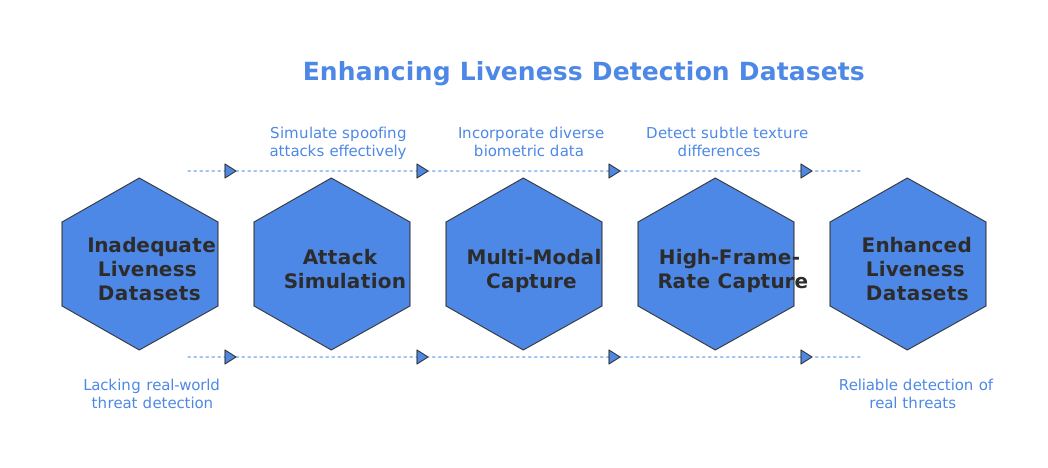
Teams intentionally simulate spoofing attacks using printed materials, screen displays, and 3D masks. Each attack is recorded under different environmental conditions. The quality of these simulations determines how reliably models will detect real-world threats.
Multi-Modal Capture Strategies
Some liveness datasets incorporate RGB, infrared, depth, and thermal data. Multi-modal datasets improve accuracy by providing additional biometric cues that spoofing media cannot replicate. Research from the EU Horizon projects demonstrates that multi-modal sensing significantly increases security in facial biometrics.
High-Frame-Rate and Macro Capture
To detect micro-movements or subtle texture differences, some datasets record high frame-rate video or close-up macro footage. These techniques capture detail that standard cameras miss, especially for micro-expression-based liveness cues.
Annotation and Quality Assurance for Liveness Data
Frame-Level Attack Labeling
Video samples require frame-by-frame labeling or at least sequence-level metadata describing attack type, onset, execution, and offset. Such granularity improves model performance on continuous authentication tasks.
Spoof Artifact Verification
Annotators and QA reviewers must confirm that each spoof sample is genuine and that no real face samples are mislabeled. Artifact verification includes checking for glare patterns, display pixelation, depth inconsistencies, and unnatural movement patterns.
Balanced Live-to-Spoof Ratios
Datasets must include balanced ratios so the model does not become biased toward predicting spoof or live too frequently. Balanced sampling helps maintain stable false-accept and false-reject rates across diverse attack scenarios.
Applications Enabled by Liveness Detection Datasets
Secure Mobile Authentication
Smartphone manufacturers rely on liveness datasets to validate facial unlocking systems. These systems must resist spoofing attempts using screen replays or printed photos. Strong liveness training ensures reliable access without compromising convenience.
Financial and Identity Verification
Fintech platforms use liveness detection for onboarding and transaction security. Preventing impersonation and identity theft requires high accuracy across real-world conditions and device types.
Border Control and Security Infrastructure
Liveness detection helps border agencies verify identity at automated checkpoints. These environments require models that handle low-light conditions, high throughput, and multiple attack vectors.
Supporting Liveness Dataset Development
Liveness detection datasets are essential for biometric systems that must defend against sophisticated spoofing and identity fraud. Their strength depends on well-defined attack categories, diverse environmental capture, precise annotation, and rigorous quality assurance. If your team requires support designing or annotating liveness datasets for secure authentication or anti-spoofing systems, we can explore how DataVLab helps build robust biometric training data tailored to complex threat environments.
What is Liveness detection dataset?
Liveness detection datasets provide the training material required for biometric systems to distinguish real human faces from spoofing attacks such as printed photos, digital displays, masks, replay attacks, and deepfake content. These datasets contain controlled and uncontrolled samples that capture subtle cues of “liveness,” including micro-movements, natural blinking, surface texture, lighting response, and depth variation.
Why does liveness detection matter for modern biometrics?
Liveness detection datasets teach AI systems to differentiate between a real human face and spoofing attempts such as printed photos, screen replays, and realistic silicone masks. Without proper training data, facial authentication becomes vulnerable to increasingly sophisticated attacks.
What does the section on “Controlled and natural capture scenarios” explain?
Liveness datasets should mix studio captures with uncontrolled real-world footage. Realistic data includes varied lighting, motion, camera quality, and distance. These variations ensure that models generalize rather than overfitting to idealized samples.
How can teams ensure quality in Liveness detection dataset?
Video samples require frame-by-frame labeling or at least sequence-level metadata describing attack type, onset, execution, and offset. Such granularity improves model performance on continuous authentication tasks. Annotators and QA reviewers must confirm that each spoof sample is genuine and that no real face samples are mislabeled.
What are the main use cases for Liveness detection dataset?
Smartphone manufacturers rely on liveness datasets to validate facial unlocking systems. These systems must resist spoofing attempts using screen replays or printed photos. Strong liveness training ensures reliable access without compromising convenience.
What does the section on “Supporting liveness dataset development” explain?
Liveness detection datasets are essential for biometric systems that must defend against sophisticated spoofing and identity fraud. Their strength depends on well-defined attack categories, diverse environmental capture, precise annotation, and rigorous quality assurance.