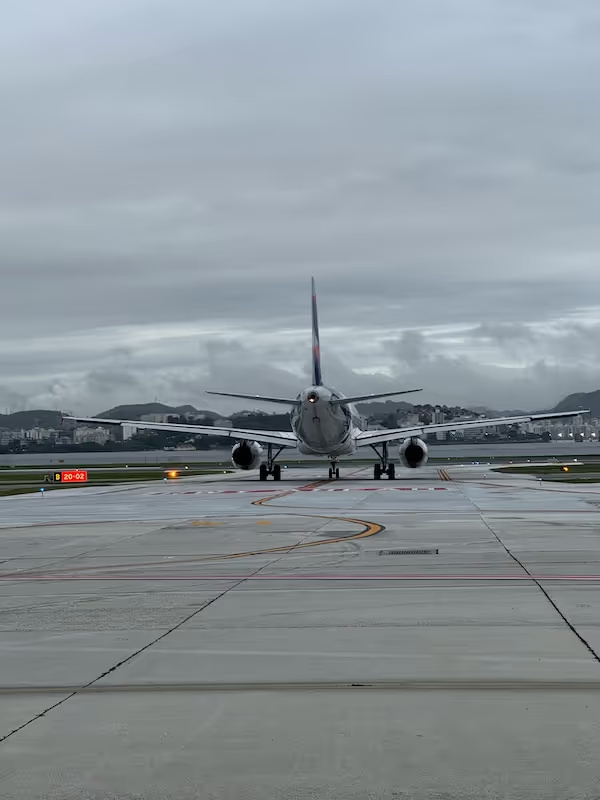
AI and Computer Vision for Aviation Safety and Operational Intelligence
Aviation operations rely on precise and reliable visual information to ensure aircraft safety, efficient ground handling, and consistent airport flow. AI powered systems now support aircraft surface inspection, runway and taxiway monitoring, equipment tracking, and operational safety analytics. These systems require carefully annotated datasets that reflect real world airport conditions, including varied lighting, weather, reflections, and complex human and vehicle traffic patterns.
DataVLab provides precise annotation services for aviation applications. We label aircraft components, runway markings, ground service vehicles, personnel, obstacles, equipment zones, and airfield environments. Our team supports segmentation, classification, defect marking, and long sequence tracking for continuous airport operations. Each workflow follows strict accuracy standards suited for safety critical environments.
Whether you are building AI solutions for aircraft inspection, airport process automation, runway safety, or flight operations support, we deliver consistent and high quality training data that improves model performance and operational reliability.

Aircraft Surface and Component Inspection
Segmentation and defect labeling for panels, wings, engines, lights, and structural surfaces to support automated inspection workflows
Runway and Taxiway Monitoring
Annotation of aircraft, ground vehicles, personnel, obstacles, and markings across runways and taxiways for safety and traffic management
Airport Ground Service Operations
Labeling of baggage carts, fuel trucks, tow tractors, service equipment, and loading areas for operational efficiency analytics
Hangar and Maintenance Video Annotation
Detection and segmentation of tools, components, technicians, and maintenance activities in hangar environments
Aircraft Tracking and Movement Analysis
Multi frame tracking of aircraft motion on the ground for flow optimization and automated surveillance workflows
Aerial and Drone Based Airfield Monitoring
Annotation of airfield layouts, infrastructure, obstacles, and environmental features from drone and aerial imagery


Annotation & Labeling for AI
Unlock the full potential of your AI application with our expert data labeling tech. We ensure high-quality annotations that accelerate your project timelines.

Enhance Computer Vision
with Accurate Image Labeling
Precise labeling for computer vision models, including bounding boxes, polygons, and segmentation.

Unleashing the Potential
of Dynamic Data
Frame-by-frame tracking and object recognition for dynamic AI applications.

Building the Next
Dimension of AI
Advanced point cloud and LiDAR annotation for autonomous systems and spatial AI.

Tailored Solutions for Unique Challenges
Tailor-made annotation workflows for unique AI challenges across industries.
NLP & Text Annotation
Get your data labeled in record time.
GenAI & LLM Solutions
Our team is here to assist you anytime.
Autonomous Flight Data Annotation Services
High accuracy annotation for autonomous flight systems, including drone navigation, airborne perception, obstacle detection, geospatial mapping, and multi sensor fusion.
Aerial Image Annotation
High quality annotation of aerial photography for mapping, inspection, agriculture, construction, and environmental analysis.
Drone Data Labeling
Multi modality drone data labeling for video, telemetry, LiDAR, and sequence based AI models.
Sensor Fusion Annotation Services
Accurate annotation across LiDAR, camera, radar, and multimodal sensor streams to support fused perception and holistic scene understanding.
Video Annotation
Video annotation services and video labeling for AI teams. DataVLab supports object tracking, action and event labeling, temporal segmentation, frame-by-frame annotation, and sequence QA for scalable model training data.
Satellite Image Annotation Services
High accuracy annotation for satellite imagery across land cover mapping, object detection, agricultural monitoring, and environmental change analysis.
We provide high-quality data annotation services and improve your AI's performances

Custom service offering

Up to 10x Faster
Accelerate your AI training with high-speed annotation workflows that outperform traditional processes.

AI-Assisted
Seamless integration of manual expertise and automated precision for superior annotation quality.

Advanced QA
Tailor-made quality control protocols to ensure error-free annotations on a per-project basis.

Highly-specialized
Work with industry-trained annotators who bring domain-specific knowledge to every dataset.

Ethical Outsourcing
Fair working conditions and transparent processes to ensure responsible and high-quality data labeling.

Proven Expertise
A track record of success across multiple industries, delivering reliable and effective AI training data.

Scalable Solutions
Tailored workflows designed to scale with your project’s needs, from small datasets to enterprise-level AI models.

Global Team
A worldwide network of skilled annotators and AI specialists dedicated to precision and excellence.
Potential Today
FAQs
Here are some common questions we receive from our clients to assist you.

What is aviation AI annotation and what does it cover?
Aviation AI annotation labels imagery, video, and sensor data from aircraft, airports, and airfield environments so that AI systems can support aircraft surface inspection, runway and taxiway monitoring, airport ground operations management, air traffic flow optimization, and aviation safety. It covers annotation of aircraft components and surfaces for defect detection, runway and taxiway elements (markings, lighting, foreign object debris), ground service vehicles and equipment, personnel in airside areas, and aircraft tracking and movement. Aviation annotation must handle the specific challenges of aircraft visual inspection: complex curved surfaces, varied lighting from hangar or outdoor inspection, and the need to distinguish minor cosmetic damage from structurally significant defects.
What is aircraft surface inspection annotation?
Aircraft surface inspection annotation labels defects and structural anomalies on aircraft surfaces so that AI inspection systems can identify areas requiring maintenance attention. Defect categories include skin damage (dents, scratches, cracks, corrosion), fastener anomalies (missing, loose, improperly seated fasteners), sealant and coating defects, panel alignment issues, and lightning strike indicators. The annotation must distinguish between cosmetic surface marks that do not affect airworthiness and structural damage that requires maintenance action, which requires annotators with aviation maintenance domain knowledge and familiarity with aircraft type-specific damage tolerance criteria. For commercial aviation programs, annotation standards must be consistent with the aircraft maintenance manual definitions of each defect category.
What is FOD detection annotation and why is it quality-critical?
Foreign object debris (FOD) detection annotation labels non-aircraft objects present on runway, taxiway, or ramp surfaces that pose a risk to aircraft operations. FOD objects range from small hardware items (nuts, bolts, fasteners, wire fragments) to larger debris (luggage components, catering equipment, wildlife). FOD detection AI must achieve very high recall (missing FOD has safety consequences) with acceptable precision (false alarms that interrupt operations have cost consequences). This performance requirement makes FOD annotation particularly quality-sensitive: every visible FOD item in training imagery must be labeled, and false negative rates in annotation directly produce false negative rates in the trained model. DataVLab implements strict completeness verification for FOD annotation.
How do aviation regulations affect AI annotation requirements?
Aviation AI systems used as components in aircraft or aircraft systems are regulated as aviation products under EASA Part 21 and may additionally fall within EU AI Act high-risk classification as safety components of safety-critical infrastructure. For AI-assisted inspection systems used in aircraft maintenance, the AI system's performance characteristics (probability of detection, false alarm rate) must be demonstrated to the applicable maintenance organization approval authority. Training data annotation quality is part of the performance evidence: annotation errors that produce systematic biases in training data are a regulatory concern in aviation AI development. DataVLab provides annotation documentation designed to support aviation regulatory submissions.
What GDPR and sovereignty considerations apply to airport AI annotation?
Airport airside operations generate significant personal data (worker identities, vehicle movements, operational patterns) that is subject to GDPR. For airport security AI systems, the processing of biometric data (facial recognition for access control) is prohibited without explicit consent or specific legal basis under GDPR Article 9. Airport training data annotation should implement anonymization of worker faces in imagery used for AI training unless specific consent covers this use. For defense-related aviation programs (military airfield monitoring, UAV operations), additional sovereignty and classification requirements apply beyond civilian aviation and GDPR standards.
What aviation annotation services does DataVLab provide?
DataVLab provides aviation annotation for aircraft surface and component inspection, runway and taxiway monitoring, FOD detection, airport ground service operations, aircraft tracking and movement analysis, and airfield monitoring from drone and aerial imagery. We work with commercial airlines, MRO (maintenance, repair, and overhaul) organizations, airport operators, ground handling companies, and aviation AI technology providers. EU-based annotation is available for European aviation programs with GDPR compliance or EASA regulatory documentation requirements.
We provide high-quality data annotation services and improve your AI's performances
Blog & Resources
Explore our latest articles and insights on Data Annotation