AI Human Detection Cameras: How Modern Vision Systems Identify People in Real Time
.jpeg)
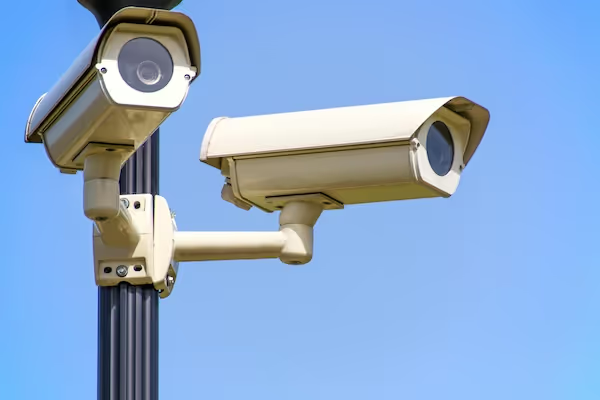
AI human detection cameras use computer vision models to identify when people appear within a scene and respond to them in real time. They support security monitoring, workplace safety, access control, and smart infrastructure applications. This article explains how these systems work, how datasets and annotations shape accuracy, and why the underlying detection workflows must be engineered carefully. Readers will also learn about model architectures, sensor considerations, deployment challenges, and current research trends in real-time AI detection. The goal is to offer a clear and authoritative overview of how human detection cameras operate and how organizations can build reliable, high-quality systems.
- AI human detection cameras use computer vision models to identify when people appear within a scene and respond to them in real time.
- This article explains how these systems work, how datasets and annotations shape accuracy, and why the underlying detection workflows must be engineered carefully.
- Readers will also learn about model architectures, sensor considerations, deployment challenges, and current research trends in real-time AI detection.
- The goal is to offer a clear and authoritative overview of how human detection cameras operate and how organizations can build reliable, high-quality systems.
Understanding AI Human Detection Cameras
AI human detection cameras are imaging devices equipped with computer vision models capable of identifying the presence of people in real time. These systems process visual inputs directly at the edge or through cloud-based inference pipelines to detect when a human appears, moves, enters restricted zones, or interacts with sensitive equipment. Their core capability lies in recognizing human shapes and patterns under varied conditions, enabling automated responses ranging from alert notifications to automated workflow triggers. Modern human detection cameras rely on deep learning architectures that learn these patterns from large annotated datasets.
The Role of Human Detection in Security and Operations
Human detection cameras serve as essential components in many security and operational workflows. Security teams deploy them at facility entrances, parking lots, and high-risk areas where rapid identification of human presence reduces response times. Industrial operations integrate them to ensure workers maintain safe distances from automated machinery. Real estate and building management teams rely on detection to optimize energy efficiency by monitoring occupancy patterns. Platforms such as Google Cloud Vision illustrate how detection models form part of larger cloud-based analytics capabilities that support automated monitoring and structured recognition tasks. These applications demonstrate that detection cameras operate not only as surveillance tools but as key contributors to operational safety and efficiency.
Difference Between Motion Detection and AI Detection
Traditional cameras use motion detection to identify changes in pixel intensity that suggest movement. AI human detection expands this capability by distinguishing between relevant human activity and irrelevant environmental motion such as animals, shadows, vehicles, or shifting light patterns. This distinction dramatically reduces false alarms and improves notification relevance. By learning from annotated examples, AI models understand human-specific visual cues that simpler systems cannot detect reliably. This fundamental advancement is why organizations increasingly favor AI-enabled detection systems over legacy motion-triggered devices.
How AI Human Detection Cameras Work
AI human detection cameras typically combine imaging hardware with onboard or remote machine learning models. The camera captures visual frames, processes them through an inference engine, and outputs detection information such as bounding boxes, confidence scores, or contextual tags. These outputs may drive automated actions, integrate with existing security software, or trigger alerts to monitoring personnel. The detection pipeline follows a structured sequence involving image acquisition, feature extraction, spatial localization, and decision thresholds.
Data Flow in Detection Pipelines
When a frame is captured, the camera either sends it to an onboard processor or a cloud-based inference service. The model analyzes the frame, extracting visual features that correspond to human silhouettes, outlines, or motion cues. Bounding boxes are generated where a person is detected, along with a confidence value that determines whether the detection should be considered reliable. Cameras must balance latency and accuracy, which makes edge computing increasingly important. NVIDIA’s research on Vision AI highlights how optimized hardware accelerates these tasks and enables real-time detection in operational environments.
Importance of Annotated Training Data
The accuracy of human detection cameras depends on the datasets used to train their underlying models. Annotated datasets provide labeled examples that show where humans appear in various conditions. Skilled annotators draw bounding boxes, mark occlusions, and identify edge cases so the model learns a wide range of visual patterns. Without high-quality annotations, models may produce false positives or miss individuals in challenging environments. Annotation consistency ensures that detection outputs remain stable across varied lighting, weather, and camera perspectives.
Core Capabilities of AI Human Detection Cameras
Human detection cameras must operate reliably under varied conditions to be useful in real deployments. This requires multiple capabilities, including precise localization, high recall for safety-critical environments, and balanced precision to minimize false alarms. Each of these capabilities relies on strong model training, robust architectures, and intentional dataset design.
Real-Time Human Presence Detection
Real-time detection is essential for applications where timing influences outcomes, particularly in safety and security contexts. Models must process frames swiftly to avoid delays that could prevent action. Cameras deployed at access points or along automated production lines rely on sub-second detection times to ensure that alerts or interventions occur promptly. Real-time inferencing also supports continuous monitoring applications, where gaps in detection accuracy could introduce operational risks.
Spatial Understanding and Region Boundaries
Detection cameras often divide scenes into regions of interest to support zone-based monitoring. A detected person entering a restricted zone may trigger an alert or halt machinery. Annotated training data that includes varied spatial arrangements helps the model understand how humans appear relative to boundaries, equipment, or structures. Platforms such as Axis Communications provide technical explanations of how analytics integrate into modern security systems, revealing how zone-based detection contributes to automated monitoring workflows.
Deploying Human Detection Cameras in Real Environments
Deployment conditions significantly influence model performance. Lighting, weather, camera placement, and scene complexity determine how reliably the camera identifies people. Cameras placed outdoors must handle glare, shadows, rainfall, fog, and nighttime conditions. Indoor cameras may encounter occlusion from equipment, shelving, or architectural features. These complexities highlight the need for datasets that incorporate environmental variations to prepare detection models for real-world unpredictability.
Camera Positioning and Field of View
Placement affects how well a detection camera captures human forms. Wide angles introduce distortion that models must interpret correctly, while narrow views may limit detection coverage. By analyzing field of view, developers can determine the optimal placement strategy that balances coverage and resolution. Annotated samples must reflect the angles and perspectives the camera will use during deployment. Without these examples, models trained on idealized angles may struggle to generalize to operational conditions.
Environmental and Lighting Variability
Lighting fluctuations change how people appear on camera, especially in outdoor locations. Bright sunlight, low indoor lighting, shadows, or reflective surfaces may distort visual patterns. Training datasets must contain annotated examples under multiple conditions to help models interpret these challenges. In applications such as parking lots or transportation hubs, the ability to operate reliably around the clock is crucial. Cameras that cannot handle variability risk generating inconsistent outputs or elevated error rates.
Detection Architectures for Human Detection Cameras
Detection models used in cameras rely on architectures optimized for edge environments or cloud deployments. Lightweight networks ensure fast inference, while more advanced models may run on specialized hardware when accuracy requirements are high. Each architecture offers trade-offs that developers must consider when selecting a detection pipeline.
Single Shot Detection Models
Single shot detection architectures extract features and perform classification and localization within a single inference pass. This approach significantly speeds up detection, making it suitable for real-time applications. While lightweight models may lose some precision, they remain effective for many use cases requiring rapid output with reasonable accuracy. These models often power edge-based camera systems due to their efficiency.
Two-Stage Detection Models
More complex scenarios rely on two-stage detection architectures, where the first stage identifies potential regions of interest and the second stage refines predictions. These models typically deliver higher accuracy but require more computation. They are often used when detection errors carry high operational risks. Meta’s computer vision research reveals how hybrid architectures can balance spatial precision with computational efficiency by integrating methodological innovations into the detection pipeline.
Edge vs Cloud Deployment
AI human detection cameras may perform inference locally (edge computing) or in remote servers (cloud computing). Each option has performance, cost, and reliability implications. Edge-based detection reduces latency and often improves privacy by keeping data on the device. Cloud-based detection offers scalability and access to high-end computational resources but introduces network dependencies.
Edge Detection Advantages
Edge detection reduces delays because inference occurs directly on the camera or a nearby device. This is important when detection drives automated responses with strict timing requirements. Edge systems also reduce bandwidth usage because frames do not need to be transmitted continuously. These advantages make edge detection attractive for large facilities or remote environments with intermittent connectivity.
Cloud Detection Advantages
Cloud detection allows the use of advanced models that may be too large for edge devices. It supports large-scale analytics, multi-camera coordination, and centralized monitoring. Systems that require detailed analysis may benefit from cloud inference due to its flexibility and computational capacity. However, maintaining low latency requires strong network infrastructure, which not all environments provide.
Evaluating AI Human Detection Cameras
Selecting a human detection camera requires evaluating several performance metrics. Precision determines how often the system generates accurate detections without false alarms. Recall measures how consistently the system identifies actual human presence. Operational reliability reflects how these metrics hold up under real-world conditions. Independent research groups such as IPVM provide detailed comparisons and performance evaluations of commercial detection systems.
Handling False Positives and False Negatives
Different applications tolerate errors differently. A false positive may generate unnecessary alerts, while a false negative may compromise safety. Evaluation metrics help organizations determine whether a camera’s error profile aligns with operational needs. Structured testing across varied environments provides clarity on how the system performs under stress conditions such as busy scenes, occlusions, and poor lighting.
Domain Adaptation and Model Drift
Detection models may degrade when environmental conditions change over time. Adapting to new conditions requires updated datasets that reflect these changes. Organizations must monitor system outputs continuously to identify drift and schedule retraining cycles when performance declines. This proactive approach ensures long-term reliability.
Challenges in Human Detection Cameras
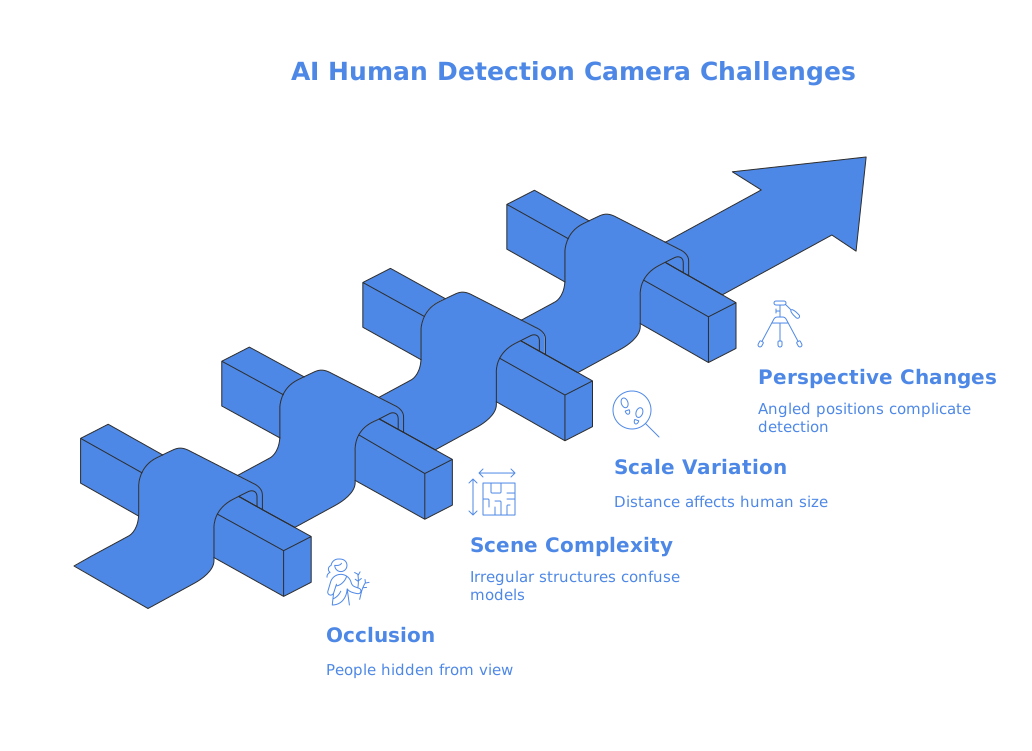
While AI human detection cameras offer powerful capabilities, they face challenges that require thoughtful development and deployment. Variations in posture, attire, environmental conditions, and crowding can confuse models. Internal testing must identify which conditions create the highest error rates and address them through dataset improvement.
Occlusion and Scene Complexity
Occlusion occurs when people appear partially hidden behind objects or other individuals. These scenarios challenge detection models because major portions of the human shape may be missing. Annotated examples of occlusion help models learn partial visibility patterns, reducing the likelihood of misdetections. Complex environments with large equipment or irregular structures require specially curated datasets.
Scale Variation and Perspective Challenges
Humans appear at different scales depending on distance from the camera. A robust detection model must handle individuals who appear extremely small in a wide field of view as well as those who appear close to the camera. Perspective changes, such as overhead or angled positions, further complicate detection tasks. Dataset diversity ensures that models can handle these variations.
Future of AI Human Detection Cameras
Advancements in vision models, sensor technologies, and optimization techniques continue to expand the capabilities of human detection cameras. Modern research explores multimodal integration, where cameras combine RGB, thermal imaging, or depth data to strengthen detection under challenging conditions. Cameras are also incorporating self-supervised learning techniques to reduce reliance on large annotated datasets.
Improvements in Embedded AI
Future detection cameras will include more powerful processors that support advanced models directly on the device. This will reduce latency and enable sophisticated reasoning without requiring cloud access. Enhanced hardware acceleration will also allow cameras to run multitask models that combine detection with segmentation, tracking, or posture analysis.
Contextual and Predictive Detection
Context-aware detection systems will interpret human presence in relation to environmental cues. Instead of simply identifying a person, they may understand whether the person is entering a hazardous area or interacting with equipment. Predictive models may anticipate risk patterns, improving safety responses and reducing operational incidents. Such capabilities rely on continuous research and enriched annotation workflows.
If You Are Deploying Human Detection Systems
Launching effective AI human detection cameras requires more than hardware selection. It demands well-annotated datasets, structured evaluation workflows, and continuous refinement to handle real-world variability. If you want support building or improving detection datasets, the DataVLab team can help you design high-quality annotation pipelines that strengthen model accuracy and reliability. Let me know your objectives, and we can explore the best approach for your project.
What is human detection in computer vision?
AI human detection cameras use computer vision models to identify when people appear within a scene and respond to them in real time. They support security monitoring, workplace safety, access control, and smart infrastructure applications. This article explains how these systems work, how datasets and annotations shape accuracy, and why the underlying detection workflows must be engineered carefully.
What does the article explain about how AI human detection cameras work?
AI human detection cameras typically combine imaging hardware with onboard or remote machine learning models. The camera captures visual frames, processes them through an inference engine, and outputs detection information such as bounding boxes, confidence scores, or contextual tags.
What are the main benefits of AI human detection cameras?
The accuracy of human detection cameras depends on the datasets used to train their underlying models. Annotated datasets provide labeled examples that show where humans appear in various conditions. Skilled annotators draw bounding boxes, mark occlusions, and identify edge cases so the model learns a wide range of visual patterns.
What does the section on “Deploying human detection cameras in real environments” explain?
Lighting, weather, camera placement, and scene complexity determine how reliably the camera identifies people. Cameras placed outdoors must handle glare, shadows, rainfall, fog, and nighttime conditions. Indoor cameras may encounter occlusion from equipment, shelving, or architectural features.
What are the main challenges of AI human detection cameras?
While AI human detection cameras offer powerful capabilities, they face challenges that require thoughtful development and deployment. Variations in posture, attire, environmental conditions, and crowding can confuse models. Internal testing must identify which conditions create the highest error rates and address them through dataset improvement.
What does the section on “If you are deploying human detection systems” explain?
Launching effective AI human detection cameras requires more than hardware selection. It demands well-annotated datasets, structured evaluation workflows, and continuous refinement to handle real-world variability.