Human Detection AI: How Reliable Vision Systems Depend on High-Quality Training Data
.jpeg)
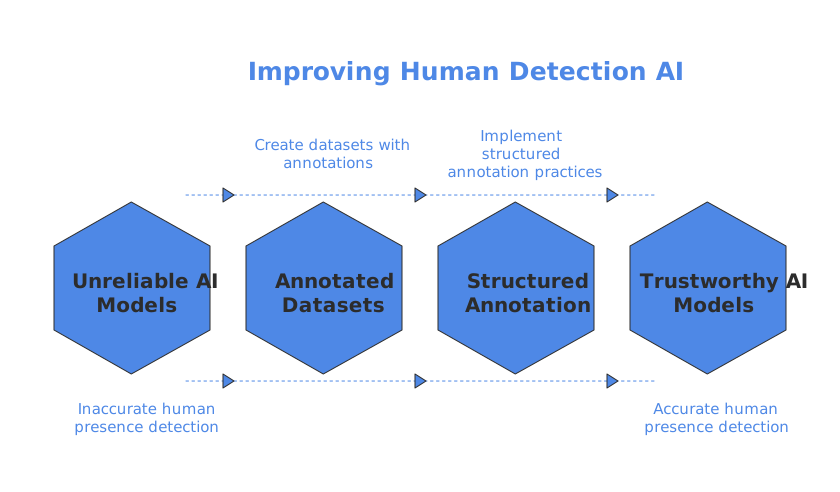
Human detection AI has become foundational to modern safety, security, and monitoring systems across industries ranging from smart cities to workplace automation. This article explains how these systems identify human presence, how annotated datasets are created, and why model reliability depends on precise labeling workflows. It also covers emerging research trends, challenges in real-world deployment, and the role of structured annotation practices in building trustworthy models. Readers will gain a clear understanding of the technical components that support human presence detection and how annotation quality influences performance and compliance expectations.
- Human detection AI has become foundational to modern safety, security, and monitoring systems across industries ranging from smart cities to workplace automation.
- This article explains how these systems identify human presence, how annotated datasets are created, and why model reliability depends on precise labeling workflows.
- It also covers emerging research trends, challenges in real-world deployment, and the role of structured annotation practices in building trustworthy models.
- Readers will gain a clear understanding of the technical components that support human presence detection and how annotation quality influences performance and compliance expectations.
Understanding Human Detection AI
Human detection AI refers to computer vision systems designed to identify people within visual inputs such as images, video streams, or multi-sensor data. These systems operate through learned patterns extracted from annotated datasets, allowing models to infer the presence, location, and sometimes posture of individuals in complex environments. Their development has accelerated with advances in deep learning and the availability of large-scale detection datasets curated by research institutions and applied research teams. Organizations such as the NIST Image Group publish resources that demonstrate how training data design influences precision in detection tasks. As industries adopt real-time monitoring systems, the demand for accurate and resilient human detection has expanded significantly. This makes dataset quality, annotation policies, and robust model evaluation essential components of any deployment.
Why Human Detection Matters Across Sectors
Human presence detection is no longer limited to surveillance use cases. Logistics centers rely on detection to ensure workers remain in safe zones around automated vehicles and heavy machinery. Smart city programs embed detection in traffic-monitoring infrastructure to support pedestrian safety in busy intersections and public areas. Retailers use computer vision systems to understand store occupancy patterns without compromising privacy requirements. In robotics, human detection allows collaborative machines to operate safely alongside operators by recognizing proximity and responding appropriately. These diverse applications illustrate that the reliability of detection models directly affects operational safety, efficiency, and compliance expectations across sectors.
Core Capabilities of Human Detection Models
Human detection models typically include capabilities such as localization, classification, and contextual reasoning. Localization allows the system to identify precisely where a person is situated within a frame. Classification mechanisms confirm that the detected entity is indeed a human rather than an object or an animal. More advanced systems incorporate contextual cues such as pose patterns, crowd density, or motion trajectories. This richness of interpretation is possible because annotated data provides examples of varied body shapes, clothing styles, backgrounds, and occlusion scenarios. Without this breadth of labeled data, detection models struggle to generalize beyond controlled environments.
How Human Detection Models Work
Human detection AI systems use deep neural networks trained on large volumes of annotated imagery. These networks learn to associate pixel arrangements with the presence of human forms under a wide range of environmental conditions. During training, models analyze example cases that delineate human silhouettes, bounding regions, and contextual attributes. The model then adjusts its weights to minimize errors across iterative recognition cycles. The resulting network can process new images and infer whether people are present, even when appearance and background differ from the training set. Research communities such as ECCV regularly publish technical insights that support advancements in detection architectures. These publications show how model design choices influence recall, precision, and computational efficiency in real-world applications.
Feature Extraction and Pattern Learning
Effective human detection relies on feature extraction methods that capture spatial hierarchies and structural cues. Early layers of a network identify basic features such as edges and contours, while deeper layers encode more abstract patterns like limbs, body proportions, and posture configurations. This multi-level representation helps models remain resilient to variations in lighting, orientation, or clothing. The more diverse and representative the dataset, the more stable these learned features become. Training workflows therefore require annotated examples across indoor and outdoor scenes, crowded and sparse environments, and varied cultural and geographical contexts.
Bounding Boxes vs. Expanded Context Cues
Most human detection systems rely on bounding box annotations, which outline the region where a person appears. Bounding boxes provide a fast and consistent way to label human presence across thousands of samples. However, in applications where spatial reasoning or risk zones matter, bounding boxes alone may not provide sufficient context. Some advanced models incorporate contextual attributes such as activity labels or environmental cues. Technical discussions from platforms like the Computer Society explore how context-aware detection contributes to safety and workflow automation. Including such annotated attributes enhances the precision of downstream models that must respond dynamically to human presence.
Human Presence Detection in Real-World Environments
Deploying human detection AI beyond controlled laboratory environments requires overcoming real-world variability. Lighting changes throughout the day, creating shadows or glare that challenge model robustness. Weather patterns alter visibility in outdoor deployments, ranging from rain to heavy fog. Indoor environments introduce occlusions created by shelves, machinery, equipment, or architectural features. A detection system must handle these complexities reliably to maintain safety and operational continuity. Dataset design therefore plays an essential role in preparing models for the nuanced conditions they will encounter after deployment.
Handling Occlusion and Crowding
In environments like warehouses, retail stores, or transportation hubs, people frequently pass behind objects or each other. Occlusion can significantly degrade detection accuracy unless the model has been trained with annotated examples that include partial human visibility. Annotators often mark partial bounding boxes, indicating where visible body regions appear and labeling cases where individuals overlap. These annotations help the model learn correct patterns even when visibility is limited. Systems trained with occlusion-rich datasets can better manage crowded scenes, which improves safety and monitoring outcomes in high-traffic areas.
Managing Motion and Low-Resolution Inputs
Video-based detection introduces challenges related to motion blur, camera vibration, and low-resolution frames. As individuals move, their shape and position change rapidly, which requires the model to track and identify them consistently across frames. Annotated sequences that include varied movement speeds and directions improve temporal consistency. Low-resolution scenarios demand that the model learn coarse-grained patterns rather than relying solely on fine details. Specialized datasets, often referenced in applied computer vision resources such as CVI Software’s technical guides provide examples that help refine the model’s handling of these constraints.
Role of Annotated Datasets in Human Detection
The foundation of any human detection model is the dataset it was trained on. Annotated datasets supply structured examples that teach models to distinguish human presence from background noise or irrelevant features. DataVLab’s workflows for annotation ensure consistency in labeling approach, quality assurance cycles, and verification steps that eliminate ambiguous or incorrect annotations. High-quality labeling reduces error propagation during model training, resulting in better generalization and fewer false alarms or missed detections.
Dataset Composition and Diversity
Diverse datasets that capture a broad spectrum of human appearances improve model generality. This includes different body shapes, clothing colors, accessories, and mobility aids. Environmental diversity — from bright office spaces to dim warehouse aisles — also contributes to model resilience. Including examples from multiple seasons, cultures, and geographic regions enhances fairness and performance across global contexts. Models trained on homogeneous datasets may show high accuracy during testing but fail dramatically when deployed in unfamiliar environments, underscoring the need for intentional dataset diversity.
Importance of Quality Assurance in Annotation
Quality assurance steps ensure that annotations remain consistent, accurate, and aligned with project goals. Multi-step validation processes catch boundary inaccuracies, mislabeled regions, and oversight errors. These checks also maintain consistency across annotators, especially in large-scale projects spanning thousands of samples. Structured QA pipelines help maintain the integrity of training data, ultimately contributing to the stability and interpretability of model outputs. Datasets validated through rigorous processes yield models that can better handle edge cases and perform effectively under variable conditions.
Challenges in Human Detection AI
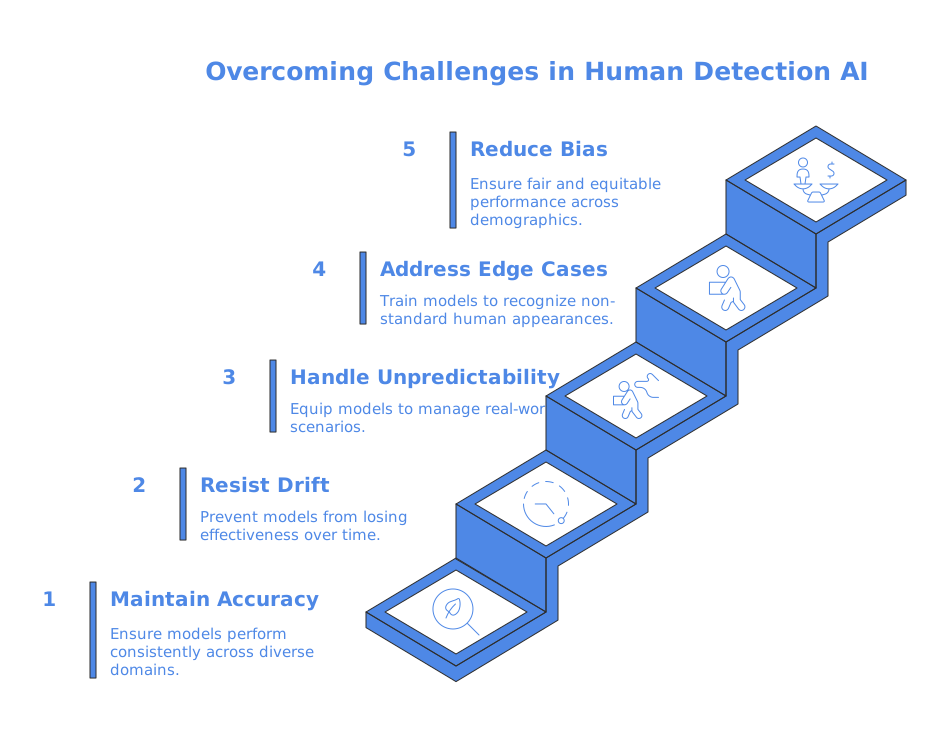
While the field has advanced rapidly, implementing human detection AI comes with several challenges. Models must maintain accuracy across domains, resist drift over time, and handle the unpredictable nature of real-world environments. False positives and false negatives have different consequences depending on context, with some applications requiring near-zero tolerance for errors. Ensuring balanced datasets, avoiding bias, and incorporating realistic scenarios remain continuing challenges in dataset curation.
Dealing With Edge Cases
Certain scenarios require special handling, such as individuals bending down, carrying large items, or wearing protective equipment. These situations may alter the visual signature of a human figure, confusing models that rely on standard posture cues. Annotating such edge cases helps models learn non-standard patterns. However, gathering sufficient examples requires careful project planning and deliberate dataset expansion to cover rare or atypical appearances.
Reducing Bias in Training Data
Bias can arise when datasets disproportionately represent specific demographic or environmental conditions. Models trained on such datasets may underperform when detecting individuals from underrepresented groups or operating in unfamiliar settings. Increasing dataset diversity and employing balanced sampling strategies reduces this risk. Research communities frequently discuss model fairness, and resources such as the Google AI blog explore emerging techniques that reinforce responsible model development.
Advances in Human Detection Research
Recent innovations in deep learning have enhanced the capabilities of human detection AI. Architectures such as multi-scale detection networks, transformer-based vision systems, and hybrid spatial–temporal models improve performance in complex settings. Research published in high-impact conferences demonstrates that integrating contextual cues, such as movement patterns, improves detection confidence in dynamic environments. The shift toward real-time inference has pushed developers to optimize computational efficiency while preserving accuracy.
Multi-Sensor Detection
Combining RGB, depth sensors, and thermal imaging enhances detection robustness, especially in low-light or visually cluttered environments. These multimodal systems can operate in varied conditions while reducing false negatives. Annotated multimodal datasets enable training workflows that align features across multiple sensor types, strengthening model resilience in real-world deployments.
Future Directions in Human Detection
Emerging research explores continual learning, enabling models to update themselves as environments evolve. Semi-supervised and active learning techniques aim to reduce manual annotation requirements by identifying the most informative samples for labeling. These approaches promise more scalable and adaptable detection systems capable of handling complex operational environments over extended periods.
Improving Model Performance Through Annotation Strategy
Optimizing an annotation strategy has a direct impact on model performance. Careful planning ensures that datasets represent real operational scenarios and target the right edge cases. Annotation guidelines define what constitutes visible human presence and how to treat partial occlusions, distance-based visibility, and ambiguous silhouettes. These rules standardize how annotators work and ensure that all samples follow the same structural logic.
Structuring Annotation Guidelines
Clear guidelines improve labeling consistency across teams. They define how bounding boxes should be drawn, how to treat overlapping bodies, and when to mark partial visibility. Consistent guidelines reduce annotation noise, which leads to tighter model error distributions and more predictable performance during deployment.
Continuous Dataset Refinement
As detection models encounter new environments, performance gaps may appear. Updating datasets with new samples helps models adapt to evolving conditions. Continuous dataset refinement ensures the system remains reliable, especially for long-term deployments. Iterative training cycles that incorporate new annotated data create models that remain aligned with changing operational needs.
Integrating Human Detection Into Larger Systems
Human detection models are often components of larger systems such as access control networks, safety monitoring platforms, or industrial robotics workflows. In these integrated systems, detection outputs feed into decision-making logic that triggers alarms, stops machinery, or records events. This makes detection accuracy critical to overall system reliability and safety assurance. Careful integration and testing ensure smooth communication across system components and reduce the likelihood of operational disruptions.
Monitoring, Logging, and Auditability
In high-stakes environments, detection systems must support logging and auditing features to track model behavior. These logs help organizations analyze system outputs, identify anomalies, and demonstrate compliance with operational protocols. When combined with well-annotated datasets, audit trails help confirm that the system is performing as intended and adhering to established safety expectations.
If You Want to Strengthen Your Human Detection Projects
High-quality human detection requires more than advanced models — it relies on precise annotation, structured datasets, and continuous refinement. If you are developing or scaling detection systems and want to improve dataset quality, annotation workflows, or edge-case coverage, the DataVLab team can support you with expert dataset curation and large-scale labeling operations tailored to your environment. Let me know your objectives, and we can explore how to accelerate your next deployment with reliable, structured training data.
What is Human detection AI?
Human detection AI has become foundational to modern safety, security, and monitoring systems across industries ranging from smart cities to workplace automation. This article explains how these systems identify human presence, how annotated datasets are created, and why model reliability depends on precise labeling workflows.
Why does human detection matter Across sectors?
Human presence detection is no longer limited to surveillance use cases. Logistics centers rely on detection to ensure workers remain in safe zones around automated vehicles and heavy machinery. Smart city programs embed detection in traffic-monitoring infrastructure to support pedestrian safety in busy intersections and public areas.
What does the article explain about how human detection models work?
Human detection AI systems use deep neural networks trained on large volumes of annotated imagery. These networks learn to associate pixel arrangements with the presence of human forms under a wide range of environmental conditions. During training, models analyze example cases that delineate human silhouettes, bounding regions, and contextual attributes.
What are the main benefits of Human detection AI?
Quality assurance steps ensure that annotations remain consistent, accurate, and aligned with project goals. Multi-step validation processes catch boundary inaccuracies, mislabeled regions, and oversight errors. These checks also maintain consistency across annotators, especially in large-scale projects spanning thousands of samples.
What are the main challenges of Human detection AI?
While the field has advanced rapidly, implementing human detection AI comes with several challenges. Models must maintain accuracy across domains, resist drift over time, and handle the unpredictable nature of real-world environments. False positives and false negatives have different consequences depending on context, with some applications requiring near-zero tolerance for errors.
What is involved in integrating human detection into larger systems?
Human detection models are often components of larger systems such as access control networks, safety monitoring platforms, or industrial robotics workflows. In these integrated systems, detection outputs feed into decision-making logic that triggers alarms, stops machinery, or records events.