Labeling Dangerous Goods with Computer Vision: How AI Improves Hazmat Compliance and Safety Monitoring
.jpeg)
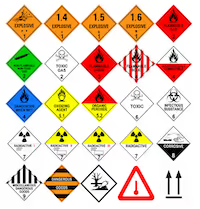
Labeling dangerous goods is essential for safety, compliance, and risk management across logistics, manufacturing, transportation, and storage environments. This article explains how computer vision enhances the accuracy and reliability of dangerous goods labeling, how annotated datasets support model performance, and how AI enables scalable inspection workflows. It also covers the challenges of hazardous material identification, the role of regulatory frameworks, and the technical foundations behind automated label recognition. By exploring real-world applications and key dataset requirements, this article provides a comprehensive view of how computer vision contributes to safer and more compliant operations.
- Labeling dangerous goods is essential for safety, compliance, and risk management across logistics, manufacturing, transportation, and storage environments.
- This article explains how computer vision enhances the accuracy and reliability of dangerous goods labeling, how annotated datasets support model performance, and how AI enables scalable inspection workflows.
- It also covers the challenges of hazardous material identification, the role of regulatory frameworks, and the technical foundations behind automated label recognition.
- By exploring real-world applications and key dataset requirements, this article provides a comprehensive view of how computer vision contributes to safer and more compliant operations.
Why Dangerous Goods Labeling Matters
Dangerous goods labeling ensures that hazardous substances are correctly identified throughout their lifecycle, from initial packaging to final delivery or disposal. These labels communicate essential information such as chemical hazards, flammability, toxicity, and handling requirements. Because mislabeling can lead to severe incidents, industries rely on strict labeling protocols to maintain operational safety. Compliance frameworks, such as those referenced in the UN’s Recommendations on the Transport of Dangerous Goods, define standardized labeling systems used globally. When combined with advanced inspection technologies, these frameworks support consistent communication across jurisdictions, transport modes, and supply chains.
The Growing Complexity of Hazmat Supply Chains
Modern supply chains involve multiple stakeholders, each responsible for maintaining label accuracy and documentation consistency. Goods may pass through manufacturing facilities, storage depots, transportation hubs, and delivery networks. Each stage introduces opportunities for label damage, fading, misplacement, or human error. These challenges increase the risk of incomplete or incorrect information reaching downstream users. As supply chains scale and diversify, manual inspection processes become too slow or labor-intensive to guarantee continuous accuracy. Computer vision provides a scalable alternative that detects hazards consistently, even under heavy operational load.
Safety and Compliance Implications
Incorrect labeling compromises the ability of workers and emergency responders to recognize hazards quickly. Unclear or missing labels can cause mishandling during loading, storage, or first-response procedures. Regulatory authorities, including OSHA’s Hazard Communication Standard within the United States, emphasize accurate labeling as a fundamental component of workplace safety. AI-supported inspection tools help ensure that these safety requirements are enforced systematically. By automating detection tasks, organizations reduce human error and maintain a consistent safety posture across all operational environments.
How Computer Vision Supports Dangerous Goods Labeling
Computer vision systems identify, interpret, and verify hazardous materials labels through trained detection models. These systems process images or video feeds from cameras installed along logistics flows or within inspection checkpoints. They analyze visual patterns to determine whether labels are present, correctly positioned, and undamaged. Annotation teams prepare training data by labeling hazardous symbols, color codes, pictograms, handling instructions, and zone indicators. These datasets enable AI models to generalize across packaging types, lighting conditions, and operational environments.
Detecting Hazmat Symbols and Pictograms
Hazardous materials labels use standardized pictograms that convey critical information quickly. These include symbols for flammable materials, corrosive substances, explosives, and toxic chemicals. AI detection models trained on annotated samples learn to recognize these pictograms even when labels appear faded, scratched, partially occluded, or wrapped around curved surfaces. This capability improves resilience in real operations where labels are rarely pristine. The U.S. Department of Transportation’s Hazardous Materials safety office highlights the importance of clear and intact labels for safe transportation. Computer vision supports this need by automating symbol verification with consistent accuracy.
Reading Supplemental Label Information
Beyond pictograms, dangerous goods labels often include alphanumeric codes, handling instructions, chemical identifiers, and regulatory classifications. Large-scale logistics operations require consistent verification of these elements to prevent documentation mismatches. Computer vision models can integrate optical character recognition to interpret text and compare it against expected values. Annotated datasets that highlight text regions and emphasize varying font styles help models read irregular labels. This supports automated workflows where labels are cross-checked against manifest records or database entries.
Technical Foundations of Hazard Label Detection
Human-annotated datasets form the core of any hazard label detection system. Annotators mark bounding boxes around pictograms, classify hazard types, and identify contextual elements such as packaging materials or transport codes. These examples teach detection models to extract features that distinguish one type of hazardous material from another. Model architectures designed for industrial labeling tasks must handle variable lighting, complex backgrounds, reflective surfaces, and distorted label shapes.
Visual Diversity in Training Data
Dangerous goods packaging varies widely in shape, size, material, and texture. Labels may adhere to metal drums, plastic containers, cardboard boxes, or flexible packaging materials. Training datasets must reflect this diversity to help models generalize beyond idealized samples. Without such variety, detection performance declines rapidly in unfamiliar scenarios. The EPA’s hazardous materials guidelines describe the many contexts in which hazardous materials appear and the importance of clear visual communication across environments. AI models trained on diverse examples perform more reliably in these varied settings.
Feature Extraction and Symbol Classification
Detection models operate by learning patterns that represent hazard symbols and related elements. Early layers focus on simple features such as edges, color blocks, or shapes. Deeper layers encode complex patterns associated with specific pictograms or structural label elements. Annotated datasets help networks differentiate between visually similar markings, such as distinguishing between explosive and flammable material symbols. This precision reduces false classifications and ensures correct hazard identification.
Real-World Challenges in Hazard Label Detection
Real operational conditions introduce variability that complicates hazard label detection. Labels may become partially detached, folded, or stained. When containers are stacked or packed closely, labels may face the wrong direction or be partially obstructed. AI detection systems must remain reliable under these imperfect conditions. The robustness of the model depends on both dataset diversity and thoughtful annotation strategies that capture these real-world imperfections.
Occlusion and Damage
Partially visible labels require models to infer hazard types from incomplete cues. Annotators represent occlusion in training data by marking partial bounding boxes or secondary visual cues. These examples help models understand the underlying structure of hazard symbols even when only fragments remain visible. Incorporating such cases improves detection accuracy in warehouses, transport hubs, and industrial yards where label damage is common.
Environmental and Lighting Conditions
Lighting conditions vary widely across operational settings, from bright outdoor terminals to dim indoor storage spaces. Shiny surfaces on metal containers or plastic drums may create glare that obscures label details. Annotated datasets must include examples captured under all of these conditions to ensure reliable detection. ISO’s fire and hazard guidelines illustrate the importance of environmental awareness in safety communication practices. AI systems trained accordingly perform more consistently in unpredictable settings.
Applications of Computer Vision in Dangerous Goods Labeling
Computer vision supports a wide range of labeling and monitoring applications across industries. Depending on organizational needs, these systems may operate continuously on live video streams or perform batch analysis on captured images. Automated workflows improve both compliance enforcement and operational efficiency.
Logistics and Transportation
Transportation networks depend on accurate hazard labeling to manage risks associated with moving dangerous goods. Computer vision can automatically verify labels at loading docks, during vehicle boarding, and at transfer points. When a label is missing or incorrect, the system can immediately alert staff. This reduces the risk of incorrectly loaded cargo and ensures compliance with transport regulations.
Manufacturing and Industrial Operations
Manufacturers routinely work with chemicals, fuels, and other hazardous materials. Computer vision can assist with verifying that raw materials and intermediate products carry correct labels before entering production lines. Automated checkpoints help prevent improper mixing, misclassification, or misuse of substances. These steps contribute to safer workplaces and reduce downtime caused by avoidable incidents.
Integrating Computer Vision With Compliance Systems
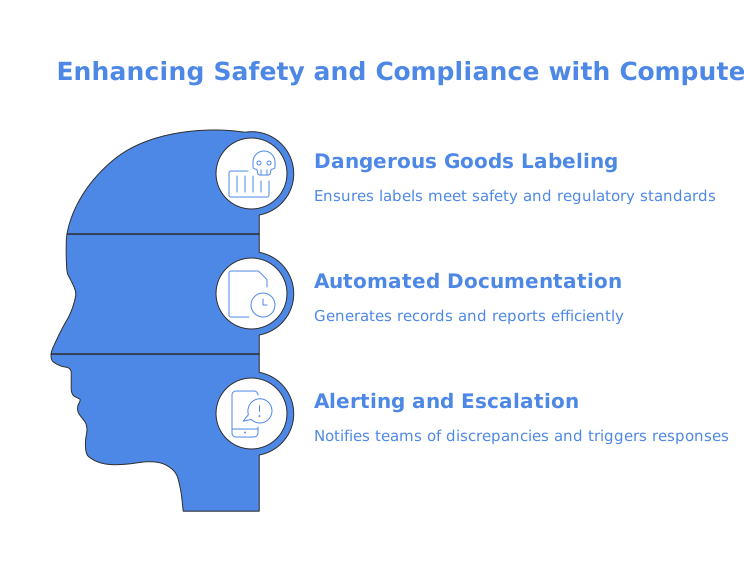
Dangerous goods labeling is not only a visual task but a regulatory requirement. Integrating computer vision with compliance systems ensures that label verification aligns with internal safety policies and external regulations. AI detection outputs can feed into enterprise resource systems, compliance dashboards, or traceability records.
Automated Documentation and Recordkeeping
Maintaining accurate records is essential for audits and incident investigations. Computer vision systems can automatically generate documentation, time-stamped inspection logs, and error reports. These automated outputs reduce administrative workload and improve traceability. By linking detection results with shipment data, organizations ensure that any discrepancies are identified quickly.
Alerting and Escalation
When detection systems identify a missing or incorrect label, automated alert mechanisms can notify the relevant team. Alerts may trigger workflow escalations that prevent hazardous materials from proceeding through the supply chain. This minimizes risk and ensures consistent hazard communication. Automated responses are especially valuable in high-throughput environments where manual inspection is impractical.
Architecture Behind Hazard Label Detection Systems
Building an effective hazard label detection system requires a thoughtful selection of model architecture, hardware components, and deployment strategies. Lightweight models may operate directly on edge devices in warehouses or transport yards, while heavier models may run on servers that process large volumes of image data.
Edge-Based Detection
Edge devices embedded within cameras or scanners can identify hazards without requiring constant network connectivity. This approach reduces latency and enhances privacy because images do not need to leave the facility. Edge detection is ideal for sites with intermittent connectivity or where immediate responses are necessary.
Cloud-Based Detection
Cloud detection allows organizations to use larger, more sophisticated models capable of handling complex detection tasks. It supports multi-site deployment, centralized monitoring, and scalability. Cloud systems can coordinate data from multiple cameras and integrate more easily with enterprise software.
Future Developments in Dangerous Goods Detection
Computer vision is evolving rapidly, and hazardous materials detection will benefit from several emerging trends. Improved sensor technologies, multimodal data fusion, and adaptive learning will strengthen future workflows.
Multimodal Detection
Combining RGB cameras with depth sensors, spectral imaging, or thermal sensors can enhance detection accuracy under challenging conditions. These modalities provide additional context that helps models differentiate between label types and detect hidden hazards.
Self-Supervised and Continual Learning
Self-supervised learning techniques reduce reliance on annotated datasets by allowing models to learn from unlabeled images. Continual learning enables systems to adapt to new label styles, packaging materials, or hazards without full retraining. These capabilities will support more flexible and scalable label detection systems.
If You Are Building Hazmat or Compliance Detection Systems
Automating dangerous goods labeling requires precise annotation, diverse datasets, and careful model validation. If you want to improve your hazardous materials detection workflows or strengthen dataset quality, the DataVLab team can help you design high-quality annotation pipelines tailored to real-world compliance environments. Share your goals, and we can explore the best approach to support your safety and compliance initiatives.
How does AI improve Hazmat compliance and safety monitoring?
Labeling dangerous goods is essential for safety, compliance, and risk management across logistics, manufacturing, transportation, and storage environments. This article explains how computer vision enhances the accuracy and reliability of dangerous goods labeling, how annotated datasets support model performance, and how AI enables scalable inspection workflows.
Why does dangerous goods labeling matter?
Dangerous goods labeling ensures that hazardous substances are correctly identified throughout their lifecycle, from initial packaging to final delivery or disposal. These labels communicate essential information such as chemical hazards, flammability, toxicity, and handling requirements. Because mislabeling can lead to severe incidents, industries rely on strict labeling protocols to maintain operational safety.
How does Computer vision support Dangerous goods labeling?
Computer vision systems identify, interpret, and verify hazardous materials labels through trained detection models. These systems process images or video feeds from cameras installed along logistics flows or within inspection checkpoints. They analyze visual patterns to determine whether labels are present, correctly positioned, and undamaged.
What are the main challenges of Labeling dangerous goods with computer vision?
Real operational conditions introduce variability that complicates hazard label detection. Labels may become partially detached, folded, or stained. When containers are stacked or packed closely, labels may face the wrong direction or be partially obstructed.
What are the main use cases for Labeling dangerous goods with computer vision?
Computer vision supports a wide range of labeling and monitoring applications across industries. Depending on organizational needs, these systems may operate continuously on live video streams or perform batch analysis on captured images. Automated workflows improve both compliance enforcement and operational efficiency.
What is the future of Labeling dangerous goods with computer vision?
Computer vision is evolving rapidly, and hazardous materials detection will benefit from several emerging trends. Improved sensor technologies, multimodal data fusion, and adaptive learning will strengthen future workflows. Combining RGB cameras with depth sensors, spectral imaging, or thermal sensors can enhance detection accuracy under challenging conditions.