Visual Grounding Datasets: How to Annotate Region-Text Alignment for Multimodal AI
.jpeg)

This article explains how visual grounding datasets are created and why precise region-text alignment is essential for multimodal AI. It covers bounding region selection, object disambiguation, referring expressions, spatial cues, attribute labeling, reasoning chains, edge cases and quality control. You will also learn how visual grounding datasets support robotics, retrieval, multimodal assistants and next-generation vision-language architectures.
- This article explains how visual grounding datasets are created and why precise region-text alignment is essential for multimodal AI.
- It covers bounding region selection, object disambiguation, referring expressions, spatial cues, attribute labeling, reasoning chains, edge cases and quality control.
- Research from the Allen Institute for AI (AI2) shows that region-text alignment is one of the strongest predictors of downstream multimodal reasoning quality.
- Studies from the University of Edinburgh Institute for Language, Cognition and Computation highlight that grounding datasets improve error tolerance in multimodal tasks by teaching models to attend to relevant visual cues.
Visual grounding is the task of linking language to specific regions in an image. Models must identify which object or area corresponds to a textual description, such as “the small cup on the left” or “the person wearing the red jacket.” This mapping requires datasets where each phrase is paired with the correct visual region. Research from the Allen Institute for AI (AI2) shows that region-text alignment is one of the strongest predictors of downstream multimodal reasoning quality. High-quality annotation ensures that models understand not only object identity but also attributes, relationships and spatial logic.
Why Visual Grounding Matters for Multimodal AI
Visual grounding supports a wide range of applications: human-robot interaction, multimodal retrieval, contextual image editing and intelligent visual assistants. Models must correctly interpret phrases describing objects, places and relationships. Studies from the University of Edinburgh Institute for Language, Cognition and Computation highlight that grounding datasets improve error tolerance in multimodal tasks by teaching models to attend to relevant visual cues. Grounding is the bridge between visual perception and language understanding, enabling more interactive and situationally aware AI systems.
Preparing Images and Text for Grounding Annotation
Before annotation begins, image and text data must be cleaned, standardized and paired appropriately. Poor data preparation leads to misalignment between textual descriptions and visual content.
Curating images with adequate diversity
Grounding datasets should include images with varied object density, lighting conditions, camera angles and background complexity. Balanced diversity helps models learn grounding beyond narrow visual distributions.
Ensuring descriptive phrases match visual content
Textual descriptions must refer to actual visual elements. Annotators must filter out mismatched or noisy text. This prevents models from learning incorrect correspondences.
Stabilizing image quality and resolution
High-resolution images provide clearer boundaries and finer details. Annotators rely on visible details to ground attributes accurately. Standardizing resolution improves annotation consistency across large datasets.
Annotating Regions for Grounding Tasks
Visual grounding requires defining regions that correspond to expressions. These regions may be bounding boxes, polygons or segmentation masks depending on dataset goals.
Selecting the correct region type
Bounding boxes are quick to annotate but less precise for irregular shapes. Polygons and masks offer higher precision. Annotators must follow guidelines on the preferred region type to maintain dataset consistency.
Ensuring region completeness
Regions must fully capture the referenced object or area without unnecessary background. Precise region boundaries improve the model’s ability to learn location-specific attributes.
Avoiding over-segmentation
Annotators must avoid splitting objects into unnecessary subregions unless descriptions explicitly reference distinct components. Excessive segmentation increases noise and distracts the model from key areas.
Writing Referring Expressions for Grounded Objects
Referring expressions describe the target object with enough detail to differentiate it from others. They form the linguistic component of grounding.
Including discriminative attributes
Expressions should specify color, size, position or other distinguishing features when needed. This helps models disambiguate between similar objects.
Maintaining natural language structure
Expressions must sound fluent and human-like. Natural phrasing ensures the model learns usable patterns for real-world multimodal tasks.
Avoiding ambiguous or generic descriptions
Generic phrases such as “the object on the table” may refer to multiple candidates. Annotators must refine expressions to eliminate ambiguity and ensure clarity.
Understanding Spatial Relationships in Grounding
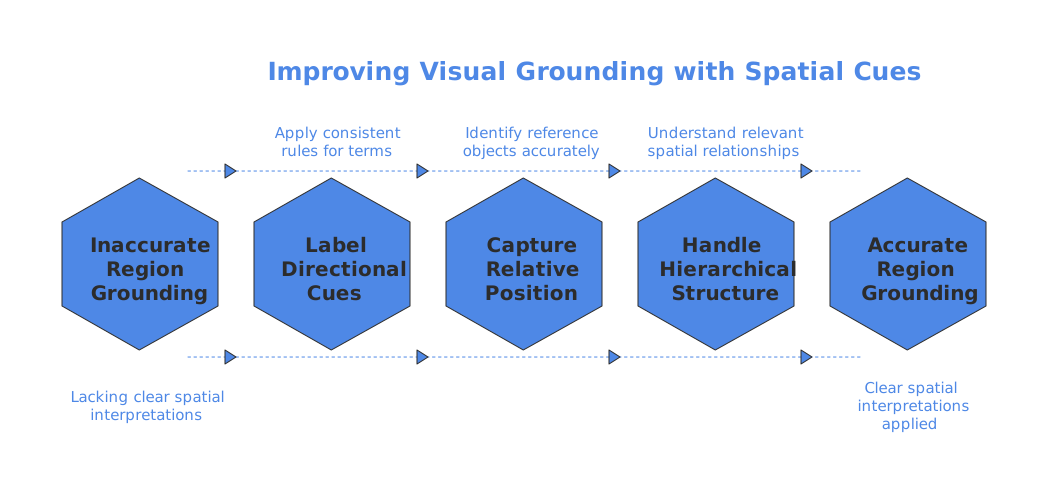
Visual grounding depends heavily on spatial cues such as direction, distance and relative position. These cues help models narrow down the intended region.
Labeling directional cues
Expressions like “on the left,” “behind,” or “near the corner” require clear spatial interpretations. Annotators must apply consistent rules for directional terms.
Capturing relative position
Many descriptions depend on relationships between objects, such as “the book next to the laptop.” Annotators must identify reference objects accurately to support relational reasoning.
Handling hierarchical spatial structure
Some scenes contain nested layouts or multi-level spatial patterns. Annotators must understand which spatial relationships are relevant for grounding and which are irrelevant.
Annotating Attributes and Object Properties
Attributes such as color, material, size and shape contribute significantly to grounding accuracy. Models rely on these descriptors to differentiate similar objects.
Identifying visible attributes
Annotators must label attributes only when clearly visible. Assumptions or guesses weaken dataset reliability.
Distinguishing primary and secondary attributes
Primary attributes are essential for grounding. Secondary attributes add richness but are optional. Annotators must balance both to avoid over-specification.
Handling multi-attribute descriptions
Some objects require multiple attributes for disambiguation. Annotators must structure these logically in expressions to avoid confusion.
Resolving Ambiguities in Grounding Tasks
Ambiguity arises when multiple objects match a description or when expressions refer to partially visible items. Annotators must follow detailed rules to resolve these cases.
Dealing with similar objects
Scenes may contain identical items. Annotators must rely on spatial cues or context to differentiate them. Clear criteria reduce disagreement between annotators.
Handling partial visibility
Objects may be partially hidden behind others. Annotators must determine whether the visible portion is adequate for grounding. This decision must remain consistent across the dataset.
Identifying ungroundable expressions
Some phrases may refer to non-visible elements. Annotators must flag these cases rather than force an incorrect alignment.
Designing Guidelines for Visual Grounding Annotation
Detailed guidelines support annotators in handling complex scenes and linguistic structures. They form the backbone of consistent grounding datasets.
Documenting region-selection rules
Guidelines must explain how to choose bounding boxes, how to treat occlusions and how to handle complex shapes. Clear documentation prevents inconsistent region selection.
Providing examples of referring expressions
Examples clarify how to describe objects with natural language. Annotators rely on these examples to maintain linguistic coherence.
Updating rules as new scene types appear
As datasets expand, new visual patterns emerge. Guidelines must evolve to incorporate new types of ambiguity or attribute combinations.
Quality Control for Grounding Datasets
Grounding datasets require meticulous review of both regions and textual expressions.
Checking region-text alignment
Each expression must match its region precisely. Quality reviews confirm that the descriptions correspond accurately to the visual content.
Sampling complex scenes
Crowded scenes, cluttered backgrounds or similar objects require extra review attention. Sampling these cases improves overall dataset reliability.
Using automated validation tools
Automated checks can detect overlapping regions, missing bounding boxes or repeated expressions. These tools accelerate quality assurance.
Integrating Grounding Data Into Vision-Language Pipelines
Once annotation is complete, grounding datasets must integrate into multimodal training workflows.
Building balanced evaluation sets
Evaluation sets must include diverse object types, attribute varieties and spatial relationships. Balanced sets provide more accurate performance measurements.
Monitoring domain drift
New scene types or lighting conditions can shift visual distributions. Monitoring helps maintain consistent model performance as datasets expand.
Supporting continuous dataset growth
Grounding datasets often grow as new environments and object categories are added. Stable annotation rules ensure long-term scalability.
If you are developing a visual grounding dataset or want to structure region-text alignment workflows, we can explore how DataVLab helps teams create high-quality multimodal datasets for advanced vision-language systems.
What are Visual grounding datasets?
This article explains how visual grounding datasets are created and why precise region-text alignment is essential for multimodal AI. It covers bounding region selection, object disambiguation, referring expressions, spatial cues, attribute labeling, reasoning chains, edge cases and quality control.
Why does visual grounding matter for multimodal AI?
Visual grounding supports a wide range of applications: human-robot interaction, multimodal retrieval, contextual image editing and intelligent visual assistants. Models must correctly interpret phrases describing objects, places and relationships. Studies from the University of Edinburgh Institute for Language, Cognition and Computation highlight that grounding datasets improve error tolerance in multimodal tasks by teaching models to attend to relevant visual cues.
How can teams ensure quality in Visual grounding datasets?
High-resolution images provide clearer boundaries and finer details. Annotators rely on visible details to ground attributes accurately. Standardizing resolution improves annotation consistency across large datasets.
What does the section on “Understanding spatial relationships in grounding” explain?
Visual grounding depends heavily on spatial cues such as direction, distance and relative position. These cues help models narrow down the intended region. Expressions like “on the left,” “behind,” or “near the corner” require clear spatial interpretations.
What is involved in designing guidelines for visual grounding annotation?
Detailed guidelines support annotators in handling complex scenes and linguistic structures. They form the backbone of consistent grounding datasets. Guidelines must explain how to choose bounding boxes, how to treat occlusions and how to handle complex shapes.
What does the section on “Quality control for grounding datasets” explain?
Grounding datasets require meticulous review of both regions and textual expressions. Quality reviews confirm that the descriptions correspond accurately to the visual content. Crowded scenes, cluttered backgrounds or similar objects require extra review attention.