Image Description Datasets: How to Annotate Static Images for Multimodal Vision-Language Models
.jpeg)

This article explains how image description datasets are created for multimodal AI systems. It covers object-level annotation, scene interpretation, descriptive language rules, contextual detail selection, attribute specification, ambiguity reduction and quality control. You will also learn how image description datasets support accessibility tools, content moderation, search engines, robotics and next-generation vision-language models.
- This article explains how image description datasets are created for multimodal AI systems.
- It covers object-level annotation, scene interpretation, descriptive language rules, contextual detail selection, attribute specification, ambiguity reduction and quality control.
- Image description datasets teach models to describe static images using natural language.
- Unlike video captioning, which focuses on temporal structure, image description emphasizes object recognition, attribute identification, spatial relationships and high-level scene interpretation.
Image description datasets teach models to describe static images using natural language. Unlike video captioning, which focuses on temporal structure, image description emphasizes object recognition, attribute identification, spatial relationships and high-level scene interpretation. Research from Carnegie Mellon University’s Multicomp Lab shows that descriptive datasets significantly improve multimodal models by helping them connect visible cues with linguistic structures. High-quality annotation ensures that descriptions remain accurate, relevant and grounded in the visual content rather than relying on assumptions. Strong image descriptions create foundational training signals for numerous multimodal tasks.
Preparing Images for Descriptive Annotation
Images must be curated carefully before annotation begins. Curating involves validating clarity, diversity and relevance so descriptions remain grounded in visible evidence. This preparation ensures that annotators consistently interpret objects, attributes and relationships across the dataset. Well-prepared imagery reduces ambiguity during annotation and supports reliable language generation. Consistent preprocessing also helps maintain uniformity across large-scale dataset projects.
Ensuring high-quality and diverse images
High-resolution images with varied lighting, environments and compositions help annotators describe scenes accurately. Diverse content develops model robustness by exposing it to different visual contexts. Annotators should avoid images that are excessively blurred or contain extreme distortions. This filtering strengthens the dataset by removing ambiguous materials. Diversity also enables descriptions that generalize across real-world conditions.
Verifying object visibility and clarity
Objects must be clearly visible so annotators can describe them without guessing. If key elements are obscured or indistinct, the resulting descriptions may become inaccurate. Annotators must confirm whether the visible evidence supports meaningful description. This reduces speculation and ensures that descriptions remain tied to actual visual content. Consistent treatment of visibility improves dataset reliability.
Standardizing formats and resolution
Images should follow standardized dimensions, aspect ratios and resolution guidelines. This allows annotators to perceive details consistently across the dataset. Standardization also supports automated downstream processing and model training. Uniform formatting helps prevent variability in how annotators interpret visual cues. This stability enhances dataset coherence from start to finish.
Describing Objects and Attributes in Static Images
Object-level description is one of the core components of image annotation. Annotators must identify what objects are present, how they appear and what attributes are relevant. Thorough and consistent annotation teaches models to connect visual elements with descriptive phrases. Object-focused annotation also helps models understand the semantic boundaries between categories.
Naming objects accurately
Annotators must identify each object using precise terminology that reflects common usage. Overly technical wording or vague references weaken linguistic alignment. Clear naming helps models learn reliable mappings between pixels and words. It also reduces ambiguity across the dataset. Accurate naming improves recognition tasks in downstream multimodal systems.
Including essential attributes
Attributes such as color, size, material or texture often provide important context. Annotators must describe attributes only when visible and relevant. Including the right level of detail improves the model’s ability to generate nuanced descriptions. Attributes help differentiate similar objects and enrich narratives. This depth supports more expressive multimodal AI.
Avoiding unnecessary over-description
Descriptions must remain informative without listing every minor detail. Annotators must strike a balance between clarity and conciseness. Excessive attribute listing introduces noise and makes the description unnatural. Maintaining focus on key visual elements improves readability. Balanced object descriptions enhance dataset usefulness across tasks.
Describing Actions, Interactions and Scene Context
Although static images do not show motion, they often imply actions or interactions. Annotators must capture visible cues without imagining unobserved events. The context surrounding objects and actors provides critical information for multimodal reasoning. Well-constructed context descriptions help models understand higher-level semantics.
Identifying implied actions without speculation
Images often capture moments that imply movement, such as someone raising an object. Annotators must describe what is visible without assuming the next step. This grounding avoids introducing fictional or speculative details. Accurate implied-action descriptions help models develop realistic interpretations. Maintaining factual coherence is essential for dataset integrity.
Describing interactions between objects and people
Interactions, such as a person holding an item or two objects arranged together, provide important semantic cues. Annotators must identify these relationships clearly and consistently. These interactions help models learn how objects relate in natural scenes. Keeping descriptions grounded in visible interactions ensures reliability. This interpretive detail enriches multimodal understanding.
Providing scene-level context
Scenes such as kitchens, streets or parks give descriptions additional meaning. Annotators must describe the environment when it is visually clear. Scene context helps models interpret object purpose, human behavior and expected patterns. Including this context strengthens general reasoning capabilities. Well-defined scene descriptions improve downstream generative tasks.
Writing Natural and Coherent Descriptions
Descriptions must resemble natural human language. They should flow smoothly, avoid redundancy and express information in a clear and organized manner. Linguistic coherence contributes significantly to training stability across vision-language models. High-quality language also improves the usability of the dataset for real-world applications.
Maintaining clear sentence structure
Annotators must write grammatically correct sentences with logical flow. Clear structure helps models learn reliable language generation patterns. Poorly constructed sentences introduce noise and reduce interpretability. Stable sentence structure enhances model training outcomes. Clarity is essential for all descriptive workflows.
Balancing brevity and detail
Descriptions should be detailed enough to convey important information but concise enough to remain readable. Annotators must determine which elements are essential based on visual evidence. This balance ensures that descriptions remain informative without becoming overwhelming. Well-balanced descriptions improve dataset quality consistently. The goal is clarity rooted in relevance.
Ensuring descriptive diversity
Diverse phrasing prevents models from overfitting to repetitive language patterns. Annotators should vary sentence structure and choice of words when describing similar scenes. Diversity improves model generalization during language generation. It also enriches the dataset’s linguistic landscape. Consistent variation enhances the overall expressiveness of the dataset.
Managing Ambiguity in Static Image Descriptions
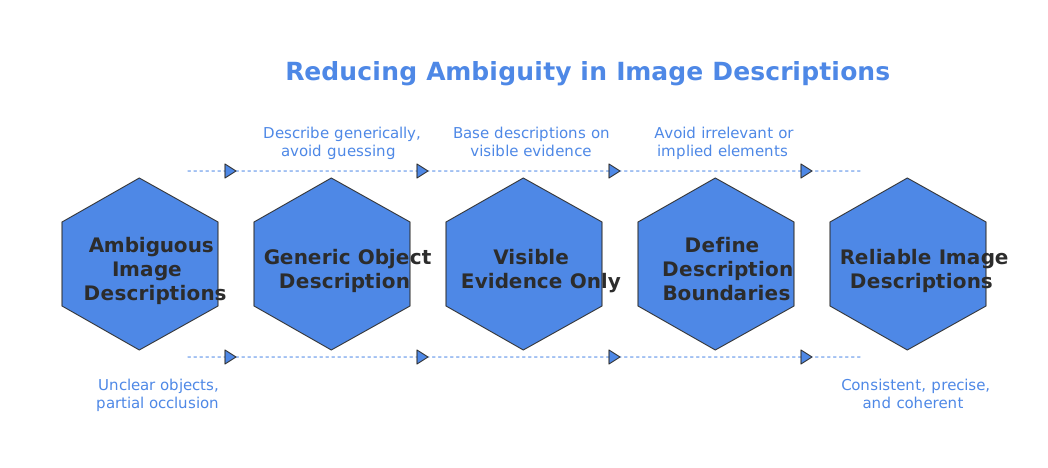
Ambiguity is common when images contain unclear objects, partial occlusion or uncertain relationships. Annotators must apply consistent rules to ensure that descriptions remain reliable. Ambiguity must be handled carefully to maintain dataset precision. Consistent treatment of ambiguous cases protects the dataset from contradictory interpretations.
Resolving uncertain object identities
If an object’s identity cannot be determined confidently, annotators must describe it more generically rather than guess. This prevents incorrect labeling that misguides the model. Clear rules for uncertainty reduce noise across the dataset. Limiting speculation strengthens dataset accuracy. Conservative annotation improves model trustworthiness.
Addressing occluded or partially visible objects
Objects may be partially hidden, which complicates description. Annotators must base descriptions only on visible evidence and avoid inferring missing parts. This prevents inconsistent descriptions across annotators. Clear occlusion policies ensure stability. Handling these cases carefully maintains dataset quality.
Defining what not to describe
Annotators must avoid referring to elements that are outside the frame, irrelevant or implied without evidence. Establishing boundaries on what not to describe helps maintain focus. This discipline prevents unnecessary noise in descriptions. It also supports better model grounding. Explicit exclusion criteria contribute to dataset coherence.
Quality Control for Image Description Datasets
Quality control is essential for ensuring accuracy, consistency and linguistic clarity. Reviewers must check each description for correctness and relevance. Strong QC processes help maintain dataset integrity across large-scale projects. Quality control also reveals patterns that may require updates to annotation guidelines.
Reviewing descriptions for factual grounding
Each description must match visible content precisely. Reviewers confirm that no speculative or fabricated details were introduced. Grounded descriptions support trustworthy model training. This step reinforces annotation reliability. Factual accuracy is a non-negotiable standard.
Evaluating linguistic clarity
Descriptions must remain grammatically correct and easy to understand. Reviewers must correct awkward phrasing or inconsistent formatting. Clear language helps models learn stable generation patterns. It also improves dataset usability. Linguistic clarity supports high-quality model outputs.
Using automated validation checks
Automated tools can detect repetitive phrases, overly short descriptions or formatting inconsistencies. These checks accelerate quality audits. Automation enhances scalability across large datasets. It also identifies patterns of annotation drift. Combining human and automated review increases dataset robustness.
Integrating Image Description Data Into Multimodal Pipelines
Once annotation is complete, image description datasets must integrate smoothly into vision-language training workflows. Clean dataset splits and balanced distribution ensure strong generalization. Integration supports downstream tasks such as captioning, retrieval and scene interpretation. Well-prepared datasets form the backbone of multimodal applications.
Building diverse evaluation sets
Evaluation sets must contain varied scenes, object types and complexity levels. Diversity helps measure model performance more accurately. It also reveals weaknesses in attribute recognition or contextual reasoning. Strong evaluation sets guide iterative improvements. They enhance long-term model stability.
Monitoring category and attribute distribution
Uneven distributions can introduce bias. Annotators and reviewers must monitor balance across categories, contexts and environments. Balanced datasets improve fairness and generalization. They also reduce blind spots in real-world applications. Monitoring distribution is essential during dataset expansion.
Supporting continuous dataset updates
Image description datasets often grow as new content becomes available. Annotators must maintain consistent style and structure across new additions. Stability enables smooth retraining and fine-tuning cycles. This scalability supports evolving product and research needs. A structured update process ensures long-term coherence.
If you are building an image description dataset or need support designing multimodal annotation workflows, we can explore how DataVLab helps teams produce accurate and scalable training data for vision-language models.
How do image-description datasets train multimodal AI models?
This article explains how image description datasets are created for multimodal AI systems. It covers object-level annotation, scene interpretation, descriptive language rules, contextual detail selection, attribute specification, ambiguity reduction and quality control. Image description datasets teach models to describe static images using natural language.
What is involved in ensuring high-quality and diverse images?
High-resolution images with varied lighting, environments and compositions help annotators describe scenes accurately. Diverse content develops model robustness by exposing it to different visual contexts. Annotators should avoid images that are excessively blurred or contain extreme distortions.
What does the section on “Describing objects and attributes in static images” explain?
Object-level description is one of the core components of image annotation. Annotators must identify what objects are present, how they appear and what attributes are relevant. Thorough and consistent annotation teaches models to connect visual elements with descriptive phrases.
What is involved in managing ambiguity in static image descriptions?
Ambiguity is common when images contain unclear objects, partial occlusion or uncertain relationships. Annotators must apply consistent rules to ensure that descriptions remain reliable. Ambiguity must be handled carefully to maintain dataset precision.
How can teams ensure quality in Image description datasets?
Quality control is essential for ensuring accuracy, consistency and linguistic clarity. Reviewers must check each description for correctness and relevance. Strong QC processes help maintain dataset integrity across large-scale projects.
What is involved in integrating image description data into multimodal pipelines?
Once annotation is complete, image description datasets must integrate smoothly into vision-language training workflows. Clean dataset splits and balanced distribution ensure strong generalization. Integration supports downstream tasks such as captioning, retrieval and scene interpretation.