Visual Question Answering Datasets: How to Annotate Multimodal Reasoning for VQA Models
.jpeg)

This article explains how Visual Question Answering (VQA) datasets are created and annotated for multimodal AI systems. It covers question generation, answer types, visual grounding, reasoning chains, compositional logic, ambiguity management and quality control. You will also learn how VQA datasets support research in robotics, search engines, accessibility, document understanding and next-generation vision-language models.
- This article explains how Visual Question Answering (VQA) datasets are created and annotated for multimodal AI systems.
- It covers question generation, answer types, visual grounding, reasoning chains, compositional logic, ambiguity management and quality control.
- Visual Question Answering requires linking image understanding with natural language reasoning.
- Models must answer questions about visual scenes, objects, actions and relationships, which demands datasets where each question is paired with a correct, unambiguous answer.
Visual Question Answering requires linking image understanding with natural language reasoning. Models must answer questions about visual scenes, objects, actions and relationships, which demands datasets where each question is paired with a correct, unambiguous answer. Studies from the Georgia Tech VPA Lab show that well-structured VQA datasets dramatically improve reasoning accuracy, especially when questions focus on multi-step logic rather than surface features. High-quality annotation ensures that models learn how to interpret visual cues, understand linguistic structure and combine both modalities to infer correct answers. As VQA becomes central to vision-language assistants and multimodal retrieval systems, robust dataset annotation is more important than ever.
Preparing Images for VQA Annotation
Before questions are written, images must be curated, cleaned and standardized so annotators work on consistent visual material. Images with extreme noise, heavy artifacts or ambiguous content produce unclear questions that weaken dataset quality. Annotators must therefore work with visuals that contain identifiable objects, clear spatial relationships and sufficient detail to support reasoning tasks. This preparation reduces uncertainty and helps ensure that question-answer pairs remain grounded in observable evidence. Consistent visual quality also supports reproducibility across different batches of annotators.
Ensuring diverse scene representation
Strong VQA datasets span indoor scenes, outdoor environments, everyday activities and specialized domains. Diversity ensures that the model avoids overfitting to narrow visual distributions. Annotators should have access to varied scene types so reasoning abilities generalize across domains. This variety also enables questions about objects, interactions and contexts that differ widely in complexity. Datasets with balanced scene coverage perform significantly better in open-world settings.
Validating object visibility
Images must include objects that are sufficiently visible to support accurate questions. If a key detail is too small, heavily blurred or obstructed, it increases ambiguity and makes question-answering unreliable. Annotators must confirm that all referenced elements remain recognizable throughout the annotation process. Ensuring visibility also prevents inconsistent interpretations across annotators. High-visibility scenes create cleaner, more interpretable VQA content.
Standardizing resolution and formatting
Resolution affects how easily annotators identify fine details such as text, accessories or small objects. Standardized resolution ensures that every annotator perceives the same amount of detail, reducing subjective variation in question creation. Uniform formatting also supports automated preprocessing during model training. This consistency helps maintain accuracy across different model architectures. Standardization is a foundational step for all VQA pipelines.
Designing Questions for VQA Datasets
Questions are the core of VQA datasets and must be written to enable a wide range of reasoning abilities. They should test object recognition, counting, attribute classification, spatial understanding and causal interpretation. Research from the Oxford Visual Geometry Group (VGG) demonstrates that question diversity strongly correlates with model robustness, especially in real-world benchmarks. Annotators must therefore construct questions that are challenging but still grounded in visible evidence. The balance between simplicity and complexity determines how effectively models acquire multimodal reasoning skills.
Creating factual, answerable questions
Each question must refer to elements visible in the image and be answerable without speculation. Annotators must avoid questions that assume unobservable context or require external knowledge. Ensuring factual accuracy helps models learn direct visual-language alignment. This process also prevents dataset noise that could distort training signals. Clean factual questions establish a strong foundation for reasoning.
Ensuring linguistic clarity
Questions must be written clearly, with unambiguous phrasing and consistent grammar. Clarity helps models learn patterns linking question structure to visual understanding. Annotators should avoid unnecessarily complex syntax that introduces linguistic noise. Clear questions also reduce interpretation differences during validation. Consistency in phrasing supports more stable training outcomes.
Including a variety of question types
Effective VQA datasets include questions that test different skills, such as counting, attribute identification, spatial relations and temporal cues. This variety reflects real-world user needs and forces models to develop general multimodal reasoning. Annotators must distribute question types uniformly across scenes. Balanced coverage improves performance on emerging multimodal benchmarks. The goal is comprehensive testing of visual understanding.
Annotating Answers for VQA Tasks
Answers must be correct, concise and aligned precisely with the corresponding question. They represent the target output for models and are essential for supervised training. Annotators must provide answers that reflect only the visible evidence in the image. Each answer must be validated to ensure it matches the intended question scope and does not rely on unobserved assumptions. Answer quality determines how reliably models learn to infer information from visual cues.
Providing concise and unambiguous answers
Answers must be short, typically one to three words, unless the task requires full sentences. Short answers reduce the likelihood of linguistic variation affecting model performance. Annotators must ensure that answers remain unambiguous and refer directly to visible elements. Concise answers simplify evaluation and improve training stability. They also minimize disagreement between annotators during quality audits.
Handling categorical and numerical answers
Some questions require selecting from predefined categories, while others demand numerical responses such as counts. Annotators must adhere to consistent formatting rules for each answer type. This uniformity helps models learn structured output patterns. It also reduces evaluation noise during benchmarking. Consistency across categories is critical for accurate multimodal interpretation.
Managing yes/no answers
Yes/no questions appear simple but often introduce ambiguity if phrased poorly. Annotators must ensure the question clearly supports a binary choice and that the answer is visually verifiable. This structure reduces accidental bias and helps models avoid guessing. Clearly defined yes/no pairs improve reliability in conversational VQA applications. They also support logic-based reasoning tracks.
Grounding Reasoning in Visual Evidence
VQA requires linking linguistic interpretation to visual grounding. Annotators must ensure that each question aligns with identifiable regions of the image. This grounding strengthens the dataset’s ability to train models that reason explicitly about objects and relationships. Studies from the University of Amsterdam VIS Lab show that models trained with grounded questions improve interpretability and reduce hallucinations. Grounding is therefore essential for trustworthy multimodal AI.
Identifying key regions relevant to the question
Annotators must identify which objects or areas of the image support the answer. This regional awareness provides a stronger training signal. Region identification also reveals cases where questions may be unclear or refer to multiple candidates. Clear grounding improves question precision. It also promotes better visual attention mechanisms in models.
Verifying spatial relationships
Many questions depend on relative position, such as “What is next to the lamp?” Annotators must confirm that these spatial cues are unambiguous and visually valid. This avoids incorrect answers that could arise from overlapping or ambiguous layouts. Spatial verification ensures the dataset tests real reasoning rather than guesswork. Accurate spatial annotation contributes to robust multimodal inference.
Confirming attribute consistency
Attributes such as color, size and material must match visible evidence. Annotators must ensure that these properties remain consistent across questions and answers within the same image. When attributes appear ambiguous, the annotator must adjust the question accordingly. Attribute consistency prevents models from learning contradictory labels. This coherence supports reliable feature extraction.
Managing Ambiguity and Edge Cases
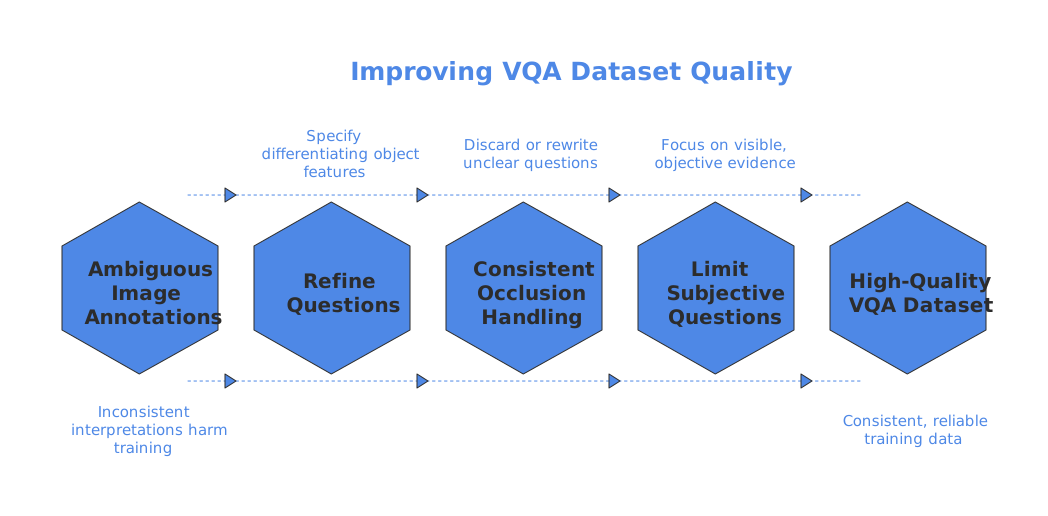
Images often contain unusual object arrangements, rare attributes or cluttered backgrounds. Annotators must handle these edge cases systematically. Ambiguity must be resolved through careful revision of questions or removal of problematic pairs. Consistent treatment ensures that the dataset remains high quality across all scenario types. This careful management also prevents inconsistent interpretations from harming training.
Handling visually similar objects
Images sometimes contain multiple similar objects such as identical chairs or identical bottles. Annotators must refine the question to specify differentiating features. This reduces ambiguity and helps models learn finer distinctions. Careful handling of these cases increases dataset precision. It also supports more advanced reasoning models.
Addressing partial occlusion
Objects may be partially hidden behind others. Annotators must decide whether enough information is visible to support a meaningful question. If not, the question should be discarded or rewritten. This prevents uncertain annotations that weaken downstream performance. Consistent occlusion handling strengthens dataset clarity.
Dealing with subjective or interpretive questions
Questions about emotion, intention or stylistic interpretation usually introduce guesswork. Annotators must avoid such subjective content unless the task explicitly supports it. Limiting subjective questions ensures that answers remain grounded in visible evidence. This restriction helps maintain dataset reliability. Objective, evidence-based questions form the core of strong VQA datasets.
Quality Control for VQA Datasets
Quality control ensures consistent reasoning across questions and answers. Reviewers must evaluate question clarity, answer correctness and visual grounding. This process identifies inconsistencies that might confuse the model. Strong quality control also ensures that the dataset aligns with evolving multimodal benchmarks. Consistent review cycles significantly improve final dataset performance.
Reviewing question-answer alignment
Reviewers must confirm that each question has a unique, visually verifiable answer. Misalignment introduces noise and weakens the training signal. Structured reviews detect such mismatches early. This improves overall dataset reliability. Alignment checks are essential for large-scale VQA pipelines.
Checking linguistic coherence
Questions and answers must remain grammatically consistent and clearly phrased. Any confusing structure should be corrected before finalization. Linguistic clarity improves training stability across architectures. It also enhances interpretability during evaluation. Coherence is essential for user-facing multimodal applications.
Running automated validation checks
Automated tools can detect overly short questions, repeated phrases or inconsistent formatting. These tools accelerate review workflows and reduce human workload. Automation supports large-scale dataset management. It also helps maintain annotation quality during dataset expansion. Combining manual and automated checks produces the most robust results.
Integrating VQA Data Into Multimodal Training Pipelines
Once annotation is complete, VQA datasets must integrate smoothly into training and evaluation pipelines. Clean splits prevent overlap between training and test scenarios. Balanced distributions ensure that models learn reasoning across all question types. Proper integration supports accurate benchmarking and long-term dataset evolution. This alignment strengthens performance across multiple multimodal tasks.
Building balanced evaluation sets
Evaluation sets must include diverse visual scenes and question types. Balanced sets provide a more realistic measure of model reasoning ability. They help reveal weaknesses in attribute recognition, counting or spatial inference. Strong evaluation sets guide iterative improvements. They are essential for high-quality multimodal models.
Monitoring dataset drift
As new data is added, scene distributions may shift. Monitoring drift ensures that the dataset remains stable and consistent. This supports long-term annotation projects. It also prevents biases from accumulating. Drift management is a key part of scalable dataset maintenance.
Supporting future dataset expansions
VQA datasets often grow over time as new categories and scenes are introduced. Annotators must maintain consistent question structures and answer formats across all additions. Stable guidelines ensure coherence as the dataset evolves. This continuity supports retraining and fine-tuning in production pipelines. Scalable design is essential for real-world multimodal systems.
If you are developing a VQA dataset or need support designing multimodal reasoning workflows, we can explore how DataVLab helps teams create accurate, scalable and well-structured training data for advanced vision-language models.
What are Visual question answering datasets?
This article explains how Visual Question Answering (VQA) datasets are created and annotated for multimodal AI systems. It covers question generation, answer types, visual grounding, reasoning chains, compositional logic, ambiguity management and quality control. Visual Question Answering requires linking image understanding with natural language reasoning.
What is involved in preparing images for VQA annotation?
Before questions are written, images must be curated, cleaned and standardized so annotators work on consistent visual material. Images with extreme noise, heavy artifacts or ambiguous content produce unclear questions that weaken dataset quality. Annotators must therefore work with visuals that contain identifiable objects, clear spatial relationships and sufficient detail to support reasoning tasks.
What is involved in designing questions for VQA datasets?
Questions are the core of VQA datasets and must be written to enable a wide range of reasoning abilities. They should test object recognition, counting, attribute classification, spatial understanding and causal interpretation. Research from the Oxford Visual Geometry Group (VGG) demonstrates that question diversity strongly correlates with model robustness, especially in real-world benchmarks.
What does the section on “Grounding reasoning in visual evidence” explain?
VQA requires linking linguistic interpretation to visual grounding. Annotators must ensure that each question aligns with identifiable regions of the image. This grounding strengthens the dataset’s ability to train models that reason explicitly about objects and relationships.
How can teams ensure quality in Visual question answering datasets?
Quality control ensures consistent reasoning across questions and answers. Reviewers must evaluate question clarity, answer correctness and visual grounding. This process identifies inconsistencies that might confuse the model.
What is involved in integrating VQA data into multimodal training pipelines?
Once annotation is complete, VQA datasets must integrate smoothly into training and evaluation pipelines. Clean splits prevent overlap between training and test scenarios. Balanced distributions ensure that models learn reasoning across all question types.