Video Captioning Datasets: How to Annotate Multimodal Sequences for Accurate Vision-Language Models
.jpeg)
This article explains how video captioning datasets are annotated and why precise multimodal labeling is essential for building strong video-language models. It covers segmentation, temporal grounding, object tracking, action identification, descriptive language generation, multimodal alignment and quality control. It also explores how video captioning datasets support video search, accessibility tools, robotics, media indexing and next-generation vision-language models.
- This article explains how video captioning datasets are annotated and why precise multimodal labeling is essential for building strong video-language models.
- It covers segmentation, temporal grounding, object tracking, action identification, descriptive language generation, multimodal alignment and quality control.
- It also explores how video captioning datasets support video search, accessibility tools, robotics, media indexing and next-generation vision-language models.
- Modern vision-language models can interpret videos, answer questions, generate video summaries and support search engines that retrieve video segments using natural language prompts.
Video captioning datasets power the newest wave of multimodal AI systems that understand both images and language. A video caption describes what is happening in a sequence by linking visual cues to coherent natural language. Research from Berkeley Artificial Intelligence Research (BAIR) shows that models trained on consistent, context-aware captions generalize far better than those trained on fragmented or single-frame descriptions. High-quality annotation is not only about describing objects but also capturing movement, temporal relationships, scene transitions and causal interactions. For this reason, video captioning annotation requires structured workflows that align visual and linguistic reasoning across time.
Why Video Captioning Annotation Matters
Modern vision-language models can interpret videos, answer questions, generate video summaries and support search engines that retrieve video segments using natural language prompts. These models need training data that accurately reflects how humans describe motion, context and interactions. Studies from the University of Toronto Visual Computing Lab show that captions lacking temporal grounding weaken model performance dramatically, especially in tasks requiring precise interpretation of actions. High-quality annotation ensures models understand not just what appears on screen but how events unfold and relate to each other.
Preparing Videos for Caption Annotation
Video captioning begins with preparing raw footage so annotators can work under consistent conditions. Videos vary in resolution, duration, lighting and frame rate, all of which influence how motion and events are interpreted. Consistent preprocessing ensures that annotators apply the same criteria for scene boundaries, object appearance and temporal pacing.
Normalizing frame rates and durations
Frame rates affect how quickly motion is perceived. Annotators must work with standardized frame rates to avoid mismatched interpretations of action intensity or event timing. The duration of each clip must also be trimmed to a reasonable length so that captions remain coherent and meaningful.
Stabilizing shaky or irregular footage
Shaky footage makes object tracking and event interpretation harder. Annotators must identify unstable areas and follow guidelines on whether to describe camera movement directly or focus only on subject motion. Stabilized video improves annotation consistency.
Ensuring clear visibility
Lighting variations, shadows and low resolution can obscure important details. Annotators must be trained on how to interpret unclear frames without inventing details. Good preprocessing reduces ambiguity and allows captions to remain grounded in visible evidence.
Segmenting Videos for Caption Annotation
Video captioning datasets typically break long videos into shorter, meaningful segments. Each segment should correspond to a coherent scene, action sequence or micro-event. Segmentation affects the quality of captions, especially for models that rely on temporal alignment.
Identifying natural scene boundaries
Annotators must identify where one meaningful event ends and another begins. These boundaries depend on changes in location, action, interaction or camera focus. Precise segmentation ensures that captions describe complete actions rather than partial or overlapping ones.
Handling continuous motion
Some videos contain uninterrupted sequences of similar actions. Annotators must know when to create micro-segments and when to treat the entire sequence as a single caption unit. Clear rules prevent inconsistent content splits across the dataset.
Avoiding excessive fragmentation
Over-segmentation leads to captions that feel disconnected or unnatural. Annotators must balance detail with coherence. The goal is to create segments that capture meaningful changes without isolating minor transitions unnecessarily.
Capturing Objects, Actors and Interactions
Video captioning requires recognizing not only who or what is present but also how these elements relate.
Identifying primary and secondary objects
Annotators must decide which objects are essential to the event. Not every visible element needs mention. Clarity about when to include secondary objects ensures captions remain focused and informative.
Tracking actors throughout the sequence
Actors may leave and re-enter the frame, change appearance or become temporarily obscured. Annotators must reference actors consistently. This stability helps models learn identity persistence and contextual reasoning.
Recognizing relationships and interactions
The value of a caption often lies in describing how objects and actors interact: picking up items, approaching others, performing tasks or reacting to changes. These interactions carry semantic weight that improves model understanding.
Describing Actions and Motion With Precision
Action interpretation is central to video captioning. Models must learn verbs, motion patterns and activity sequences through accurate annotation.
Choosing verbs that reflect actual movement
Annotators must avoid vague verbs and choose expressive, grounded language. This helps models understand action categories more precisely. For example, “throws,” “hands over” and “launches” convey different nuances despite all involving hand motion.
Capturing multi-step actions
Many actions consist of preparation, execution and follow-through. Annotators must capture these phases when important for meaning. These detailed descriptions enhance the model’s ability to reason about temporal structure.
Handling ambiguous motion
Some movements are difficult to classify. Annotators must follow rules for uncertainty, describing what is visible without speculation. Transparent handling of ambiguous scenes improves dataset integrity.
Writing Natural and Contextually Rich Captions
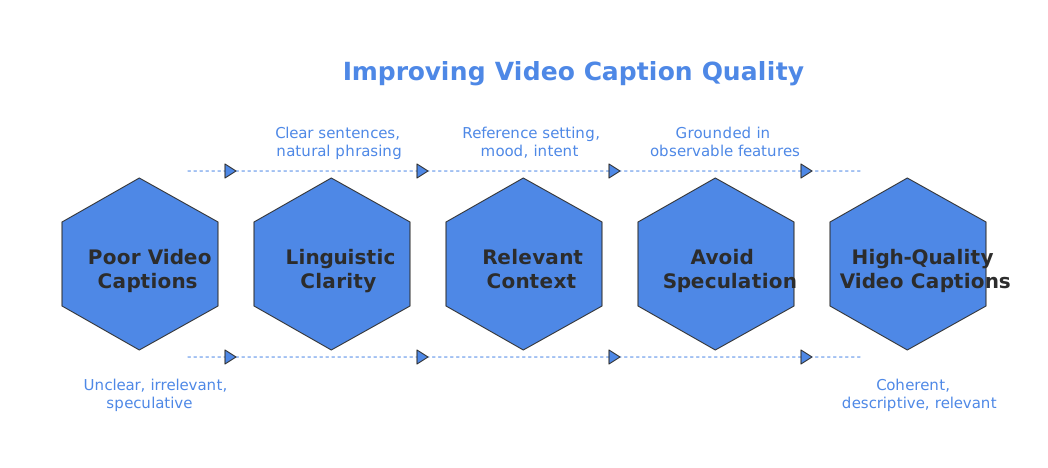
A video caption must be linguistically coherent, descriptive and relevant. The goal is to link visible events with natural language that resembles how humans describe scenes spontaneously.
Maintaining linguistic clarity
Captions must use clear sentence structures and avoid overly technical language. Natural phrasing supports generalization across different model architectures.
Including relevant context
Captions may reference setting, mood or intent if visible. For example, describing a person running “toward a doorway” adds spatial context. This helps models learn scene interpretation in addition to object recognition.
Avoiding speculation
Annotators must avoid guessing invisible intentions or unobserved events. High-quality captions remain grounded in observable features. This grounding is essential for trustworthy vision-language modeling.
Handling Audio and Multimodal Context
Some video captioning tasks incorporate audio cues such as speech, environmental noise or background music. These cues enrich interpretation when visible actions alone are insufficient.
When audio should influence captions
Annotators may include audio cues when they support event understanding, such as describing someone “answering a ringing phone.” Natural integration of audio enhances multimodal performance.
When audio should be ignored
Audio that does not influence visual meaning should not be included. This maintains focus and avoids misguiding the model.
Aligning audio and visual information
Annotators must accurately match speech or sound to visible actions. Consistent alignment improves models designed for speech-vision fusion.
Annotating Temporal and Causal Relationships
Temporal clarity is unique to video captioning, because events unfold over time. Annotators must express how actions follow, influence or relate to each other.
Capturing action order
Sequence matters. Annotators must describe events in the order they occur. Clear ordering helps models understand cause and effect.
Describing causal hints
Some actions imply causality, such as someone jumping after hearing a noise. Annotators may describe visible reactions without inferring invisible motivations. This strengthens causal reasoning in multimodal models.
Handling overlapping actions
Actions sometimes happen simultaneously. Annotators must describe both when relevant. This ensures the model captures multi-agent dynamics.
Quality Control for Video Caption Datasets
Quality control improves consistency and reduces noise across the dataset.
Reviewing segment cohesion
Each caption should match its corresponding segment with no missing or irrelevant details. Cohesion checks reduce mismatches between video and text.
Ensuring temporal accuracy
Captions must reflect exact visual timing. Reviewers confirm that events occur as described. This is especially important for training time-aware architectures.
Using automated tools for consistency
Automated validation can detect repeated phrases, inconsistent formatting or overly short captions. Automation complements human intelligence and improves reliability.
Integrating Captioning Data Into Vision-Language Pipelines
Video captioning datasets must integrate smoothly into training workflows for multimodal models.
Building evaluation sets for diverse scenarios
Evaluation sets must include multiple environments, lighting conditions and action types. Variety ensures the model performs well beyond the training domain.
Monitoring distribution balance
Diverse actions, actors and settings help prevent bias. Balanced datasets improve generalization.
Supporting continuous dataset expansion
As new videos are added, the dataset must maintain coherent style and annotation rules. This stability supports long-term scalability.
If you want to build accurate video captioning datasets or design workflows for multimodal annotation, we can explore how DataVLab helps teams produce high-quality training data for cutting-edge vision-language models.
What are Video captioning datasets?
This article explains how video captioning datasets are annotated and why precise multimodal labeling is essential for building strong video-language models. It covers segmentation, temporal grounding, object tracking, action identification, descriptive language generation, multimodal alignment and quality control.
Why does video captioning annotation matter?
Modern vision-language models can interpret videos, answer questions, generate video summaries and support search engines that retrieve video segments using natural language prompts. These models need training data that accurately reflects how humans describe motion, context and interactions.
What does the section on “Handling audio and multimodal context” explain?
Some video captioning tasks incorporate audio cues such as speech, environmental noise or background music. These cues enrich interpretation when visible actions alone are insufficient. Annotators may include audio cues when they support event understanding, such as describing someone “answering a ringing phone.” Natural integration of audio enhances multimodal performance.
What does the article explain about when audio should influence captions?
Annotators may include audio cues when they support event understanding, such as describing someone “answering a ringing phone.” Natural integration of audio enhances multimodal performance.
How can teams ensure quality in Video captioning datasets?
Quality control improves consistency and reduces noise across the dataset. Each caption should match its corresponding segment with no missing or irrelevant details. Cohesion checks reduce mismatches between video and text.
What is involved in integrating captioning data into Vision-Language pipelines?
Video captioning datasets must integrate smoothly into training workflows for multimodal models. Evaluation sets must include multiple environments, lighting conditions and action types. Variety ensures the model performs well beyond the training domain.