
Diagnosis Annotation Services for Clinical AI, Imaging Models, and Decision Support Systems


Diagnosis Annotation Services
Built for teams shipping medical AI who need reliable labeled documents. You get bounding boxes, segmentation masks, and polygons, stable label guidelines, and QA you can audit, without slowing your roadmap. Diagnosis Annotation Services is delivered with secure workflows and consistent reporting from pilot to production.
Structured labeling of diagnostic cues, predefined findings, and meaningful clinical regions.
Support for imaging, document based, and multimodal diagnostic datasets.
Multi stage quality control aligned with research and clinical requirements.
Diagnosis oriented AI systems require datasets where diagnostic cues, visual indicators, and medically relevant regions are consistently labeled. While annotation teams do not perform diagnosis, they can label predefined features, structures, or regions of interest that support classification, triage, or pattern recognition tasks. DataVLab provides diagnosis annotation services that focus on structured labeling of findings, visual patterns, and predefined diagnostic categories across imaging, clinical text, and multimodal datasets.
Annotators follow detailed guidelines created by your research or clinical team to ensure clear interpretation of each class and consistent labeling across the entire dataset. We support imaging datasets such as MRI, CT, X-ray, ultrasound, pathology slides, and specialized modalities.
We also annotate structured diagnostic cues in clinical documents, waveform signals, and combined datasets.
Tasks include region of interest labeling, classification tags, bounding boxes, polygons, segmentation masks, event identification, and attribute based labeling. Quality control processes include multi step review, sampling, instruction refinement, and consistency checks.
Sensitive datasets can be processed within GDPR aligned workflows and EU only annotation is available when required. Our diagnostic annotation workflows allow AI teams to create training datasets that reflect clinically relevant patterns while maintaining clear separation between annotation and medical decision making.
How DataVLab Supports Diagnosis Oriented AI Development
We annotate predefined diagnostic features and regions that help AI systems learn medically relevant patterns without performing clinical interpretation.

Diagnostic Region Labeling in Medical Imaging

Annotation of predefined findings in MRI, CT, and X-ray
We label regions of interest such as opacities, nodules, lesion outlines, structural changes, and visually identifiable patterns according to your class taxonomy.
Ultrasound Diagnostic Feature Annotation
Frame consistent labeling for dynamic diagnostic cues
We annotate anatomical structures, motion relevant indicators, and predefined ultrasound findings across abdominal, cardiac, vascular, and obstetric sequences.
Pathology Diagnostic Feature Annotation
Region based annotation for tissue and cell patterns
We label tumor regions, gland structures, nuclei patterns, and tissue categories that support oncology research and classification models.
Clinical Text Diagnostic Annotation
Entity tagging and structured labeling in clinical documents
We annotate terms, findings, categories, and structured elements in clinical notes or reports following predefined diagnostic taxonomies.
Multimodal Diagnostic Annotation
Consistent labeling across images, text, and signals
We annotate integrated datasets that combine imaging, waveform signals, and textual information, maintaining class consistency across modalities.
Diagnostic Dataset Quality Review
Validation and correction cycles for consistency
Reviewers check region boundaries, class accuracy, and instructions alignment to ensure clean datasets for diagnostic AI development.
Discover How Our Process Works

Defining Project
Sampling & Calibration
Annotation
Review & Assurance
Delivery
Explore Industry Applications
We provide solutions to different industries, ensuring high-quality annotations tailored to your specific needs.
We provide high-quality annotation services to improve your AI's performances

Annotation & Labeling for AI
Unlock the full potential of your AI application with our expert data labeling tech. We ensure high-quality annotations that accelerate your project timelines.
Medical Annotation Services
Medical annotation services for radiology, pathology, clinical text, and biosignals. Expert workflows, strict QA, and secure handling for sensitive healthcare datasets.
Medical Data Labeling Services
High quality labeling for medical imaging, clinical documents, biosignals, and multimodal datasets used in healthcare and biomedical AI development.
Medical Image Annotation Services
High accuracy annotation for MRI, CT, X-ray, ultrasound, and pathology imaging used in diagnostic support, research, and medical AI development.
Radiology Image Annotation Services
High accuracy annotation for radiology imaging including MRI, CT, X-ray, PET, and specialized scans used in diagnostic support and medical AI development.
Pathology Annotation Services
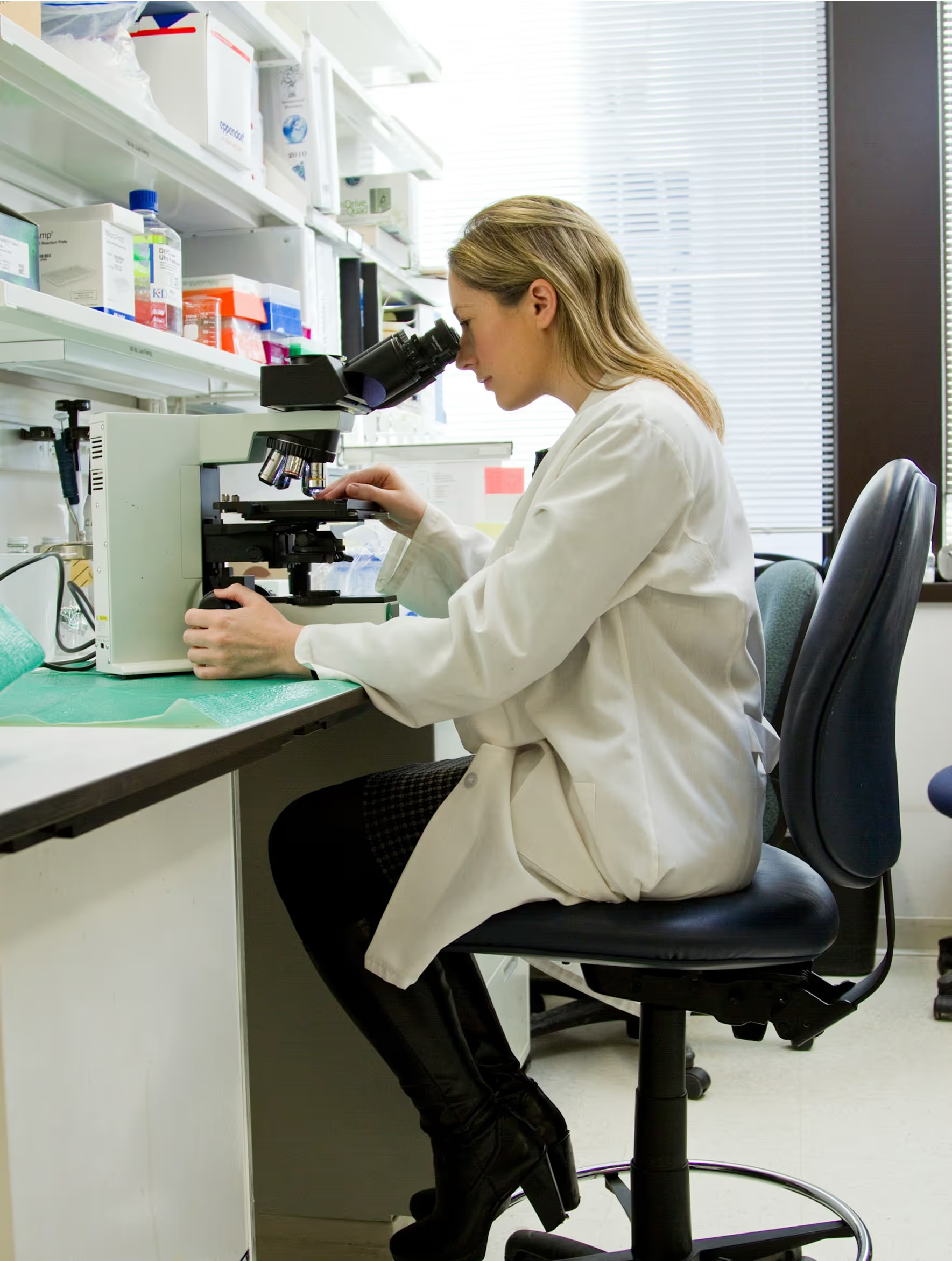
High accuracy annotation for pathology and microscopy datasets including whole slide images, tissue regions, cellular structures, and oncology research features.
FAQs
Here are some common questions we receive from our clients to assist you.
What is diagnosis annotation and how does it differ from general medical annotation?
Diagnosis annotation labels medical imaging data specifically for AI-assisted diagnostic systems: flagging and characterizing diagnostic findings, lesions, and pathological regions that clinicians use to make diagnostic decisions. It includes marking the presence and location of abnormalities (tumors, calcifications, fractures, effusions, lesions), characterizing their properties (size, shape, margins, density, enhancement pattern), assigning Likert-scale severity or confidence ratings, and annotating differential diagnosis categories. Unlike general medical segmentation annotation, diagnosis annotation is specifically designed to train systems that support clinical decision-making.
Why must diagnosis annotation be performed by licensed physicians?
Diagnosis annotation requires licensed physicians with the relevant specialty training as annotators or reviewers. Radiologists for CT, MRI, and X-ray annotation. Pathologists for histopathology annotation. Ophthalmologists for retinal imaging annotation. Dermatologists for skin lesion annotation. This is non-negotiable for two reasons. First, diagnostic accuracy requires clinical knowledge that even highly trained non-physicians cannot provide: the subtle imaging features that distinguish a malignant from a benign lesion require years of clinical training to recognize reliably. Second, regulatory submissions for clinical AI typically require demonstration that training data was created by qualified clinicians, which makes annotator credentials part of the compliance documentation.
How is quality measured in diagnosis annotation?
Diagnosis annotation quality is typically measured with clinical-grade metrics. For segmentation tasks, Dice Similarity Coefficient (DSC) above 0.85 is typically required for clinical-grade datasets, with some applications requiring 0.90 or above. For classification tasks, Fleiss kappa above 0.75 is typical. For the most critical applications (cancer detection, stroke diagnosis), multiple board-certified specialists annotate each case independently, and adjudication by a senior specialist resolves disagreements. The adjudication process is itself documented, because the adjudication decision rather than any individual annotation represents the dataset's ground truth for difficult cases.
How do medical device regulations affect diagnosis annotation requirements?
AI-assisted diagnostic systems typically fall within the medical device regulatory framework. In Europe, AI systems used as medical devices require CE marking under the Medical Device Regulation (MDR) or In Vitro Diagnostic Regulation (IVDR), and AI-powered diagnostic support tools embedded in medical devices are additionally high-risk under the EU AI Act Annex I. This means training data documentation must satisfy both MDR/IVDR clinical evidence requirements and EU AI Act Article 10 data governance requirements. Annotation methodology, annotator qualifications (including specialization and board certification status), inter-annotator agreement metrics, and dataset coverage evidence are all part of the required documentation.
How are patient privacy and ethics handled in diagnosis annotation programs?
Diagnosis annotation datasets are subject to the strictest privacy and ethical standards of any annotation category. Patient data is special category personal data under GDPR. Datasets created from clinical practice require either explicit patient consent for AI research use or pseudonymization meeting GDPR standards. Ethics committee approval is typically required for research annotation programs using patient data. Institutional data sharing agreements govern cross-institutional annotation programs. DataVLab works within these frameworks for diagnosis annotation projects, including EU-based processing under GDPR-compliant protocols and coordination with institutional ethics requirements.
What diagnosis annotation services does DataVLab provide?
DataVLab provides diagnosis annotation across radiology (CT, MRI, X-ray, PET for oncology, neurology, musculoskeletal, and cardiac applications), pathology (whole slide imaging for cancer grading, tumor characterization, and biomarker identification), ophthalmology (fundus photography and OCR for diabetic retinopathy, glaucoma, and AMD staging), and dermatology (dermoscopy for melanoma detection and skin lesion classification). We work with medical AI companies, diagnostic imaging AI developers, hospital digital health programs, and clinical research organizations. All diagnosis annotation programs use licensed specialists for annotation and review, with inter-annotator agreement documentation for regulatory submissions.


Custom service offering

Up to 10x Faster
Accelerate your AI training with high-speed annotation workflows that outperform traditional processes.

AI-Assisted
Seamless integration of manual expertise and automated precision for superior annotation quality.

Advanced QA
Tailor-made quality control protocols to ensure error-free annotations on a per-project basis.

Highly-specialized
Work with industry-trained annotators who bring domain-specific knowledge to every dataset.

Ethical Outsourcing
Fair working conditions and transparent processes to ensure responsible and high-quality data labeling.

Proven Expertise
A track record of success across multiple industries, delivering reliable and effective AI training data.

Scalable Solutions
Tailored workflows designed to scale with your project’s needs, from small datasets to enterprise-level AI models.

Global Team
A worldwide network of skilled annotators and AI specialists dedicated to precision and excellence.
Potential Today
Blog & Resources
Explore our latest articles and insights on Data Annotation




We are here to assist in providing high-quality data annotation services and improve your AI's performances