Sport Performance Tracking with AI: How Computer Vision Measures Speed, Load and Player Efficiency
.jpeg)
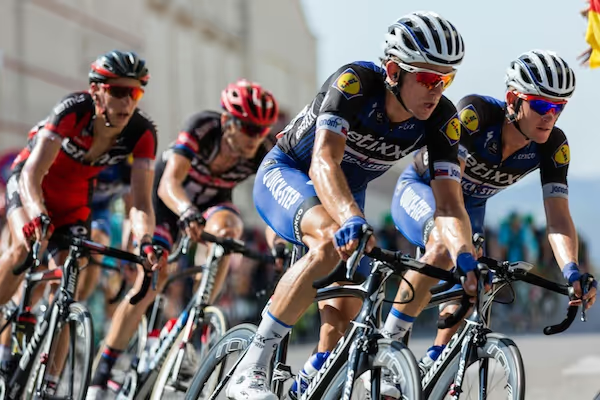
This article explains how AI-powered sport performance tracking works, focusing on the annotation of movement data, speed metrics, acceleration patterns, player load and biomechanical parameters. It covers dataset preparation, player identity tracking, pose-based performance indicators, quality control and integration into applied sports technology. It also highlights how annotated performance datasets support coaching, injury prevention and real-time feedback.
- This article explains how AI-powered sport performance tracking works, focusing on the annotation of movement data, speed metrics, acceleration patterns, player load and biomechanical parameters.
- It covers dataset preparation, player identity tracking, pose-based performance indicators, quality control and integration into applied sports technology.
- It also highlights how annotated performance datasets support coaching, injury prevention and real-time feedback.
- High-quality annotated datasets are central to these systems, ensuring accurate representation of speed, acceleration, load and athlete-specific movement patterns.
AI-driven sport performance tracking is transforming how teams and athletes understand physical effort, tactical execution and biomechanical efficiency. Instead of relying solely on wearable sensors, computer vision systems extract movement and performance indicators directly from video. Research from the EPFL Sports Technology Lab shows that vision-based tracking can match or surpass traditional GPS in structured environments. High-quality annotated datasets are central to these systems, ensuring accurate representation of speed, acceleration, load and athlete-specific movement patterns.
Why Performance Tracking Matters in Modern Sports
Performance tracking drives decisions in training, tactical planning and injury prevention. Coaches need reliable data on sprint patterns, fatigue levels, reaction times and workload across entire matches or sessions. Studies from Australian Institute of Sport (AIS) Performance Science highlight that accurate movement datasets improve conditioning programs and reduce injury risk. Computer vision enables continuous evaluation without intrusive hardware, making it a scalable solution across amateur and professional environments.
Preparing Video for Performance Tracking Models
Performance tracking models require video with consistent field geometry, stable viewpoints and clear athlete visibility. Before annotation begins, teams must standardize the footage, correct distortions and align camera angles. Guides from NVIDIA Metropolis emphasize the importance of preprocessing for stable motion estimation and trajectory extraction.
Standardizing resolution and frame rates
Frame rate variability can distort speed and acceleration estimates. Annotators must ensure that all videos are synchronized and frame-consistent. This alignment prevents inaccurate time-based metrics.
Correcting parallax and perspective
Performance indicators depend on accurate spatial interpretation. Annotators must rectify perspective distortions so that distances and speed estimates remain consistent across the field. This supports reliable biomechanical modeling.
Removing visual noise
Shadows, reflections and camera vibrations can influence motion interpretation. Annotators must flag noisy sequences and apply correction rules. Clear preprocessing ensures that extracted metrics remain stable.
Tracking Players for Speed and Acceleration Measurement
Player tracking forms the baseline of performance analytics. Identifying each athlete’s movement patterns allows models to estimate sprint speed, acceleration bursts, deceleration phases and fatigue indicators.
Maintaining identity across sequences
Identity continuity ensures that sprint or load measurements correspond to the correct athlete. Annotators must track identity through occlusions and directional changes. Consistent identity assignments strengthen model accuracy across long sequences.
Labeling trajectories and movement paths
Annotators must trace player trajectories to generate accurate spatial paths. These paths support distance calculation, speed estimation and micro-movement analysis. Structured rules ensure trajectory consistency in crowded scenes.
Handling player-to-player occlusion
Occlusion disrupts movement continuity. Annotators must follow predefined logic when identity becomes uncertain. These rules prevent erroneous jumps in trajectory estimation, which significantly impact performance metrics.
Annotating Performance Indicators From Pose Data
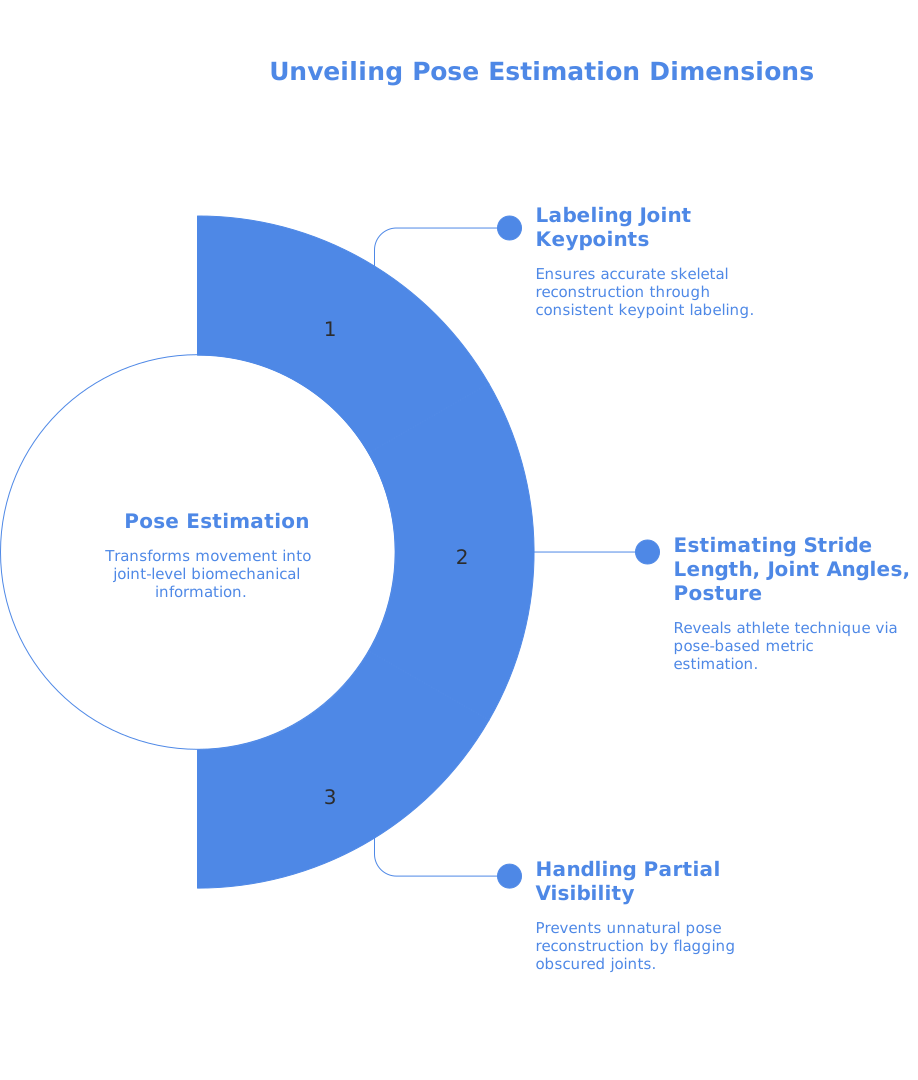
Pose estimation transforms raw movement into joint-level information that enables biomechanical and physical analysis. Annotators label joint positions, movement patterns and postural changes to support downstream modeling.
Labeling joint keypoints consistently
Consistent keypoint labeling ensures accurate skeletal reconstruction. Annotators must follow rules for visibility, symmetry and body alignment. These labels form the basis of movement mechanics evaluation.
Estimating stride length, joint angles and posture
Pose-based metrics reveal athlete technique. Annotators must capture variations in stride, knee flexion, torso lean and landing patterns. These indicators support technique analysis and injury-prevention assessments.
Handling partial visibility
Some joints become obscured during turns or collisions. Annotators must flag these cases and apply consistent fallback rules. This prevents unnatural pose reconstruction that would distort biomechanical interpretation.
Measuring Load, Fatigue and Physical Output
Physical load is one of the most valuable insights in performance tracking. AI systems infer load from movement intensity, acceleration patterns and posture changes. High-quality annotations are necessary to support these estimates.
Calculating acceleration-derived load
Acceleration spikes correlate with high physical stress. Annotators must ensure that acceleration sequences are labeled precisely and consistently. This supports reliable load estimation.
Identifying fatigue indicators
Fatigue appears as movement deterioration: reduced stride frequency, decreased sprint intensity or delayed reactions. Annotators must document these patterns during key phases. Fatigue detection helps prevent overtraining.
Distinguishing effort from tactical choice
Slow movement is not always fatigue-related. Annotators must understand the tactical context to avoid misinterpreting deliberate pacing for physical decline. Clear examples help reduce misclassification.
Annotating Sport-Specific Performance Metrics
Different sports require different performance metrics. Annotators must understand domain-specific movement patterns, roles and tactical responsibilities.
Soccer: sprints, pressures and recovery runs
Soccer performance depends on transition speed and off-ball effort. Annotators must label these actions with high clarity. Correct labeling supports detailed tactical and physical interpretation.
Basketball: explosive movements and lateral agility
Basketball emphasizes verticality and lateral quickness. Annotators must capture short burst acceleration, changes of direction and jump mechanics. This helps models detect movement efficiency.
Tennis: footwork patterns and kinetic chains
Tennis relies heavily on coordinated footwork and rotational mechanics. Annotators must document stance shifts, reaction steps and swing preparation. Consistency ensures accurate biomechanical tracing.
Designing Guidelines for Performance Annotation
Performance tracking annotation demands a balance of sports knowledge and biomechanical understanding. Guidelines must define how to interpret movement data across different scenarios.
Defining consistent movement categories
Categories such as sprinting, jogging, pivoting, cutting and decelerating must be well defined. Annotators need examples to differentiate between similar motions. This clarity improves dataset stability.
Explaining biomechanical cues
Annotators must recognize when movement changes reflect technique adjustments versus performance degradation. Guidelines should describe these cues clearly. This reduces subjective interpretation.
Updating rules as new techniques emerge
Athletes and teams evolve tactically and biomechanically. Annotation rules must adapt to capture new movement patterns. Version control ensures alignment across annotators.
Quality Control for Performance Tracking Datasets
Performance tracking requires meticulous quality control because small annotation errors produce large metric deviations. Quality control ensures reliability across dense motion data.
Reviewing trajectory consistency
Trajectory drift or identity switches can distort performance indicators. Reviewers must inspect long sequences to verify continuity. These checks prevent major distortions in speed or load metrics.
Sampling sprint and high-intensity sequences
High-intensity actions require detailed precision. Sampling these segments ensures that acceleration peaks and movement patterns are labeled correctly. This improves downstream analysis.
Using automated motion validation
Automated systems can detect sudden trajectory jumps, unnatural pose changes or inconsistent speed spikes. These tools complement human review and increase dataset robustness.
Integrating Performance Data Into AI Pipelines
Once annotation is complete, performance datasets must integrate smoothly into training pipelines. Proper structuring ensures accurate benchmarking and real-world usability.
Building evaluation sets for different intensity levels
Evaluation data must include low, moderate and high-intensity sequences. This distribution ensures reliable model behavior across scenarios. Precise labeling in evaluation sets strengthens benchmarking.
Monitoring physical metrics over time
Performance indicators evolve across seasons or training cycles. Teams must monitor changes to detect long-term trends. Tracking stability ensures continued model performance.
Supporting continuous dataset updates
As teams gather new video data, performance datasets expand. Ongoing updates require stable guidelines and consistent quality processes. This ensures long-term reliability and scalability.
If you’re building a performance tracking dataset or want to structure annotation workflows for movement, load or biomechanical metrics, we can explore how DataVLab supports high-accuracy sports AI pipelines across training, competition and rehabilitation.
What is Sport performance tracking with AI?
This article explains how AI-powered sport performance tracking works, focusing on the annotation of movement data, speed metrics, acceleration patterns, player load and biomechanical parameters. It covers dataset preparation, player identity tracking, pose-based performance indicators, quality control and integration into applied sports technology.
Why does performance tracking matter in modern sports?
Performance tracking drives decisions in training, tactical planning and injury prevention. Coaches need reliable data on sprint patterns, fatigue levels, reaction times and workload across entire matches or sessions. Studies from Australian Institute of Sport (AIS) Performance Science highlight that accurate movement datasets improve conditioning programs and reduce injury risk.
What does the section on “Tracking players for speed and acceleration measurement” explain?
Player tracking forms the baseline of performance analytics. Identifying each athlete’s movement patterns allows models to estimate sprint speed, acceleration bursts, deceleration phases and fatigue indicators. Identity continuity ensures that sprint or load measurements correspond to the correct athlete.
What does the section on “Measuring load, fatigue and physical output” explain?
Physical load is one of the most valuable insights in performance tracking. AI systems infer load from movement intensity, acceleration patterns and posture changes. High-quality annotations are necessary to support these estimates.
What is involved in designing guidelines for performance annotation?
Performance tracking annotation demands a balance of sports knowledge and biomechanical understanding. Guidelines must define how to interpret movement data across different scenarios. Categories such as sprinting, jogging, pivoting, cutting and decelerating must be well defined.
How can teams ensure quality in Sport performance tracking with AI?
Performance tracking requires meticulous quality control because small annotation errors produce large metric deviations. Quality control ensures reliability across dense motion data. Trajectory drift or identity switches can distort performance indicators.