Gait Analysis Datasets: How to Annotate Walking Patterns for Biomechanics and Movement AI
.jpeg)
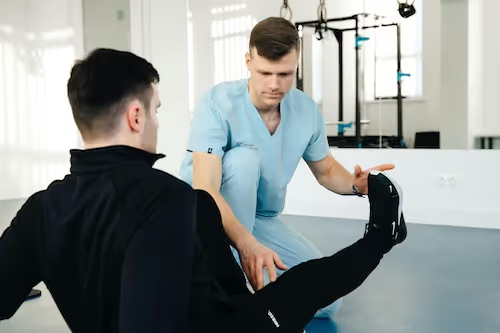
This article explains how gait analysis datasets are created, how walking cycles are annotated, and why precise labeling of phases, keypoints and temporal structure is essential for biomechanical AI. It covers cycle segmentation, foot-strike identification, pathological gait annotation, spatial metrics, and multi-view data. You will learn how gait datasets support healthcare diagnostics, sports performance, rehabilitation and movement science.
- This article explains how gait analysis datasets are created, how walking cycles are annotated, and why precise labeling of phases, keypoints and temporal structure is essential for biomechanical AI.
- It covers cycle segmentation, foot-strike identification, pathological gait annotation, spatial metrics, and multi-view data.
- High-quality gait datasets are crucial for biomechanics research, rehabilitation systems, elite sports performance analysis and medical diagnostics.
- The gait cycle contains distinct phases, each requiring precise temporal annotation.
Gait analysis focuses on understanding how humans walk by measuring limb movement, timing, symmetry and posture. High-quality gait datasets are crucial for biomechanics research, rehabilitation systems, elite sports performance analysis and medical diagnostics. Research from the University of Michigan Movement Science Lab shows that gait cycle accuracy strongly influences AI models that detect abnormalities or track recovery. Annotating gait data requires precision, anatomical knowledge and temporal consistency across entire walking sequences.
Why Gait Analysis Matters in Sports and Healthcare
Gait patterns reveal critical information about strength, balance, fatigue and musculoskeletal function. In sports, gait influences running economy, sprint acceleration and injury risk. In healthcare, abnormal gait can signal neurological disorders, orthopedic injuries or rehabilitation progress. Studies from the Johns Hopkins Motion Analysis Lab highlight that gait parameters predict functional mobility and recovery outcomes. Accurate annotation helps AI models detect subtle irregularities in posture, timing and joint coordination.
Preparing Data for Gait Annotation
Gait data comes from video, motion-capture systems, depth sensors or multi-view camera setups. Before labeling begins, data must be standardized to ensure consistent interpretation.
Ensuring controlled capture conditions
Lighting, floor texture, background and camera positioning must be standardized. Variability introduces noise that complicates gait interpretation. Stable environments produce cleaner annotations.
Aligning multi-camera viewpoints
Gait analysis often requires synchronized views from multiple angles. Annotators must validate alignment to avoid timing discrepancies. Correct alignment ensures accurate phase segmentation.
Filtering out non-walking behavior
Gait analysis requires isolated walking sequences without pauses, turns or distractions. Annotators must mark invalid segments. Clean sequences improve cycle prediction during training.
Annotating 2D and 3D Pose for Gait Cycles
Pose estimation plays a central role in gait annotation. Keypoints represent body segments and joints used to measure posture and motion.
Labeling joint keypoints consistently
Keypoints include hips, knees, ankles, pelvis, spine and foot landmarks. Annotators must ensure consistent placement across frames. Even slight deviations distort gait metrics such as step length or joint angle.
Handling foot landmarks
Foot-strike and toe-off require accurate foot keypoint interpretation. Annotators must place landmarks reliably even when shoes or floor reflections cause ambiguity. This supports precise temporal segmentation.
Adding depth information for 3D gait analysis
When 3D motion-capture or depth systems are used, annotators must confirm accurate joint trajectories across all axes. Depth stability is critical for detecting asymmetries.
Segmenting the Gait Cycle
The gait cycle contains distinct phases, each requiring precise temporal annotation.
Identifying initial contact
Initial contact is the moment the heel or foot first touches the ground. Annotators must use frame-by-frame analysis to identify this moment. It defines the start of each gait cycle.
Labeling stance and swing phases
The stance phase involves ground contact, while the swing phase reflects forward movement. Annotators must define these boundaries with precision. Phase labeling supports biomechanical modeling and abnormal gait detection.
Detecting toe-off
Toe-off occurs when the foot leaves the ground. Annotators must capture this moment consistently. Accurate toe-off timing is essential for stride and cadence estimation.
Measuring Biomechanical Gait Features
Gait analysis relies on spatial and temporal parameters that describe coordination and symmetry.
Step length and stride length
Annotators must confirm consistent measurement of distance between foot placements. This improves running analysis and balance evaluation.
Cadence and gait speed
Cadence reflects the number of steps per minute. Annotators must validate temporal alignment to ensure correct cadence calculation. These metrics matter for performance and rehabilitation.
Joint angles and limb coordination
Annotators must label joint trajectories that reveal coordination patterns. These angles help detect compensatory movements and biomechanical inefficiencies.
Annotating Pathological or Irregular Gait Patterns
Clinical gait analysis requires annotators to identify abnormal movement patterns that deviate from healthy norms.
Recognizing asymmetries
Differences between left and right limbs may indicate injury or neurological conditions. Annotators must mark asymmetries with high precision. This helps models detect subtle deviations.
Labeling compensatory movements
People with mobility limitations often adjust movement to reduce pain or effort. Annotators must record these compensations accurately. This supports clinical interpretation.
Documenting irregular or unstable steps
Parkinsonian gait, ataxic gait or spastic gait have distinct signatures. Annotators must follow domain-specific rules to recognize these patterns. Clinical examples help reduce ambiguity.
Handling Edge Cases in Gait Annotation
Edge cases require special attention because they disrupt smooth gait cycles.
Turning or directional changes
Turns affect step length and timing. Annotators must either exclude or segment these periods depending on dataset goals. Clear decisions improve cycle consistency.
Uneven surfaces
Slopes or textured surfaces influence gait mechanics. Annotators must document these environmental variations. Environment labeling supports robustness testing.
External interference
Occasional visual obstruction, equipment or people entering the frame must be flagged. These events disrupt cycle detection and must be marked clearly.
Designing Guidelines for Gait Annotation
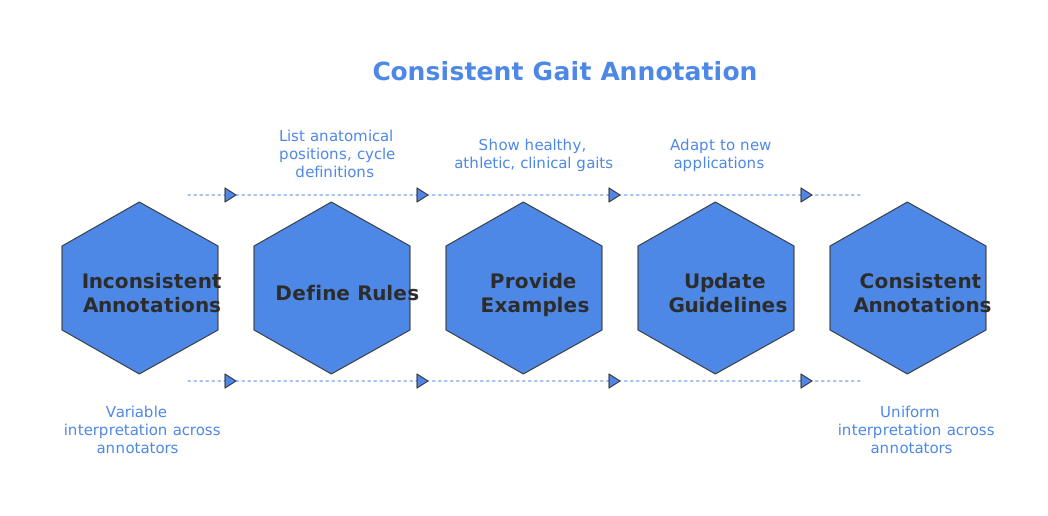
Structured guidelines ensure consistent interpretation across annotators and sessions.
Defining anatomical and temporal rules
Guidelines must list anatomical positions, cycle definitions and timing rules. Annotators rely on these instructions for consistency.
Providing clinical and sports-specific examples
Examples help annotators recognize healthy, athletic and clinical gait variations. Diverse examples reduce misinterpretation.
Updating guidelines as new applications emerge
Gait analysis evolves across domains. Guidelines must adapt to sports, healthcare or robotic use cases. Version control maintains coherence.
Quality Control for Gait Datasets
Gait datasets require intensive review because small timing errors or joint misplacements change the meaning of entire cycles.
Reviewing cycle segmentation
Cycle boundaries must be checked for each walking sequence. Mistimed phases distort downstream metrics. Careful review improves dataset reliability.
Inspecting keypoint smoothness
Inconsistent keypoints cause jitter in reconstructed gait. Reviewers must verify smooth trajectories. Smoother keypoints generate more realistic biomechanics.
Using automated temporal and spatial validation
Automated tools detect timing inconsistencies, unnatural step patterns or joint anomalies. These validations reduce annotation load and improve dataset quality.
Integrating Gait Data Into AI Pipelines
Gait datasets must integrate smoothly into machine learning workflows.
Building evaluation sets across populations
Evaluation sets must include diverse age groups, genders, gait speeds and clinical conditions. This diversity improves model generalization.
Monitoring domain drift across environments
Lighting, floor texture or camera calibration can shift over time. Monitoring drift helps maintain model stability.
Supporting continuous dataset expansion
As new walking conditions and populations are recorded, datasets expand. Stable guidelines ensure consistent integration.
If you’re developing gait analysis datasets and want support with biomechanical annotation, temporal segmentation or multi-view motion labeling, we can explore how DataVLab helps teams build high-quality movement datasets for sports performance, rehabilitation and medical AI.
What are Gait analysis datasets?
This article explains how gait analysis datasets are created, how walking cycles are annotated, and why precise labeling of phases, keypoints and temporal structure is essential for biomechanical AI. It covers cycle segmentation, foot-strike identification, pathological gait annotation, spatial metrics, and multi-view data.
Why do gait analysis matter in sports and healthcare?
Gait patterns reveal critical information about strength, balance, fatigue and musculoskeletal function. In sports, gait influences running economy, sprint acceleration and injury risk. In healthcare, abnormal gait can signal neurological disorders, orthopedic injuries or rehabilitation progress.
What does the section on “Segmenting the gait cycle” explain?
The gait cycle contains distinct phases, each requiring precise temporal annotation. Initial contact is the moment the heel or foot first touches the ground. Annotators must use frame-by-frame analysis to identify this moment.
What is involved in annotating pathological or irregular gait patterns?
Clinical gait analysis requires annotators to identify abnormal movement patterns that deviate from healthy norms. Differences between left and right limbs may indicate injury or neurological conditions. People with mobility limitations often adjust movement to reduce pain or effort.
What is involved in designing guidelines for gait annotation?
Structured guidelines ensure consistent interpretation across annotators and sessions. Guidelines must list anatomical positions, cycle definitions and timing rules. Examples help annotators recognize healthy, athletic and clinical gait variations.
How can teams ensure quality in Gait analysis datasets?
Gait datasets require intensive review because small timing errors or joint misplacements change the meaning of entire cycles. Cycle boundaries must be checked for each walking sequence. Automated tools detect timing inconsistencies, unnatural step patterns or joint anomalies.