Computer Vision Sports Analytics: How AI Transforms Performance, Strategy and Coaching
.jpeg)

This article explains how computer vision is transforming sports analytics by turning raw video into tactical, biomechanical and strategic insights. It covers player detection, event recognition, spatial tracking, domain-specific annotation, data challenges and quality control. You will also learn how high-quality annotated video datasets support coaching decisions, performance optimization and next-generation sports technology.
- This article explains how computer vision is transforming sports analytics by turning raw video into tactical, biomechanical and strategic insights.
- It covers player detection, event recognition, spatial tracking, domain-specific annotation, data challenges and quality control.
- Computer vision is reshaping sports analytics by allowing teams, leagues and performance platforms to extract meaning from video automatically.
- Sports datasets must integrate into training workflows tailored for detection, tracking and event recognition.
Computer vision is reshaping sports analytics by allowing teams, leagues and performance platforms to extract meaning from video automatically. Instead of relying solely on manual review, AI systems detect players, track their movement, classify events and measure performance indicators at scale. Research from the MIT CSAIL Sports Analytics Group highlights that visual AI significantly enhances tactical understanding by providing granular movement and context. Building these systems requires annotated datasets that accurately represent real match conditions, diverse viewpoints, motion patterns and sport-specific events.
DataVLab’s image annotation services can structure player, ball, pose, and event labels for these computer-vision datasets.
The Role of Computer Vision in Sports Analytics
Sports analytics has moved beyond traditional statistics to include positional heatmaps, biomechanical analysis, reaction speed estimation and opponent-behavior modeling. Computer vision provides the foundation for these insights by converting pixels into structured actions and spatial relationships. Studies from UCL Centre for Artificial Intelligence show that automated vision pipelines outperform manual analysts in consistency and volume, especially for fast-paced sports. High-quality annotation ensures that models understand athlete identity, movement, ball interaction and tactical context.
Preparing Video Data for Sports AI Systems
Sports video comes from heterogeneous sources such as TV broadcasts, sideline cameras, drones, training facilities and wearable sensors. Each source produces different image quality, perspectives and occlusion patterns. Before annotation begins, teams must standardize formats, ensure frame alignment and compensate for lighting variations. Guides from NVIDIA AI Video Processing emphasize preprocessing as a critical phase for stable computer vision performance across diverse conditions.
Normalizing footage from different camera angles
Normalizing video ensures that player scale, orientation and field geometry remain consistent. Annotators must understand how to treat wide-angle shots versus close-ups. This consistency allows models to interpret spatial patterns across games.
Handling motion blur and fast action
Sports introduce rapid acceleration, frequent direction changes and ball dynamics. Annotators must label blurred frames accurately without overcorrecting. Clear rules improve dataset coherence across high-speed plays.
Managing occlusion and overlapping players
Bodies often overlap, especially in contact sports. Annotators must follow rules for identifying partially visible athletes to prevent inconsistent labeling. Structured decision paths reduce noise in crowded scenes.
Building Player Detection and Tracking Datasets
Player detection is the baseline of sports analytics. Models must reliably identify each athlete regardless of jersey number visibility, pose variation or field region. Tracking extends this by preserving identity across frames. Both rely on consistent annotation.
Labeling bounding boxes and segmentation masks
Bounding boxes capture player presence, whereas segmentation masks provide precise silhouettes. Teams must choose the format based on desired downstream accuracy. Clear guidelines reduce boundary variance in difficult poses.
Maintaining consistent player identity
Identity tracking requires annotators to follow each athlete across long sequences. In sports like basketball or football, jersey numbers may be occluded. Annotators must use motion continuity and context clues to maintain identity. Consistent decisions strengthen long-term tracking quality.
Handling substitutions and player re-entries
Player swaps complicate identity tracking. Annotators must document substitution moments and align identity labels accordingly. This ensures that models do not confuse newly entering players with those already tracked.
Annotating Sport-Specific Events and Actions
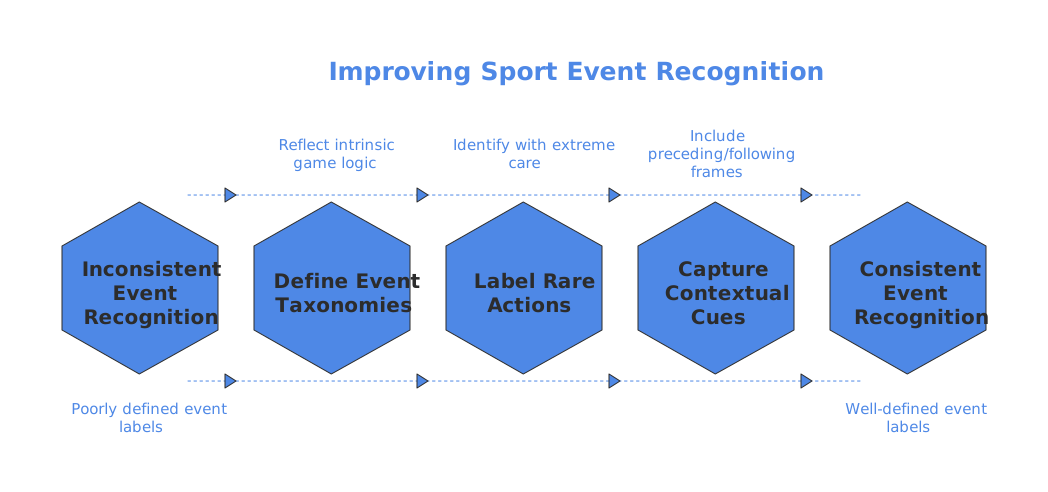
Every sport has its own vocabulary of actions: tackles, assists, shots, sprints, passes, blocks, serves, volleys, transitions and strategic formations. Models require well-defined labels to recognize these events consistently.
Defining event taxonomies for each sport
Event taxonomies must reflect the intrinsic logic of the game. For example, soccer requires pass types, zones of play and ball possession rules, whereas tennis requires serve classes and rally sequences. Clear definitions improve classification accuracy.
Labeling rare or high-impact actions
Important actions such as goals, turnovers or fouls appear infrequently. Annotators must identify these events with extreme care because models rely heavily on rare examples during evaluation. Detailed examples reduce false positives.
Capturing contextual cues around events
Event labeling must include preceding and following frames because context influences interpretation. A sprint before a shot or a position shift before a serve provides essential predictive cues. Annotators must maintain temporal consistency to preserve meaning.
Measuring Spatial and Tactical Behavior With Vision Data
One of the most powerful uses of sports analytics is tactical understanding: team shape, spacing, off-ball movement and role execution. Spatial labeling enables models to detect formations, evaluate space usage and generate coaching insights.
Creating field coordinate mappings
Coordinate mapping transforms pixel locations into real-world field geometry. Annotators must understand calibration procedures and maintain accuracy across camera angles. Reliable mapping supports formation recognition.
Annotating zones, lanes and corridors
Different sports rely on spatial division: half-spaces in soccer, lanes in basketball, zones in volleyball. Annotators must label these boundaries consistently. This helps models interpret tactical structure reliably.
Tracking off-ball behavior
Off-ball runs influence match outcomes but are often overlooked. Annotators must label movement that does not directly involve the ball. These annotations allow models to detect buildup phases, defensive reactions and off-ball intelligence.
Handling Data Imbalance and Edge Cases
Sports datasets often suffer from imbalance: many seconds of idle play and few seconds of meaningful events. Edge cases such as referees entering the frame, crowd interference or lighting changes affect annotation consistency.
Balancing idle versus action frames
Idle frames dominate match footage. Annotators must maintain consistent labeling even when no major events occur. Balanced sampling ensures that models learn both active and passive sequences properly.
Detecting non-player actors
Referees, medical staff or fans may appear in the frame. Annotators must follow rules for whether these actors are labeled or ignored. Clear policies prevent dataset contamination.
Handling extreme camera movement
Broadcast-style pans and zooms challenge tracking algorithms. Annotators should flag unstable frames for separate treatment. Structured handling improves overall dataset reliability.
Designing Annotation Guidelines for Sports Analytics
Sports annotation requires more domain knowledge than general computer vision tasks. Annotators must understand the game's structure, typical tactical patterns and edge cases to label data accurately.
Writing sport-specific rulebooks
Guidelines should include examples of each action, ambiguous play situations and borderline events. These examples help annotators maintain consistency during difficult sequences.
Documenting spatial logic
Formations and tactical cues must be described clearly. Annotators should learn how to read player positioning beyond raw movement. Structured documentation strengthens tactical interpretation.
Updating guidelines as rules evolve
Sports rules change over time. Annotation guidelines must adapt to maintain alignment with official standards. Version control keeps datasets coherent across seasons.
Quality Control for Sports Video Annotation
Video annotation is error-prone due to fast motion, occlusion and visual complexity. Quality control layers ensure stability across hundreds of thousands of frames.
Running consensus reviews
Multiple annotators reviewing the same play helps identify disagreements. These reviews highlight unclear taxonomy sections. Refining these areas improves long-term consistency.
Sampling difficult sequences
Edge cases such as scrums, pile-ups or sprint duels require detailed inspection. Sampling these sequences reveals structural annotation issues. This helps refine training and guidelines.
Using automated motion checks
Automated tools detect anomalies such as sudden identity swaps or bounding box drift. These checks help maintain coherence across long video sequences.
Integrating Sports Analytics Datasets Into AI Pipelines
Sports datasets must integrate into training workflows tailored for detection, tracking and event recognition. Clean dataset structure, metadata and evaluation design ensure stable performance.
Designing robust evaluation sets
Evaluation sets must include varied lighting conditions, multiple camera angles and rare event categories. Annotators must label these examples with extra precision. Strong evaluation sets provide realistic performance indicators.
Monitoring domain drift across seasons
New uniforms, stadiums or rule changes introduce visual drift. Teams must monitor how newer footage differs from training data. Updating datasets prevents long-term degradation.
Supporting continuous dataset expansion
Sports analytics systems improve as more games and seasons are annotated. Ongoing expansion requires stable guidelines and quality benchmarks. This ensures that models evolve while preserving reliability.
If you're building a sports analytics dataset and want support with video annotation, player tracking design or event labeling workflows, we can explore how DataVLab helps teams develop high-precision sports AI systems that deliver real tactical and performance insights.
How does AI transform Performance, strategy and coaching?
This article explains how computer vision is transforming sports analytics by turning raw video into tactical, biomechanical and strategic insights. It covers player detection, event recognition, spatial tracking, domain-specific annotation, data challenges and quality control. Computer vision is reshaping sports analytics by allowing teams, leagues and performance platforms to extract meaning from video automatically.
What does the section on “The role of computer vision in sports analytics” explain?
Sports analytics has moved beyond traditional statistics to include positional heatmaps, biomechanical analysis, reaction speed estimation and opponent-behavior modeling. Computer vision provides the foundation for these insights by converting pixels into structured actions and spatial relationships.
What does the section on “Measuring spatial and tactical behavior with vision data” explain?
One of the most powerful uses of sports analytics is tactical understanding: team shape, spacing, off-ball movement and role execution. Spatial labeling enables models to detect formations, evaluate space usage and generate coaching insights. Coordinate mapping transforms pixel locations into real-world field geometry.
What is involved in designing annotation guidelines for sports analytics?
Sports annotation requires more domain knowledge than general computer vision tasks. Annotators must understand the game's structure, typical tactical patterns and edge cases to label data accurately. Guidelines should include examples of each action, ambiguous play situations and borderline events.
How can teams ensure quality in Computer vision sports analytics?
Video annotation is error-prone due to fast motion, occlusion and visual complexity. Quality control layers ensure stability across hundreds of thousands of frames. Multiple annotators reviewing the same play helps identify disagreements.
What is involved in integrating sports analytics datasets into AI pipelines?
Sports datasets must integrate into training workflows tailored for detection, tracking and event recognition. Clean dataset structure, metadata and evaluation design ensure stable performance. Evaluation sets must include varied lighting conditions, multiple camera angles and rare event categories.