What Is Human Activity Recognition? A Complete Guide to HAR Datasets and Annotation
.jpeg)

This article explains what Human Activity Recognition (HAR) is, how it combines computer vision and motion analysis, and why annotated datasets are essential for accurate action detection. It covers activity taxonomies, segmentation logic, temporal labeling, sensor–video fusion, quality control and integration into AI pipelines. You will also learn how HAR models support sports tracking, healthcare monitoring and real-time automation.
- This article explains what Human Activity Recognition (HAR) is, how it combines computer vision and motion analysis, and why annotated datasets are essential for accurate action detection.
- It covers activity taxonomies, segmentation logic, temporal labeling, sensor–video fusion, quality control and integration into AI pipelines.
- Research from the University of Wisconsin Human Activity Recognition Lab shows that HAR models require detailed temporal annotations to distinguish between similar activities.
- HAR models support applications ranging from fall detection in elderly care to movement assessment in sports and gesture understanding in robotics.
Human Activity Recognition (HAR) is the process of identifying and classifying human behaviors such as walking, sitting, running, lifting or interacting with objects. It enables AI systems to understand motion patterns in homes, workplaces, sports fields and healthcare environments. Research from the University of Wisconsin Human Activity Recognition Lab shows that HAR models require detailed temporal annotations to distinguish between similar activities. High-quality ground truth is essential because small labeling inconsistencies can significantly weaken model performance.
Why HAR Matters Across Multiple Industries
HAR models support applications ranging from fall detection in elderly care to movement assessment in sports and gesture understanding in robotics. Their versatility comes from their ability to interpret time-based motion patterns. Studies from Georgia Tech GVU Center highlight that HAR is one of the fastest-growing areas in applied AI because it enables natural interaction with technology. Precise annotation ensures that models understand the full sequence of an activity, not just isolated frames.
How HAR Differs From General Action Recognition
General action recognition identifies single behaviors like “jumping” or “kicking,” whereas HAR focuses on multi-step activities that unfold over time. HAR requires understanding transitions, context and continuity rather than isolated motion. Guidance from Carnegie Mellon Human Sensing Lab emphasizes that HAR systems must interpret the start, middle and end of each activity to achieve high accuracy.
Activities as multi-step sequences
HAR activities include phases, such as preparation, execution and release. Annotators must label these phases consistently. Phase-level detail improves model understanding of complex behaviors.
Importance of temporal windows
HAR depends on correctly defining the duration of each activity. Annotators must determine when the activity starts and stops. This ensures that temporal boundaries align with real-world motion.
Context over single frames
Isolated frames cannot express activity meaning. Annotators must evaluate sequences holistically. This approach improves classification across subtle or ambiguous movements.
Preparing Data for HAR Annotation
HAR datasets come from diverse sources: static cameras, wearable sensors, drones and mobile devices. Each modality introduces specific challenges in alignment, visibility and temporal segmentation.
Synchronizing multiple data sources
When video and sensors are combined, timestamps must align perfectly. Annotators must check synchronization to avoid misaligned sequences. Synchronization errors distort temporal interpretation.
Normalizing video sequences
Frame rates, lighting and resolution vary across capture environments. Annotators must standardize sequences before labeling. This reduces annotation bias and improves model transferability.
Handling occlusions and cluttered backgrounds
Human motion may be partially hidden by objects or other people. Annotators must follow rules for labeling partially visible actions. Consistent treatment prevents dataset fragmentation.
Designing Activity Taxonomies for HAR
A HAR taxonomy defines which actions and activities will be labeled. Activity complexity varies across domains, and taxonomies must balance clarity with completeness.
Choosing the right level of detail
Some projects require coarse-grained activities such as “walking,” while others need fine-grained distinctions like “walking with load.” Annotators need clear definitions to avoid confusion.
Differentiating similar activities
Activities such as “bending” and “squatting” appear visually similar. Annotators must use joint posture, speed and trajectory to differentiate them. Detailed examples strengthen consistency.
Including transitional activities
Transitions such as “sit-to-stand” or “stand-to-walk” carry significant information. Annotators must include these segments when required. Recognizing transitions improves temporal modeling.
Annotating Activities With Temporal Precision
Temporal annotation is central to HAR. Annotators must identify when activities begin, when they end and how they evolve through time.
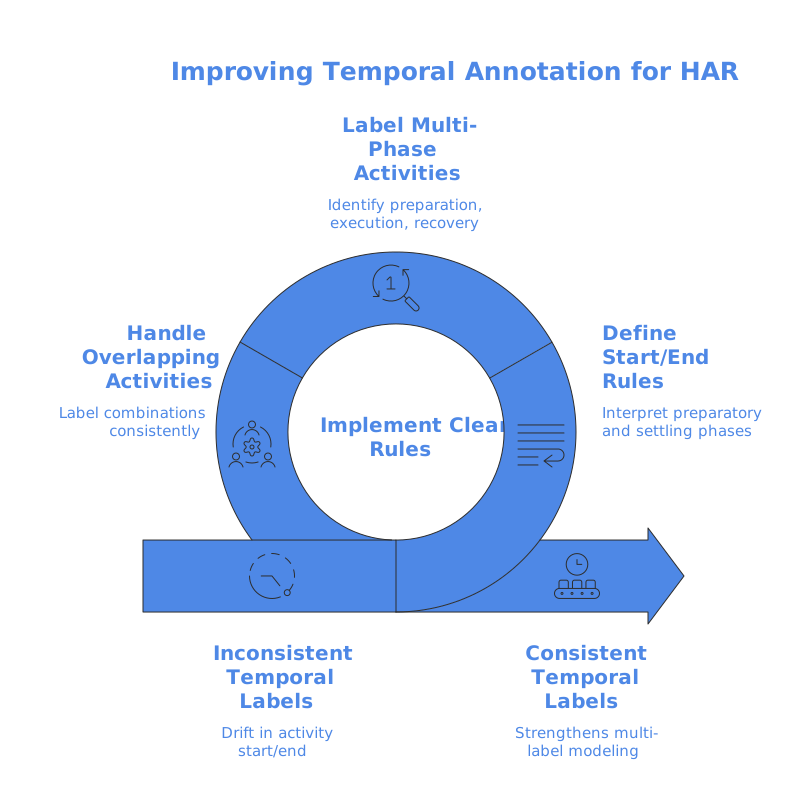
Defining clear start and end rules
Activities rarely have crisp boundaries. Annotators must follow rules for interpreting preparatory movements and settling phases. This consistency prevents drift in temporal labels.
Labeling multi-phase activities
Complex actions may include preparation, execution and recovery. Annotators must identify each phase when required. Multi-phase annotation improves interpretability.
Handling overlapping or simultaneous activities
People may perform more than one action at once, such as walking while carrying an object. Annotators must label these combinations consistently. This strengthens multi-label modeling.
HAR With Pose Estimation and Skeleton Tracking
Pose estimation enhances HAR by providing joint-level motion information. Skeleton data helps models interpret posture, gait and fine-grained body dynamics.
Labeling keypoints for joint movement analysis
Annotators must ensure consistency in keypoint placement across frames. Correct labeling improves model interpretation of posture and gait cycles.
Using pose sequences to detect micro-activities
Small movements such as weight shifting or hand gestures may reveal important transitions. Annotators must label these micro-activities clearly. This enhances temporal resolution.
Handling occluded or missing joints
Joints often disappear during turns or partial occlusion. Annotators must follow rules for missing keypoints. This prevents inconsistent skeleton reconstruction.
HAR With Wearable and Sensor Data
Some HAR datasets include accelerometer, gyroscope or pressure sensor data. Annotators must incorporate sensor context into labeling workflows.
Interpreting sensor signatures
Sensor signals require understanding of acceleration patterns, orientation changes and noise. Annotators must identify patterns aligned with video when applicable.
Aligning sensor segments with video timelines
Misalignment leads to inaccurate activity boundaries. Annotators must validate temporal alignment carefully to ensure synchronized labeling.
Handling sensor noise and drift
Wearable devices introduce noise that affects activity recognition. Annotators must apply cleaning rules and mark unreliable sequences. This improves model robustness.
Designing Guidelines for HAR Annotation
HAR guidelines must help annotators interpret ambiguous, transitional and multi-step activities consistently. Clear guidance reduces disagreement and improves dataset stability.
Writing activity definitions with examples
Definitions must describe how to recognize each activity phase. Annotators rely on these examples for consistency. Strong definitions reduce ambiguity.
Documenting edge cases
Unusual movements or atypical transitions require documented decisions. This documentation prevents confusion and reduces variability.
Updating guidelines as new activities emerge
As datasets grow, new activity patterns appear. Guidelines must evolve to remain relevant. Version control ensures alignment across annotators.
Quality Control for HAR Datasets
HAR datasets contain long, complex sequences that require careful review to ensure reliability.
Reviewing temporal boundaries
Small errors in start or end markers can distort entire activity sequences. Reviewers must inspect boundaries closely. Clear review processes improve temporal accuracy.
Sampling edge-case sequences
Rare activities or confusing transitions must be reviewed with extra care. Sampling ensures these cases follow consistent rules.
Using automated temporal consistency checks
Automated tools can detect abrupt shifts, inconsistent phase duration or incorrect labels. These checks complement human review and reduce long-term noise.
Integrating HAR Datasets Into AI Pipelines
HAR datasets must integrate into training workflows that require temporal structure, balanced representation and accurate phase segmentation.
Building evaluation sets with mixed activity difficulty
Evaluation sequences should include simple and complex activities. Balanced evaluation sets ensure reliable performance measurement.
Ensuring dataset balance
Some activities occur much more frequently than others. Annotators must monitor distribution patterns to avoid extreme imbalance. Balanced datasets improve generalization.
Supporting iterative dataset refinement
As new data emerges, HAR datasets grow. Teams must ensure that new sequences follow existing rules. This preserves consistency across versions.
If you are developing a Human Activity Recognition dataset and want to structure annotation workflows for temporal labeling, pose analysis or sensor-video fusion, we can explore how DataVLab supports high-precision HAR projects across sports, healthcare, robotics and smart environments.
What is human activity recognition?
This article explains what Human Activity Recognition (HAR) is, how it combines computer vision and motion analysis, and why annotated datasets are essential for accurate action detection. It covers activity taxonomies, segmentation logic, temporal labeling, sensor–video fusion, quality control and integration into AI pipelines.
Why does HAR matter Across multiple industries?
HAR models support applications ranging from fall detection in elderly care to movement assessment in sports and gesture understanding in robotics. Their versatility comes from their ability to interpret time-based motion patterns. Studies from Georgia Tech GVU Center highlight that HAR is one of the fastest-growing areas in applied AI because it enables natural interaction with technology.
What does the article explain about how HAR differs from general action recognition?
General action recognition identifies single behaviors like “jumping” or “kicking,” whereas HAR focuses on multi-step activities that unfold over time. HAR requires understanding transitions, context and continuity rather than isolated motion. Guidance from Carnegie Mellon Human Sensing Lab emphasizes that HAR systems must interpret the start, middle and end of each activity to achieve high accuracy.
What are the main benefits of Human activity recognition?
HAR depends on correctly defining the duration of each activity. Annotators must determine when the activity starts and stops. This ensures that temporal boundaries align with real-world motion.
What is involved in designing guidelines for HAR annotation?
HAR guidelines must help annotators interpret ambiguous, transitional and multi-step activities consistently. Clear guidance reduces disagreement and improves dataset stability. Definitions must describe how to recognize each activity phase.
How can teams ensure quality in Human activity recognition?
HAR datasets contain long, complex sequences that require careful review to ensure reliability. Small errors in start or end markers can distort entire activity sequences. Rare activities or confusing transitions must be reviewed with extra care.